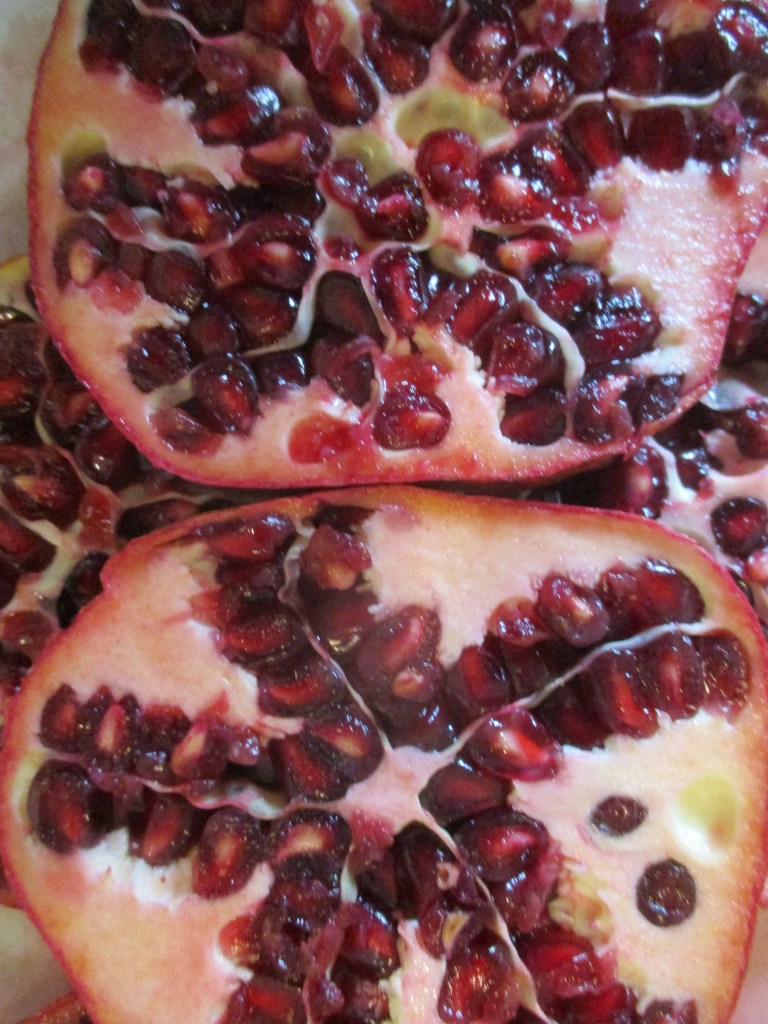
As for fig, date, avocado, grape and olive, the esteemed pomegranate, Punica granatum, has been in cultivation for a very long time. Several thousands of years of domestication have generated countless cultivars. They are now popular in many regions and cultures throughout the World. They produce very well here and in other Mediterranean climates.
Most locally popular pomegranate fruits are brownish red, and about three to four inches wide. Each fruit contains hundreds of seed, which are surrounded by juicy and delicately succulent flesh. They separate easily, like many tiny and tender berries. Most are garnet red. Some cultivars produce fruit with darker purplish, lighter pink or even colorless flesh.
Without dormant pruning, pomegranate trees can get taller than fifteen feet, and develop dense thicket growth. Fruit is easier to collect from well groomed shorter trees. Individual trees may develop a few trunks, and live for two centuries. Orangish red flowers bloom in spring. Leaves turn yellow prior to defoliation in autumn. Fruit ripens in autumn or winter.
 A mature persimmon tree, Diospyros kaki, is often too much of a good thing. The fruit is both big and abundant as it ripens this time of year. Much of the fruit in taller trees is out of reach. Nearly ripened but somewhat firm fruit can be picked and shared with neighbors for a while, but must be picked immediately once completely ripe. Otherwise, it falls and makes a squishy mess that can not be raked up! Nearly ripe fruit ripens easily off the tree. Individual fruits only need to be spread out in a single layer to limit molding.
 In milder climates of California, where many of us expect at least a few flowers to bloom right through winter, autumn foliar color and colorful winter berries are not appreciated quite as much as they are where autumn and winter arrive earlier, and are cool enough to prevent lingering bloom. Coincidentally, the same mild weather that allows winter bloom here also limits autumn foliar color.
 Tony Tomeo