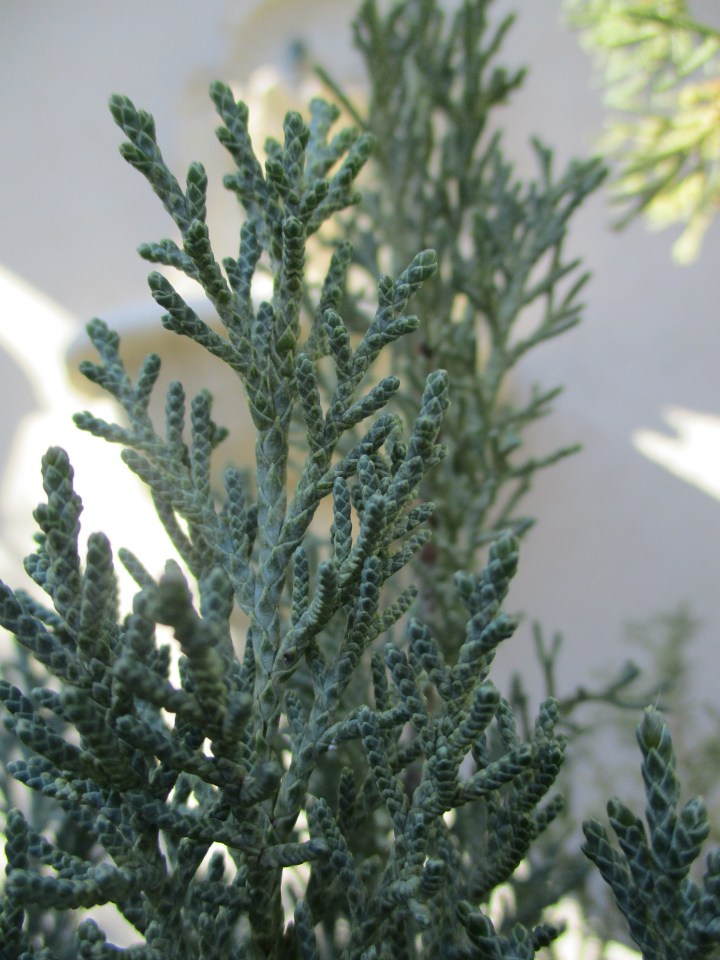
 It is no coincidence that many plants with gray foliage are from mountains or deserts. Gray foliage is ‘glaucous’, which, like glaucoma, diffuses light. This helps to protect it from desiccation and scald when sunny weather is also hot, windy or arid. The glaucous foliage of Rocky Mountain juniper, Juniperus scopulorum, is what distinguishes it most from related North American junipers.
Garden varieties of Rocky Mountain juniper are even grayer than wild plants. Some are even silvery. Also, they tend to maintain a somewhat symmetrical form. Most are compact, with dense evergreen foliage. Some loosen up with age. All want full sun, and seem to enjoy warmth. They lean away from shade. Color seems to be better if plants get watered occasionally through summer.
‘Skyrocket’ is very narrow while young, like a small silvery Italian cypress that gets only about fifteen feet tall. ‘Blue Arrow’ is similar, and becoming more popular because it is more resistant to disease. ‘Medora’ and ‘Cologreen’ are more bluish green. All get plump with age. ‘Wichita Blue’ and ‘Moonglow’ are more conical. ‘Wichita Blue’ is more bluish. ‘Moonglow’ is more silvery gray.
 Tony Tomeo
We had some conifers in the first house that we owned and we sadly had to leave them behind when we moved. One of our best looking trees is the Silver Leaf tree but they have a limited life span of about 25 years: http://pza.sanbi.org/leucadendron-argenteum
LikeLiked by 1 person
Oh, I remember those! They were popular here around 1990. Our neighbors had some. They do well in sandy soil, but like you say, they do not last forever. I have not seen one in a long time. I think they lost popularity because the healthiest ones would fall over, which was normal for them, but not desirable in the home garden. Our neighbors knew that they would lay down, so put them on the edge of the garden, and ‘helped’ them lay in a desired direction. It was quite ingenious; although in the end, the trees dies anyway. For twenty years or so, they were spectacular. By the time they died, the rest of the landscape had filled in, so the silver trees were not replaced.
LikeLiked by 1 person
It seems every state in the lower 48 has at least one species of juniper:
http://bonap.net/Napa/TaxonMaps/Genus/County/Juniperus
By far the most common in central Texas is Juniperus ashei.
LikeLiked by 1 person
Yes, but it is not used in landscaping, which is odd. Even the ‘common’ eastern red cedar, Juniperus virginiani, has garden varieties. I have never seen the Ashe juniper in the wild. The junipers I saw in Texas were just eastern red cedar, which are disliked by many who live with them.
LikeLike
Austin has tons of Ashe juniper, including the several around our house. Many people don’t like it because the wind-borne pollen released by the male trees in winter is highly allergenic.
LikeLiked by 1 person
Are they more like the Rocky Mountain juniper, or the Eastern red cedar?
LikeLike
I don’t know the Rocky mountain juniper but I think Ashe juniper is more like eastern red cedar.
LikeLiked by 1 person
I believe that is what I read about them, although I do not remember. They were so foreign to me when I went through the area that I would not have known an Ashe juniper if I had seen one. In areas, there were junipers that resembled tiny Monterey cypress.
LikeLike
We had an Eastern Red Cedar (Juniperus virginiana) in front of our house when we first moved here. I took it down and replaced it with a crabapple. Thing is, my wife likes to walk barefoot in the garden, and the scales of this tree could make that painful. On the other hand, it’s a great tree for birds. I feel guilty sometimes about taking it down.
LikeLiked by 1 person
It seems that those who have it do not like it. After seeing how common it is in Oklahoma, I do not think that I would like it either if I had to deal with it like that. However, because we do not have it here, I brought some back with me.
LikeLiked by 1 person
Reblogged this on Wolf's Birding and Bonsai Blog.
LikeLiked by 1 person