Maritime Ceanothus

70322What ever happened to Point Reyes ceanothus? It is such a nice low growing shrub, with small holly-like leaves, and cheery blue flowers in very early spring. It was quite popular when it initially became available, but now seems to be rare. Maritime ceanothus, Ceanothus maritimus, from San Luis Obispo County, is a similar species that presently seems to be getting more attention.

‘Frosty Dawn’ is the standard cultivar of maritime ceanothus, although there may be at least three cultivars with the same name. The ‘correct’ cultivar gets about two feet tall and five feet wide, with rigid but arching stems, grayish half inch long leaves, and dense trusses of minute blue flowers as winter ends. Another cultivar gets taller with more open growth. Another has lighter blue flowers.

Once established, maritime ceanothus can probably survive without any watering, but it might be happier with occasional watering through summer. New plants will need to be watered until they disperse their roots. Compared to other ceanothus, maritime ceanothus grows relatively slowly, but lives longer. (Many ceanothus can be short-lived.) Also, it is a bit more tolerant of partial shade.

Autumn Really Was For Planting

70531thumbIt is easy to see why there are optimum times to prune, and just as easy to see when pruning should not be done. Generally, deciduous plants prefer to get pruned while dormant and bare. They should not be pruned when actively blooming or making new foliage. Roots are of course not so easy to see. Do we really know what they are doing, or what sort of mischief they are getting into?

Autumn is the best time for planting most plants. They are less active than they had been earlier in the year, and many are going dormant. Either way, they do not need much. Once in the ground, their roots are kept cool and moist by the weather. They get to sit there all winter, as they slowly begin to disperse their roots to get ready for the following spring. It all fits into their natural life cycle.

Shopping habits, however, do not. By autumn, many plants are neither as pretty nor as tempting as they were earlier in the year. By winter, the weather keeps many of us inside, and out of nurseries. Now that it is spring, it is difficult to resist all the pretty plants that are blooming so delightfully. We are tempted to buy them compulsively, even if we have no immediate plans for them.

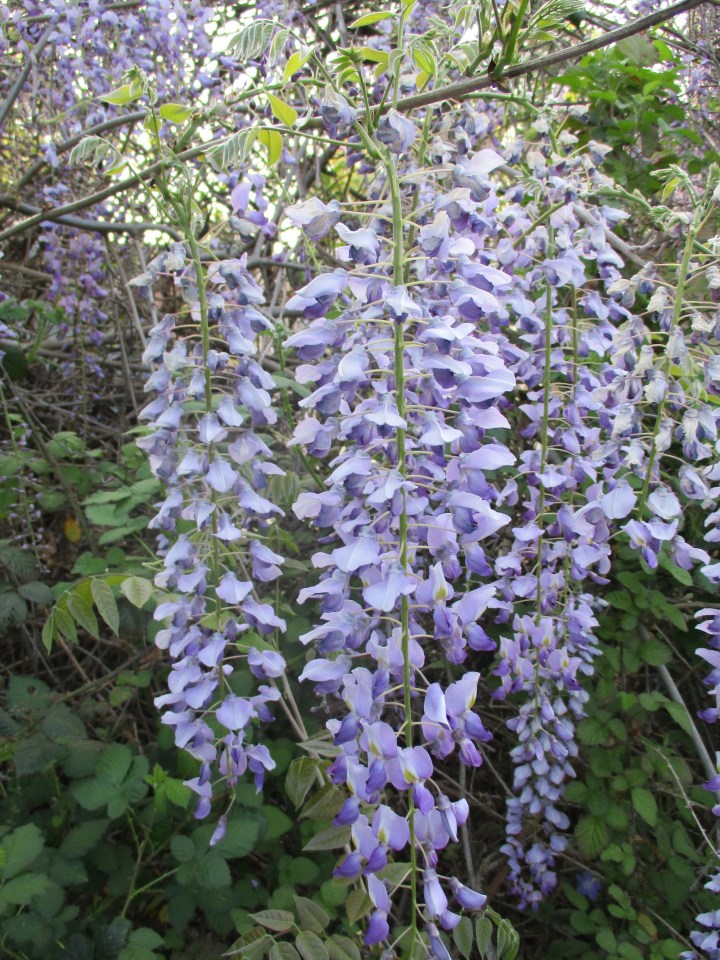
That is okay. We can make this work. Buying certain plants in bloom actually has certain advantages. It shows how and when particular plants bloom. This might be helpful when trying to decide between different cultivars of deciduous magnolias, flowering cherries, flowering crabapples or wisterias, for example. Besides, they will finish blooming quickly, and start to produce new foliage.

If planted before new foliage matures, new plants should be planted in cool weather, and maybe sprayed lightly with water after the roots get soaked in. This is best for drought tolerant plants like ceanothus, that want out of their cans (nursery pots) as soon as possible. If new plants stay in their cans long enough for foliage to mature, they must be watered carefully, but not kept saturated. The black vinyl cans should be shaded, since they get warm in sunlight.

Na2CO3•NaHCO3•2H2O

P80321Trona

That is what this seemingly disorganized jumble of letters and numbers represents; the chemical formula for the mineral known as trona. It is what a certain small town in the very northwestern corner of San Bernardino County is named for. Trona is one of a few minerals mined and refined there. Apparently, not much else happens there.

Trona the town is about as out of the way as one can get in the contiguous United States of American. Death Valley to the northeast at least gets tourists. Not much flora survives in the hellish summer heat and caustically saline soil. The athletic field at Trona High School is famous for being grassless dirt. Even the now defunct golf course was dirt. Roofs are more important for providing shade than for keeping the four inches of annual rainfall out. A leaky house is more likely to petrify before it rots. The inertly arid air, roasting heat and acrid drifting minerals seems to sterilize and embalm even abandoned houses. The Google Satellite image shows how boringly uniform the factory tract houses are. Many are now abandoned. Some are missing.

Why am I mentioning Trona here? Because horticulture is so limited in Trona. There might not be many better places in America for a horticulturist who lives amongst dense forests of the tallest trees in the world to go on vacation! There are so few distractions! The vast desert extends for miles in every direction, with only a few plants surviving in home gardens in town. The satellite image shows how empty the gardens are. A single lawn can not be found. Even artificial turf is notably absent, perhaps because no one wants to go outside in such horrid weather.

I suppose that I will never know until I go there.

Baby’s Breath

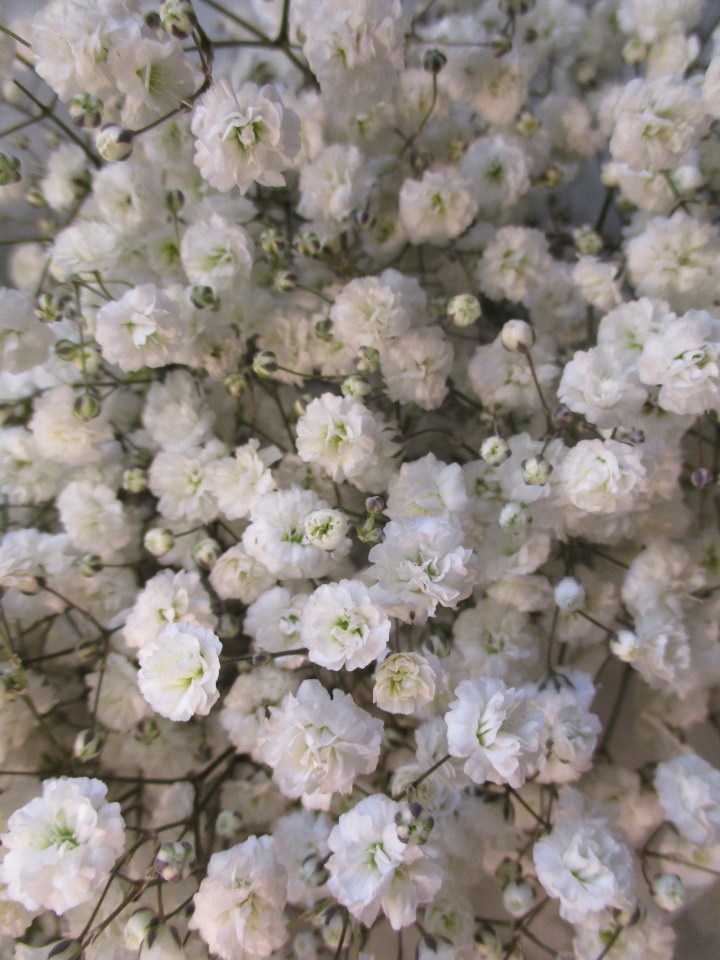
80328You might think that such a popular flower would be easy to get a picture of. Baby’s breath, Gypsophila paniculata, is everywhere, and almost a standard component of the mixed bouquets found in supermarkets. However, the flowers are so small and so sparsely arranged on thin stems, that they do not look like much in pictures. This picture is a closeup of a tightly bound bundle of bloom.

As common is it is with other cut flowers, baby’s breath is quite uncommon in home gardens. It is not often available in nurseries. Seed should have been sown by about now. Baby’s breath grows something like a tumbleweed about three or even four feet high and wide. The stems look too delicate to stand so tall. The minute flowers are usually white but can be pale pink and slightly fluffier.

While blooming in summer, baby’s breath is so handsome that no one wants to cut the flowers. It is difficult to take just a few good stems to add to other cut flowers without ruining the symmetry of a well rounded plant. Some people who grow it prefer to put it out of the way, or grow it amongst other flowers to hide the disfigurement of harvest. Baby’s breath blooms better if crowded anyway.

Frost Is History For Now

80328thumbThere is no doubt that frost will return next autumn. It does that every year. Right now, we are more concerned that is should not return prior to that. It is now safe to plant plants that are sensitive to frost. Even if the weather were to somehow get cold enough to necessitate protection of frost sensitive plants, it will not be severely cold, and it will not last long. It is best to start now than to delay.

It is also safe to prune away foliage and stems that were damaged by frost through winter. It was best to leave it in place through winter, both to provide a bit of insulation for undamaged stems below, and to not promote new growth. Pruning it away allows warming sunlight to the undamaged stems, and stimulates generation of new growth. A bit of new growth might already be apparent.

Many leafy perennials can be cut to the ground, or at least just above their rhizomes. The tall vertical canes of cannas can be cut back to the low horizontal rhizomes that creep along the ground. The canes are not really stems anyway, but are merely upright foliar shoots. Any shorter new shoots that are beginning to develop can remain, even if a few outer leaves happen to be damaged.

Zonal geraniums can likewise be pruned almost to the ground, leaving only stubs of lower stems, even if only upper and outer foliage was damaged by frost. Although they do not need to be cut back so severely, they respond to such pruning splendidly, with vigorous new stems and foliage. The fungal foliar disease known as ‘rust’ overwinters in old leaves that get removed in the process.

Lemons, limes and any other citrus that were damaged by frost only need to have their damaged stems removed as far back as viable growth, where new buds might already be visible. However, if more pruning is necessary, this would be a good time to do it. Major pruning should not be done later in summer because the sensitive bark of inner stems can be scalded by sudden exposure to too much sunlight. Small trees that are sensitive to frost become more resilient as the grow larger.

Shady – MSDS – (yes, another sequel)

P80318+

As the Certified Pesticide Applicator working for the ‘landscape’ company that I wrote about earlier ( https://tonytomeo.wordpress.com/2018/03/18/shady/ ), I assumed several responsibilities pertaining to the pesticides and other chemicals that the ‘landscape’ company used. Among other things, I needed to inventory all the chemicals, monitor their use, submit use reports to the Department of Agriculture for each of the nine counties in which we used these chemicals, and provide MSDS binders for all of the ‘landscape’ company offices and vehicles within their fleet.

MSDS is for ‘Material Safety Data Sheet’. They are actually several pages each. Each MSDS binder contained two copies of the MSDS for every chemical the ‘landscape’ company used, or even had on site, whether it was actually used or not. One MSDS was in American English. The other was in Mexican Spanish.

So every office and every facility and every vehicle in the fleet of the ‘landscape’ company was equipped with an MSDS binder. Every binder was equipped with two copies of the MSDS for every chemical even remotely associated with the ‘landscape’ company. That is a whole lot of MSDS!

It’s the law.

I was required to provide all of this literature in languages spoken by anyone and everyone in the workplace, for all vehicles and facilities. Okay, so we’re clear on all that.

However . . .

There is no law requiring those using chemicals to be literate.

I certainly do not expect everyone to be literate in American English. They do not need to be able to read or write it. That is why there were copies of all the literature in Mexican Spanish. I could translate field notes from those who wrote them in Mexican Spanish. That would not have been a problem.

The problem was that many of those using the chemicals could neither read nor write in ANY language! At first, I though we could improvise. I instructed the accounts managers to inform their technicians to merely write down basic information, like the identification number of a chemical being used, the volume of the chemical used, and so on. Most of it involved copying information from the label, and the location from the work order provided to the accounts managers. It sounded simple enough. Sadly, it was not. Copying such information was too much to expect from those handling these potentially dangerous and polluting chemicals. The literature in the MSDS binders that I had so dutifully printed and provided was merely used as napkins and toilet paper.

By the time I could no longer be affiliated with this particular ‘landscape’ company, I had no idea where all of the inventoried chemicals ended up or how they were applied.

Shady

P80310+++++Shady applies to more than trees. It applies to many of those who are hired to maintain trees and landscapes. In my career, I have worked for some of the best arborists, nurserymen and other horticulturists. In fact, some of my colleagues, particularly a landscape designer, two nurserymen and at least three arborists, happen to be legendary. I would say that I don’t mean to brag, but that would be inaccurate. I will write about some of them sometime. This here is not about them.

Sadly, I have had the misfortune to work with some really shady characters and businesses. They may seem to be more professional than the real professionals who take their professions very seriously, but it is all for show. I can tell you all about the brochures, and use all the buzz words, but it is all a lie. From sustainability and planting natives to save water, to diagnosing problems before they become serious, they are all lies. Their objective is to take money; as much money as possible, for as little effort as possible.

Even their contracts were not considered to be sustainable. I once informed an operations manager that the oleanders that were planted below a sign were not the dwarf oleanders that they were supposed to be, and that in order to prevent them from obscuring the sign, they would need to be pruned and deprived of bloom. He was not concerned, and told me that we have no idea who will be taking care of the landscape by the time that happens.

Sure, they would plant garden varieties of native ceanothus, supposedly to save water, but then water them so much that they would rot and die. In fact, they would put so much water on lawns that many established trees would rot and die. They would then charge a lot of money to remove the dead trees, and then charge more money to plant new ones, even though they were responsible for killing the originals.

I was once instructed to go look at a ‘Marina’ madrone that was a street tree in what had been the old Fort Ord, where some of the old homes, buildings and landscapes were in the process of being salvaged or renovated. I was only informed that the tree was in bad condition. Upon arrival, I found the single madrone in a well matched row of others, on a curving street. I was quite annoyed that the tree was so distressed from severe aphid infestation that it could not be salvaged. The subject looked as if it had been healthy for many years, but only recently became infested with aphid within the previous two years. The other ‘horticultural professionals’ at the site should have noticed the problem before the tree had deteriorated as much as it had. Now, removing the tree was going to compromise the conformity of the evenly spaced and well matched row of street trees. I wrote the report prescribing removal.

I needed to visit the site for another problem a few weeks later, and when I drove by where the tree should have been removed, I noticed that it was still there, and very dead. Interestingly, a tree next to it was missing. That made me wonder. I radioed in, and was informed that the tree had been cut down. You can guess where this is going. They had cut down the wrong tree; a perfectly healthy ‘Marina’ madrone. Why didn’t the crew removing the healthy tree question the removal of such a healthy tree next to a dead tree? Who knows. I wrote another report prescribing the removal of the dead tree, which was removed the second time around.

The client was charged for the removal and replacement of BOTH trees, the dead tree, and the healthy tree that was removed by ‘mistake’! The replacement trees were large boxed trees that better matched those that were removed!

For those who do not know, madrones should be planted while young, and will rather efficiently grow to match the others. Boxed trees get too distressed from the transition to recover right away, and wait around for years before they resume growth. By the time a big boxed tree starts to grow, a smaller tree would have already gotten established and grown larger. Boxed madrones are really for those who want to charge more money than they could get for smaller trees that cost much less.

So, the landscape company charged a lot of money to maintain the landscape, so that trees would not die from negligence. Then, they charged not only for the removal and replacement of a tree that died as a result of their negligence, but also a tree that was killed by their stupidity. As if that were not enough, they charged for the the most expensive replacement trees available. They were shadier than the trees that they killed.

Poppies . . . again

P80317+This one is different though. It is not the characteristic homogeneous bright orange that California poppies should be. The orange in the middle is what the entire flower should look like. The outer yellow hallow is not typical.
California poppies used to much more common than they are now. Not only did they grow wild, but they grew wild in abundance. Some of the East Hills were blushed orange with them when poppies bloomed this time of year. The lower hills just to the east of Highway 101 to the south of San Jose were more than blushed. There seemed to be almost as much orange as there was green. By the spring of 1985, those same hills were neither south of San Jose, nor quite so orange. They were within the suburban sprawl of San Jose, and were mostly green with invasive exotic grasses. Only wispy swaths of orange bloomed down low and near the top of the western slope. Those same hills are now devoid of orange, and are part of an urban neighborhood.

California poppies just do not grow naturally like they used to. Those who want them must sow seed for them. Their environment is so different from what it once was.

Even the flowers are different. They were naturally the most perfect orange, with perfectly simple petals. When we could find pale yellowish white or lavender poppies (known as purple poppies), they were something very rare and special.

California poppies are now readily available in a variety of colors, including the once very rare pale white and lavender, as well as various hues of yellow and red, some with swirled patterns. Some have fluffier double flowers. It all seems to be so unnatural for a flower that needed no improvement.

Six on Saturday: Infirmary


Some of the plants that get recycled at work go to a small nursery next door to the shop until they find a new home. Many are out of season annuals that are really perennials. Some were not performing adequately, so got replaced. Some just needed to get out of the way for something else. Because most plants must recover from transplant, or whatever happened to them out in the landscape, the nursery is more of an infirmary. Only a few plants were recently purchased at a nursery for installation into a new project.

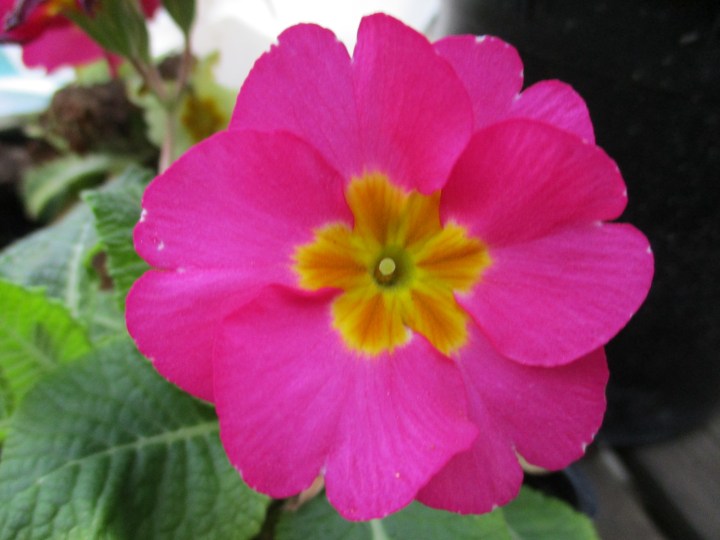
1. Primrose blooms in many colors besides white – the sequel to the sequel – https://tonytomeo.wordpress.com/2018/03/03/six-on-saturday-my-favorite-color-ii-the-sequel/P80317
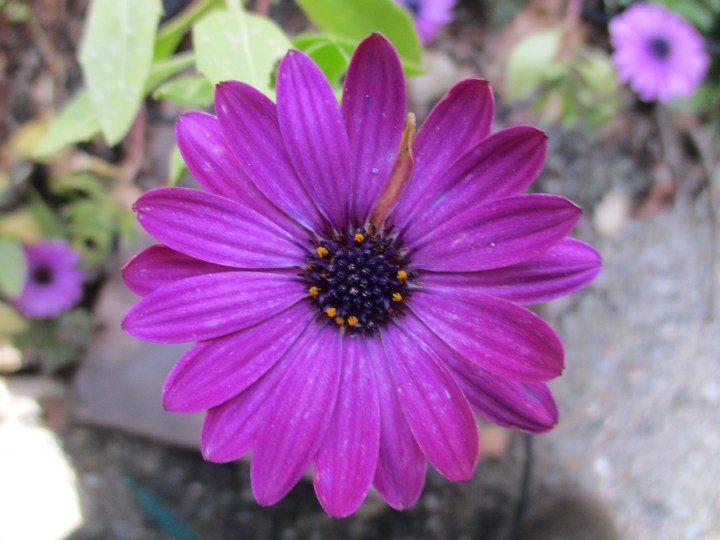
2. African daisy works well in the sunnier parts of our unrefined landscapes.P80317+
3. ‘Sunset Gold’ breath of Heaven is a new acquisition for a newly landscaped area; but was not my choice. This picture makes it look even worse than it really is.P80317++
4. Wallflower will go with the ‘Sunset Gold’ breath of Heaven.P80317+++
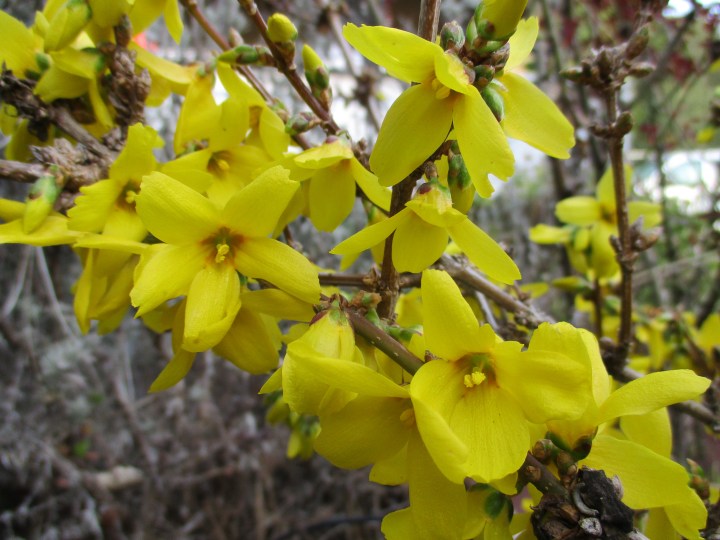
5. Forsythia is rare here. Besides this one, there is only one other in the landscape. This picture was taken earlier, while the forsythia were still blooming.P80317++++
6. ‘Black Lace’ elderberry is starting to foliate. I really want to try the berries from this ornamental cultivar, if it fruits, to see how they compare to the native blue elderberry.P80317+++++
This is the link for Six on Saturday, for anyone else who would like to participate:

https://thepropagatorblog.wordpress.com/2017/09/18/six-on-saturday-a-participant-guide/

Star Magnolia

70315Before its new lime green foliage emerges, the otherwise modest star magnolia, Magnolia stellata, dazzles with a surprising profusion of crisp white, blushed or pale pink bloom. The three inch wide flowers have between a dozen and two dozen floppy petals (which are actually tepals). If the weather is right, the flowers might be slightly fragrant. If only bloom could last longer than it does!

Star magnolia is too small to be much of a tree, but too open and sculptural to be shrubbery. It grows slowly and might never reach downstairs eaves. Only the biggest trees might reach the lower sills of upstairs windows. However, the angular low branches, usually on multiple trunks, are ideal for displaying the distinctive bloom. The light gray bark resembles that of fig trees. Leaves are about four inches long, and an inch and a half wide. Foliage turns soft yellow before falling in autumn.