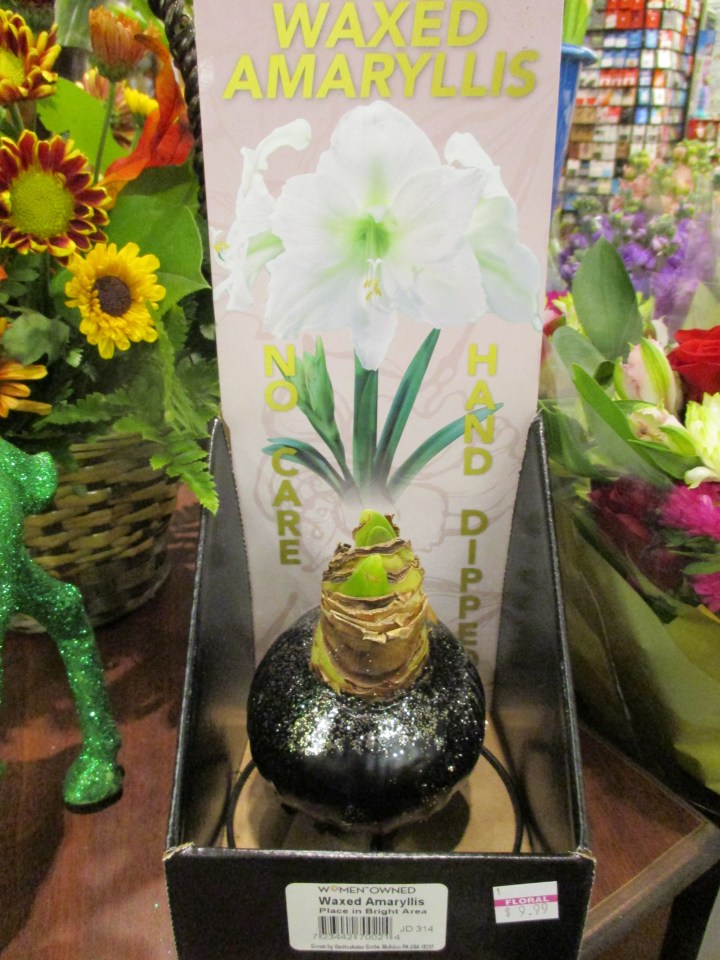
 Two others have already written about this far more proficiently than I would have:
https://sweetgumandpines.wordpress.com/2018/11/18/abomination/
Amaryllis, Queen of the Forced Bulbs
These two articles say it all. I would not have bothered to write about it too if I had not already taken the picture above. I did not read the label to learn what one of these articles said about why these bulbs were waxed. It seals in moisture, so that the bulbs do not desiccate while they bloom without water or moist media. They at least get water when forced by the conventional manner.
I suppose to many who force amaryllis bulbs, there is no problem with waxing them like this, since they are typically discarded as their forced bloom deteriorates. There is no expectation for the bulbs to survive the process to regenerate and bloom the following year.
We can at least pretend that we intend to nurture amaryllis bulbs that bloom in a ‘forcing kit’ that includes a small volume of potting media that sort of sustains the fleshy roots through the process. After all, they can survive the process and get potted into larger volumes of media to recover and bloom again. Some of us have actually sustained such bulbs for a few years Bulbs that are purchased bare and then potted directly into more reasonable volumes of media are of course more sustainable from the beginning.
Poinsettias and living Christmas trees are no better than forced amaryllis. Nor are the Easter lilies in spring.
Like amaryllis bulbs, Easter lilies can be purchased bare and grown directly out in the garden. Those that are forced in pots can be planted out in the garden afterward to possibly recover. Otherwise, they too get discarded after bloom.
Poinsettias can technically be grown as houseplants, but rarely survive that long. Those that do not get tossed after they shed their colorful bracts are likely to get tossed as they languish in recovery from the process of forcing them to bloom in a very contrived greenhouse environment.
Living Christmas trees are actually more of a problem if the ‘do’ survive. They so often get planted into small gardens, and often next to foundations of homes, with the belief that they will always stay small and innocent. The problem is that most are seedlings of the Italian stone pine, which grows very big and very fast, and soon becomes a problem that is very expensive to remove. If not planted in a garden and allowed to destroy all within reach, they die from neglect and confinement within their own pots, often within their first year.
- Comment
- Reblog
-
Subscribe
Subscribed
Already have a WordPress.com account? Log in now.
 Tony Tomeo
The display says “no care.” Well, I actually like nurturing the bulbs and hoping they will flower the next year. Seems such a waste to throw them away after flowering.
LikeLiked by 1 person
It seems to defeat the purpose. Artificial flowers need no care either, and they last longer.
LikeLiked by 1 person
I agree.
LikeLiked by 1 person
You’ve brought back wonderful memories of my mother, who expected — and received — amaryllis each year. She wasn’t a tosser, though. She’d have me replant the bulbs for her in pots on her balcony, and lo! they not only survived, over the years they began to multiply. By the time she died, there was an amaryllis forest to be passed on to others. I kept one potful, and the plants still are doing their thing. It’s my one huge gardening success, particularly since Mom died in 2011!
LikeLiked by 2 people
That is impressive to keep them alive for so long! I grew up thinking that cyclamen were the same way. They were perennials that got planted out in the garden, where they would perform for years or decades. By the time one rotted, another received as a gift would replace it.
LikeLike
I got one of these for a gift (not the waxed kind; it was planted) and was not thrilled, but it blossomed nicely and I planted it outside, where it thrived for several years and also blossomed. It was outside the fence at the garden, though, and people would cut the blossoms off and I think someone pulled it up and made off with it, because at one point it disappeared. But they do survive here in zone 7 just fine.
LikeLiked by 1 person
Oh, that would make me SO angry! It happens in my downtown planter box often, which is why I only grow perennials that can spare a few bits and pieces. I have seen amaryllis do well in San Jose, but they do need protection there from the mild frost. It does not get cold here, but it apparently gets just cool enough to annoy amaryllis. I think I would prefer to grow them in pots.
LikeLiked by 1 person
I really like the scent of amaryllis but I haven’t grown it for years. Perhaps, now, I’ll try to source them again locally.
LikeLiked by 1 person
Scent?! I have never met one that was fragrant. There are so many unusual varieties and even some newly introduced specie out there that I have never seen.
LikeLiked by 1 person
I think the one I was referring to was Amaryllis Belladonna or so I was told by an old gardener who recognised the plant.
LikeLiked by 1 person
Oh, that one naturalized all over here! We have many of them at work. Although I have never noticed a fragrance, I know that many types are fragrant. Crinum lilies are similar, but provide more variety of color.
LikeLiked by 1 person
Hi Tony, I was replying to your comment on the LP pot, when I accidentally trashed the comment. No idea how I managed that and no idea how to bring it back – even though it said undo the delete it didnt! My apologies. I was only going to make some smart arse remark anyway about you aversion to vinyl, lol.
LikeLike
That just seems like such a waste. Those poor plants deserve a better fate than this.
LikeLiked by 1 person
Yes! It is so degrading!
LikeLiked by 1 person
Reblogged this on Tony Tomeo and commented:
This is just too weird for me to comment on again.
LikeLike
Sounds like something that would have been a good idea for Captain Kirk on Startrek. It would have brightened up the Entreprise,.
LikeLiked by 1 person
Some of the distant planets that the Enterprise went to were in Franklin Canyon Park, above Beverly Hills. The flora there is interesting, but not quite as weird as this.
LikeLiked by 1 person
Very good point about them being planted out in an inappropriate spot. I often see poorly chosen contractor selections in front of newly built houses. Give them a few years, and they are going to be a major headache.
LikeLiked by 1 person
Christmas trees? They can get into some very weird situations. It is worse when so-called ‘landscapers put things into bad situations, because they should know better.
LikeLike
No, often nicer stuff, like cedars and cypresses just a few feet from the foundation. Looks great while they are 5-6′ tall, but once they start growing…. well, you know the rest. Seriously careless practices!
LikeLiked by 1 person
Oh, yes, of course. I used to work for one of those so-called ‘landscape’ companies that ‘maintained’ landscapes at model homes. It was horrid, although I can sort of understand why it was done. The landscapes were designed to look as lush as they could while the homes were selling. There was no plan for their future. Of course, the landscapes were never modified after the homes sold. Some tracts of homes were sold without landscaping (beyond the model homes), while others were outfitted with basic landscaping. I was amazed at how dysfunctional even the basic landscapes were.
LikeLike
I hear you loud and clear… 😦
LikeLiked by 1 person