 English ivy, Hedera helix, is probably the nastiest and most aggressively invasive exotic species that I work with. It climbs high into redwood trees and overwhelms understory plants (that live below the trees). It invades many of the landscapes, and worst of all, it climbs building where it ruins paint and causes rot. It grows faster than we can keep up with it.
English ivy is actually a nice ground cover plant for refined landscapes. I grew it at my home in town. Contrary to popular belief, it does not root into and parasitize the trees that it climbs. Actually, it rarely overwhelms and shades out large trees. It prefers to keep them alive for support, from which it disperses its seed. However, it does promote decay in the trunks that it climbs, particularly where it retains moisture at ground level. Native trees are not accustomed to that.
We try to remove as much English ivy at work as possible, which includes removing it from trees and buildings. So far, with a few exceptions of small bits of ivy that broke off high in the trees that it climbed, I have been able to remove all ivy from the trees and walls that I have worked on.
Others were not so fortunate. When quick and efficient removal of ivy from the bases of as many mature trees as possible is the priority, ivy is more often severed down low, and left to die on the trunks of the infested trees. It looks shabby to say the least, and takes many years to deteriorate and fall away. In the picture above, dead ivy that was severed within the past few years is already being replaced by new ivy, which will also need to be severed.
The same technique happens with ivy on buildings. It gets cut at the foundations, but left on the walls to shrivel and turn brown. The dead ivy in the picture below was reaching upstairs eaves when it was severed, and remains there a few years later.
What annoys me so much about this technique is that it does not take much extra effort or time to tug quite most of the lower ivy from trees and walls. For most situations, all ivy can be dislodged, although tiny aerial roots remain. It is much easier to dislodge while fresh than after it is dried and crispy.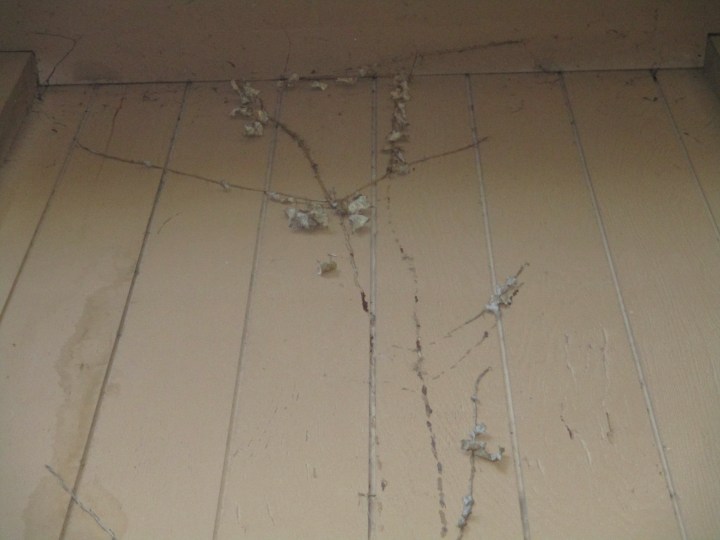
 Tony Tomeo
I hate ivy (they’re very attractive to German wasps here -NZ- too) – I once removed a huge one from a timber-sided house; it was too late as it’d started to lift the boards, caused 10’s of thousands of $ damage.
LikeLiked by 1 person
It also gets infested with rats. Even if it is kept out of trees and off of buildings, it finds other ways of being a problem.
LikeLike
I hate that ivy and when it’s up a tree, it’s even worse! Good post!
LikeLiked by 1 person
Thank you.
LikeLike
When we moved into our current home, there was ivy everywhere! It was all over the backyard and climbing on the back side of our house to the point you couldn’t see the walls. Curiously, at the same time, the sprinklers were running regularly and we couldn’t find the timer to regulate them. One day my husband finally decided he was tired of the ivy and all the nasty pests it hid and so he started ripping it off the side of the house. Lo and behold, the mystery sprinkler timer was discovered, buried under several inches of ivy!
LikeLiked by 1 person
It is amazing what ivy will eat. It would be nice to find some long lost treasure out there. All I get is rat nests and old car parts.
LikeLiked by 1 person
Some people here let it climb on walls, especially brick houses. I must admit that looks nice, but this stuff can do lots of damage.
LikeLiked by 1 person
It is not problem on the concrete sound walls on freeways, and actually helps muffle sound and obscure graffiti. It mus needs to be contained, so that it does not go over the walls and into something else.
LikeLiked by 1 person
Horrible stuff. At our first house, it covered almost an acre of ground and all the trees. Winding it up off the ground uncovered several wasp nests–the wasps were not pleased with us, but it was worth it. With the ivy gone, several species of native orchids started popping up.
I confess that we just snipped it at the base of the trees, but in our defense, the dead stems rot fairly quickly in this climate.
LikeLiked by 1 person
If we had only an acre of it, it would be gone by now.
LikeLike
Ivy is vile once it climbs because it matures and fruits. Hungry birds then disperse it everywhere. To prevent this spreading menace, remove it anywhere it climbs, even from utility poles! Love your work, Tony! Keep it up!
LikeLiked by 1 person
Thank you. I intend to.
LikeLike
Reblogged this on Tony Tomeo and commented:
Oops! I neglected to schedule this reblogged article to post at midnight as it should.
LikeLike