The first three of these six are the last of my trip to the Los Angeles and Phoenix regions. That was weeks ago. If there were a time limit for such pictures, these first three pictures would have exceeded it. With a limit of six pictures weekly though, it takes quite a while to post all of an abundance of pictures. Cool weather has inhibited activity in the garden anyway. Although there is plenty of bloom, much of it is no longer new. I am still waiting for vegetative growth from a few tropical types of vegetation that prefer warmth to grow. This includes the last three here.
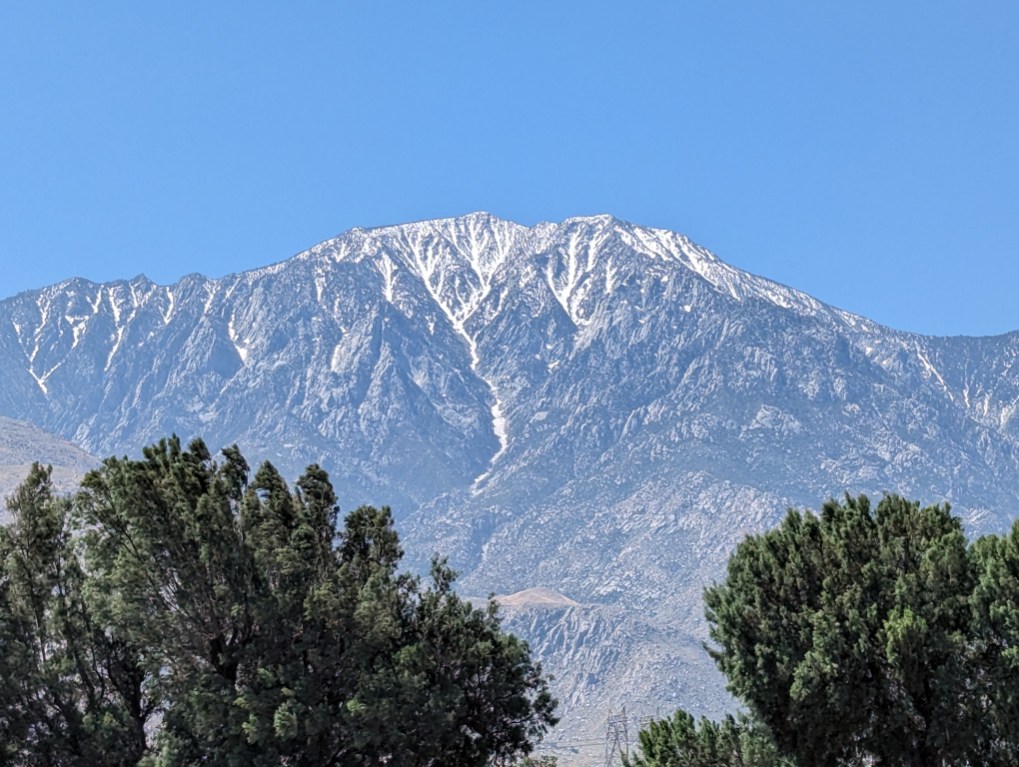
1. Mount San Jacinto is not exactly horticulturally relevant, and I do not even know what that vegetation in the foreground is, but it is a grandly scenic backdrop to Palm Springs.
2. Phoenix dactylifera, date palm grows in date orchards throughout the Mojave Desert and the Sonoran Desert, and is most likely the origin of the name of Phoenix in Arizona.

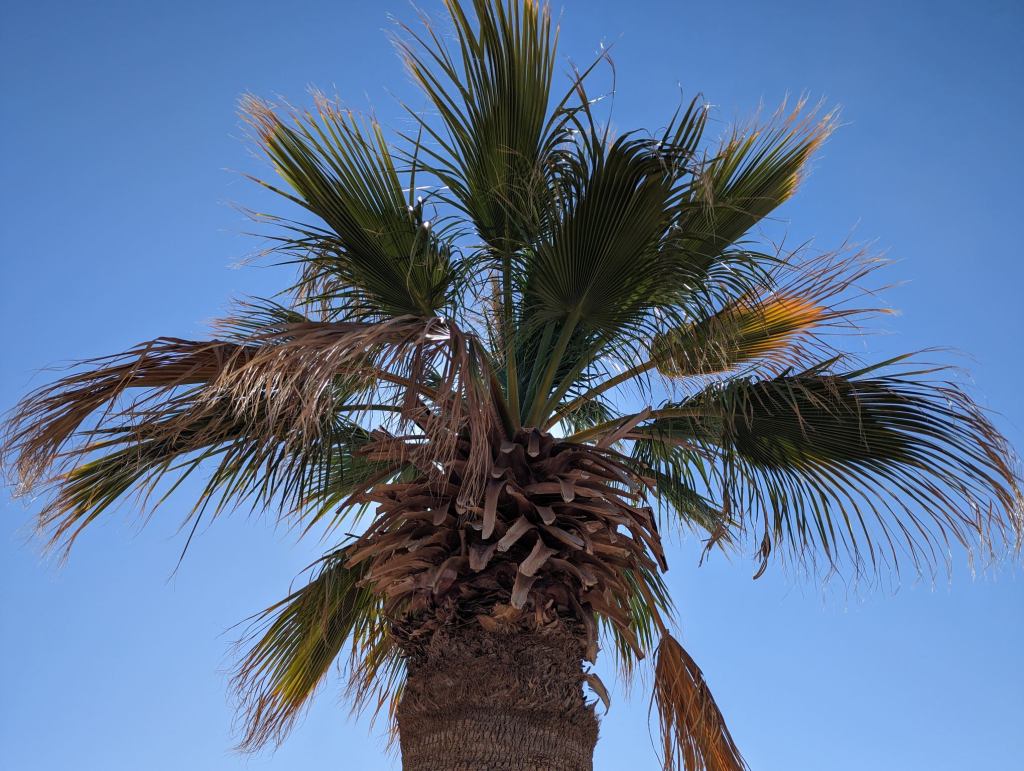
3. Washingtonia filifera, California fan palm is the only palm that is native to California. It is the origin of the name of Palm Springs because it grows wild around nearby springs. This happens to be an atypically shabby specimen at a roadside rest stop on Highway 10.
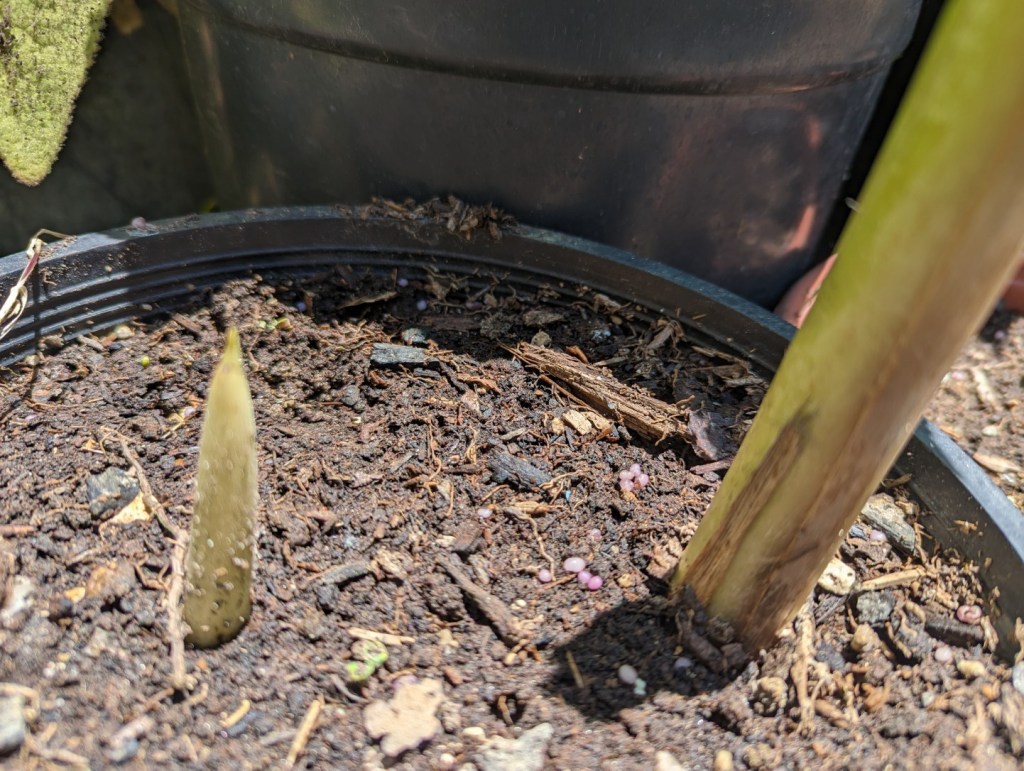
4. Heliconia psittacorum, parrot heliconia had done no more than survive last winter. It needed to be removed from Brent’s garden, so came here. It is finally beginning to grow.
5. Hedychium greenii, red butterfly ginger arrived with the parrot heliconia, but canned separately here. I did not know what it is until Brent mentioned that his is now missing.

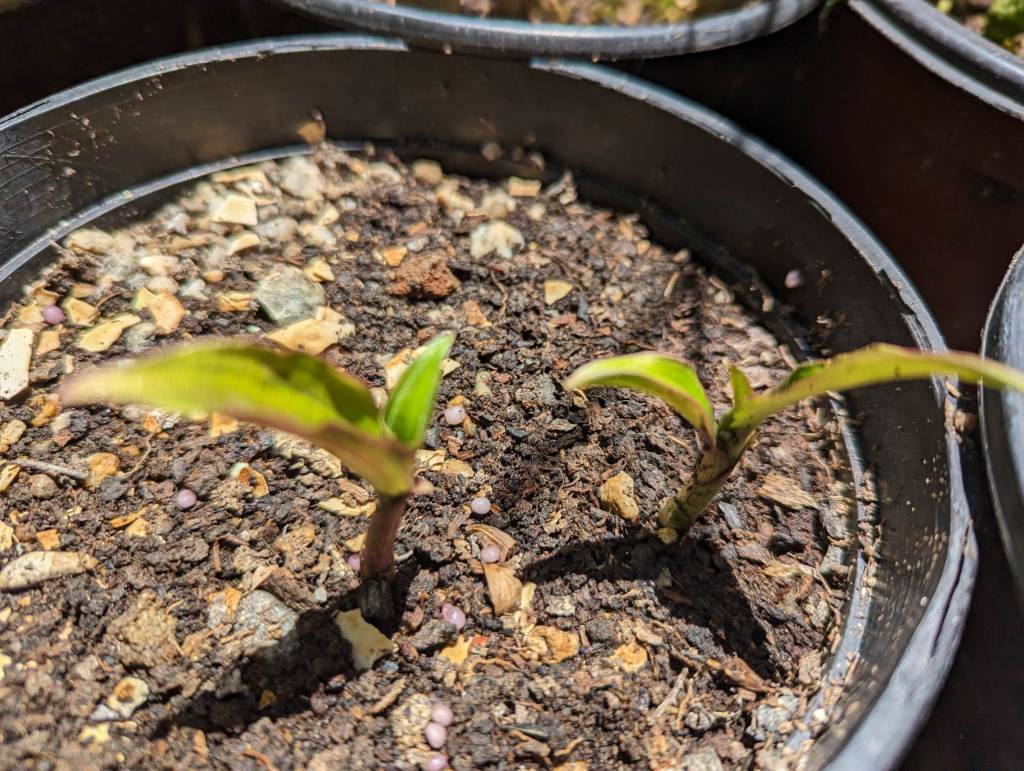
6. Dichorisandra thyrsiflora, blue ginger was not expected to survive the unusually cold frost of last winter, but finally is slowly generating these little shoots from eight cuttings.
This is the link for Six on Saturday, for anyone else who would like to participate: https://thepropagatorblog.wordpress.com/2017/09/18/six-on-saturday-a-participant-guide/
 Tony Tomeo
All those little sprouts are full of hope for the future. The blue desert skies make great backdrops for your palms and the beautiful view of the mountain. So much to learn about your part of the country! I never knew the relationships between plants and place names you’ve explained here. Thank you!
LikeLiked by 1 person
Mount San Jacinto is certainly impressive. It is the sixth most prominent peak in America. (Although other mountains are taller, they are not so high above the surrounding terrain.) I am impressed by how bare it is. The mountains here are obscured by forests. Although the climate there is a desert climate, it is one of the few places in California with good availability of ground water that is not very far below the surface. Springs at the base of Mount San Jacinto are quite cold. So is the water in creeks that come from melting snow. It is weird to see snow on top of the Mount San Jacinto while the weather is hot in Palm Springs. It is also weird that the oasis ecosystems around the springs below the palm groves can be so cool while the exterior is so hot. The palms enjoy the heat, but also like water.
LikeLiked by 2 people
What a play of contradictions! It must be stunning there- and a wonderful place to explore. Our ‘mountains’ here are all tree covered and very old. I would love to see Mount San Jacinto someday.
LikeLiked by 1 person
California is geologically dynamic. Mount San Jacinto is not as old as eastern mountains, such as the Apalachia. It is actually the biggest fault scarp in North America.
LikeLiked by 1 person
Yes- those faults in CA and those just offshore of OR and WA have my full attention. There must be some interesting features if you hike along the area of displacement. It takes a while for trees to take hold in such areas again, though. You did a good job of capturing photos of the types of plants that are able to grow in the area, with such thin soils.
LikeLiked by 2 people
Continental drift is a very slow process. It is not actually ‘seen’. Mount San Jacinto took millions of years to get where it is now. The Pacific Plate moved only about six feet to the north, with only about four feet of elevation lift of adjacent mountains during the Loma Prieta Earthquake. The displacement is dispersed over so many miles that it is only visible in small increments within only a few locations. Typical earthquakes involve only a few inches of displacement. Mount San Jacinto is sparsely forested not because of seismic activity, but because of the desert climate. It really is harsh out there.
LikeLiked by 1 person
Oops! Will you tell Brent about his ginger?
LikeLiked by 1 person
He is aware of it now, but does not mind. He was not impressed with it in his garden, but also knows that I will grow some healthy specimens here, so that he can grow it again later. I can grow healthy specimens that will bloom in his garden faster than he could have gotten it to bloom if it had stayed there.
LikeLike
The mountain photo is spectacular, says the person who lives in flat lands.
LikeLiked by 1 person
It really is. It is the sixth most prominent peak in America, and is not cluttered by forests like mountains here.
LikeLiked by 1 person
Dramatic mountain landscape. I hope you’ll show these shoots again when they are blooming, I’d love to see the flowers
LikeLiked by 1 person
Perhaps I should take more pictures of what is blooming rather than what is growing but not even close to blooming. I am a nurseryman, so I do not consider bloom as much as propagation. On the farm, the objective was to get product into retail nurseries or to other clients ‘before’ it bloomed.
LikeLike
Palm Springs is calling me!
LikeLiked by 1 person
It is not what it was. I am glad that I saw it in the late 1980s. It was in between hip and trendy phases at that time, so was not as stylish and desirable as it had been earlier, but was not yet as fancy as it is now. I did not even stop on this trip past it. It seems to be too weird for my taste. The scenery around it is still as awesome though, and I would like to go back to the Aqua Caliente Indian Reservation where the California fan palms grow wild around the springs.
LikeLiked by 1 person
Wonderful pictures and I hope you had a good time on your trip.
LikeLiked by 1 person
It was RAD! I had never been past Palm Springs that far south. I had only been through Arizona twice before, on the way to and from Oklahoma, but it was farther north.
LikeLiked by 1 person
Do I remember a picture of you standing on a corner in Winslow Arizona? (You sang that instead of just reading it.) That’s good that you had a good time in new places. Rad!
LikeLiked by 1 person
Actually, . . . I just read it. It was awesome to actually be there though, on THE corner!
LikeLiked by 1 person
Yes, THE corner. These young people don’t get to have the memory of such a good song, and good group, in a time when the music was amazing.
LikeLiked by 1 person
Winslow is such a delightful town anyway. It was nothing fancy, and unlikely appealing to average tourists, but I liked it because it seemed to be so ‘normal’, . . . except for THE corner, . . . that was pretty rad!
LikeLiked by 1 person
Absolutely, and you got to do it.
LikeLiked by 1 person
Actually, we did not even plan to do it. We just pulled off to stop at a market and maybe get gasoline. I do not remember. I just remember that after getting groceries, and leaving to avoid eating in the parking lot, we happened to park at THE CORNER to get out and walk around a bit after driving for so long.
LikeLiked by 1 person
It’s so fun that they put the sign there to make old(er) people think about the song and their ability to stand on that corner.
LikeLiked by 1 person
Technically, the corner was not originally specified. Actually, it was almost in another town, and was only in Winslow because it sounded better. The corner of North Kinsley Avenue and Second Street, which is also the old Route 66, became ‘THE’ corner because of tourism.
LikeLiked by 1 person
Yea, the song said A corner…….not which corner. I forget, did a girl my lord in a flatbed Ford slow down to take a look at you?
LikeLiked by 1 person
No; she works only during the tourist season. We were there during October and December.
LikeLiked by 1 person
Ha, ok. You missed her then. 😜
LikeLiked by 1 person
Yes, but we saw pictures of her with tourists at the tourist stop that we stopped at. She has a reserved parking spot on the West side of North Kinsley Street, just north of West Second Street, so tourists can get pictures with her.
LikeLiked by 1 person
She’s an old lady by now.
LikeLiked by 1 person
She has been replaced, perhaps a few times. The Winslow Business Association hires her to mingle with tourists next to where she parks the old Ford. We were there a decade ago, so another girl might be doing it now.
LikeLiked by 1 person
Oh you’re serious, this is real, that they keep it going?
LikeLiked by 1 person
Well, yes; although that was a decade ago. I have not been back.
LikeLiked by 1 person