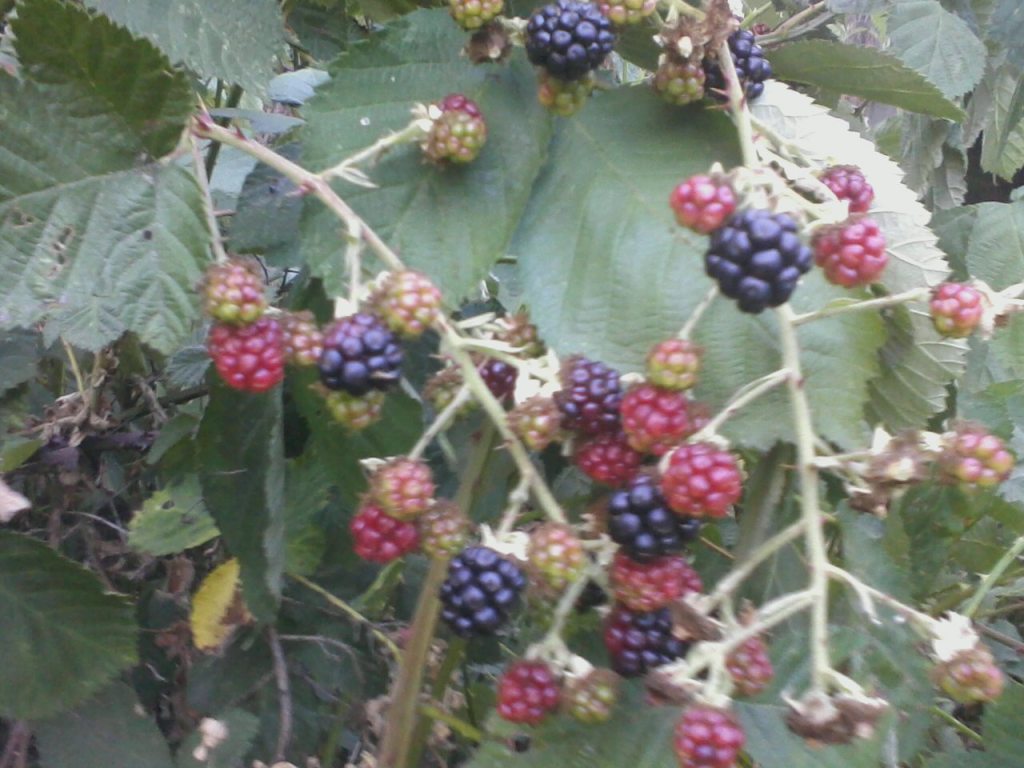
Rampant brambles of feral blackberry, Rubus fruticosus, canes are much too common and give blackberries a bad reputation. Yet, with regular selective grooming and pruning, their biennial stems that emerge from woody perennial roots are both more productive and easier to contain than one would guess. ‘Primocanes’ grow rapidly to six to sixteen feet in the first year. In the second year, they become ‘floricanes’, which do not grow longer, but instead develop lateral stems that bloom and fruit. Only a few modern ‘fall bearing’ or ‘everbearing’ cultivars fruit on primocanes.
Canes are trailing, semi-trailing or erect. As the names imply, trailing types like ‘Marion’, ‘Boysen’ and ‘Olallie’, need support. They are the most popular locally because they are more productive. Erect types that need no support, like ‘Navaho’, ‘Choctaw’ and ‘Arapaho’, are less productive, but because they are more tolerant to frost, are more popular where winters are colder. Old classic blackberry varieties are quite prickly. Modern thornless varieties are becoming more popular as more varieties are developed. All have palmately compound leaves with five or seven leaflets. Simple small white or pale pink flowers that bloom late in spring are followed by the familiar blackberries that are ripening now.
 Tony Tomeo