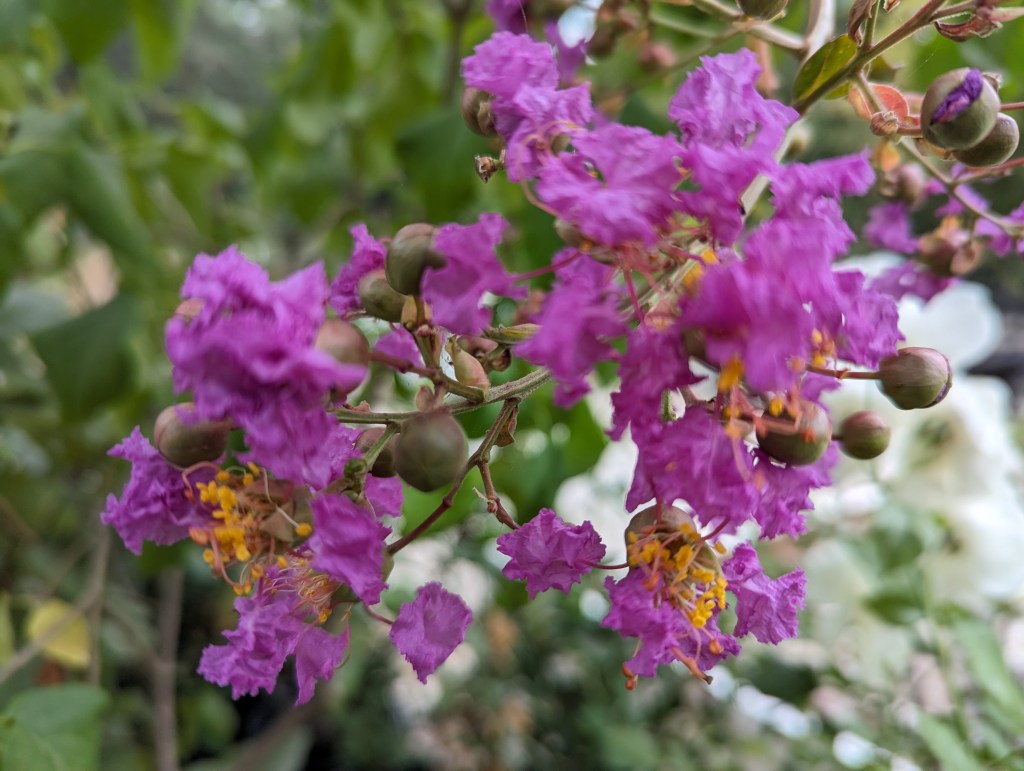
What cultivar of crape myrtle is this?! I realize that this picture is blurred, which is why it was not included within my ‘Six on Saturday’ post this morning, but it is the floral color that is important. Is it purplish pink, or just bright pink? What cultivar does it look like?
I expected this crape myrtle to be one of the old reliable cultivars because it was a gift from the Arbor Day Foundation. The primary old reliable cultivar that blooms with similar floral color is ‘Muskogee’. Yet, even with my limited ability to discern color quality, this floral color seems to be a bit too rich. I sort of expect a milder and scarcely purplish pink from ‘Muskogee’. I suppose that the Arbor Day Foundation can also grow modern cultivars like the rest of us.
Regardless of its identity, it is certainly pretty. The foliar color during autumn is comparable to that of old reliable cultivars. Because neighbors like it, I grew a few copies for them. We would like to incorporate more crape myrtles into the landscapes at work. The abundance of spring color from other species there mostly finishes prior to the summer bloom of crape myrtle. Summer is the busiest season, so justifies flashy color.
Embarrassingly though, I am still none too keen on crape myrtle. If I did not typically spell ‘crape’ as ‘crepe’, I would prefer to spell it without the ‘e’ at the end. I was impressed with it when I first started to notice it through the 1980s, but then realized that it was becoming too common through the 1990s. That was long after Brent told me that it had become too common throughout the Los Angeles region significantly earlier. Decades later, it is still too much of a good thing.
 Tony Tomeo
Looks like a muskogee to me. Usually pretty big for a crape myrtle.
LikeLiked by 1 person
This one is still in a #5 can. Its copies are growing fast.
LikeLiked by 1 person
They were 25 feet in Atlanta.
LikeLiked by 1 person
Specimens that I believe to be ‘Muskogee’ downtown are about as big, but took many years to grow so tall. There is a brighter pink cultivar that gets about as tall, but does so faster, and develops a more rounded canopy.
LikeLiked by 1 person
Bashams Party Pink? Not kidding.. or maybe one of the Indian named cultivars
LikeLiked by 1 person
It is one of the old reliable sorts.
LikeLiked by 1 person
Yes common in the south.. Louisiana especially
LikeLiked by 1 person
Tony, the Arbor Day site – https://shop.arborday.org/crapemyrtle -lists nine different crape myrtle varieties, many of them recent hybrids. The generic ‘crape myrtle’ at the top of that list looks like your photo and doesn’t bear a cultivar name. They do offer L. ‘Muskogee,’ but it has a much lighter, more lavender flower. I don’t believe that what you have there is Muskogee. More important than flower color is tree size at maturity. Many of the newer hybrids are bred to grow into much smaller trees than the older varieties. I like the color in your photo as it is the classic crape myrtle in our area, where some towns lined their streets with crape myrtle trees propagated by city horticultural staff in the middle of the last century. Maybe they are ‘overdone’ to some sensibilities. I’ve always delighted in their pops of bright color during a long, hot summer, when most of the landscape is a uniform dusty green. I like some of the recent cultivars that sport red leaves in spring, then purplish leaves through the summer. Some of these have beautiful reddish or reddish purple flowers. My favorite crape myrtle flowers are white. The white flowered trees have naturalized around our home and we love them because they look ‘cool’ on hot summer days.
LikeLiked by 1 person
This particular crape myrtle lacked a name when I got it. I should not be surprised that it looks like the specimen in the picture. I am told that it looks like ‘Muskogee’, but I really thought that ‘Muskogee’ had a lighter color. Ultimately, it will not matter much. It is what I have here, and along with as many as three other cultivars, I have plenty to grow. I am not so keen on the ‘Natchez’ white though. White has always been my favorite color, but that white is not so bright, and the bark is a bit too blotchy. Also, the branch structure gets unusually shabby. The primary advantage to ‘Natchez’ is that it has the best foliar color for autumn.
LikeLiked by 1 person
Yes, Natchez requires a lot of pruning to maintain a nice shape. But, it is tough. I had some broken down nearly to the ground during a storm several years ago when an oak fell on them. They all survived and have grown back into nice sized trees. They are a little later to bloom, though, than some of the other varieties. Arbor Day may be selling seedlings for their straight ‘crape myrtle’ offers rather than named cultivars. I haven’t had the best luck with them in getting the species I intended to order. If yours came free, then, it could be most variety but will still have the beautiful bloom and form of a crape myrtle. I dig and pot up volunteer crape myrtle trees in our yard if there isn’t space for them to mature, because any crape myrtle is better than no crape myrtle 😉
LikeLiked by 1 person
Well, that was what I expected, which is why I expected it to bloom bright pink, as I thought that a straight crape myrtle should. I am pleased with this color regardless. My Arizona cypress were grown from seed, so they exhibit genetic variability, which will eventually look odd in their hedge.
LikeLiked by 1 person
Tony, did you indicate earlier this summer that you were hoping to find a white flowering Canna? I just got an ad from Plant Delights Nursery (NC) this morning with a gorgeous, white flowering Tiger C. generalis: https://www.plantdelights.com/products/canna-generalis-white-tiger
This is apparently a new introduction. Thought you might like to see it.
LikeLiked by 1 person
Thank you, but until I can find a justification for a specifically white Canna, I will not purchase one. I enforce a rule against doing so. Everything in my garden must be from ‘somewhere’. For example, the white butterfly iris and beautyberry are from Williamsburg! I can explain where each of my Canna were procured. Each of my bearded iris has history, including one that came from my great grandmother’s garden. My lily of the Nile is the same that I was told to remove from a neighbors garden when I was in the seventh grade. All the inhabitants of my garden have history.
LikeLiked by 1 person