Woodland Gnome of Our Forest Garden awesomely sent me six seedlings of Ilex opaca, American holly from Williamsburg! I had been wanting to get more acquainted with this species since encountering it in school in about 1986, but never justified doing so before. It is unavailable from nurseries here anyway. As with beautyberry, esperanza, poinciana, red elderberry and several other species that I want to get acquainted with, I specifically wanted their wild form, as it grows from seed, rather than cultivars. This is exactly what these seedlings are. I am already very pleased with them, and we are barely acquainted.
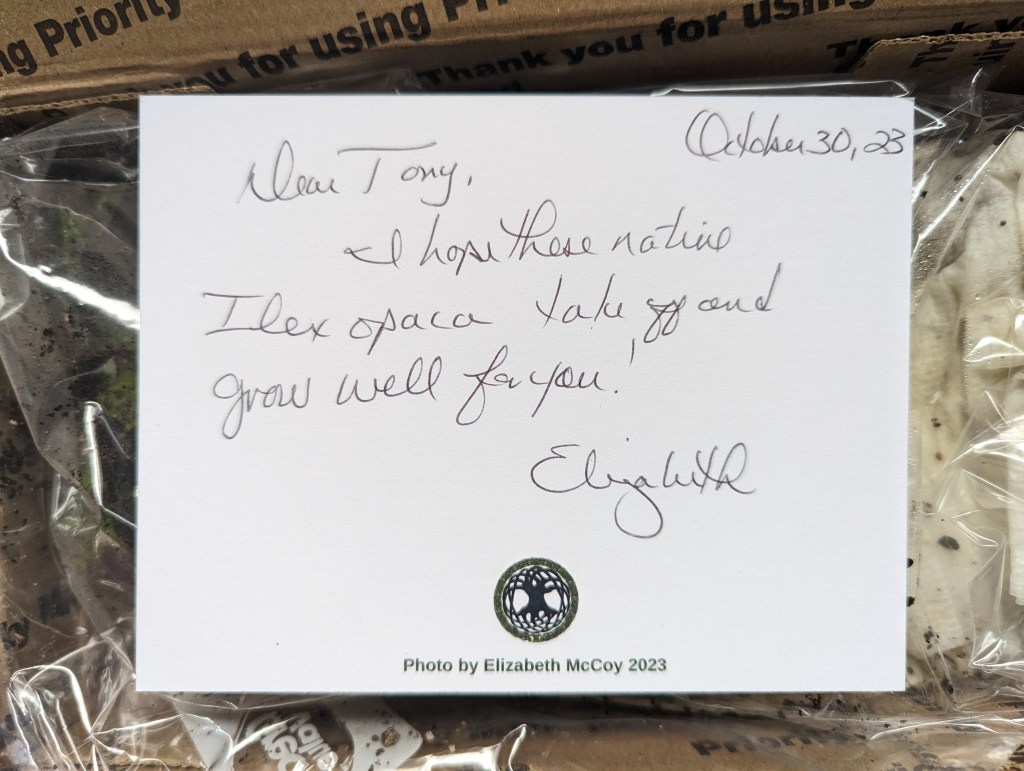
1. Cards and letters written by hand with ink on paper and sent by mail have become an old fashioned courtesy. It is gratifying to know that some still express such graciousness.
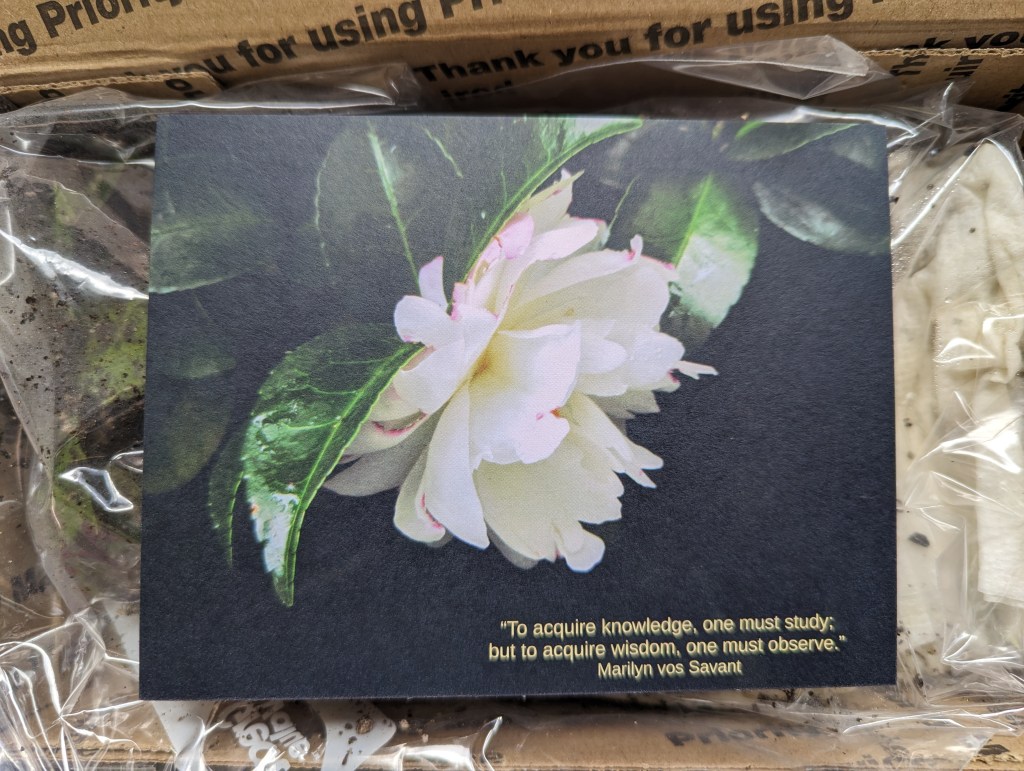
2. Camellia sasanqua, sasanqua camellia is the illustration for the other side of the card. It very likely bloomed where the contents of the parcel originated from in Williamsburg.
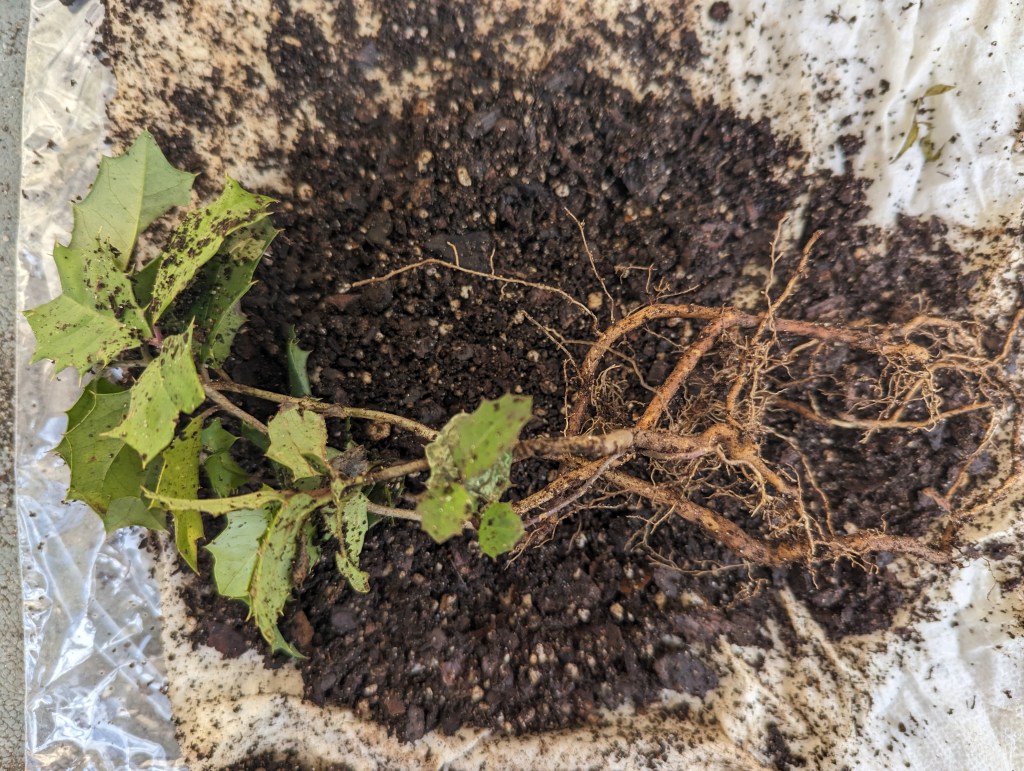
3. Ilex opaca, American holly was the contents of the parcel. There are six seedlings. For me, this is a remarkable acquisition, like beautyberry, red elderberry and Louisiana iris.
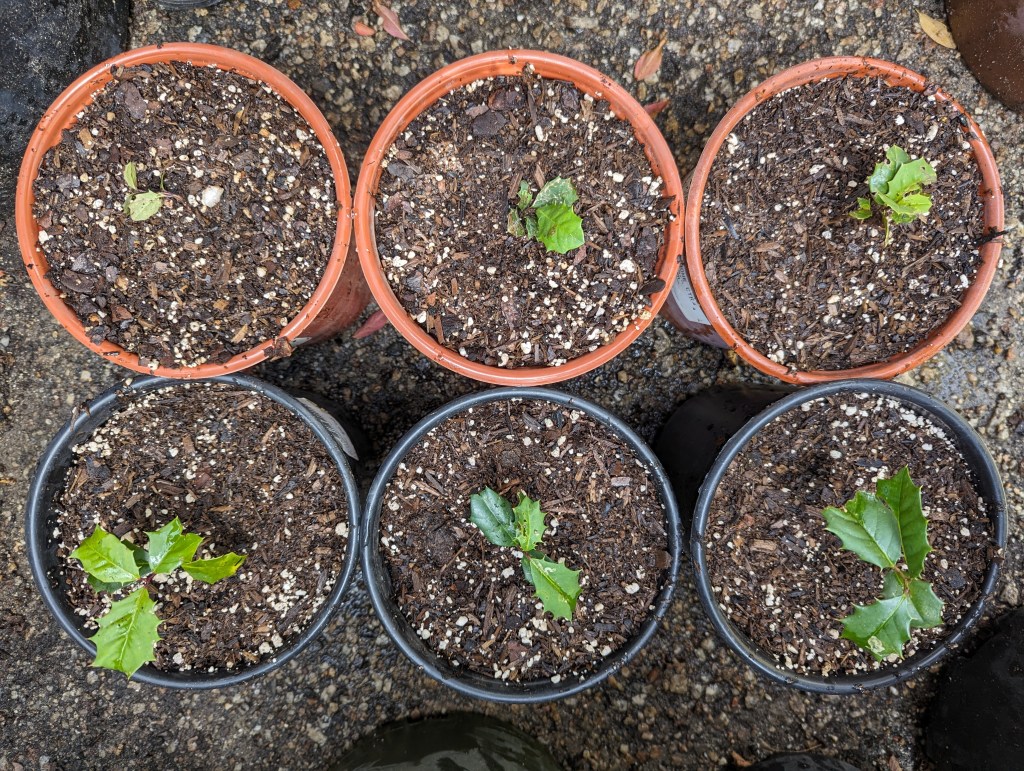
4. Ilex opaca, American holly seedlings were canned and happy shortly after arrival here two weeks ago. They can now disperse roots through winter to sustain growth next year.
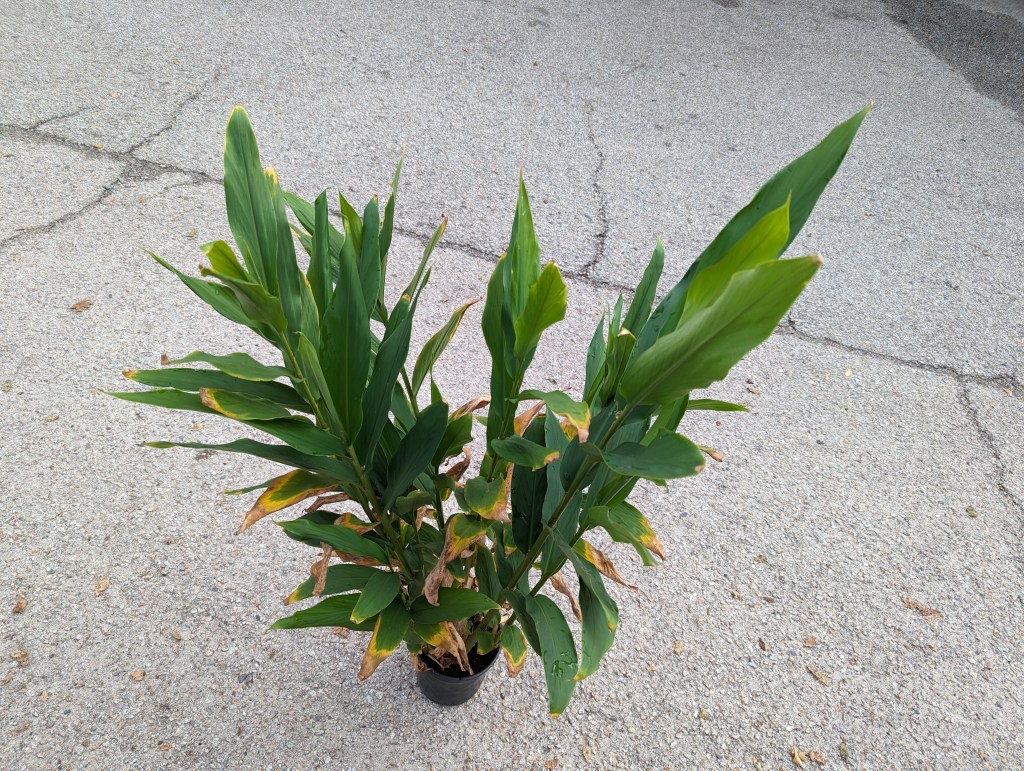
5. Hedychium coronarium, white butterfly ginger came from the same source two years ago. Some was planted at the Chapel. This remaining specimen is higher than three feet. It really wants to be in the ground. The mild warmth last summer likely inhibited bloom.
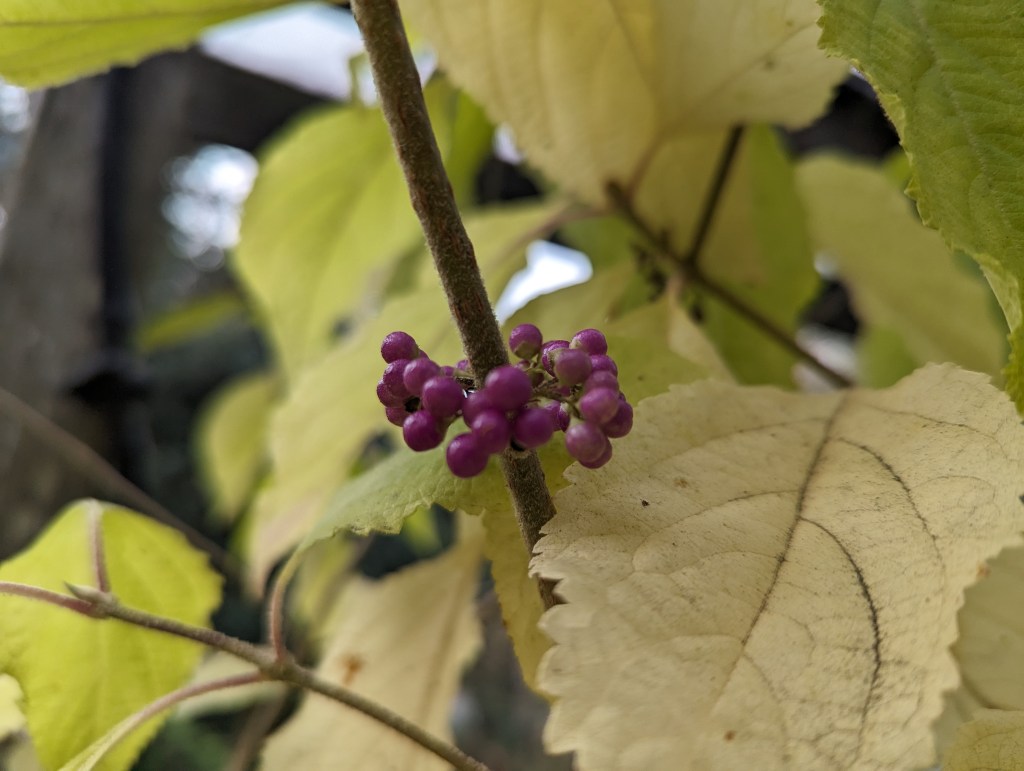
6. Callicarpa americana, American beautyberry was an even more excellent acquisition two years ago. The mild warmth last summer likely inhibited the ripening of the berries. Larger clusters of berries are still green. This yellow foliage will likely be gone after rain.
This is the link for Six on Saturday, for anyone else who would like to participate: https://thepropagatorblog.wordpress.com/2017/09/18/six-on-saturday-a-participant-guide/


I totally agree with you about handwritten notes, the card is lovely and so is the sentiment. Gardening folk are quite often good people, not always, but often. 🙂
LikeLiked by 1 person
Old fashioned cultural refinement and graciousness are RAD! Gardening folk appreciate that which is RAD!
LikeLiked by 1 person
Ilex opaca seems not to have been grown much over here because it is not very different to our own native holly. One of my books says it has numerous cultivars in the US but when I looked at pictures online I couldn’t find any variegated forms, which surprised me since there are numerous variegated forms of Ilex aquifolium and Ilex x altaclarensis. In gardens they are much more common than green forms. Does I. opaca not do variegation?
LikeLiked by 1 person
Rarely do any of our natives have variegation. I seem to remember seeing at least 1 hybrid of I. opaca with variegation, but can’t recall its name. The leaves on this plant are matte, rather than shiny. The tree is stunning this time of year when the berries first ripen and it has good form, but the leaves don’t compare to European or Asian hollies, in my opinion. Jim, I’ve tried multiple times to leave on your site today still without success. It seems to be a bad day for technology in our area as there have been other glitches on this end, too. I’ll try again, later. Best to you-
LikeLiked by 1 person
Oh, of course. I neglected to mention that the leaves are not quite as glossy.
LikeLiked by 1 person
That is one reason that folks around here don’t like it in residential landscapes as much as they like Asian or European holly. It is beautiful in a natural setting and makes a wonderful tree- just a little ‘wild’ to grow as a foundation planting….
LikeLiked by 1 person
Incidentally, although I do not remember much about what was said about American holly when we studied it in school, I distinctly remember that the professor mentioned that it was a traditional choice for foundation planting. I was unfamiliar with the species, but was not convinced that it would be so practical for such application. (Foundation planting is very different here because of the architecture.)
LikeLike
Back here, Yaupon holly, I. vomitoria, is the native that is recommended for foundation plantings. But as you observed, the architecture and terrain are quite different. It will require persistent pruning to keep the I. opaca from following its predilection to grow into a beautiful tree. Happy Thanksgiving to you and yours!
LikeLiked by 1 person
Ilex vomitoria is another species that I have not worked with since we were in school in the late 1980s. Unlike Ilex opaca, I have seen a few of them around in the early 1990s, but not many, and I do not remember seeing it in this century. I was not so impressed with it, although the more compact form is more appropriate to refined landscapes.
LikeLiked by 1 person
It is OK- I worked with a tall pendulous form at the botanical garden which blew over in a storm, but friends saved it. It is pretty but top-heavy. And of course, you need a mated pair to get berries. We use a lot of ‘Nana’ and ‘Bordeaux’ at our neighborhood entrance to replace the Junipers that used to grow there and became diseased. It is totally boring, but very neat and requires no maintenance.
LikeLiked by 1 person
So-called ‘landscapers’ here are unaware that hollies need a pollinator to produce berries. They rarely use holly, but when they do, they neglect to add a male cultivar.
LikeLiked by 1 person
‘So-called’ is right! I spent a happy 4 hours yesterday watching Continuing ed videos on the urbanforestrytoday.com site. I love Dr. Linda Chalker-Scott of WSU, who makes an excellent argument for increasing bio-diversity by using non-native woody plants in residential landscapes, as well as certain parks and public gardens. She documents how they support a variety of wildlife- including various berries and nectar sources. I sent you six seedlings with the expectation that the odds would be in your favor to receive at least one seedling of each gender. Now- it is going to take 5 years or more for you to know which of those are which- so I am glad that patience is one of your virtues.
LikeLiked by 1 person
I will be pleased with the foliage even without berries. My first English holly produced only a few berries, but the foliage was excellent. In the distant future, I may grow cuttings of a female specimen, so that I can put at least one where it can grow as a tree with natural form. If it goes into a separate garden, away from the originals, I can add a male, even if pruned down as shrubbery.
LikeLiked by 1 person
I do not know. I am completely unfamiliar with it. I met it briefly while in school, but then never saw it again. It is more popular in eastern North America, but only because it is native there. A few cultivars of English holly, mostly variegated, are available here, but are not very popular. Of the few at work, only one variegated specimen was planted intentionally. The others are ‘politely’ naturalized. American holly is not as prickly as English holly.
LikeLike
All looking good Tony.
LikeLiked by 1 person
Thank you. I am very pleased with them.
LikeLike
Thank you for this wonderful update on your hollies, beautyberry and gingerlily. I’m so happy to see that your beautyberry made berries this year! They are lovely! Our gingerlily had little bloom this year, too. Something in the air, maybe? I hope you get flowers next year because they smell so wonderful. Thank you for all of your kind comments here, I’m glad you like the card. Yes, that Camellia blooms still about 10 feet from where I dug up your holly seedlings.
LikeLiked by 1 person
None of the gingers bloomed, and there are six other types. Kahili ginger was the only variety that was here prior to the white butterfly ginger. Red butterfly ginger, common culinary ginger, galangal ginger (which is another culinary type), coral ginger and an unidentified variegated ginger that we do not know the floral color of arrived afterward.
LikeLiked by 1 person
I can’t wait to see that variegated ginger bloom!
LikeLiked by 1 person
I hope that it blooms white, as Brent said it would, but I suspect that it is ‘Tahitian Flame’. A variegated version of the white butterfly ginger that you already sent to me would be rad. Perhaps I can send a rhizome a year after this winter.
LikeLiked by 1 person
I would love that! Thank you! I would love to grow out the variegated version of ginger lily.
LikeLiked by 1 person
There are too many gingers here now. The white butterfly ginger that you sent was only the second. All the others arrived only recently. I already prefer the white butterfly ginger that is not variegated (which you sent), because the white variegation might seem to be redundant to the white of the bloom. Of course, that will not prevent me from putting it into the landscapes somewhere. One of the advantages of working partly in public landscapes is that, even if I am not so keen on something, someone else is! Do you grow kahili ginger already? Is the white butterfly ginger the only ginger there?
LikeLiked by 1 person
I love the white butterfly ginger because of its sweet fragrance as much as for its beautiful flowers. We got off to a rough start this spring because of smoke for weeks from wildfires and from dry weather when everything should have started growing. Our ginger didn’t do very well, helped along by the fact that my partner helpfully ‘pruned’ it back one day (it was leaning towards the driveway) which cost most of the flowers. So I am looking forward to a better year next year. That was a gift from a neighbor when we first moved here and is the only ornamental ginger I grow. I have some culinary ginger (not hardy here) growing in pots. I would like to try the Kahili ginger. A local specialty nursery (geophytes) offers several different hedychiums, but I haven’t ventured beyond what we have in that genus. I am normally blowing my pocket change on some new Caladium, Colocasia or Alocasia….
LikeLiked by 1 person
The white bloom of the white butterfly ginger is what appealed to me. Kahili ginger is not appropriate for the White Garden at the Chapel (el Catedral de Santa Clara de Los Gatos). I am very pleased that the white butterfly ginger is there now. The others were unplanned. None are dormant yet. When they are, I should see if I can send a bit of Kahili ginger. I planted only a few rhizomes a few years ago, and they were immediately eaten by gophers. I dug and canned what remained, but it was not much earlier this year.
LikeLiked by 1 person
I will appreciate a gift of some Kahili ginger. I hope that the cold in transport won’t hurt it. We expect our first hard freeze this coming week. I will also can it and keep it indoors until things warm up again in April. USDA just shifted us from Zone 7b to 8a, but I believe that we have fit the 8a parameters for several years now anyway. The palms you sent are really growing well now and 2 of them live happily beside our front porch. I left the other 2 in large containers beside the pavilion at the botanical garden, where they made a nice backdrop for wedding photos. I can only hope that they are still there and thriving.
LikeLiked by 1 person
Transportation should not be a problem. They will be dormant, like bare Canna rhizomes. Their packaging insulates them from direct chill, like being under a bit of soil, fallen leaves and snow. I must wait for them to be dormant to send them though. That may take a while. Because gophers ate them, there are not many rhizomes. I have your address here, on the package that the American holly came in.
LikeLiked by 1 person
Sounds great. If the gophers get them, keep the stock you have and perhaps there will be enough to share next year. I am always fighting voles, which got into the Cannas this year, and completely understand the damage rodents can do to planting stock.
LikeLiked by 1 person
The gophers already got them, so the remainder is canned where they can not get to them.
LikeLiked by 1 person
Ilex opaca! cool, We have that here. I remember it from the woods growing up. You should love it. My Beautyberry is thin on fruit this year. Did you see Fred’s?
LikeLiked by 1 person
Yes. Although they are not so impressive here, I am impressed because this is their first bloom and fruit set. I still have no plan for the American holly, but will likely put the originals where they can assume natural form, even if they need a bit of pruning for confinement. In the future, after they express their genders and distinct characteristics (if they exhibit noticeable genetic variability), I may grow a few genetically identical cuttings from one for a female hedge, with a copy of a male nearby.
LikeLiked by 1 person
They are very slow growers here.
LikeLiked by 1 person
That could be an advantage if I want a hedge of it to stay somewhat low. My old English holly was excellent, but a bit too vigorous. I tried to keep it smaller than it wanted to be.
LikeLike
Plant parcels are the best parcels! I love seeing cameos from other bloggers appearing in post, thinking about the threads connecting one garden to another.
LikeLiked by 1 person
I enjoy growing things with history, even if such history is not very interesting to anyone else. Some of the vegetation here is quite uninteresting, with comparably uninteresting histories; but somehow, they are very important to me because of their sources. Some are both important to me, and are also actually interesting, such as the white butterfly ginger from Williamsburg, and the Gladiolus papilio from Ilwaco, and the Eastern redcedar from Pecan Valley Junction, and . . . There is not much in my garden that lacks history.
LikeLiked by 1 person