Spring is beginning to express itself. Only one of my six thinks that it is still winter. After a mild winter, I expected this sooner.
1. Colocasia gigantea ‘Thailand Giant’ elephant ear is the only one of these six to remain dormant. I still must determine if two will go directly into a landscape or get canned like the other two next week. I actually purchased these corms, but do not feel guilty about it.

2. Alocasia macrorrhiza ‘Borneo Giant’ elephant ear is another guiltless purchase. It has a very similar name and is from a similar region as the ‘Thailand Giant’ elephant ear, but grows from smaller rhizomes rather than fat corms. It is already generating new growth.
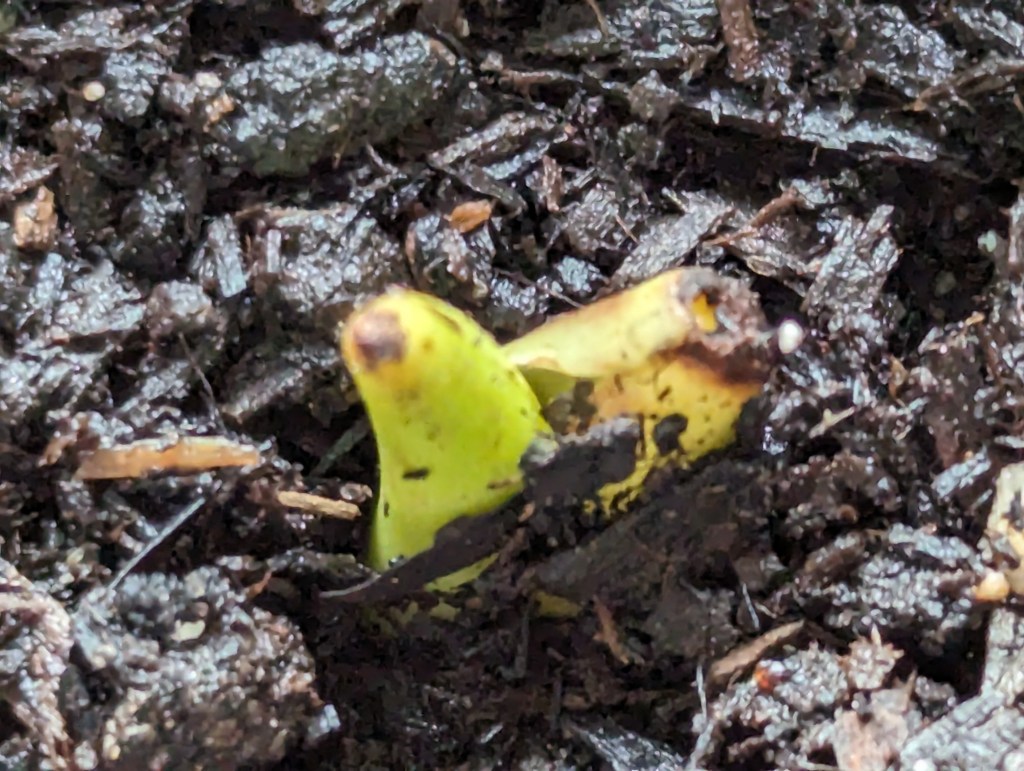
3. Musa acuminata ‘Double Mahoi’ banana was one of several items that I brought back from Los Angeles last year. After taking several small pups from it, I gave the original to a neighbor. Then, all the pups seemed to die! Now I am pleased that they are recovering.

4. Actinidia deliciosa, fuzzy kiwifruit cuttings are generating foliage. I hope that they are also generating roots. They are a male pollinator for a female cultivar that grew last year from a single pruning scrap that an associate here neglected to remove from his pickup.

5. Platycerium bifurcatum, staghorn fern looks weird as it extends new foliage. Actually, it always looks weird, which is its primary allure. I am concerned that such fresh foliage can be damaged by cold rain. It likes rain and humidity but in conjunction with warmth.

6. Viburnum tinus, laurustinus is the only floral feature of these six. I am not so keen on it, but am learning to appreciate it because its early spring bloom is popular where harsh weather through winter inhibits other bloom. It is simple white, without any pink blush.

This is the link for Six on Saturday, for anyone else who would like to participate: https://thepropagatorblog.wordpress.com/2017/09/18/six-on-saturday-a-participant-guide/
 Tony Tomeo
These Colocasia rhizomes are amazing! I thought it was the ones you cleaned up and overwintered in a box that were in perfect condition, and ready to replant….
LikeLiked by 1 person
No; that one gave no pup rhizomes like these. It is an elongated rhizome that was originally on the surface of the ground. I canned it while it was active, and did not dig, clean and overwinter it when it went dormant. Most of it is below the potting medium, but the vertical portion that extends above the medium is now developing pups. I believe that it might be Colocasia odora.
LikeLiked by 1 person
What a collection! Wonderful even the viburnum!!
LikeLiked by 1 person
I am getting to appreciate the Viburnum tinus. It makes nice hedges. This particular specimen happened to grow precisely where its bit of evergreen foliage became an asset. It obscures an air conditioner without becoming too obtrusive.
LikeLiked by 1 person
Sounds perfect!
LikeLiked by 1 person
and it provides layered stems, just in case I need another hedge.
LikeLiked by 1 person
Glad that the banana pups seem to be well!
LikeLiked by 1 person
Oh, I am also. It would have been embarrassing if they did not survive. A few small tissue culture plugs did not survive, so I must eventually request pups from friends who I earlier shared copies of the same cultivars with. Their plugs grew nicely.
LikeLike
I love your photo of C. ‘Thailand Giant.’ What a great way to display them! That is a Colocasia I’ve never tried. How large do they grow in your climate? Alocasias in my basement are throwing up new growth, but nothing is visible in those outside. That is a gorgeous Viburnum! How pretty for so early in the season! How close is the CA snow this week to you? Looks like an interesting, non-horticultural- weekend for lots of folks in CA!
LikeLiked by 1 person
I do not know how big they will grow because I have not grown them yet. I suspect that they will get almost ten feet tall like they can in milder climates. They must start over annually, but they grow very fast, like banana trees. The tallest Canna grow almost that tall. The snow is about a hundred and fifty miles inland from here. The rain is weirdly cool though.
LikeLiked by 1 person
Staghorn and Elkhorn ferns are incredibly popular here. I think they are weird too and just don’t get it. I want to see the Colocasia in foliage. Viburnums just don’t have a lot of appeal for me. Do you actually get bananas?
LikeLiked by 1 person
Banana trees are not very productive here. They occupy large spaces and are very consumptive of fertilizer and water, but produce only small trusses of small fruit. They are not very responsive to seasons, so can bloom just as easily in late summer as they might in spring. If they bloom in late summer, the fruit does not get enough time to ripen before rotting through winter. Statistically, most bloom occurs when there is not enough time for the resulting fruit to ripen. A few happen to bloom in early spring, their fruit ripens through summer, but because the weather is not very warm, the fruit does not develop well. I will grow them anyway.
LikeLiked by 1 person
I would grow the red ones for summer annuals when living further north. I don’t think I could get enough water on them in my garden. And we don’t really like bananas. Though the tropical foliage is wonderful.
LikeLiked by 1 person
I did not give it much consideration until Brent mentioned that there is better looking tropical foliage available. He is right. Most banana trees exhibit awkward form, and their foliage gets shabby with the least bit of wind.
LikeLiked by 1 person
This is true!
LikeLiked by 1 person