P was about a white blooming perennial pea, Lathyrus latifolius, that I recently found to replace what I inadvertently lost earlier. P II was irrelevant to both that and this, but did happen to get a title that incorrectly designates it as a sequel to P, and prevents me from using that title for this Six on Saturday post with three variants of perennial pea and the more typical sort. Perhaps I should not have expended such effort for such a weed. What is worse is that I canned and am now growing copies of the three variants as well as the favored white blooming variant.
1. Canna are irrelevant to the primary topic, but are too cool to not mention. These were placed here temporarily in random pots until a new landscape gets installed next winter.
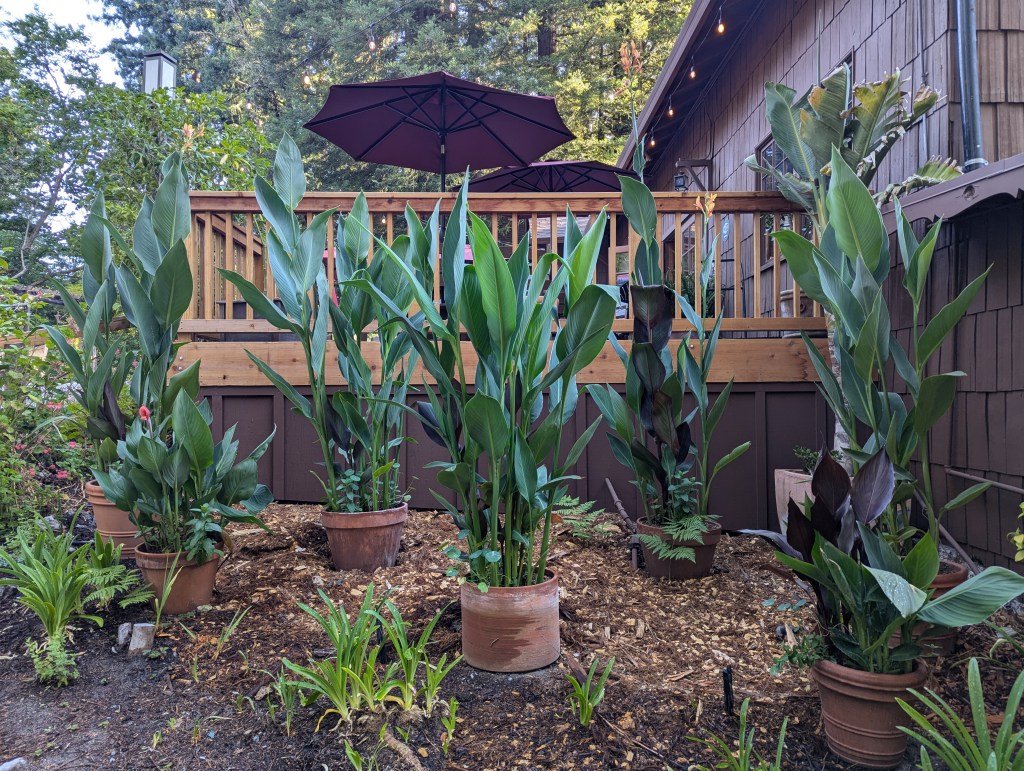
2. Canna musifolia dominates, which is why there is not much bloom. This one stands a bit more than eight feet high in its pot. It might be ‘Omega’ like the compact Oldsmobile.
3. Lathyrus latifolius, perennial pea is the primary topic because I found three variants. This one blooms with swirled pink flowers. It is about as rare as those that bloom white.

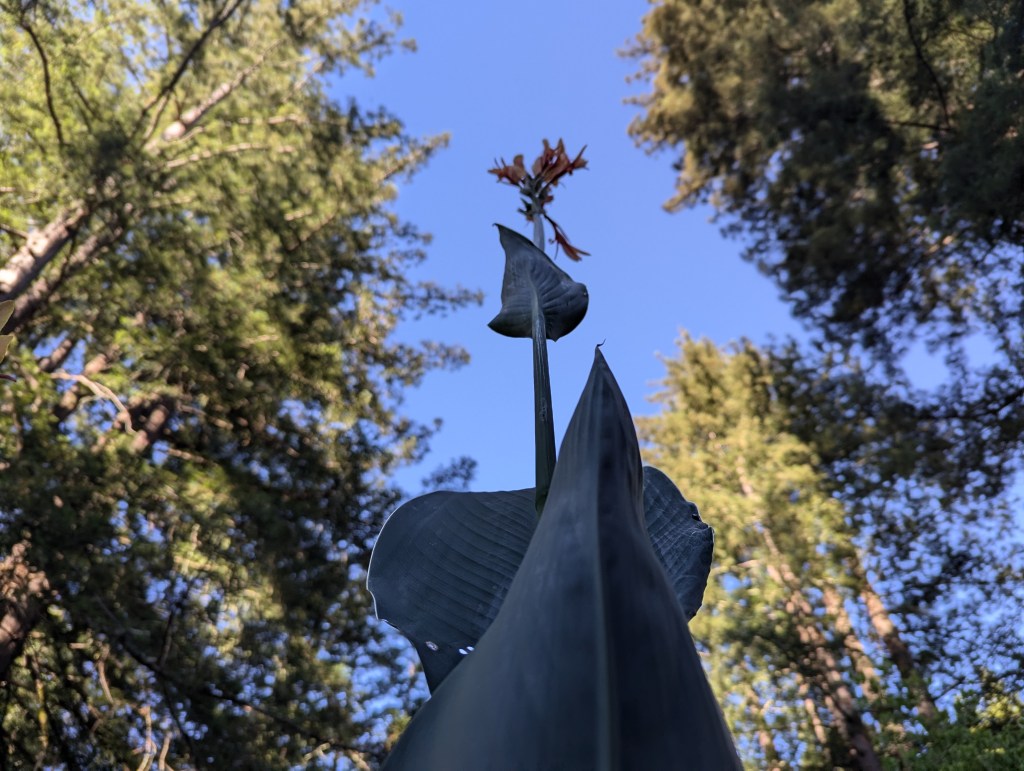
4. This looks white in this picture but is actually blushed very slightly with pink. I should have gotten a better picture. I dug and canned a copy because I had never seen it before.

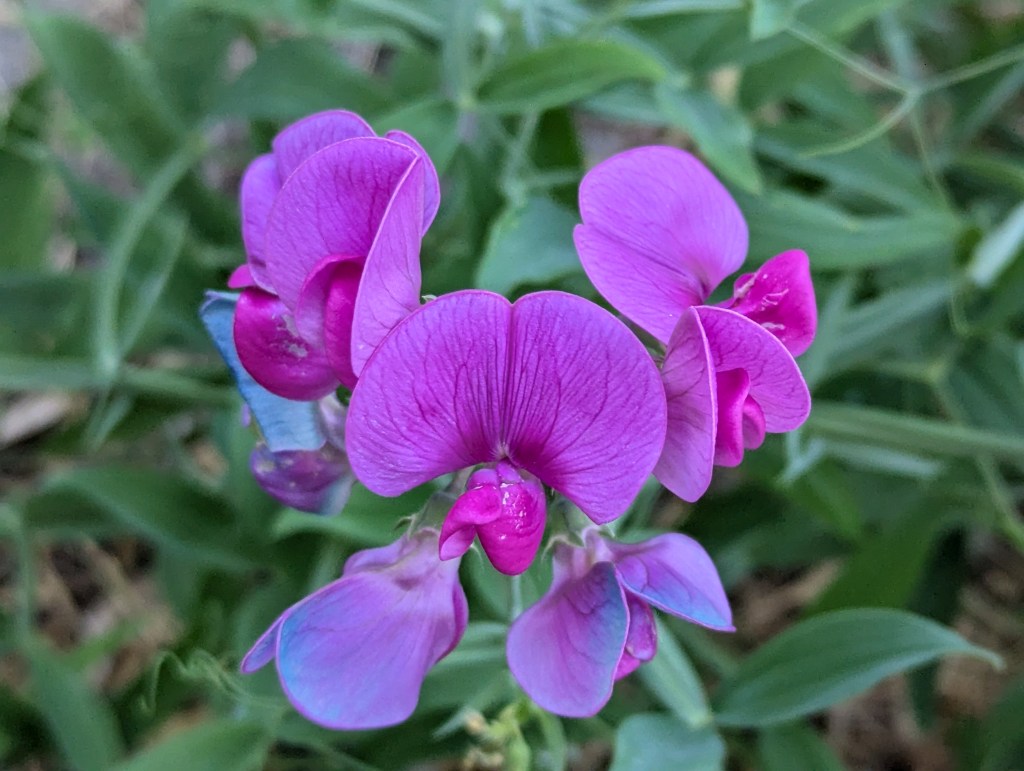
5. This is the typical floral color of the species. To me, it looks purplish pink. I am not so proficient with color. Others say it is pinkish purple. It justifies my preference for white.
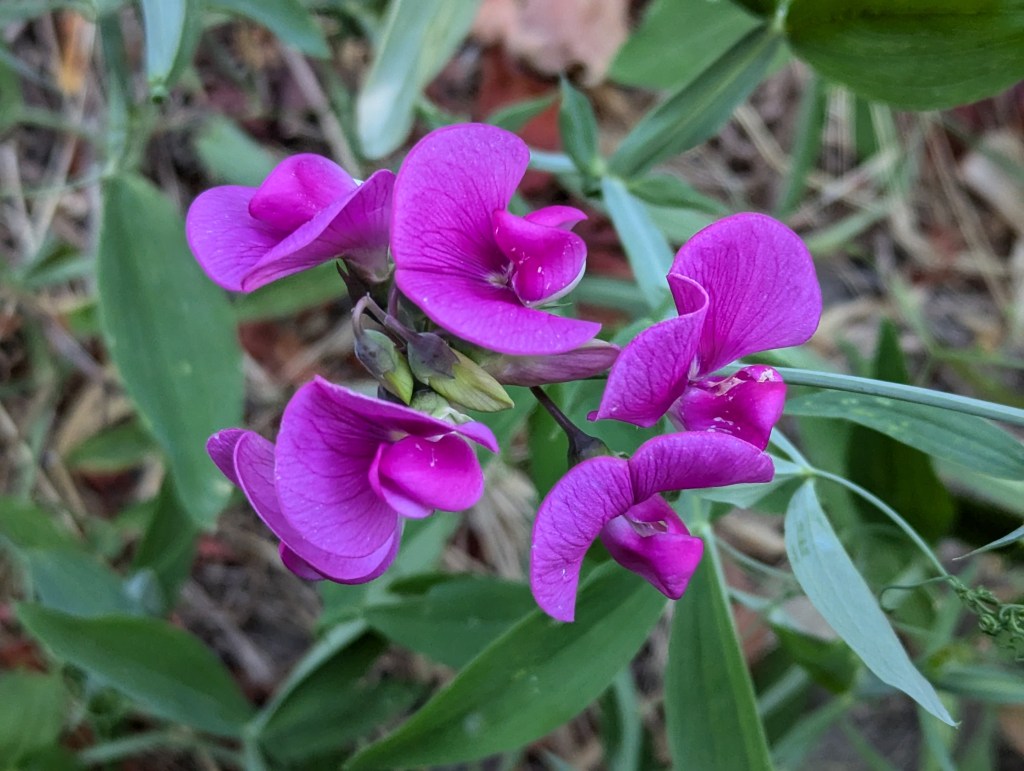
6. Like the picture of the very slightly blushed white flowers, this is not a good picture of flowers that seem to be slightly richer purple than the typical purplish pink. I got a copy.
This is the link for Six on Saturday, for anyone else who would like to participate: https://thepropagatorblog.wordpress.com/2017/09/18/six-on-saturday-a-participant-guide/


The canna are magnificent and the sweet peas very pretty. A great combo!
LikeLiked by 1 person
Thank you! I SO dig those Canna! They are unpopular with those who like Canna because they expect more floral display. I like their foliar boldness! There are more floral Canna in there also, but they are not blooming much, and are sort of subdued by the taller Canna musifolia. The peas are actually perennial pea, not sweet pea. they lack fragrance, but grow like weeds. Sweet pea do not do much here.
LikeLike
Pea flowers are pretty. I have white flowered snow peas in the garden. I used to find sweet peas growing in the canyons near my house growing up. I would sometimes eat the peas when I was out exploring.
LikeLiked by 1 person
Perennial pea is a naturalized weed in some of our landscapes. That is why I am hesitant to add even the white sort to my own garden. I know that once it gets established, that it will be there for all eternity. Sweet pea do not perform well here. My niece grew them when she was a kid in the Los Angeles region, which is even drier than here, but they bloomed only briefly. That was all she needed. Even edible peas are marginal here. We grow them for spring and perhaps again for autumn.
LikeLike
We don’t hear much about sweet peas anymore but I was thinking about them a few days ago. I need to plant more varieties along the fence rows. I have a patch of wild sweet peas that grown around, and in, an old brush pile. Thanks for sharing!
LikeLiked by 1 person
Are those the perennial pea (like those that I got pictures of)? It is a weed here, but I sort of like them, especially the white sort. Because they are a weed, I am not so keen on planting more. Sweet pea (which are annual) do not perform well for us. I used to send seed to my niece because she liked growing them in the Los Angeles region, even though they grew slowly through winter, only to bloom briefly.
LikeLiked by 1 person
I think the plants growing in the backyard are Lathyrus latifolius (Everlasting Pea, Broad-Leaved Pea, Wild Sweet Pea, etc.). They are an introduced wildflower. They come up in the ditch in front of the garden and around an old wood pile in the backyard. Perhaps remnants of what my grandparents planted many years ago.
LikeLiked by 1 person
Yes, Lathyrus latifolius, with a few common names.
LikeLiked by 1 person
Do the perennial peas work better in warmer climates?
LikeLiked by 1 person
I do not know. They are an invasively naturalized exotic species all over the West Coast. They might be more common in the Pacific Northwest, and are not as common outside of riparian ecosystems in Southern California. Because the get crispy as the weather gets warmer and drier, their foliage lasts longer farther north than farther south. That does not necessarily mean that they do better in one climate or the other. They merely adjust their season.
LikeLike
The peas are lovely – I like the pale pink one (the first photo) best and it is similar to what I have.
LikeLiked by 1 person
I was not certain if yours would resemble the first or second (although the second does not show much blush in this particular picture). The second really is white with only a slight blush. The first is what I consider to be pink, even though it is partly white also. Because I have never seen red, I am sort of wondering if the common bright purplish pink is what others consider to be red.
LikeLiked by 1 person