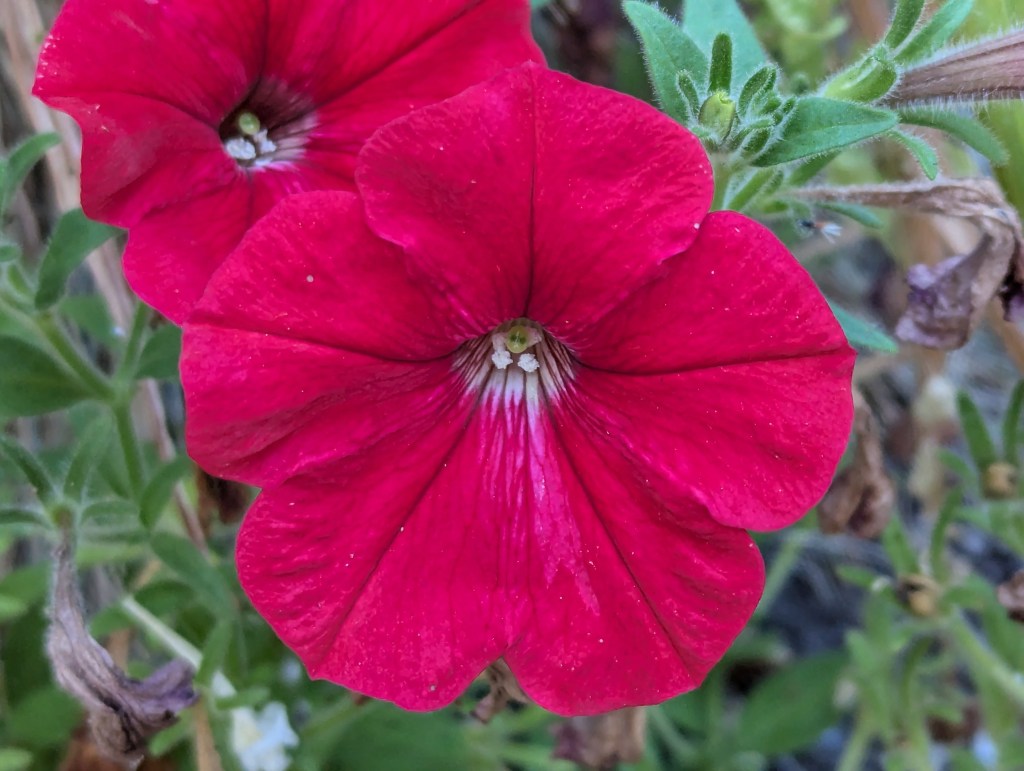
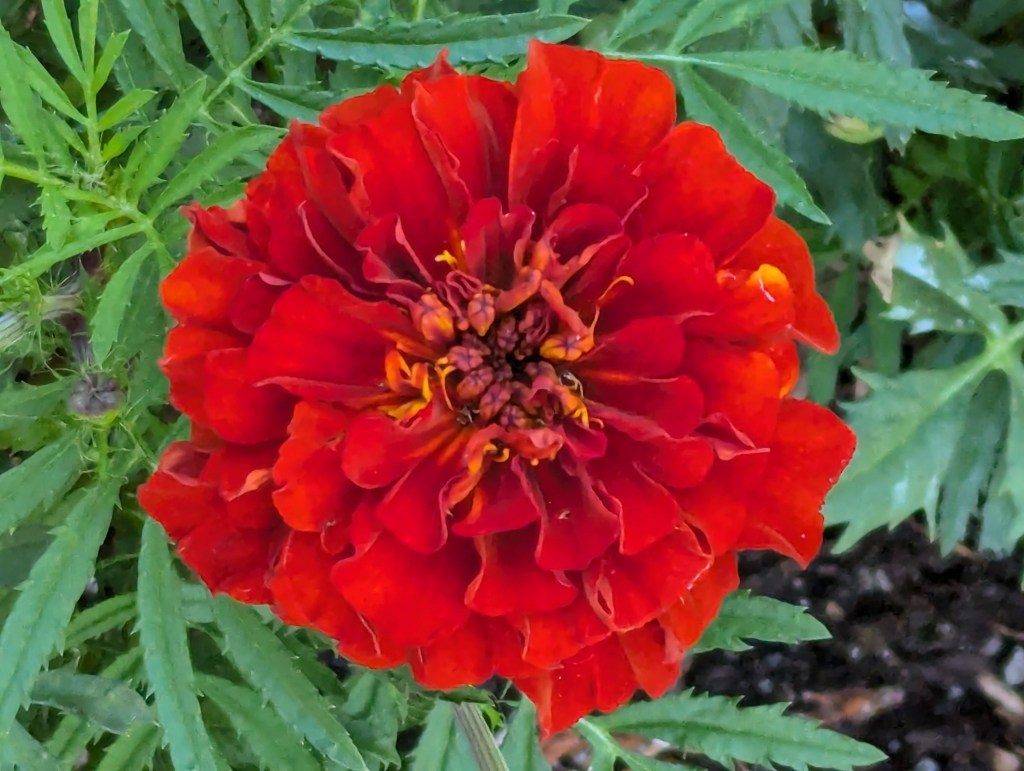
Cool season annuals are beginning to replace warm season annuals not because weather is beginning to cool for late summer, but because warm season annuals are beginning to deteriorate after their long and warm summer. Deterioration of remaining petunias was accelerated by warm weather today. It was warmer than a hundred degrees. Fortunately, marigolds are the first and only cool season annuals that were added into the landscapes already and they tolerate such warmth. I believe that they are varieties of ‘Durango’. I do not know what the petunias that they are replacing are, but they resemble old fashioned red, white and blue varieties of ‘Madness’ that were too popular during the Bicentennial Summer of 1976, although a comparable white variety is notably lacking.
1. ‘Madness – Blue Vein’, if I remember accurately, looks something like this. Its name is not as appealing as its color, and might have been less appealing in the summer of 1976.

2. ‘Madness – Blue’, which looks like this, was one of the three most popular varieties for the summer of 1976, with ‘Madness – Red’ and ‘Madness – White’, but is almost purplish.

3. ‘Madness – Red’ is more convincingly red, very much like this, and just like ‘Madness – Blue’ and ‘Madness – White’, was very popular in profusion through the summer of 1976.
4. ‘Durango – Gold’ is not very different from marigolds that were overly popular during the 1970s, when ‘Madness’ petunias were popular. I do not know when it was developed.

5. ‘Durango – Orange’ is just as familiar as ‘Durango – Gold’ because of its similarity with old fashioned varieties. Only a few specimens of ‘Durango – Flame’ are blooming nearby.

6. ‘Durango – Red’ is the only of these Six that, to me, does not seem to resemble the sort of varieties that were popular in the 1970s likely because red bloom was developed later.
This is the link for Six on Saturday, for anyone else who would like to participate: https://thepropagatorblog.wordpress.com/2017/09/18/six-on-saturday-a-participant-guide/


Wow, that’s not what I expect from TT! Where’s all the white? But they are glorious none the less!
LikeLiked by 1 person
Too much white gets boring. Even I know that. There are creamy white marigolds, but they are not very pretty. Besides, marigold excels at marigold colors, yellow, orange and perhaps red and brown. I do happen to like white petunias, and we have grown a few in the past, but richer colors work better in these particular applications. Although I am not so keen on annuals, I do enjoy those that I must work with.
LikeLiked by 1 person
Petunias don’t do that well for me – they look good for a few weeks then start to get all straggly and brown, not matter how much I water or feed them. Perhaps they don;t enjoy our humidity in the summer. Marigolds, on the other hand, do just fine – I like these three varieties.
LikeLiked by 1 person
Petunias perform even better in the Los Angeles region, which is more arid than here, so perhaps they do dislike humidity. Ours are scraggly now, but only because they grew so much through their long season. Although I would not want to grow any more than what typically grows here, I do like seeing them in other landscapes. They were still popular when I went to Los Angeles in 1986, and were still very colorful in early autumn. I like marigolds even more, but would be less likely to grow them in my own garden because their season is shorter than other cool season annuals. Ours may last until spring. However, in other gardens, they are merely transition flowers between petunias and pansies. Pansies replace them later in early winter or so.
LikeLiked by 1 person
I like all the petunias, I have had Callibrachoas lately. Were wave petunias the next fad? I like the bigger marigolds like these.
LikeLiked by 1 person
Oh yes, I remember ‘Wave’ now that you mention it. Callibranchoa does not last as long, perhaps because they are greenhouse grown. Large specimens appear in nurseries in spring, but get sort of crispy looking with summer warmth. They might be happier if planted from cell packs, like petunias, and allowed to grow through their season. I do not know because I have not seen any exemplary specimens after spring.
LikeLiked by 1 person
I usually have them in winter here..they wither in summer heat
LikeLiked by 1 person
Calibrachoa? So, they are as vulnerable to heat as they are to desiccation? That is interesting. I only guessed that they dislike the aridity, but did not confirm it.
LikeLiked by 1 person
That first Petunia would catch my eye, but I usually avoid buying them as annuals as they just don’t hold up to our weather here – unless in a very sheltered spot.
LikeLiked by 1 person
What do they dislike there? They seem to be happy in most situations here, as long as they get water.
LikeLike
I am not sure. Perhaps a bit more shade would help in my garden. Possibly the difference in daytime and night temperatures? No idea.
LikeLiked by 1 person