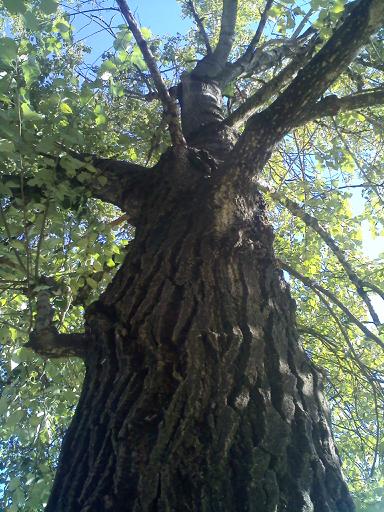
The brilliantly clear yellow autumn color of Western cottonwood, Populus fremontii, is best in the higher elevations and inland areas of its extensive range, which spreads from the coast of California to the Rocky Mountains and as far south as Mexico. Although it thrives in local riparian areas, particularly Coyote Creek and Guadalupe River, mild temperatures in both summer and winter do not allow it to get as colorful as it does in Nevada. It is almost never planted intentionally, but has a sneaky way of sometimes growing from seed in well watered gardens.
The bad news is that Western cottonwood grows big, fast and aggressively. The shallow roots displace pavement, compete with other desirable plants and damage septic and drainage systems. Large trees produce an abundance of annoyingly fuzzy seeds that adhere to anything. After causing so much damage, Western cottonwoods survive only a few decades, leaving big deteriorating carcasses that need to be removed before collapsing. Consequently, Western cottonwood is really suitable only for large open areas or in the wild.
Mature trees can be more than fifty feet tall and more than half as broad. Their somewhat thick leaves are almost triangular, with paired angular lobes on the sides and blunt tips. ‘Nevada’ is a male cultivar that does not produce fuzzy seeds.
 Tony Tomeo
Is the wood from the tree of any value?
LikeLiked by 1 person
It depends on who you ask. I grew six Lombardy poplars for firewood. They are also poplars, but with very narrow form, so occupy less space than other cultivars or species. I cut one down for firewood annually. (Not much firewood was used at that home.) They grew so fast that by the time all six were cut down, the tree that was cut down six years earlier was ready to be cut down again. The firewood was not of good quality, and would have been perishable if stored outside for more than a year, but was good enough for me. Anyway, cottonwoods are just as good for firewood. Also, for certain styles of furniture, and some discriminating craftsmen, cottonwood, which is known as poplar, can be desirable.
LikeLiked by 1 person