‘Beurre d’Anjou’ pear has been elusive. I visited the Scion Exchange of the Monterey Bay Chapter of the California Rare Fruit Growers to find scions, but none were unavailable. I got the few other scions and cuttings of the first three of these Six instead. That was two weeks ago. Some other deciduous vegetation is beginning to demonstrate that there was not much time to spare. Oddly, one banana tree did not bother with dormancy this year. It seemed to be comfortably sheltered.
1. Pomegranate, persimmon, caprifig, white mulberry and black mulberry cuttings are a bit too numerous to cite with their botanical and cultivar names. Most lack labels since I can identify them as they grow. They are plugged into the same can to occupy less space.

2. ‘Allegheny’ pawpaw scion is hopefully happily grafted onto seed grown understock. It is longer, with more buds than I would have preferred, but is rather thin. ‘Mango’ to the left is even dinkier. Three other small seed grown trees remain ungrafted without scions.
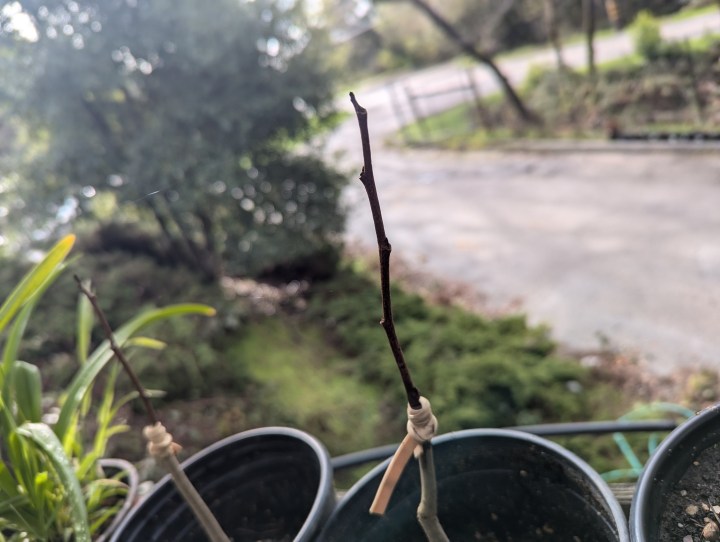
3. ‘Seckel’ and ‘Beurre d’Anjou’ pear were what I came for. I did not find ‘Beurre d’Anjou’ but this is ‘Seckel’. The quince understock is big enough for a pair of cleft grafted scions. Basal scraps from the scions were plugged as cuttings. Redundancy could be useful later.

4. Sambucus racemosa, red elderberry reminds me that winter dormancy will be ending soon for most deciduous plants. Grafting, bare root planting and dormant pruning must therefore be done sooner. Norway maple might be the last deciduous species to refoliate.

5. Musa acuminata, banana trees look so shabby after even minor frost that their foliage gets cut back. This unidentified specimen stayed nicely foliated under the eave and close to those uninsulated walls of the associated building, which happens to be a coffee shop.
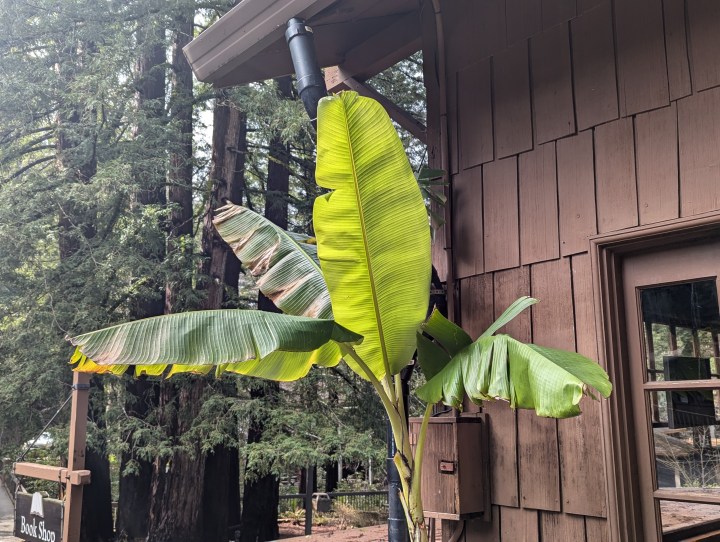
6. This happens to be on the menu board of the coffee shop, which happens to be within view from where the banana tree that did not get frozen is situated. Another banana tree that is just a few feet away but unsheltered was deprived of the last of its frosted foliage.

This is the link for Six on Saturday, for anyone else who would like to participate: https://thepropagatorblog.wordpress.com/2017/09/18/six-on-saturday-a-participant-guide/


I also have pawpaw cuttings that are about the same stage. Do you know when the bud break is at your place?
LikeLiked by 1 person
I have no idea when the buds pop. Pawpaw is very rare here. I have seen only a few, and only during the past few years. I believe that all that I encountered, like mine, were grown from seed. Therefore, none are cultivars. I grafted the scions because I read that they graft more easily than they root as cuttings. I plugged the basal scraps of the scions as cuttings anyway.
LikeLiked by 1 person
So interesting, all the grafting and such. I find it fascinating that it can even be done, but the plants want to live, give hem a chance, they will take it, even if it means relying on someone else’s roots!
LikeLiked by 1 person
Many of the fruit trees and shrubbery that I grow are ungrafted, just because I want to grow them as most who are familiar with them grow them. For example, although I grow cultivars of American elderberry, I am also growing some from seed, just because those who know the species in the East harvest the fruit from the wild, rather than grow improved cultivars. I tried two pawpaw cultivars just because they became available, but I also grow three from seed, with no immediate intention of grafting onto them.
LikeLike
Viewing all those scions gives loads of hope for a fruitful season ahead. Seckel pears are some of my favorites.
LikeLiked by 1 person
There are more cuttings than scions here, just because several of what I acquired do not need to be grafted. Also, the basal scraps of the scions became cuttings. I have no idea how well a ‘Seckel’ pear performs on its own roots, but I doubt it would perform too poorly. After all, that is how the original started. I have cuttings of ‘Eureka’ lemon here, which concern me though. Without dwarfing rootstock, they can grow huge! Dwarf trees are difficult to manage, so larger trees would be even more difficult.
LikeLiked by 1 person
Are you starting an orchard?
LikeLiked by 1 person
It is only a home orchard. Most of the grafted fruit trees are on dwarfing rootstock, rather than standard, like the apple trees on the farm. I am literally growing dwarf copies of the standard orchard trees. (Many of the fruit trees that do not grow too large are ungrafted. I grew them either from seed or cuttings. Some of the cuttings are cultivars, but of course, the seed are not.)
LikeLiked by 1 person
What, maybe 6 years until fruit or longer?
LikeLiked by 1 person
Six years?! Some can begin to produce in half that time. They may not produce much, but I do not need much.
LikeLike