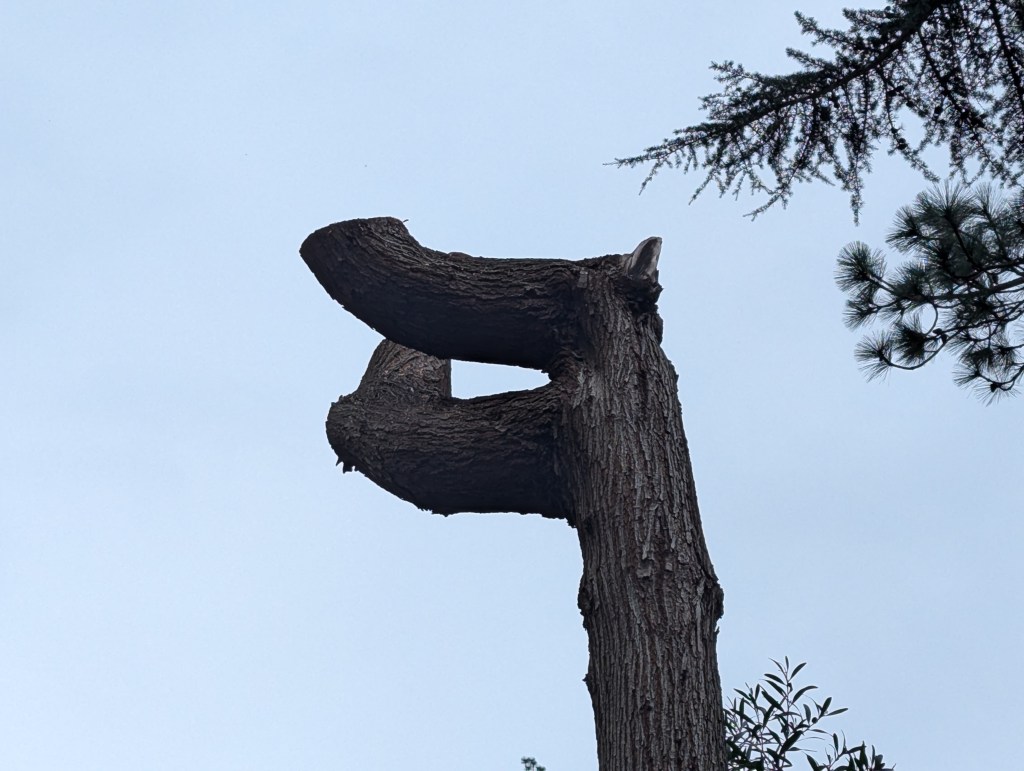
Actually, this does not even qualify as pollarding. It looks as if this tree, which was one of a few similarly damaged Acacia melanoxylon, black acacia trees, was in the process of being removed when the crew who was removing it left for the day. It would not have been so bad if they had returned to remove it and the others completely. They did not. This was the finished product. It and the others were almost twenty feet tall in this condition. They were about twice as tall prior. This sort of hack job is what gives pollarding a very bad reputation. It also demonstrates why proper pollarding should not be so vilified that arborists do not learn how to do it. Very obviously, this is not proper. Because they could not be salvaged, all of these trees were cut down a few days after I got this picture.
Pollarding can be done for a variety of reasons, and has been done for centuries in various cultures. It is still respected technique in many or most cultures. It stimulates vigorous growth that can be fodder for some types of livestock, including silkworms who consume the vigorous foliage of pollarded white mulberry trees. It can prevent some trees from producing troublesome pollen or fruit, such as old orchard olive trees that were retained as homes and their respective gardens were constructed around them. It can enhance autumn foliar color for some types of deciduous trees, such as the old Schwedler maples that were formerly common as street trees in San Jose. It stimulates growth of vigorous cane stems that are useful for basketry, fences, trellises or kindling. Locally though, it is considered to be as egregious as the technique pictured above, which is why no one here learns about it.
 Tony Tomeo
Thank you for the thorough explanation. We don’t pollard here in the frozen north–at least I have never seen it done. But wow, have I seen too many examples of terrible pruning!
LikeLiked by 1 person
Everyone thinks that they can do it.
I work with several professionals of various disciplines, such as electricians, plumbers, carpenters, masons and so on. Almost all of us respect the others. For example, electricians do not try to do plumbing; and plumbers do not try to do carpentry. Yet, any of them will hack vegetation that gets in their way without telling me about it, and do not understand why I get so infuriated when they cause major damage.
LikeLiked by 1 person
Yes, that’s it exactly! None of us would attempt surgery–and yet, without thinking, that’s what they’re doing on trees. Not only can it scar them for life, but it could be dangerous for them or for others. I really wish people understood that.
LikeLiked by 1 person
Horticultural industries, more than any other industries that I can think of, attract those who flunked out of some other industry. When I was working, I was very frequently told by ‘landscapers’ that they became andscapers because they got tired of working in their particular profession. After being especially annoyed by one particularly bad landscaper, who told me that he became a landscaper because he thought that his chiropractic work was too much . . . work, I told him that nursery work is so demanding (which it is) that I might become a chiropractor. He was offended, and told me that he had to go to school to become a chiropractor, as if I did not go to school to be a horticulturist. I suspect that I am more educated than he is.
LikeLiked by 1 person
I suspect you may be right. Nursery work is incredibly demanding. I cannot fathom how people don’t know that.
But those same landscapers you are talking to will no doubt change professions again once they figure out that they are tired of all the work landscaping requires.
Sometimes people just don’t want to work hard either.
LikeLiked by 1 person
The misconceptions about horticultural professions are staggering. It gets insulting when people want to argue with me about how easy such work is, as if anyone can dig a hole, so anyone is qualified to be a horticultural professional. It is like saying “I have a steak knife, so I could be a brain surgeon.”.
LikeLiked by 1 person
Wow, I had no idea. On the plus side, I guess it is humbling. But of course, our plants often give us enough opportunities to stay humble too.
LikeLiked by 1 person