Flowers in the gardens of others remind me that I should be more adventurous in regard to trying new things. These six are not completely unfamiliar, but happen to be different from the cultivars that inhabit our landscapes. All are Not In My Back Yard.
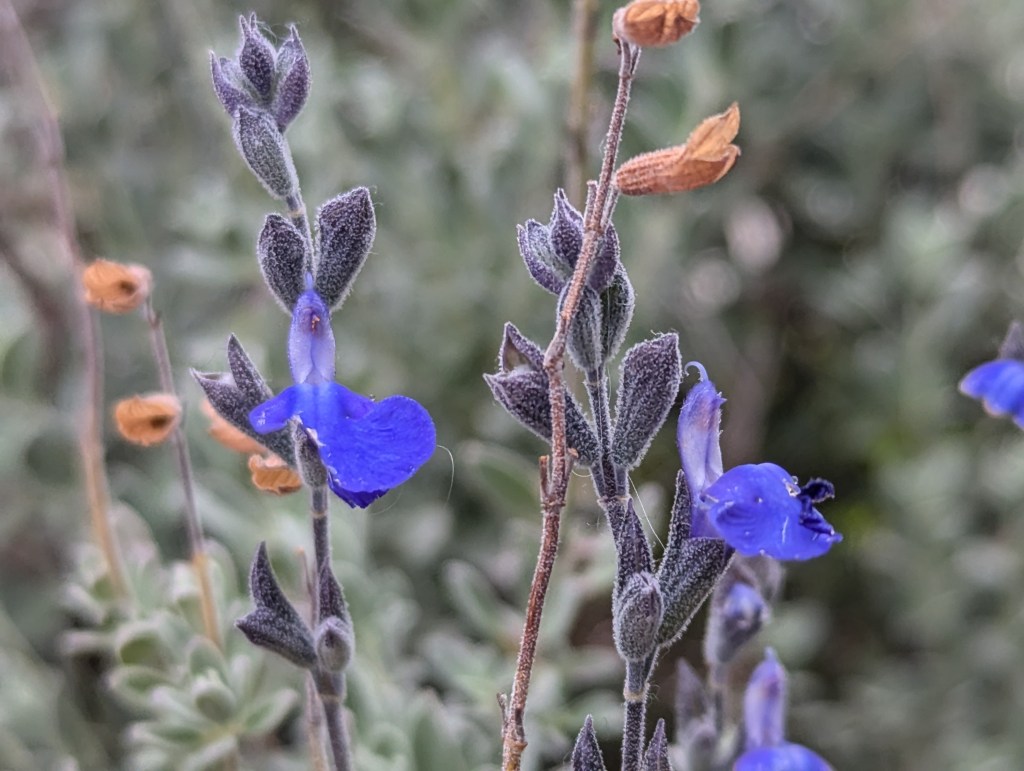
1. Salvia chamaedryoides ‘Marine Blue’ sage, like other species here that are more often grown as common annuals, has performed reliably as a perennial for at least a few years. Like other sages, it is very popular with hummingbirds. It stays small, but gets attention.
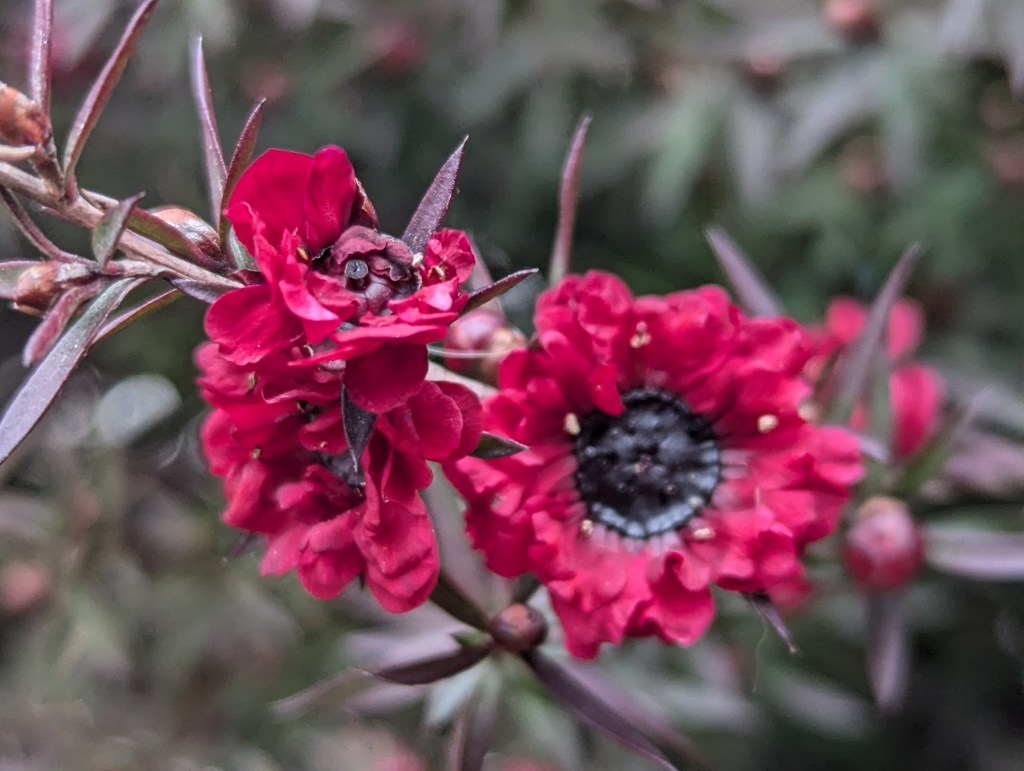
2. Leptospermum scoparium ‘Ruby Glow’ New Zealand tea tree is deprived of its natural form by frequent shearing, but somehow manages to bloom with a few sporadic flowers. Bees are grateful. Its tiny leaves are very dark green, but perhaps technically not bronze.
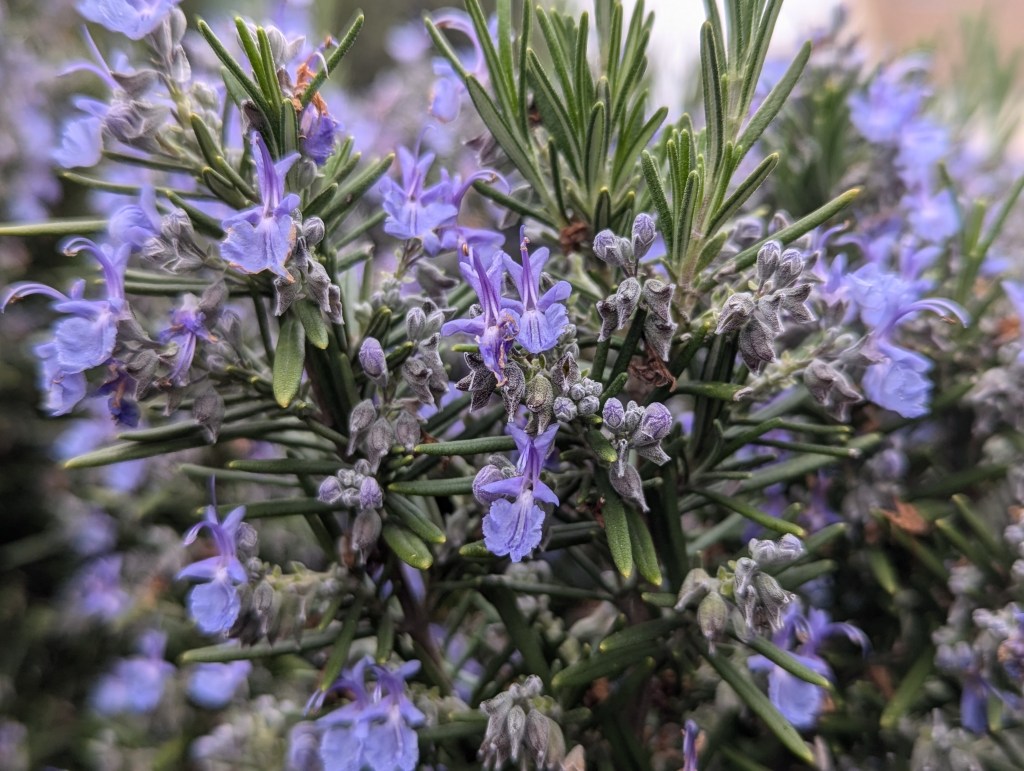
3. Rosmarinus officinalis ‘Tuscan Blue’ rosemary is shrubbier with more upright growth than the sprawling ground cover cultivars that I am more familiar with. I still remember this cultivar as ‘Tucson Blue’ because that is how we said it in school prior to about 1990.
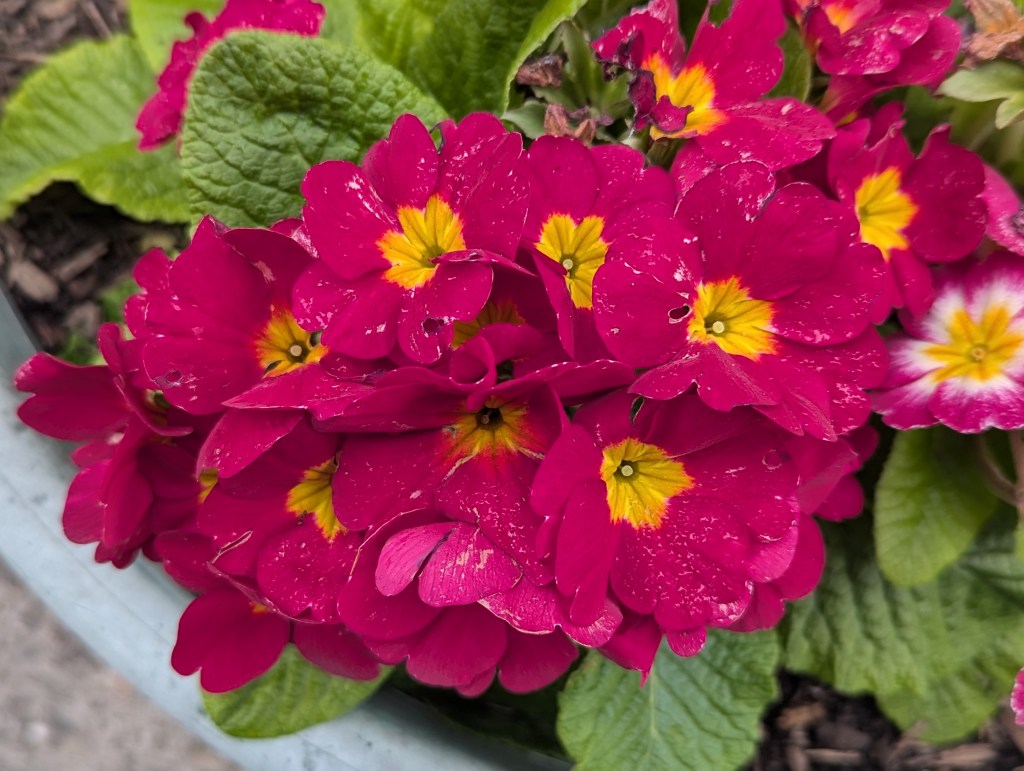
4. Primula X elatior ‘Pacific Hybrids’ English primrose can bloom yellow, white, purple, lavender, blue, maroon, red, orange, or, like this specimen, pink; all with yellow centers. They look like the flowers that Mickey Mouse picked for Minnie Mouse, from her porch.
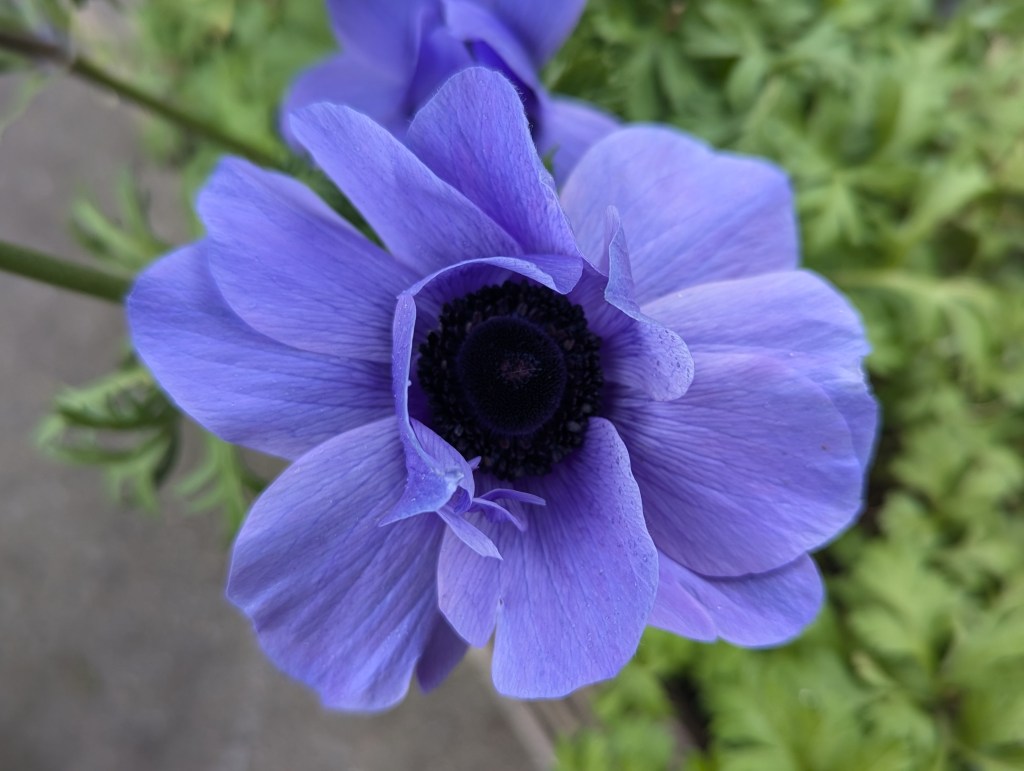
5. Anemone coronaria ‘Mr. Fokker’ windflower has been impressively perennial here for a few years, like the ‘Marine Blue’ sage. Although it technically should be this perennial, it rarely is here. It might prefer cooler winter weather than it typically experiences here.
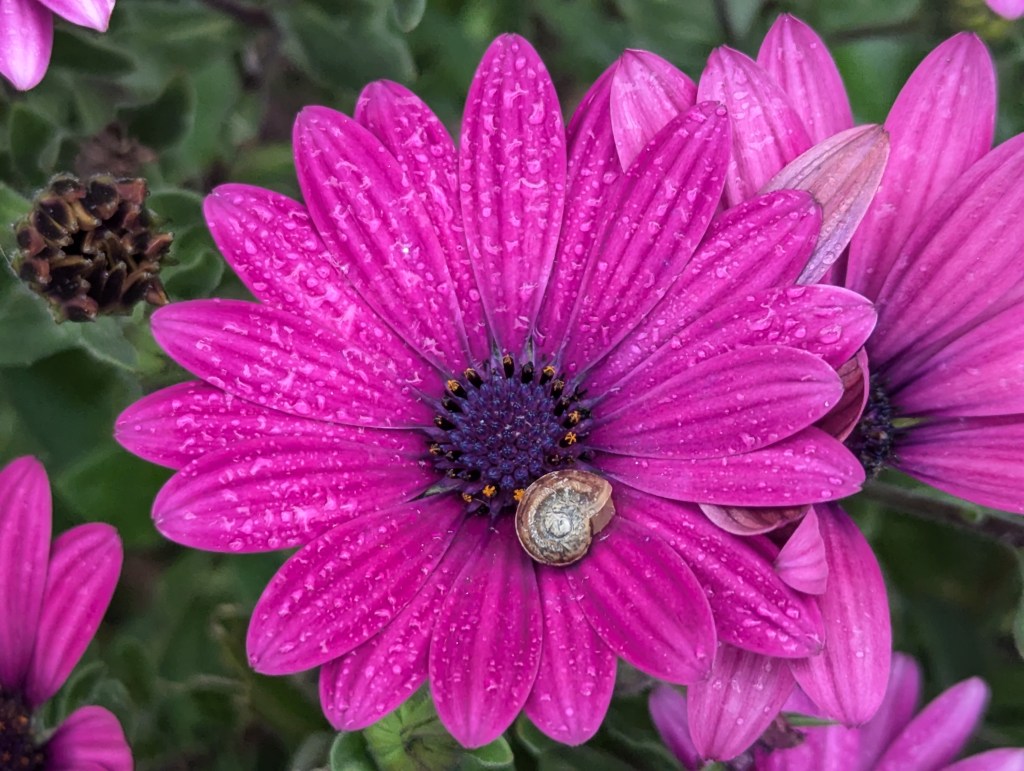
6. Osteospermum ecklonis ‘Flower Power Compact Purple’ African daisy is notably more compact than its extensive name is. Its purple floral color seems to be more purple than any within the landscapes at work. Perhaps I should grow a copy, but without that snail.
This is the link for Six on Saturday, for anyone else who would like to participate: https://thepropagatorblog.wordpress.com/2017/09/18/six-on-saturday-a-participant-guide/
 Tony Tomeo
I’d have that osteospermum any day, it’s glorious but yes, without the snail!
LikeLiked by 1 person
It is very easy to grow from pruning scraps or a gently ‘borrowed’ cutting, but we already grow so many other cultivars that I do not bother with it. (I did happen to procure a bit of red passion flower vine from a fence just above this same African daisy, though.)
LikeLiked by 1 person
Love all of the gardening posts in my feed today.
LikeLiked by 1 person
Well, that is what happens on Saturday.
LikeLiked by 1 person
I love the color of the anemone, and both rosemary and african daisy remind me of my mom. She had a rosemary hedge along her driveway which she never liked (I thought it was awesome) so she removed it. We also had african daisies – the white one with dark center. Nice selections!
LikeLiked by 1 person
Oh! Were they those old fashioned ground cover type of African daisy, Osteospermum fruticosum? I have not seen any in many years. They used to be so common.
LikeLike
Still laughing about Minnie Mouse and the primula!
LikeLiked by 1 person
but it is so accurate. Popeye did the same when he arrived at the Oyl Residence.
LikeLiked by 1 person
yes!
LikeLiked by 1 person
What a great six even if NIYBY! The blue salvia is so very blue. Lovely.
LikeLiked by 1 person
The prettiest flowers are NIMBY. Although I can grow just about anything, I am not at all proficient with selecting visually appealing cultivars. I prefer to grow those that I have been growing for a very long time, so am hesitant to try anything new.
LikeLike
Whenever I used African daisies in my container gardening, I would be disappointed that they had so many dark periods, with no blooms, throughout the summer. Just last year I learned that they prefer cooler weather. I put them in pots by themselves, instead of mixed containers, and displayed them until the weather got really hot and they stopped blooming. Then I put them in a less visible area until fall, when they did indeed have a glorious rebloom.
I love that anemone! It should grow here for me, but I’ve not had much success at all with anemones.
LikeLiked by 1 person
Gee, I was not aware that African daisy stop blooming when they get too warm. Although the climate here is warmer earlier and later than most other climates, it does not often get hot. African daisy is rarely without bloom here. The anemone surprises me though. We try them, but they do not bloom much, and then mostly die out at the end of their season. Those that survive for a second year are typically too wimpy to bloom again. Yet, we try them again. The anemone in the picture, though, has been blooming like this for at least several years.
LikeLike