This is an intentional attempt to eschew the most obvious options.
1. Tanacetum parthenium ‘Aureum’, golden feverfew is the only of these six that I know the cultivar of, but only because it is the only cultivar that I am aware of with such sickly chartreuse foliar color that passes for golden. Its little daisy flowers are splendid though.

2. Dianthus caryophyllus, mini carnation is one of those cool season annuals that never gets removed at the end of its season. It neither flourishes nor dies, so has been here for several years. It will probably die back partially now that the weather is getting warmer.

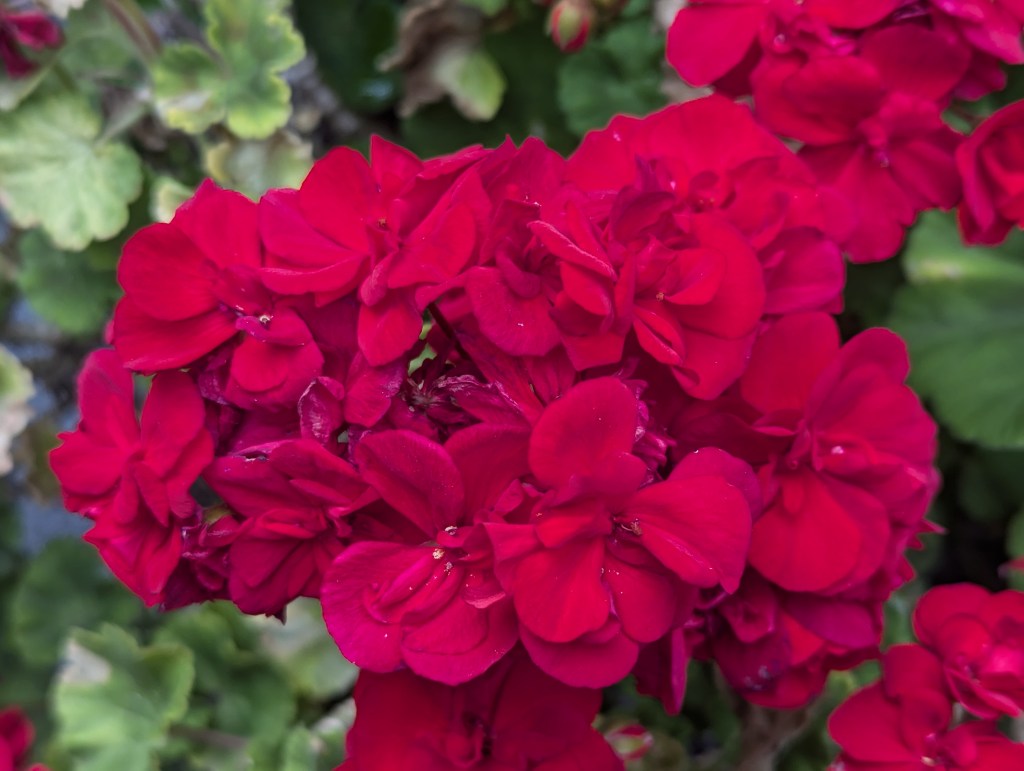
3. Pelargonium X hortorum, zonal geranium may seem to be cheap and common, but it has been very reliable. Besides, I happen to be fond of them. They were some of the first perennials that I grew during my childhood. This and others like it are modern cultivars.
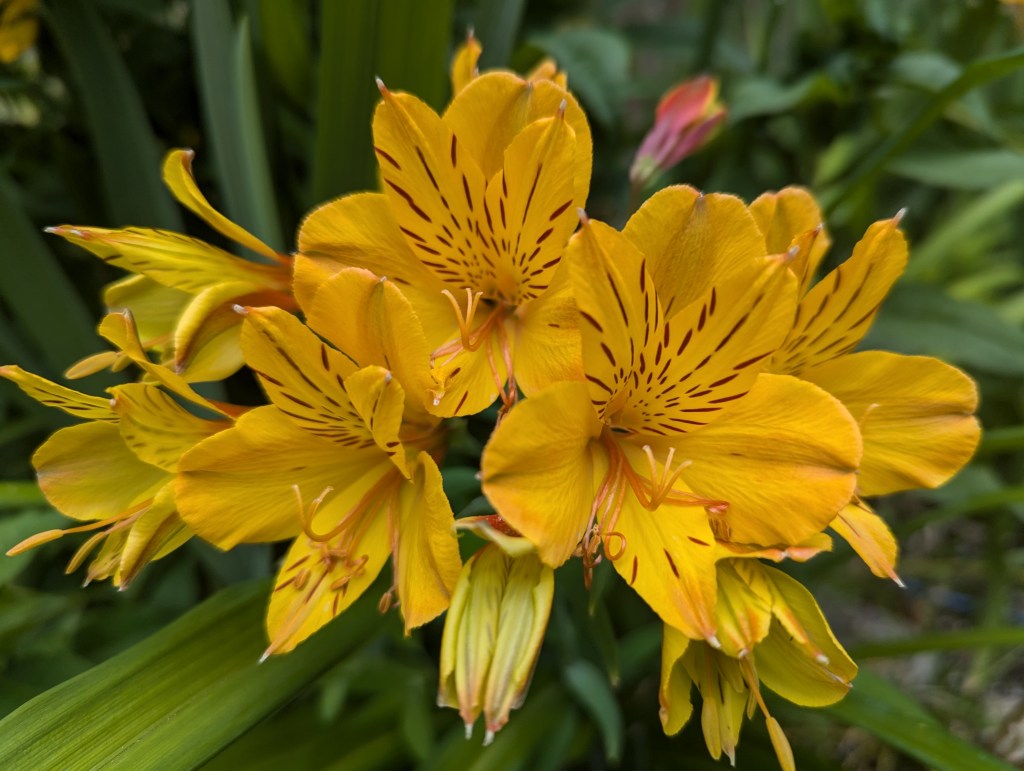
4. Alstroemeria spp., Peruvian lily was the first large scale cut flower crop that I worked with during the summer of 1986, while I was studying horticulture at Cal Poly, San Luis Obispo. This and a few cultivars at work seem to be as old fashioned as those from 1986.
5. Lilium auratum, Asiatic lily was a gift from a neighbor while its bulbs were dormant a few winters ago. It was not expected to perform as well as it has. Not only has it become reliably perennial, but it has multiplied so much that I must eventually dig and divide it.

6. Cornus florida, flowering dogwood is the last dogwood to bloom so late. This could be because of distress associated with its relocation last winter. I do not remember when it bloomed last year, or if it should bloom as late next year. I suppose that we will see then.

This is the link for Six on Saturday, for anyone else who would like to participate: https://thepropagatorblog.wordpress.com/2017/09/18/six-on-saturday-a-participant-guide/
 Tony Tomeo
Lovely flowery six, Tony. Especially fond of the alstroemeria and the lily. Didn’t miss the roses, always miss Rhody. 😀
LikeLiked by 1 person
Oh, not ‘that’ Rhody. I meant that I did not post six pictures of only rhododendrons or only roses, which I typically do about now. Only a few rhododendrons are still blooming anyway.
LikeLiked by 1 person
Ok, you are forgiven. 😀
LikeLiked by 1 person
I should remember to get a good picture of Rhody for next week.
LikeLiked by 1 person
Thank you 😀
LikeLiked by 1 person
A great collection, the flowering dogwood has such a lovely flower.
LikeLiked by 1 person
Yes; and I have no idea what cultivar it is. It needed to be removed from a landscape quite a while ago, so was left canned for a few years before finally getting recycled into its new landscape.
LikeLiked by 1 person
Feverfew is a very nice plant. I guess I had some other cultivar in my first Seattle allotment as it did not have sickly green leaves, just normal ones. And the alstromeria. I have never grown it but love it in a vase. Flowering dogwood is another lovely – you are making me homesick for Seattle!
LikeLiked by 1 person
Most feverfew has simpler green foliage, and grows more vigorously. This ‘golden’ sort is not as prolific, which can be an advantage, although I am not so keen on the foliar color. It spreads short distances by stolons. This year, I found it growing a more significant distance away, which suggest that it grew there from seed, and also, is true to type. Although I do not like the foliar color much, I do not want to get rid of it. It is the only feverfew here at the moment, and others like it.
LikeLike
I can’t stand the smell of feverfew. But I love your other choices. Do you get the dreaded lily beetle? They make lily growing a headache here. That’s such a cute dianthus.
LikeLiked by 1 person
No; lily beetle is like a mythical creature that we can only read about. However, many lilies prefer more pronounced seasons than they experience here, so are not reliably perennial for long.
LikeLike
Wow! that seems very late for Dogwoods. My wedding was during Dogwood season in Atlanta, mid April. Beautiful flowers today. Those geraniums are a winter staple here.
LikeLiked by 1 person
All the other dogwoods finished quite a while ago. Dogwoods are so uncommon outside of this particular ecosystem that I do not know what is normal for them, but I can guess that this is not normal. Perhaps it is normal for the cultivar. in 1990, I saw some sort of wild dogwood blooming spectacularly in the middle of June near Mount Saint Helen’s.
LikeLiked by 1 person
Interesting. I thought there were only pink cultivars, but I see disease resistant, which is great. they just announced a citrus greening resistant orange here.
LikeLiked by 1 person
Most of our dogwoods are pink. Red cultivars look like dark pink to me.
LikeLiked by 1 person
I don’t like the cultivars, they look fake to me.
LikeLiked by 1 person
They are all I know, since flowering dogwoods are not native here.
LikeLiked by 1 person