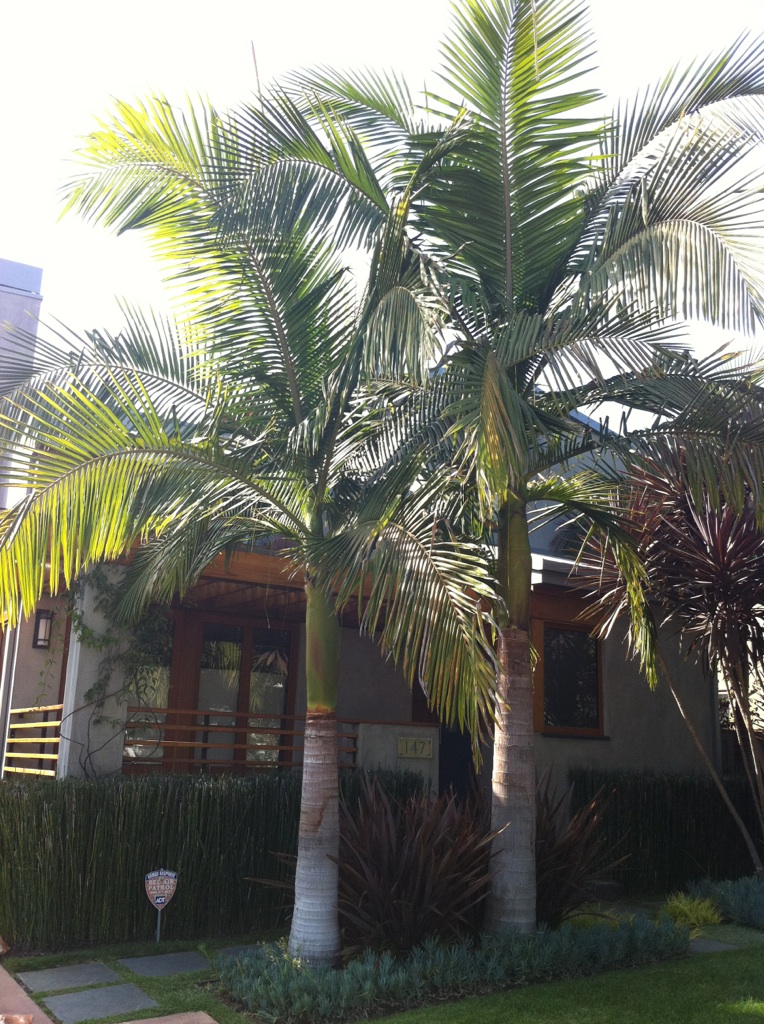
Where it grows wild in rain forests of eastern Australia, the piccabeen or bangalow palm, Archontophoenix cunninghamiana, is a strikingly elegant tree that gets to about fifty feet tall on a clean, slender trunk. The six to ten foot long feather fronds (pinnate leaves) form a light but distinctive canopy about ten to fifteen feet broad. Smooth green petioles (leaf stalks) encase the upper few feet of crownshaft, eventually peeling away cleanly to reveal the smooth trunk as it grows below. A juvenile king palm does not bloom, but eventually flaunts adulthood with softly pendulous ‘graduation’ tassels of profuse but tiny purple tinged white flowers.
Locally, this palm is known more commonly as the king palm, and does best as a large houseplant or where it is protected from frost. Outdoors, it seem to be happiest close to the San Francisco Bay where it is somewhat insulated by all the water, but can unfortunately get smacked about by the wind there. A mature tree is somewhat more tolerant to frost than a young tree is, but can be damaged or even killed if it gets cold enough.
King palm fortunately does well in the partial shade of larger adjacent trees or buildings that might shelter it from frost. However, it can not be pruned down for clearance from higher trees, ceilings or any other overhead obstruction (including utility cables), so should be planted where it has plenty of room to grow vertically, or where no one will mind it getting removed when it gets too tall after many years.
Unlike most other palms, king palm does not transplant easily when mature. It has no problem getting planted from a pot to a larger tub or planter, or into the ground. Once in the ground though, it is there to stay.
 Tony Tomeo
I am staring in amazement at that whole landscape this morning and marveling at how exotic it appears. That hedge, especially, is so different. Perhaps it’s so striking because here in the Frozen North our heat is kicking on now in the early mornings and the leaves are flying off our trees. Anything exotic really stands out.
LikeLiked by 1 person
Oh my! That ‘hedge’ is shorn equisetum! It is quite a weed, but somehow became a fad for hedges such as this in the 2000s and 2010s. The picture is rather old now, and was taken somewhere in Los Angeles.
LikeLiked by 1 person
I wondered if it was something crazy like that–or even shorn bamboo. But it looks really rad, as you would say.
LikeLiked by 1 person