Trees conform to an overly vague definition. Most simply, they are substantial and woody perennial plants with tall trunks and branches. Yet, several Japanese maple trees are no more substantial than big shrubbery. Tree ferns and banana trees are neither woody nor branched. Arboriform yucca trees and palm trees are technically herbaceous, not woody.
Doum palms, which are the only palms that develop branches, are extremely rare locally. Any other palm which develops a branch is an extremely rare aberration. Therefore, with very few and extremely rare exceptions, palm trees develop no branches. A few, such as the Mediterranean fan palm, develop a few trunks though. All trunks develop at the base.
Palm trees are either fan palms or feather palms. Fan palms have round palmate leaves on sturdy petioles. Feather palms have elongated pinnately compound leaves on sturdy rachises. Most fan palms have nasty teeth on their petioles. Several feather palms have dangerously sharp spines on the bases of their rachises. All palms trees are evergreen.
Once palm trunks begin to grow upward, they do not widen. Nor do their foliar canopies. They grow only vertically. Those that encroach into high voltage cables require removal. Unfortunately, most palm trees grow high enough to necessitate the services of arborists. Although trunks do not expand, some large palms develop widely distended basal roots.
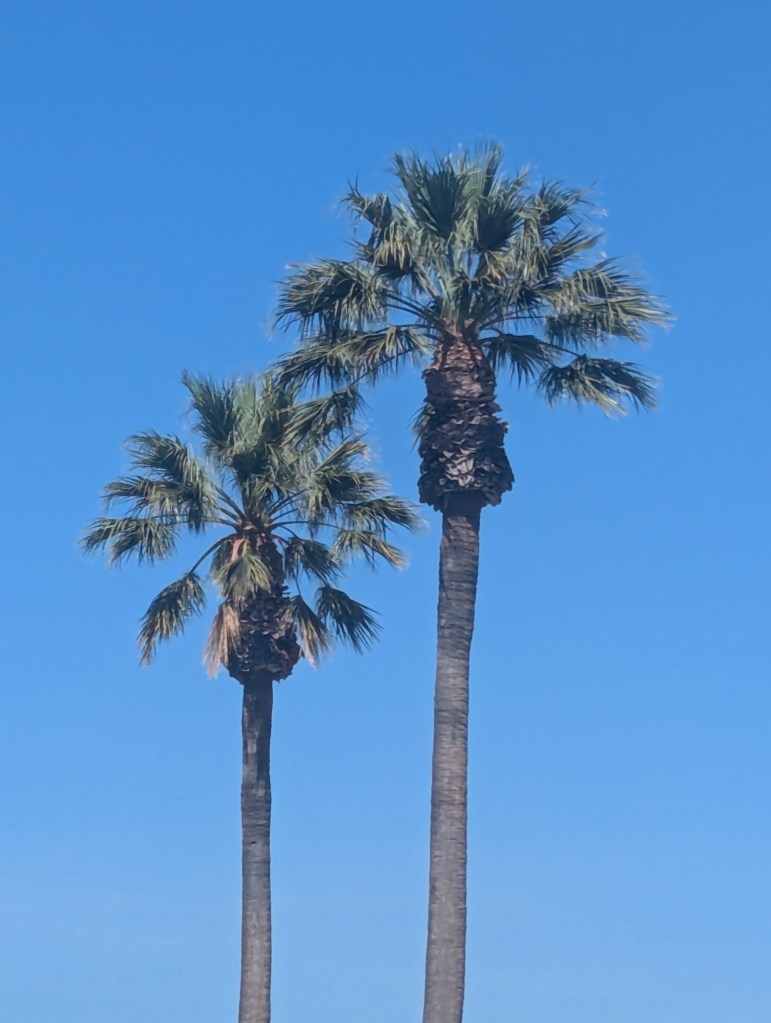
Mexican fan palms are the most prominent of palm trees locally because they are so tall. California fan palms, or desert fan palms, are shorter and stouter but much less common. Canary Island date palms are big and bold feather palms with wide and dense canopies. Common date palms, which only became common recently, are not as broad and dense.
Queen palms develop billowy and feathery canopies on tall and elegant trunks. They are among the most popular of palm trees nowadays. Windmill palms are relatively small fan palms with very shaggy trunks, but can grow tall. Mediterranean fan palms stay lower but with a few curving trunks. These are merely a few examples of many different palm trees. A few more are available. Bismarck palm and hesper palm are becoming more popular.

