Horticulturists are by nature, nonconforming. I happen to find it difficult to conform to what makes us nonconforming. Trends are fleeting. Old technology that has worked for decades or centuries is still best. Although I am not totally against chemicals, I find that almost all are unnecessary for responsible home gardening. Pruning is underappreciated, and fixes many problems.
I certainly got good deals on these recent acquisitions. However, I have no idea what I will do with them.
It is such a bad habit! Even if I spend no money, I spend too much time perusing what I could spend a little bit of spare cash on. On rare occasion, I actually do spend a little bit on something that I can get a good deal on, not because I actually have any use for it, but merely because I got a good deal on it, . . . or because I believe that I may not be able to find it for sale again later.
Now, I have more than two hundred seed for Pygmy date palm, Phoenix roebelenii. They certainly were inexpensive, costing less than a few dollars. Most of the expense was for postage. It really was a good deal. However, I have no…
It seems to be related to Boston fern because it is. Sword fern, Nephrolepis cordifolia, is a less refined species of the same genus. It does not want to live as a docile houseplant. Instead, it prefers room to grow and spread in the garden. It has potential to spread a bit vigorously though. Containment protects adjacent smaller perennials or bedding plants.
Sword fern foliage is the same light and slightly yellowish green as that of Boston fern. It generally stands more upright though. Rather than hang softly from planters, like Boston fern does, it leans outwardly. Its pinnately compound fronds can grow almost two and a half feet tall. Pinnae might be about an inch and a half long, with a slightly grainy texture.
Sword fern is not particularly discriminating about exposure, moisture or soil. It can cling to trunks of Canary Island date palms and infest their canopies epiphytically. Sword fern is greenest with regular irrigation and shelter from harsh exposure though. Its evergreen foliage can discolor and partially defoliate when distressed. Grooming might be tedious. Healthy colonies may hide their old foliage.
Ferns are foliar perennials. They provide neither floral color nor fragrance. They provide neither fruits nor vegetables. With few exceptions, they provide no shade. The very few that are deciduous are not impressively colorful for autumn here. Ferns can not grow as hedges. Nor can they become lawns. They exclusively provide distinctive fern foliage.
They do so splendidly! Most produce the sort of distinctively lacy fern foliage that ferns are famous for. Some exhibit even more finely textured and airy foliage. A few exhibit a relatively coarse foliar texture. Almost all ferns are rich and deep green. Some are lighter or slightly yellowish green. A rare few are silvery gray, or display an intricate silver lining.
Almost all ferns that are popular within home gardens are evergreen. Most benefit from occasional grooming to remove deteriorating old foliage. Some produce new growth on top as old growth lies down below. Several grow most lushly after removal of all foliage prior to their growing season. A few deciduous types of fern defoliate for their dormancy.
Ferns do not develop stems or trunks like most other vegetation does. They sprawl over the ground with rhizomes, which are fleshy stems. Rhizomes grow only in length, but not in diameter. Tree ferns grow upward as their rhizomes deteriorate below. Roots that grow through the deteriorating rhizomes form what seems to be trunks. Fern roots are fibrous.
Leaves of ferns are fronds. Such fronds of most ferns divide into pinnae, which are like smaller leaflets. Pinnae of some ferns divide into even smaller pinnae. Rachi are central stalks that suspend the pinnae within individual fronds. Ferns reproduce by spores, so lack flowers. Most ferns propagate efficiently by division of preferably dormant rhizomes.
Because of their fibrous root systems, ferns are complaisant to confinement within pots. Most ferns are naturally understory vegetation, so are innately tolerant of partial shade. Ferns that tolerate aridity as well as shade and confinement are delightful houseplants. Most ferns are very tolerant of relocation, although some must replace foliage to adapt.
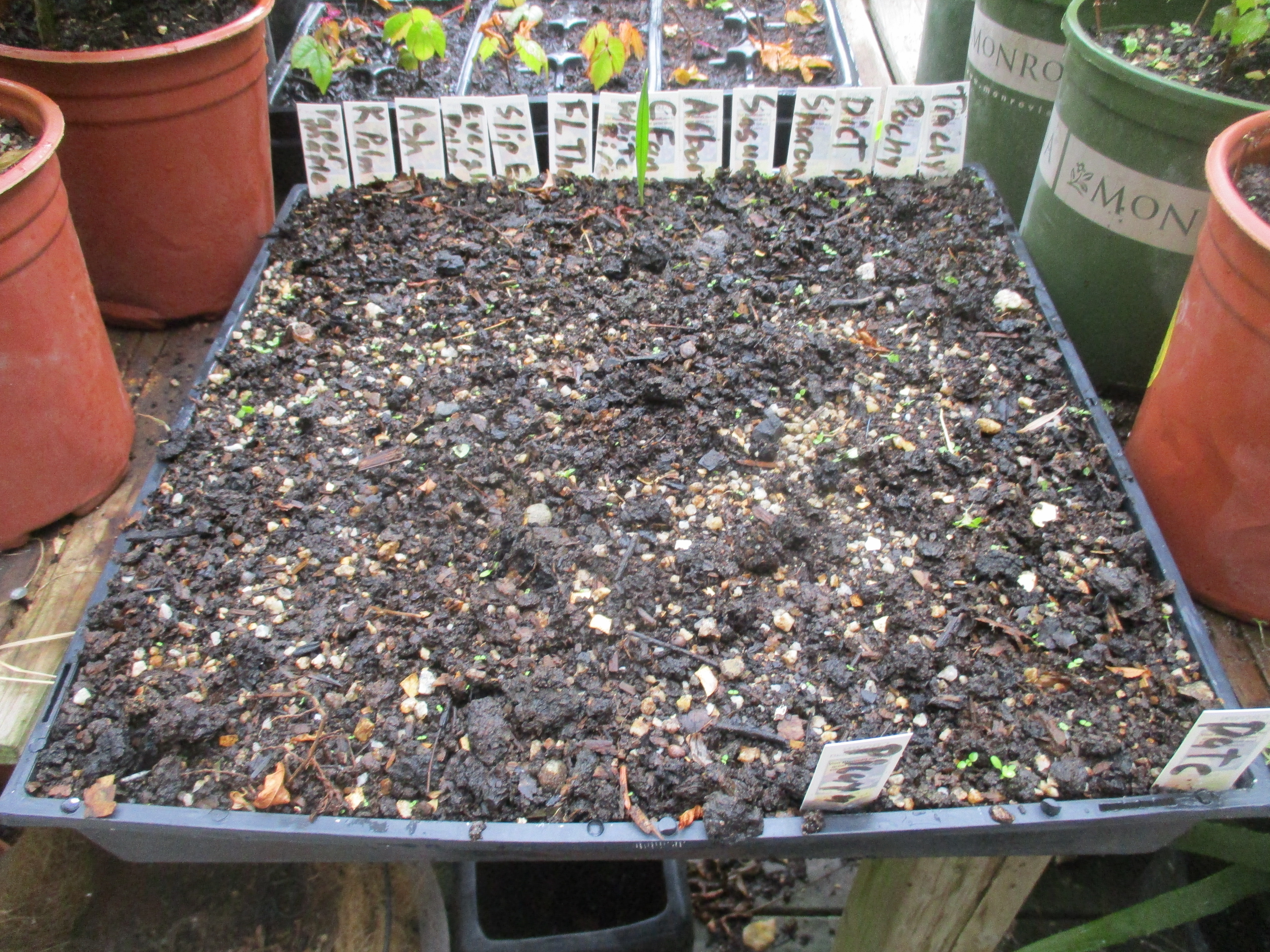
One is the loneliest number. (It is in the middle of the far edge of the flat.)
By now, I can safely assume that any of the various old seed that were sown late last February that have not yet germinated are not likely to do so. They were all so old that I knew at the time that their viability was questionable. Nonetheless, I could not discard them without confirming that they were no longer viable. Four months later, this empty flat just about confirms it.
So far, the sole survivor is a seedling of a California fan palm, Washingtonia filifera. It looks silly all alone in the otherwise empty flat. Yet, even if no other seedlings germinate, the effort will have been worth this dinky palm seedling. California fan palm happens to be my favorite palm; but I would have been just as pleased with something that…
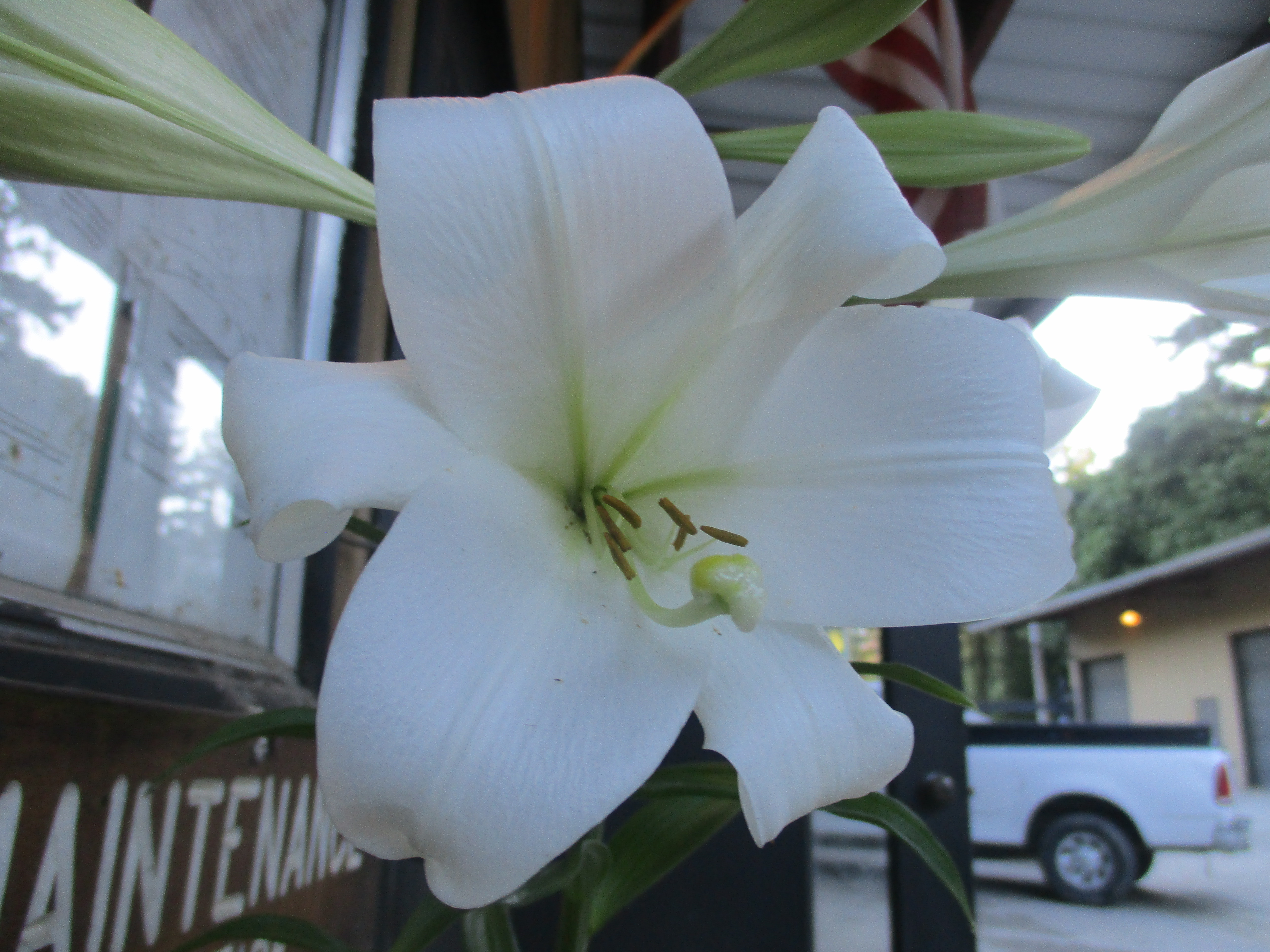
Although this particular lily is not performing well in the landscapes, others have actually proliferated more than expected. A few are blooming so abundantly within their now crowded colony that I am considering splitting them this winter.
Easter lilies are still my favorite of the lilies!
Weddings are normally common at the small historic chapel at work. This is normally the busiest season there. Since the chapel is presently unused, and it will likely remain unused for quite a while, we have not replaced the white pansies, that were out front through winter, with new white blooming warm season annuals for summer. The minimal landscape seems a bit emptier.
A colony of white hydrangeas to the left of the chapel happen to be blooming late this year, as if they know there is no rush. The smaller hydrangeas in the foreground of this colony were not original to the landscape, but were added as they were left behind after weddings. (Florist hydrangeas are innately more compact.) Blue and pink hydrangeas went to blue and pink colonies.
Our chrysanthemums were left behind after weddings too. They were originally…
Val culture developed within the Santa Clara Valley prior to its assimilation into the San Fernando Valley. I totally know how to use “like” in a sentence, and can do so repeatedly if I like. These Six are not about Val culture during the 1980s though. They are just a few items that are sort of like each other, and five items that I like. Eventually, I will like the item that I do not yet like. Totally!
1. Sambucus nigra ‘Black Lace’ is an ornamental cultivar of European elderberry. As the name implies, it has darkly bronzed and intricately lobed foliage. All but two of the herd of cuttings that I plugged rooted. I wanted a few, but got forty-eight. I was not at all fond of this cultivar or even this species when I met it a few years ago, but I now sort of like it.
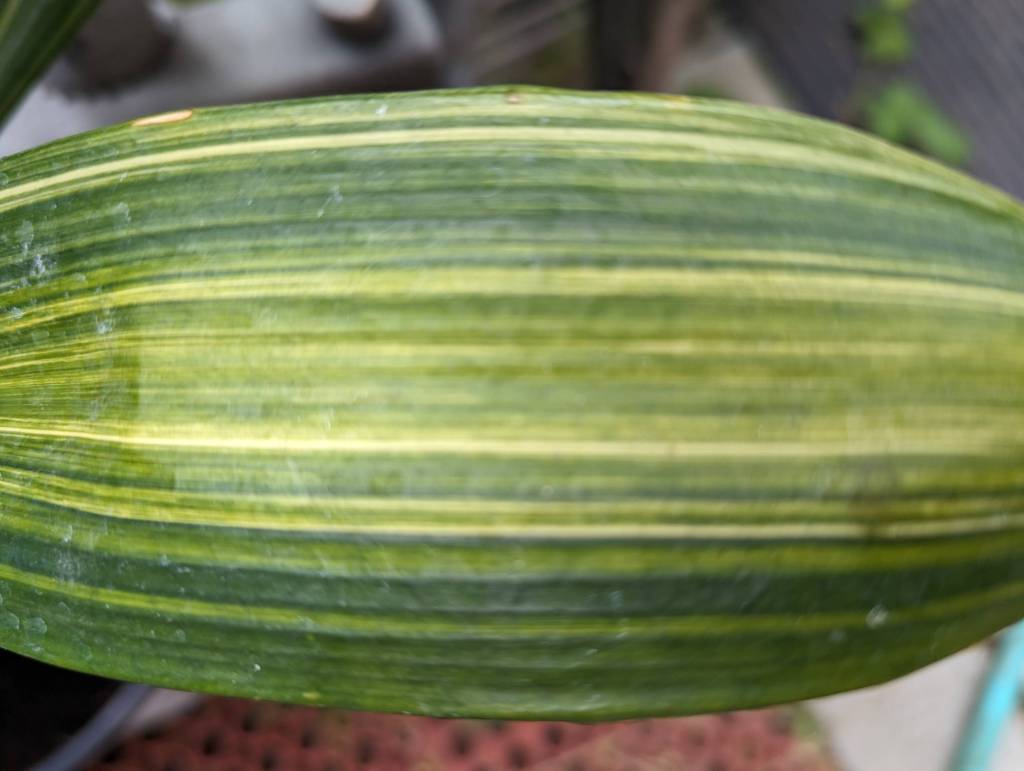
2. Clivia miniata, Kaffir lily lacks bloom now, but like ‘Black Lace’ European elderberry, provides colorfully ornamental foliage. It is variegated with these narrow yellow stripes. I believe it blooms orange. I do not know what cultivar it is. It came from Brent’s garden.
3. Canna ‘Stuttgart’, like the Cymbidium and the other two Canna, lacks a species name. Like 1, 2 and 4, it provides colorful foliage. Like 4 and 5, it is a Canna. It has a lot to like. Most importantly, it came from Tangly Cottage Gardening, and is approved by Skooter!!
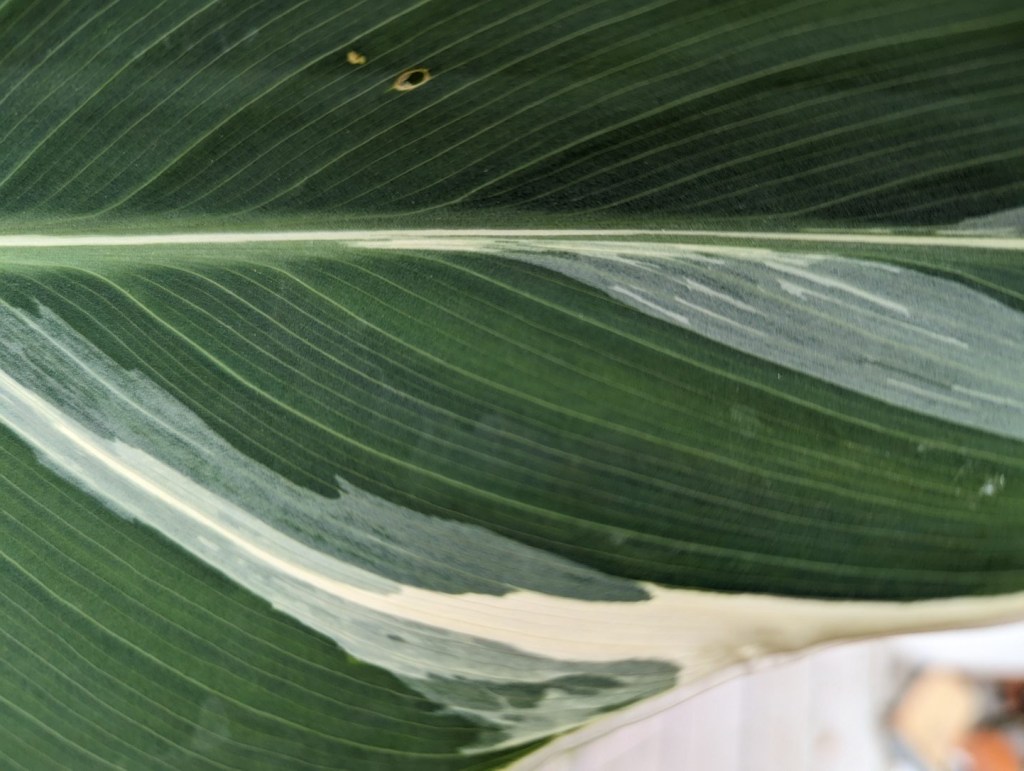
4. Canna ‘Australia’ might be described like ‘Stuttgart’ Canna above, but is not approved by Skooter. Its colorful foliage is darkly bronzed, but this specimen is striped with green.
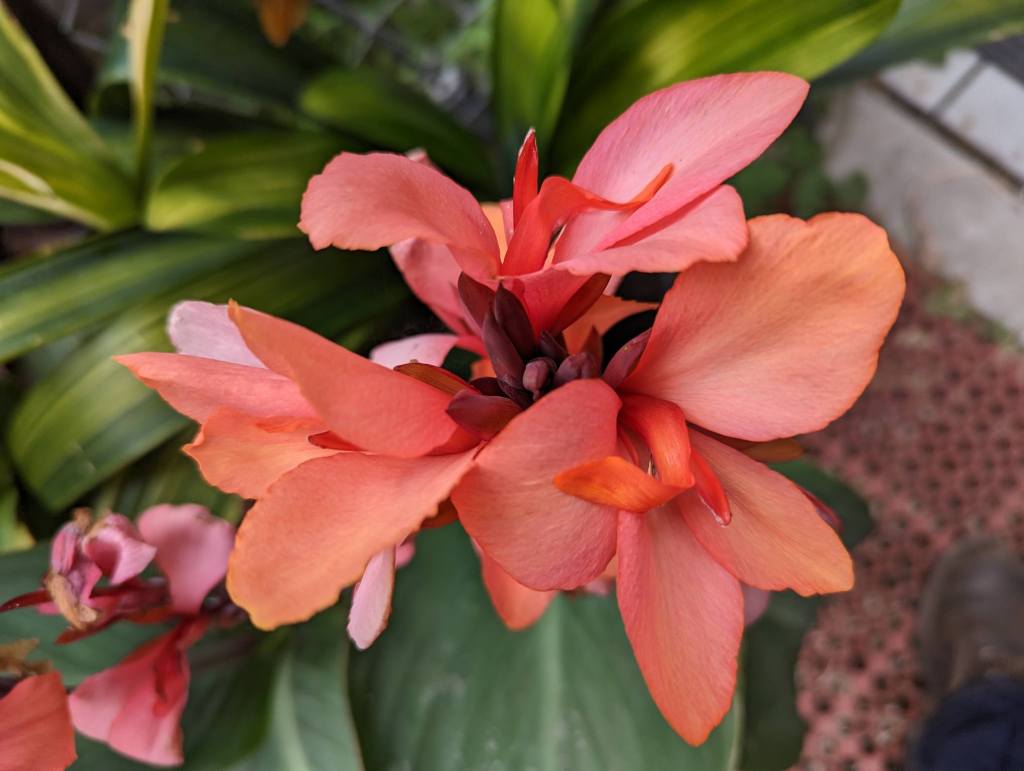
5. Canna ‘Cannova Mango’, like 3 and 4, is a Canna, but that is about its only similarity. I do not like it much because it is a modern cultivar, and it blooms with this weird color.
6. Cymbidium orchid, like 3, 4 and 5, lacks a species name. I like it because I have grown it since the early 1990s. Bloom began in March, but is only now beginning to deteriorate.
Even though silk never became a major commodity in North America, it indirectly made an impression on American gardening. The tree that was developed to most efficiently feed silkworms is now among the most popular of shade trees. The fruitless mulberry, Morus alba, wastes no resources producing fruit while providing only abundant foliage, which is the only sustenance for silkworms.
Young trees grow at a good rate to nearly thirty feet tall, and can eventually reach fifty feet. They are often pollarded (pruned severely back to the same burly ‘knuckles’ every winter), which causes them to regenerate stems at an alarming rate during summer. Shoots from mature pollarded knuckles have no problem reaching fifteen feet in all directions! Mulberries incidentally have the distinction of the fastest motion known to the plant kingdom, because they launch their pollen at more than half the speed of sound!
The serrate leaves are quite variable. Those of vigorous young shoots of pollarded trees are mostly about six inches long with rounded wide lobes, but can be nearly a foot long! They turn bright yellow and typically fall neatly from the tree within a limited time in autumn, facilitating raking. Leaves on slower growing stems of lightly pruned mature trees are mostly unlobed and less than six inches long. They begin to fall earlier in autumn and linger over a longer time, sometimes with slightly subdued autumn color.
As improper as this extreme pruning is, the would will heal more efficiently without sealant.
Sealing pruning wounds with grafting compound or any other gunk, like paint, wax, tar or roofing compound, literally adds insult to injury. Grafting compound should only be used to temporarily limit desiccation while graft unions knit. It eventually flakes off as the affected parts (understock and scion) grow. Because the cut surfaces of pruning wounds do not grow, grafting compound does not flake off right away, so can remain mostly intact for years, retaining moisture and actually promoting rot. Some thick emulsions may even inhibit callus growth over wounds (healing).
Because so many people expect pruning wounds in trees to be treated with some sort of dressing, some tree services apply black spray paint. Most who do so fortunately know that it is best to apply the paint lightly enough to be porous instead of actually sealing the surface. Some use temporary marking paint, which is designed to deteriorate in the weather. (The cut surfaces hopefully darken simultaneously so that no one notices.)
The best way to promote healthy recovery from pruning is to prune properly, leaving no stubs to interfere with compartmentalization (healing). The sort of rapid growth that most efficiently compartmentalizes pruning wounds naturally occurs at branch unions, even after the associated branches get pruned away. This is because the remaining foliage beyond the unions (the parts that do not get pruned away) remain vascularly active and able to sustain such growth. Similar growth at the end of a stub is much slower because there is no foliage beyond.
More often, a stub dies, leaving an obtrusive peg lodged where callus growth should be closing a wound. By the time the stub rots enough to not interfere, rot will have also extended into the union with the supporting stem.
Radishes seemed like a good idea back when I sowed the seed in the garden. I had not grown any in many years. I thought that the particular location would be cool enough to inhibit bolting, even though it was starting to get close to the end of their season here. They are definitely a cool season vegetable here, with brief seasons in spring and autumn. Some linger through winter.
The seed germinated efficiently. The seedlings started out well. Radishes are small roots that mature in only about three weeks. Technically, they were right on schedule. I happened to get a few tiny radishes from the batch. However, after the seed were sown, but before the radish roots developed, the formerly cool spring weather warmed suddenly enough to stimulate bolting.
The elongation of floral stalks was visible within the foliar rosettes of most of the individual…
It is endemic to every Californian County except for only Imperial County. It is endemic to every American State except for only Hawaii. Yarrow, Achillea millefolium, gets around! It is also endemic to many temperate climates of Europe and Asia. Apparently, it is not very discriminating in regard to climate or soil. It is as happy at the coast as it is farther inland.
Wild yarrow mostly bloom white or with pink blush. Modern cultivars bloom various hues of yellow, orange, red, pink or pinkish lavender. A few of the most florific modern cultivars are hybrids with other species. Phases of bloom might continue from spring until autumn. Tiny flowers form dense corymbs as broad as five inches, on stems as high as three feet.
Ferny grayish or light green yarrow foliage has a softly fine texture. However, it develops compact and mounded form. Individual leaves are tomentous and as long as six inches. Foliar aroma is variable among cultivars. Some cultivars may be objectionably pungent. Propagation by division of any overgrowth is easiest prior to the end of the rainy season.

 I certainly got good deals on these recent acquisitions. However, I have no idea what I will do with them.

 One is the loneliest number. (It is in the middle of the far edge of the flat.)
  Easter lilies are still my favorite of the lilies!



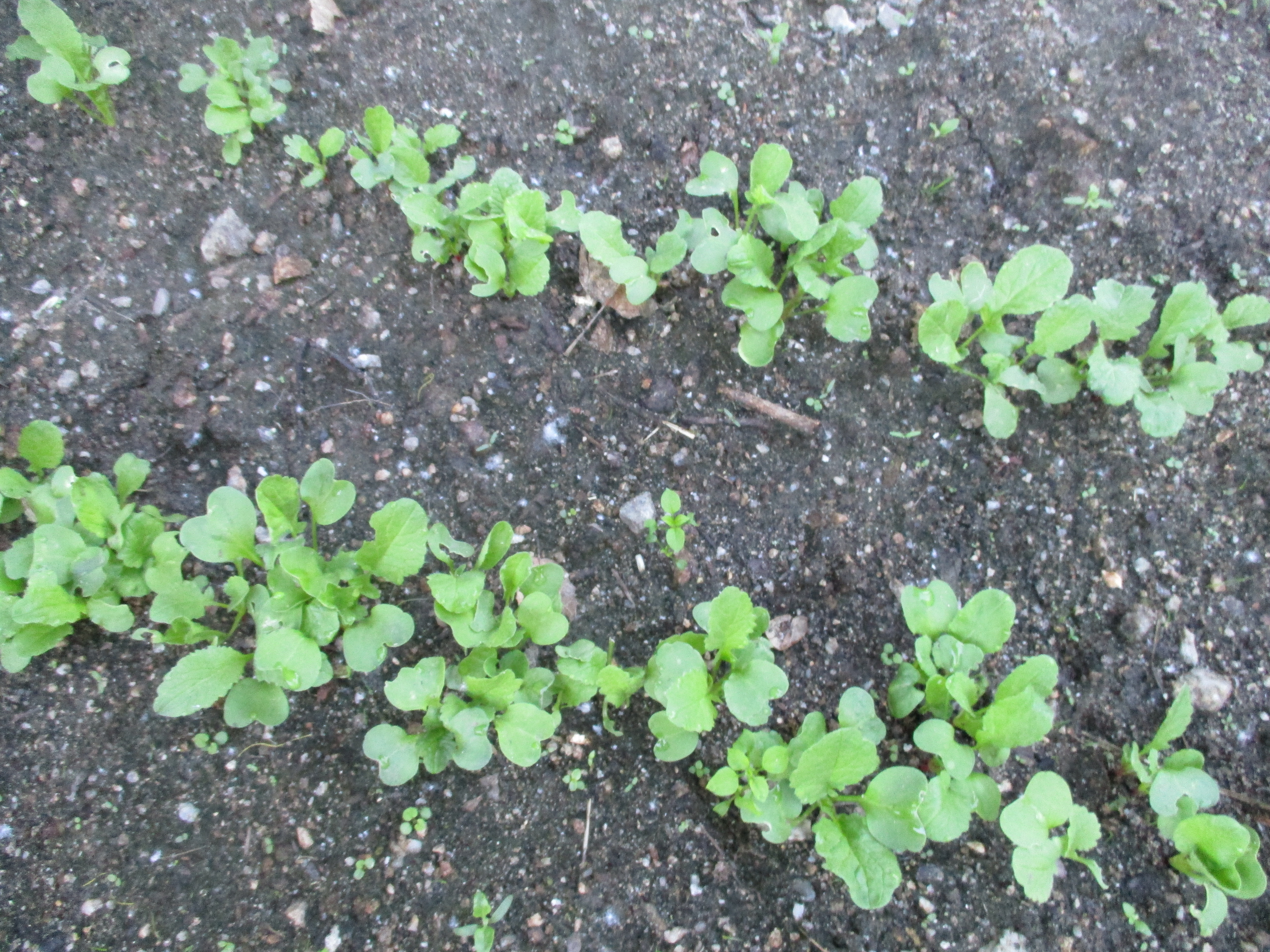 They started out nicely.
 Tony Tomeo