Horticulturists are by nature, nonconforming. I happen to find it difficult to conform to what makes us nonconforming. Trends are fleeting. Old technology that has worked for decades or centuries is still best. Although I am not totally against chemicals, I find that almost all are unnecessary for responsible home gardening. Pruning is underappreciated, and fixes many problems.
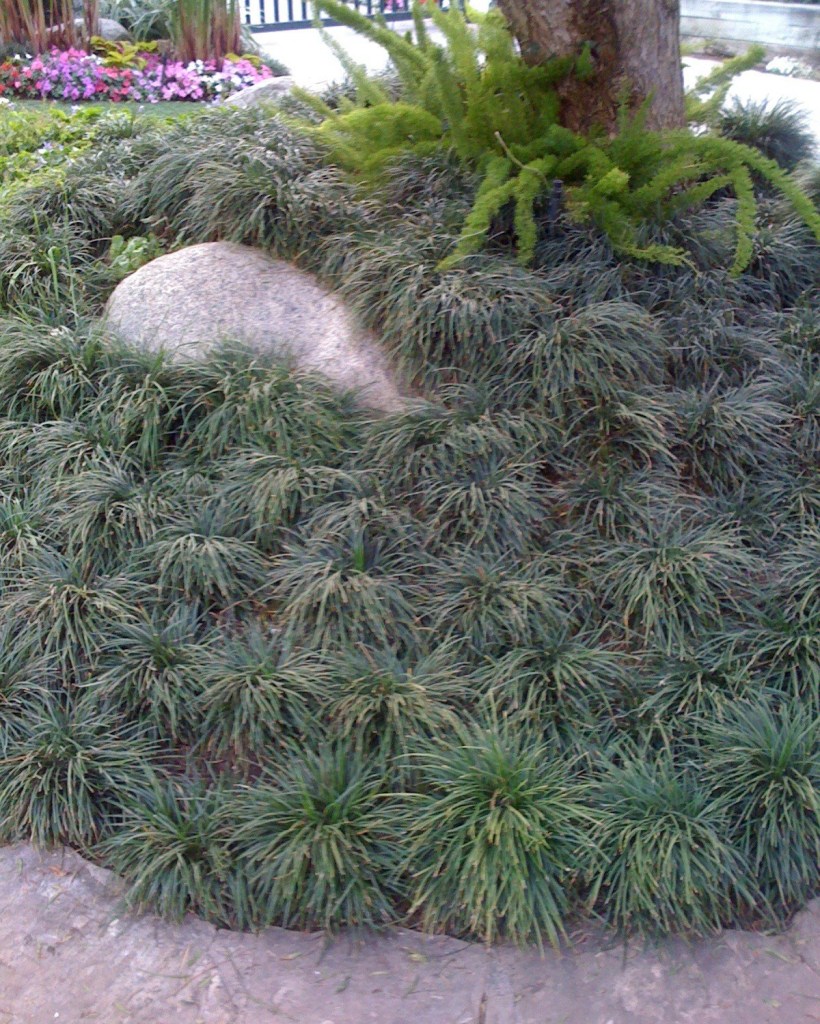
This simple green (unvariegated) mondo grass has been doing well.
The thick clumps of evergreen grass-like foliage of mondo grass, Ophiopogon japonicas, make a nice lumpy ground cover for small spaces. Because it is rather tolerant of shade, and actually prefers partial shade to full sun, it works nicely under Japanese maples or highly branched overgrown rhododendrons. It gets only about half a foot deep. Narrow stems with small pale purplish blue flowers that bloom in summer are not too abundant, and are generally obscured below the foliage, but can actually get taller. ‘Silver Mist’ is variegated with white.
New plants are easily produced by division of large clumps. Overgrown or tired looking clumps can be shorn down at the end of winter, before new growth begins. Slugs and snails can be problematic.
This specimen would be a challenge for an arborist.
(This article is recycled from a decade ago.)
Pasadena sustained the worst of the damage caused by the strongest Santa Ana Winds in three decades. Huge piles of debris from broken trees are much more than can be removed any time soon. Falling debris and trees damaged many roofs, cars and anything else that happened to get in the way.
Other towns and neighborhoods throughout the area, particularly those at the base of mountains, also sustained major damage. At the same time, severe winds ravaged the San Francisco and Monterey Bay Areas as well, particularly in the Santa Cruz Mountains and the hills of the East Bay.
Some of the damage caused by wind in urban areas might have been less disastrous if trees had gotten the respect and attention that they deserve. Some trees develop structural deficiencies that need to be corrected by pruning, either to eliminate the problems, or at least to decrease the strain exerted onto the structurally deficient parts. A few trees that become unstable as they mature may likewise need to be pruned or even removed.
It is not always possible to prune trees to remove all structural deficiencies without damaging the affected trees more, or causing more structural problems to develop. For example, major pruning to remove all parts that may get blown down by wind, such as pollarding or ‘topping’, may seem to be effective for the short term, but actually stimulates the development of vigorous secondary growth or watersprouts that are disproportionately heavy and even more likely to tear off from the older limbs.
Structural pruning more often involves thorough reduction of weight and wind resistance. Weight of foliage and stems directly applies leverage against unions where smaller stems are attached to the larger stems from which they originate. Wind resistance adds more leverage as foliage gets blown about by wind. Thinning obviously removes significant weight, and also decreases wind resistance to allow wind to blow though the affected canopies.
Besides helping to compensate for structural deficiency, structural pruning is also beneficial to potentially unstable trees for the same reasons. However, unstable trees typically need even more reduction of weight and wind resistance. Some of the most unstable trees and those that are deteriorating need to be removed because their instability cannot be accommodated.
During winter, while deciduous trees are bare, evergreen trees are more susceptible to wind damage, obviously because they retain their weight and wind resistance through winter while the weather is the most severe. Unstable trees become even more destabilized as rain softens the soil. Regardless of the potential for susceptibility to wind damage, this would be a good time of year to get any needed tree maintenance done, prior to any more windy and rainy winter weather.
Arborists certified by the International Society of Arboriculture are the most qualified to identify potential structural problems or instability, and to prescribe corrective procedures. A list of certified arborists can be found at the website of the International Society of Arboriculture at http://www.isaarbor.com.
Blowers put the ‘blow’ in ‘mow, blow and go’. They really blow! The only power tool used by so-called ‘gardeners’ that is more detestable to the rest of us is the power hedge shears, and that claim is contestable. Some consider blowers to be worse because they are so obnoxiously noisy, and generate so much dust. Some municipalities have outlawed the use of the noisiest sorts.
The mess on the hood and windshield in the picture above was not actually caused by blowers. The picture below shows the bridge that was power washed above. Oops. I should have been suspicious that no one wanted that parking space. Anyway, this picture was just too funny to not share; . . . and I happen to lack pictures of the sorts of dusty messes that blowers can stir up.
Where I lived in town, the so-called ‘gardeners’ who ‘maintained’ the apartment buildings…
In the wild, Atlas cedar can get almost a hundred feet tall. Bluish gray or rarely yellowish cultivars which are popular for home gardens are generally more compact. Perhaps they could get as grand as wild trees after a few centuries. Weeping blue Atlas cedar, Cedrus atlantica ‘Glauca Pendula’ is an strange one. It can barely stand fifteen feet tall and wide.
The trunks and limbs of weeping blue Atlas cedar are initially so pliant that they sag onto the ground without support. New stems try to grow upward, and may do so for a few feet, or may hang downward after achieving only a few inches of height. Trunks need binding for either straight or serpentine form. They lignify slowly as they mature and gain caliper.
Weeping blue Atlas cedar requires commitment. Indiscriminate pruning or shearing ruins the naturally sculptural form. Such pendulous growth necessitates meticulous grooming, although it may not be necessary very often within spacious situations. Expanding trunks eventually absorb the curves of serpentine form. Low stems can sprawl over the ground.
Seasons here may seem to be less extreme than they are within other climates. Summer warmth is rarely too hot, and when it is, it does not continue for too long. Winter chill may be insufficient for some plants that rely on it to sustain their winter dormancy. Autumn and spring are as notable for the first and last seasonal rain as for colorful foliage and bloom.
This is actually very relevant within local chaparral climates. Rain and lack of rain define seasons here as much as extremes of temperature. Where the traditional four seasons of winter, spring, summer and autumn merge so softly, the rainy season and the dry season generally do not. Rain begins abruptly in autumn, and ends almost as abruptly in spring.
Consequently, home gardens can get inhospitably dry without adequate irrigation during more than half of the year. Then, they may require no irrigation for almost half of the year. Warm weather that coincides with the dry season enhances aridness. Cool weather that coincides with the rainy season enhances dampness. Mild climates can get extreme too.
Recent rain ended both the dry season and the fire season, and began the rainy season. For many plants, irrigation will be unnecessary until the dry season resumes next spring. Plants that continue to require irrigation will require much less, and only as their soil gets dry during prolonged lapses of rain. Therefore, automated irrigation requires adjustment.
Potted plants, bedding plants and young plants with minimal root dispersion will be more likely to want watering during warm lapses of rain. Substantial foundation plants beneath eaves generally extend roots beyond sheltered soil, but some do not. Also, potted plants under eaves of porches are unable to reach rain moistened soil with their confined roots.
While diminishing the need for irrigation, rain can be messy. It is, of course, wet. It makes soil muddy. Runoff can cause erosion. Stormy weather, which typically involves both rain and wind, dislodges copious foliar debris. Such debris accumulates while no one wants to go outside during stormy weather to rake it. Inconvenient timing seems to be a pattern. Yet, rain is undeniably gratifying.
English holly is politely naturalized here. This means that, although naturalized, it is not aggressively invasive, and does not seem to be too detrimental to the ecosystem. It is only annoying to see out in forests, far from the landscapes that the seed escaped from, and wonder if it has potential to significantly compete with native vegetation. It would be better if it were not there.
At least it is pretty. In refined landscapes, it happens to be one of my favorites for distinctively glossy and prickly foliage. There is nothing else like it. Variegated cultivars are just as striking, with a bit of color for situations where there is already plenty of rich dark green. Female plants produce a few bright red berries. Older or distressed plants might produce more than others.
So, I have mixed feelings about this overgrown English holly tree that I must eventually cut down…
Spruce happen to very compatible with the landscape style here. They fit in nicely with surrounding redwoods, but are more proportionate to sunny spots of some of the refined landscapes. We intend to add a few into some of the landscapes as they get renovated. They will stay branched to the ground, like big dense shrubbery, with the personality of distinguished forest trees.
Several dwarf Alberta spruce, which is a very compact cultivar of white spruce, have been incorporated into landscapes that were renovated during the past few years. They really are dinky though, and stay smaller than most shrubbery. Some of the very compact cultivars of blue spruce that we would like to add next will eventually get significantly bigger, but do not grow fast.
A few spruce that grow more like tree rather than shrubbery would be really excellent. The taller blue spruce with more open branch structure…
Autumn is the season for planting. For portions of the landscapes that lack irrigation, we must wait until the beginning of the rainy season. By the time the rainy season ends next spring, new plants should be outfitted with irrigation, or sufficiently established to need none. Now that the weather got rainy, as well as windy and messy, planting is facilitated by a sale at one of our suppliers. We normally do not purchase much, but the prices were too good to ignore. I did not get enough pictures, so added random pictures, such as the shabby bearded iris foliage. The important details of #5 are difficult to distinguish.
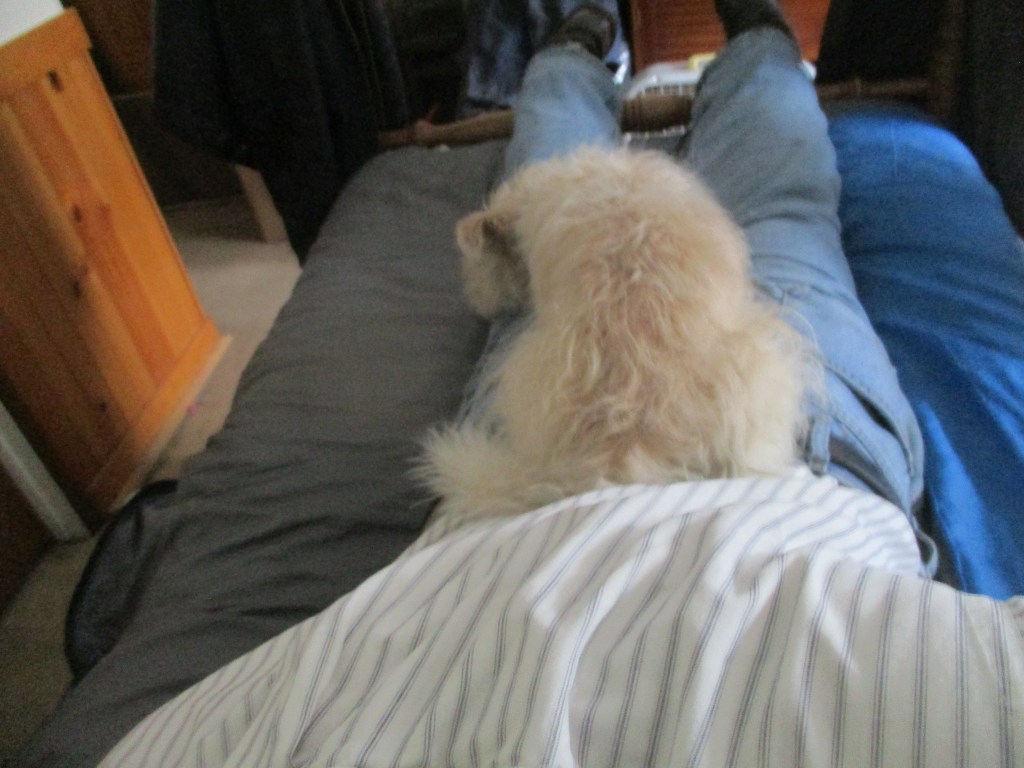
1. Scout at least tried to cooperate for a picture, which is more than Rhody does. He just does not know how to cooperate. He was too wiggly to get a picture that was not blurred.
2. Cedrus atlantica ‘Glauca Pendula’, weeping blue Atlas cedar is an oddly limber trophy tree that my colleague here had wanted for a while, but could not justify procurement of.
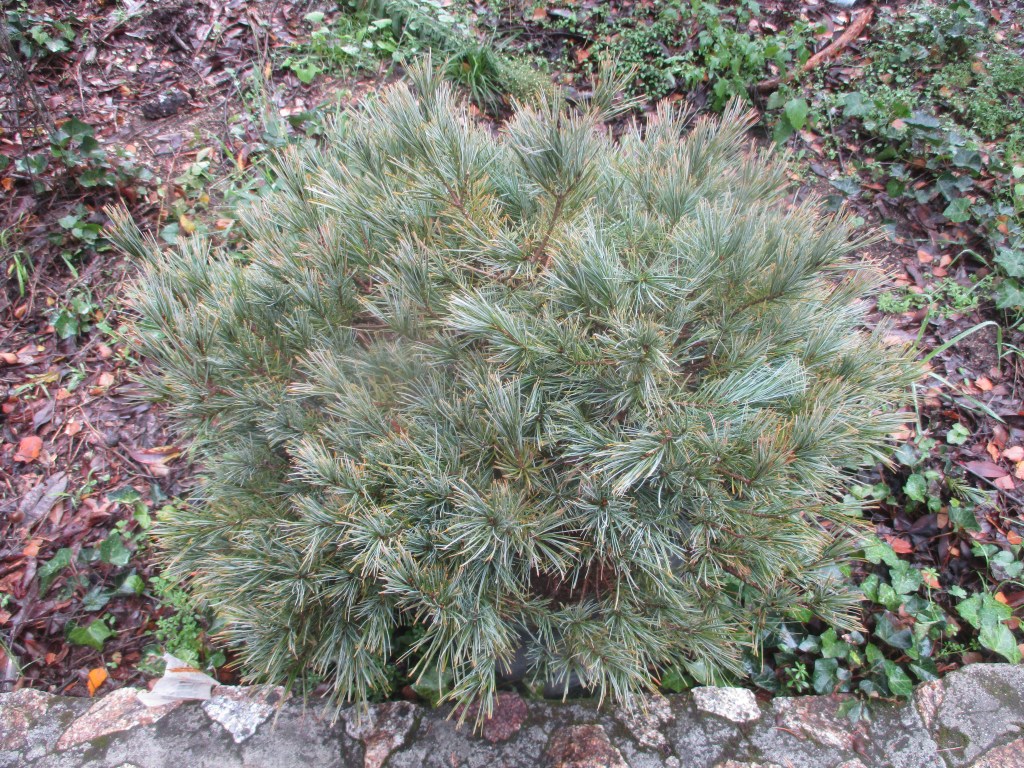
3. Pinus strobus ‘Nana’, dwarf Eastern white pine was not planned, but like the weeping blue Atlas cedar, was unusually affordable. There are eight in a row. Mugo pine are next.
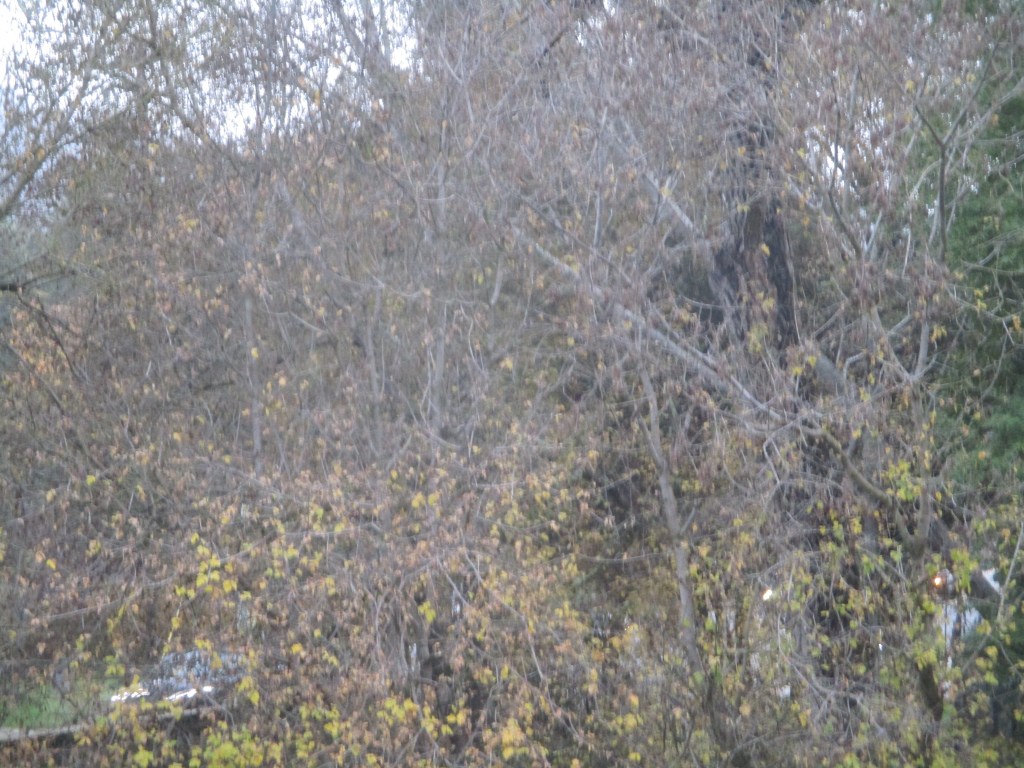
5. Wind is messy! Those two diagonal trunks just above and to the right of the middle of this picture were not diagonal earlier. Those headlights to the lower left are on a bridge.
6. Rain is messy also! This is a spillway of a drainage pond at work. While the sycamores and other deciduous trees continue to defoliate, it can get partially clogged and flooded.
These four pictures below are not affiliated with the Six on Saturday above, but at the request of one of his most enthusiastic fans, were added to compensate for the lack of a picture of Rhody, the star of my blog. I had assumed that he was being uncooperative with my attempts to get a good picture, but he reminded me of what his fans really want to see. Can you guess what the last picture shows?
Coffee was more popular as a houseplant decades ago.
The White Raven Coffee Shop, the best little pourhouse in Felton, has an interesting but old fashioned houseplant on the counter. This group of four small but rapidly growing coffee trees, Coffea arabica, was a gift from a loyal customer.
Mature plants can get to thirty feet tall in the wild. Fortunately, coffee trees are easy to prune to fit interior spaces. Pruning for confinement is actually better than relocating big plants outside, since they do not like cold weather and are sensitive to frost.
Like various species of Ficus, coffee is appreciated more for lush foliage that happens to grow on a tree that can be trained by pruning to stay out of the way, overhead or in other unused spaces or corners. The simple remarkably glossy leaves are about two and half inches long or a bit longer. The very fragrant small white flowers are almost never seen among well groomed houseplants, and only rarely and sporadically bloom among less frequently pruned larger trees in greenhouses and conservatories.
The half inch wide coffee fruit, which is known as a ‘cherry’, is even more rare than flowers among houseplants because of the scarcity of both pollinators and pollen (from so few flowers). Those fortunate enough to get flowers sometimes pollinate them with tiny paintbrushes or clean make-up brushes to compensate for a lack of insects about the house. The resulting bright red or somewhat purplish cherries barely taste like cherries and only make two coffee ‘beans’ each; not enough to bother roasting and grinding for coffee, but great for bragging rights.
This weird Euphorbia is one of the few small evergreen trees that drops no foliage.
Contrary to popular belief, most deciduous trees, those that drop all their leaves in autumn, are not as messy as most evergreen trees. There are of course a few exception; such as cacti that lack foliage completely, or Italian cypress that drop their finely textured foliage straight down within a very narrow drip-zone, where it decomposes and disappears unnoticed. Very few leaves fall from a big silver maple through winter, spring and summer, so that almost all of the raking is done when almost all the leaves get shed in autumn. However, a big Southern magnolia generally drops leaves throughout the year, so that raking is always necessary.
The problem is that when deciduous trees get to be messy, they are very messy. Also, they get to be messy at the worst time of year, when their leaves mix with rain to clog drains and gutters. Unraked leaves become hazardously slippery when they get wet and start to decompose. It is amazing how something that can be so appealingly colorful through autumn can so quickly become such a nuisance.
Leaves of deciduous trees somehow seem to be better for composting than those of some of the evergreen trees. Anyone with a Southern magnolia knows how slow the foliage is to decompose. Foliage of camphor, bay, carob and various eucalyptus certainly decompose slower than various maple, ash, poplar and birch. Many of us outfitted with green waste bins or curbside collection of green waste prefer to recycle the less desirable evergreen foliage, and compost primarily deciduous foliage. Those of us who do not compost but need to rake under large or many deciduous trees may fill bins for several weeks, or leave very big piles of leaves at the curb.
Small leaves, such as those of most elms, or finely textured compound leaves, such as those of silk tree, jacaranda or locust, may not need to be raked if they fall onto lower shrubbery or ground cover. Small leaves or the small leaflets of disintegrating compound leaves simply sift through the lower plant material to decompose below. However, large elms may produce such an abundance of foliage that some may need to be removed. Maple and other large leaves are not so easy to ignore. They can shade lawns, ground cover or bedding plants, so need to be raked as they fall.


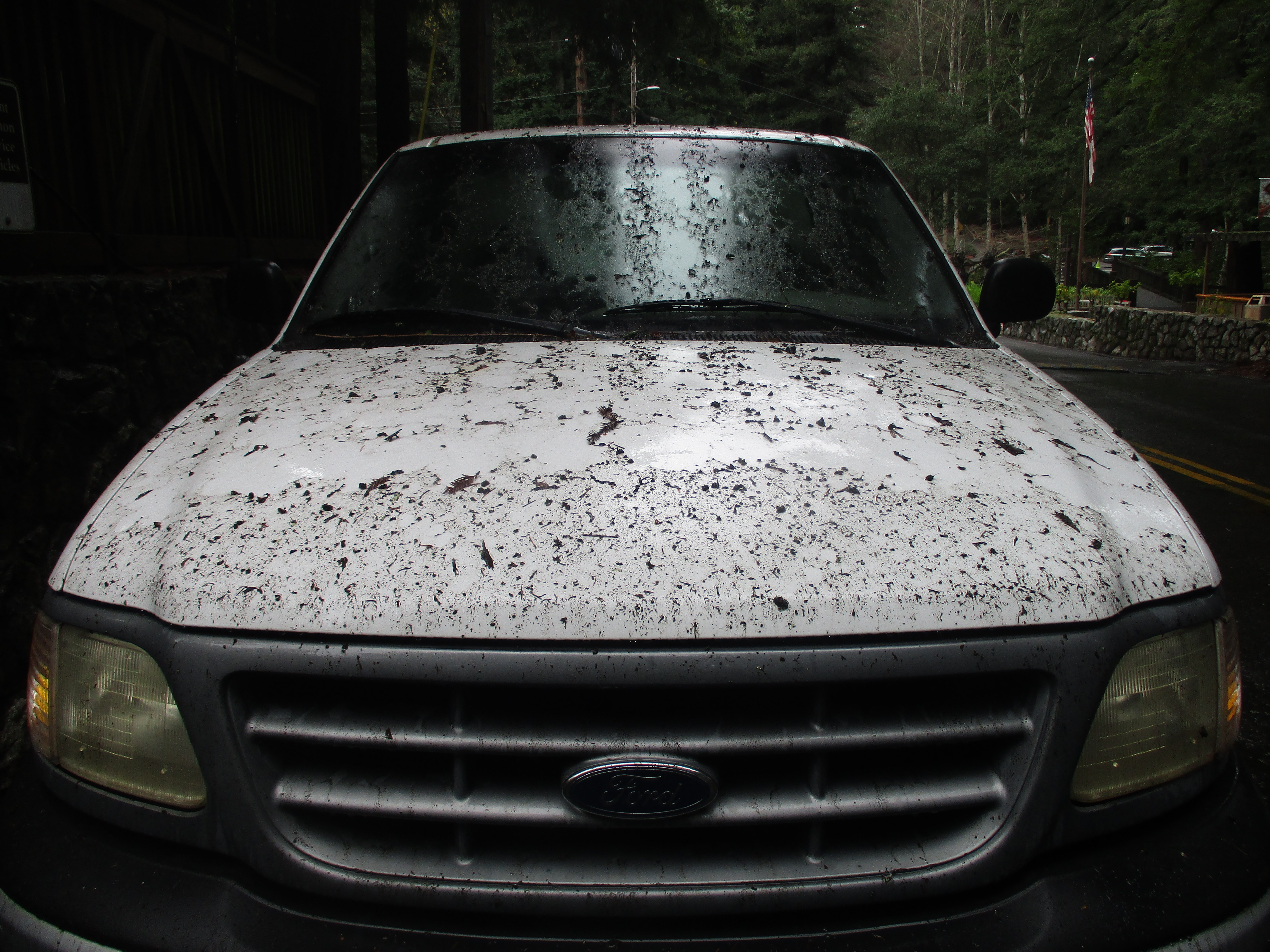 Blowers put the ‘blow’ in ‘mow, blow and go’. They really blow! The only power tool used by so-called ‘gardeners’ that is more detestable to the rest of us is the power hedge shears, and that claim is contestable. Some consider blowers to be worse because they are so obnoxiously noisy, and generate so much dust. Some municipalities have outlawed the use of the noisiest sorts.
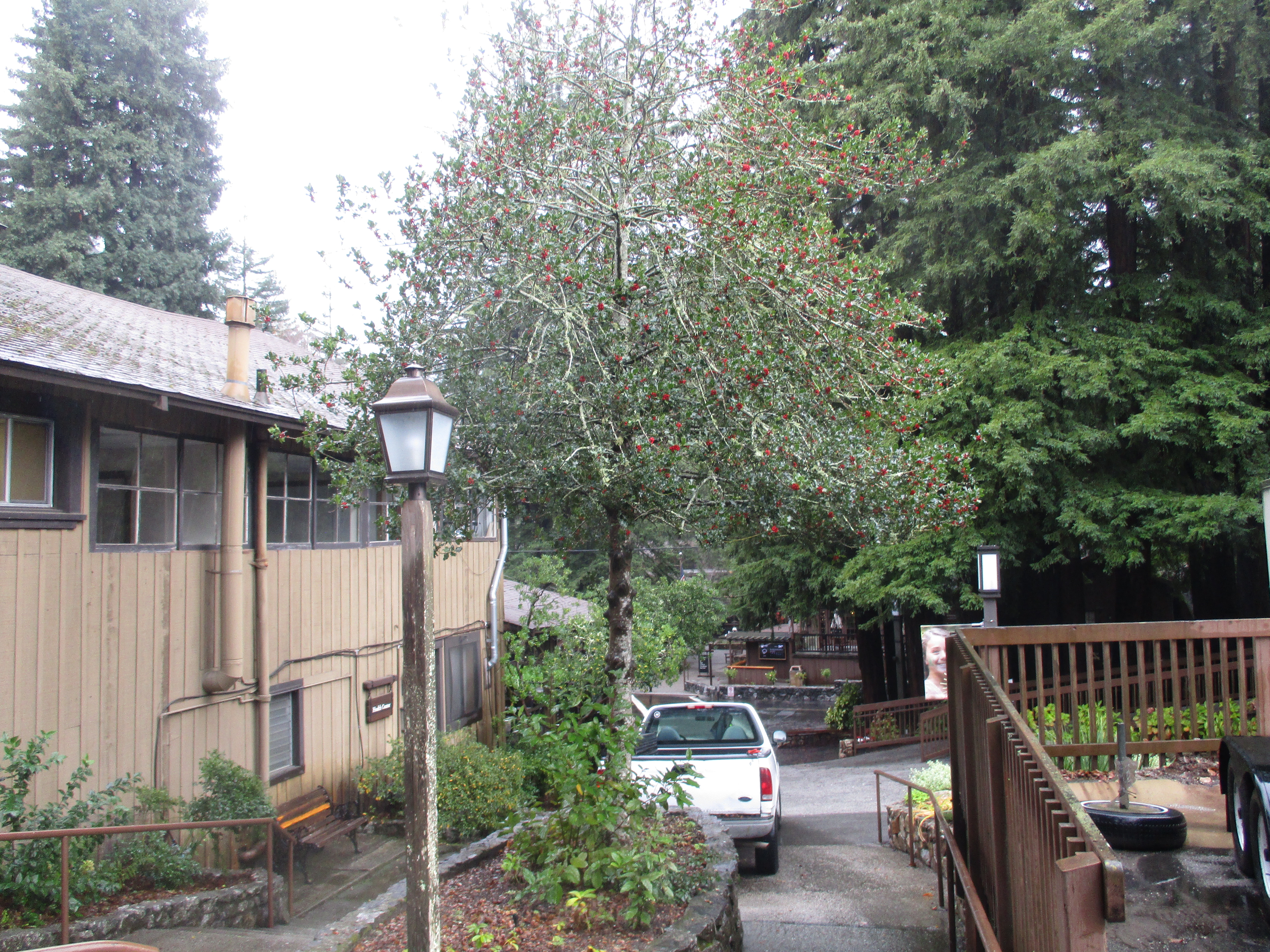 English holly is politely naturalized here. This means that, although naturalized, it is not aggressively invasive, and does not seem to be too detrimental to the ecosystem. It is only annoying to see out in forests, far from the landscapes that the seed escaped from, and wonder if it has potential to significantly compete with native vegetation. It would be better if it were not there.
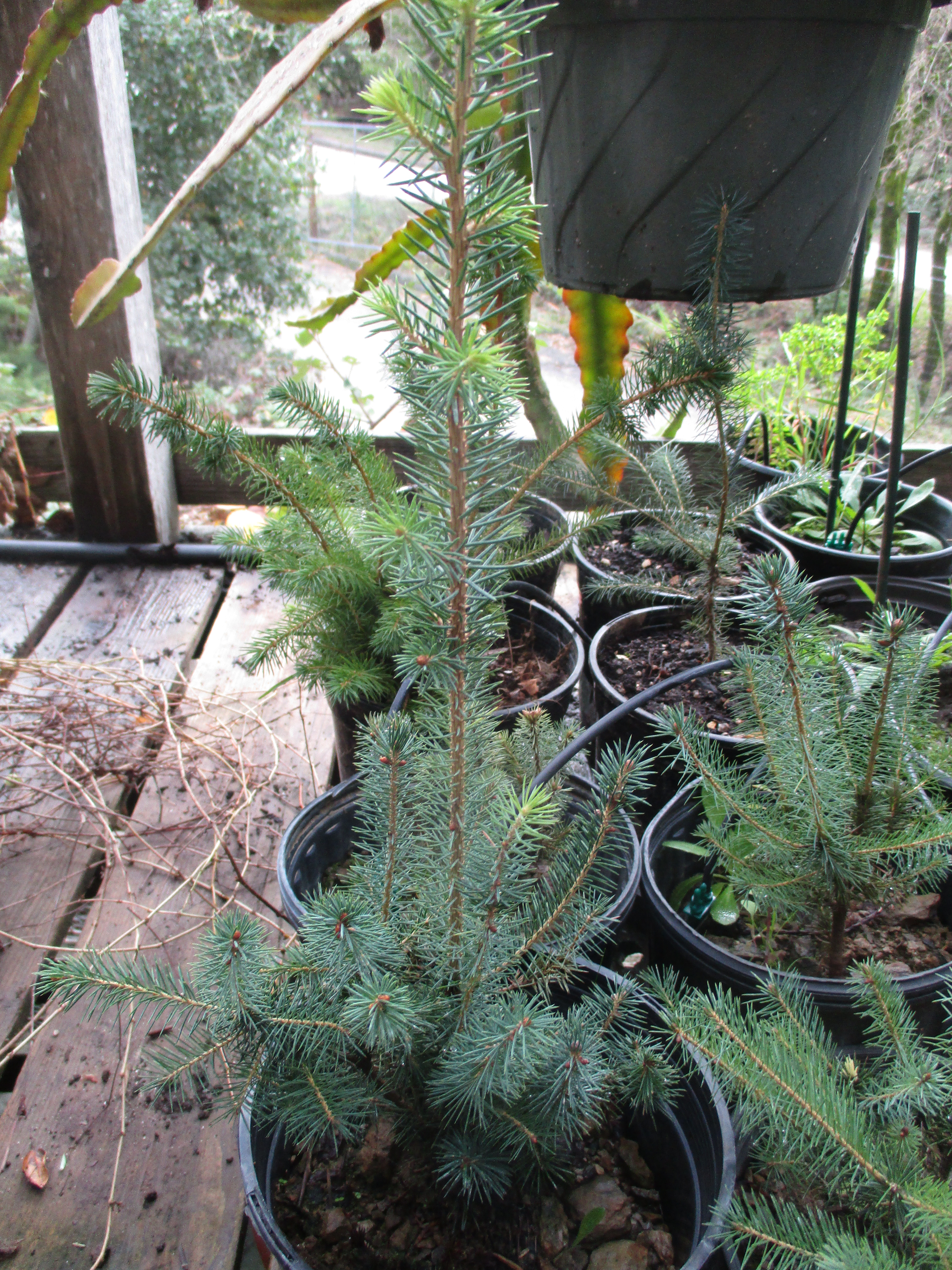 Spruce happen to very compatible with the landscape style here. They fit in nicely with surrounding redwoods, but are more proportionate to sunny spots of some of the refined landscapes. We intend to add a few into some of the landscapes as they get renovated. They will stay branched to the ground, like big dense shrubbery, with the personality of distinguished forest trees.