Horticulturists are by nature, nonconforming. I happen to find it difficult to conform to what makes us nonconforming. Trends are fleeting. Old technology that has worked for decades or centuries is still best. Although I am not totally against chemicals, I find that almost all are unnecessary for responsible home gardening. Pruning is underappreciated, and fixes many problems.
Three or four might be better than two. Perhaps that is what this queen palm was thinking when it decided to get extras.
This is not a good picture, and the tree is a bit too shaggy with old foliage to see what is going on inside clearly. To the left, a secondary limb is curving downward and away from the main trunk, before curving back upward as a secondary canopy. Another limb is developing immediately above this secondary canopy, and another is visible to the right of the main trunk. It is hard to say how many individual canopies are within the collective canopy of this single specimen.
What is weird about this development is that the popularly available palms do not form branches. Think of it. When was the last time you saw a palm tree with a limb or branches? Before you answer that, yuccas (such as…
There are so many big trees in the Santa Cruz Mountains that keep most of us looking up. It is easy to miss much of the understory plants that grow on the forest floor.
While getting the pictures for the ‘Six on Saturday’ article posted earlier, I happened to notice these few small pale flowers that contrasted more with their own dark green foliage than they would have if they were more brightly colored. Perhaps that is a technique to get the attention of pollinators. It certainly got my attention.The flowers were not completely white. They were very pale hues of pink. The wood sorrel in the last picture was slightly more pinkish than the unidentified cruciferous (of the family Cruciferae) flowers of the first two pictures. Pale flowers, particularly those that seem to be adorned with barely perceptible patterns, are typically those that use infrared and ultraviolet color…
Norway maple is aggressively invasive in the Pacific Northwest and the northeastern quadrant of America. It is no problem here though, and is actually rare. Schwedler maple is a cultivar of Norway maple that used to be more popular as a street tree in San Jose. I had been trying to grow copies for years. Besides propagating by cutting, I also tried grafting.
1. Double white angel’s trumpet is irrelevant to Schwedler maple. It belonged with the Six for last week, but with the addition of the picture of Rhody, did not fit. Omission of Rhody’s picture would have been unacceptable. The parent plant lives at the Santa Cruz Civic Auditorium. The piece in this picture is a pruning scrap that became more new cuttings. Bloom is very fragrant!
2. Scion wood looks like a bunch of bare twigs because that is precisely what it is. This is an important bunch of bare twigs for me. It is from an elderly tree that I met in the summer of 1976.
3. The usual suspects. Norway maple is notoriously invasive elsewhere. The few cultivars that live here are both rare and seemingly sterile. However, one noncultivar tree seeded these five.
4. High bud grafting is not my style, but was likely easier on the thinner portions of trunks five and a half feet up. Besides, the straight trunks were too perfect to waste. It will look silly later.
5. Cleft grafting was also an easier option to more typical budding. Besides, I do not trust budding with such fat buds and such thin bark. I could not find rubbers, so used elastic from masks.
6. Rhody is about as relevant to Schwedler maple as the double white angel’s trumpet. Nonetheless, he is always the main attraction of my Six on Saturday. He is as uncooperative as always.
This is the link for Six on Saturday, for anyone else who would like to participate:
What is the difference between narcissus and daffodil? That is very open to interpretation. Daffodil is really only a particular type of narcissus that tends to bloom with larger and more colorful flowers that lack the rich fragrance of the smaller and commonly white flowers of other narcissus. Most daffodil bloom singly. Only a few bloom with a few flowers together. Other narcissus are outfitted with more individual flowers to each stem.
When they were buried in sunny spots last autumn, bare daffodil bulbs looked like pointed onions. They rested through much of winter so that they could be among the first flowers to bloom late in winter. The rather short and narrow bluish leaves stand vertically. The flaring flowers face outward with a bit of a downward or upward tilt. After bloom, deteriorating flowers should be plucked, but foliage should remain until it yellows and gets shed naturally.
The most familiar daffodil are bright yellow. Others can be white, various shades of orange or yellow, or a combination of these colors. Six outer petals (which are actually three petals and three sepals) radiate around a central trumpet.
Young trees are so impressionable. Too much water can damage their roots, or cause them to disperse too shallowly. Improper pruning can disfigure their branch structure, and ultimately compromise structural integrity. Improper staking to keep them stable can actually interfere with development of stabilizing roots, and interfere with trunk development.
Newly planted trees will of course want to be watered from spring to autumn for at least the first year, and more likely for a few years. Those that will eventually be less reliant on watering as they mature are actually the most demanding while young, because their confined roots are not yet adequately dispersed for self sufficiency. The problem is that too much water can keep lower soil too saturated for new roots to disperse into. This causes roots to instead disperse closer to the surface of the soil, which is not only unhealthy for the trees, but puts the roots closer to pavement, other plants and any other features that they can eventually damage as they grow.
Many young trees should be pruned as they grow to eliminate structural problems, and to instead promote good branch structure. The problem is that improper pruning can actually cause structural problems that will be with the victimized trees for the rest of their lives. Pruning should leave no stubs that will take longer to compartmentalize (heal), or that might produce vigorous but weakly attached new stems.
Stakes are unfortunately necessary to stabilize new trees. The problem is that the trees can become so reliant on stakes for support that they do not develop enough trunk strength to support their canopy without stakes. That is why trees should be tied loosely enough to their stakes to be able to move at least a little in a breeze. Nursery stakes (that trees are bound to for a straight trunk in the nursery) should be removed when sturdier stakes are added.
New trees are naturally a bit more distressed than mature trees that have settled into their environment. They are consequently more susceptible to disease and insect infestation.
Remember the Beverly Hillbillies? That was a really lame sitcom; but it was somehow very popular at the time.
Each episode began with the stupid jingle that explains how and why the formerly impoverished but suddenly wealthy Clampetts left their home in Bugtussle and moved to Beverly . . . Hills that is.
As they drive their decrepit Oldsmobile down Bedford Drive just west of downtown, the palms flanking the roadway are prominently visible to the left and right. This strictly regimented collection of Canary Island date palms alternating with Mexican palms was not very big back then, in the early 1960s. By the 1980s, they were strikingly grand. Sadly, they are now deteriorating from old age. Many of the broad Canary Island date palms have succumbed to pink rot, so are now absent. Some of the Mexican fan palms are also lacking. It is saddening to see them now…
All crabapple trees flower. Almost all subsequently produce fruit. Those designated as ‘flowering’ crabapples exhibit the most spectacular bloom, but generally produce inferior fruit. A few cultivars are nearly fruitless. Crabapples not designated as ‘flowering’ are not as bold in bloom, but generally produce larger fruit of better quality. Their fruit is useful for jelly and other culinary applications.
Almost all crabapple trees here are flowering crabapples. Fruiting crabapples are rare locally. Their fruit is not as popular as it is in other regions. However, flowering crabapples that produce big fruit are increasingly trendy. Their fruits can get as wide as an inch and a half, almost as big as fruits of fruiting crabapples. If not picked or eaten by birds, even typical berry sized fruits are messy.
White, pink or reddish pink bloom is impressively profuse, just prior to spring foliation. In fact, bloom is comparable to that of flowering cherries, and only a bit later. Most flowering crabapples get no taller than fifteen feet. Aggressive annual dormant pruning is not necessary as it is for trees that produce heavy apples. Instead, mature trees appreciate summer structure pruning and thinning.
Most major pruning happens while the plants that need it are dormant through winter. That is why it is known as ‘dormant pruning’. Such pruning would be so much more disruptive while plants are blooming, fruiting, foliating or growing. Pruning that happens during other seasons is not as aggressive as dormant pruning. Spring pruning, although practical for some plants, is relatively docile.
For deciduous fruit trees, dormant pruning is very important. It concentrates resources into fruit production, but also limits production to sustainable quantities. Otherwise, such fruit trees would be unable to support the weight of their own copious fruit. Spring pruning of such trees is simply too late. By that time, superfluous fruit has already consumed significant resources, only to be wasted.
Stone fruit trees and pome fruit trees are familiar examples of deciduous fruit trees that rely on dormant pruning. Stone fruits include peach, nectarine, apricot, plum and their relatives. Pome fruits are primarily apple and pear. Ironically though, their fruitless but flowering counterparts perform best with spring pruning instead. As similar as they all are, they have completely different priorities.
Flowering cherry trees bloom more spectacularly than fruiting cherry trees, but produce no fruit. Similarly, flowering crabapple trees bloom more colorfully than fruiting apple trees, but produce only tiny fruit. Neither must sustain production of significant fruit. Nor must they support the increasing weight of developing fruit. Prolific bloom is their primary function. Spring pruning accommodates.
Spring pruning allows flowering trees to first bloom as profusely as possible. Pruned out stems have already served their purpose. Because fruit production is not a concern, spring pruning is less severe than dormant pruning. Nonetheless, because dormant pruning is so practical for so many plants, spring pruning may seem impractical. It is tempting to prune dormant flowering trees now. Doing so harmlessly compromises bloom.
Every invasive exotic (non-native) species has a story of how it got here.
Blue gum and red gum were imported to produce the timber needed for railroad ties. Many annual specie were forage crops for grazing cattle. Some got here by stowing away as seed on or inside cattle or other animals. Supposedly, mustard seed was broadcast by those traveling on the El Camino Real so that other travelers could find the route later. Then there are all sorts of invasive exotics that were imported simply because people liked to grow them in their gardens.
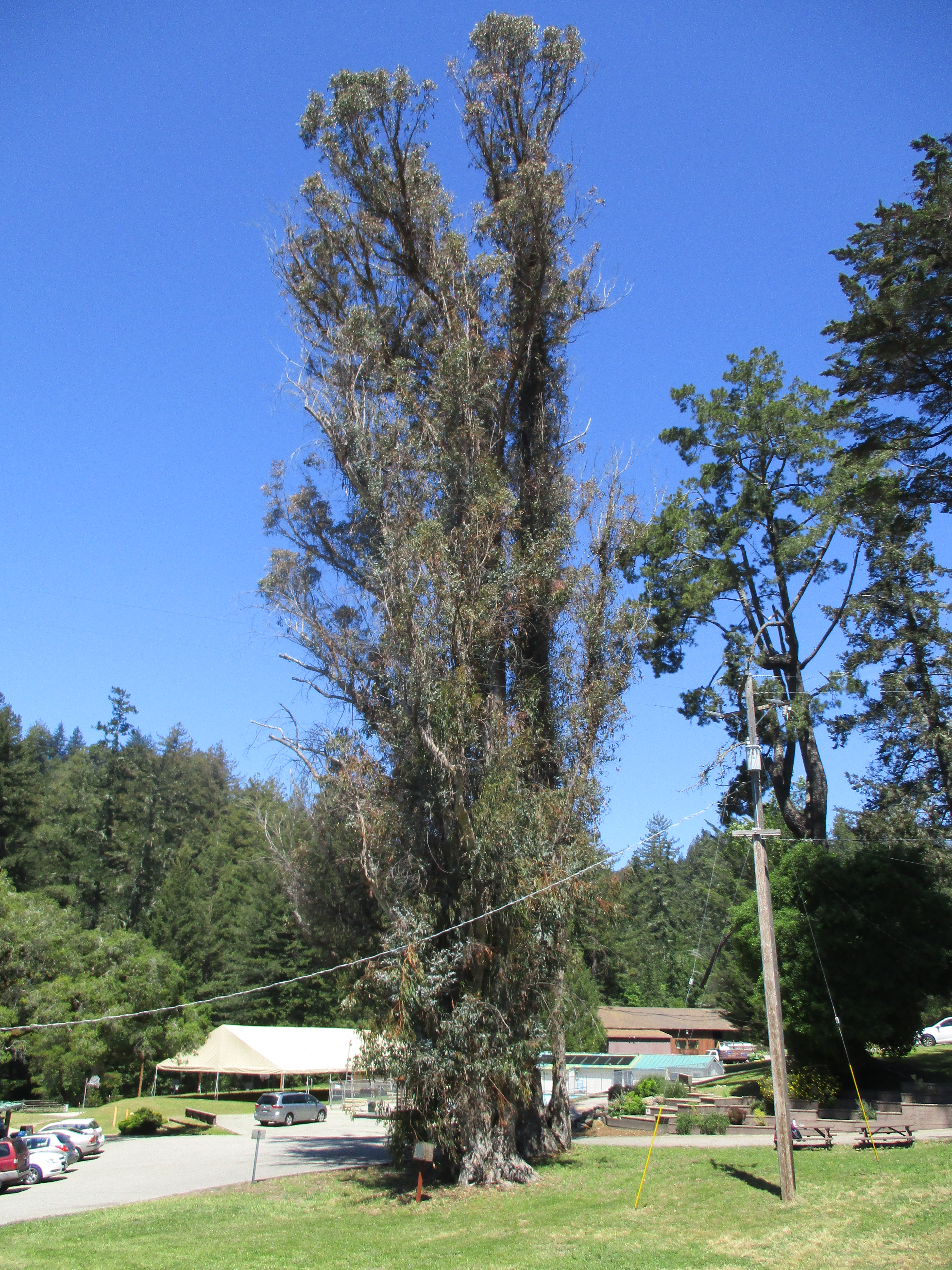
It is difficult to imagine why anyone would import any of the weedy specie of broom (Genista specie) or the sloppy species of pampas grass (Cortaderia jubata). It might have made sense at the time, before more appealing specie were introduced, or before less invasive modern cultivars were developed. Black locust has…
According to Ecclesiastes 3:1, “There is a time for everything.” Unfortunately, this is still not the time for me to write new articles, which is why I continue to recycle old articles such as this.
There is a time for everything, and a season for every activity under the Heavens:
Verses 2 through 8 continue to list a few examples of more specific activities that happen at specific times. If there were more examples, autumn foliar color would probably be cited as well. After all, autumn foliar color happens in . . . well, . . . autumn.
Perhaps it was omitted for brevity. Of course, there is the possibility that it was omitted to avoid confusion. If it had been cited, it might have been described simply as ‘foliar color’ rather than ‘autumn foliar color’. Some foliage colors earlier if distressed. Some foliage does not color until frosted. Some might even delay color until it is in the process of getting replaced by new foliage. Then there are the many sorts of evergreen foliage that do not color at all, or at least in…