Freeman Maple

Freeman maple colors with minimal chill.

It is a hybrid. It is naturally occurring. Yet, most cultivars (garden varieties) resulted from intentional hybridization and selection. It is not as strange as it seems. Freeman maple, Acer X freemanii, is a naturally occurring hybrid of silver maple and red maple. It grows wild where the natural ranges of the parents overlap. From their example, breeders learned to selectively breed the cultivars.

These cultivars combine the fast growth rate of silver maple with the structural integrity of red maple. None get to be as imposing as the silver maple. Some get to be about forty feet tall and wide, which is a bit bigger than red maple gets in local climates. Foliage is lacy like that of silver maple, but more substantial, like that of red maple. It develops brilliant orange and red color for autumn.

Freeman maple, although locally uncommon, is one of the more practical maples here. Like silver maple, it does not require much chill in winter. Like red maple, it develops a symmetrical canopy with reasonably high branches. Roots should be complaisant with concrete. Because it is a hybrid, it is mostly sterile. It does not produce enough seed to be invasive in more conducive climates.

Tree Surgeons Evolved Into Arborists

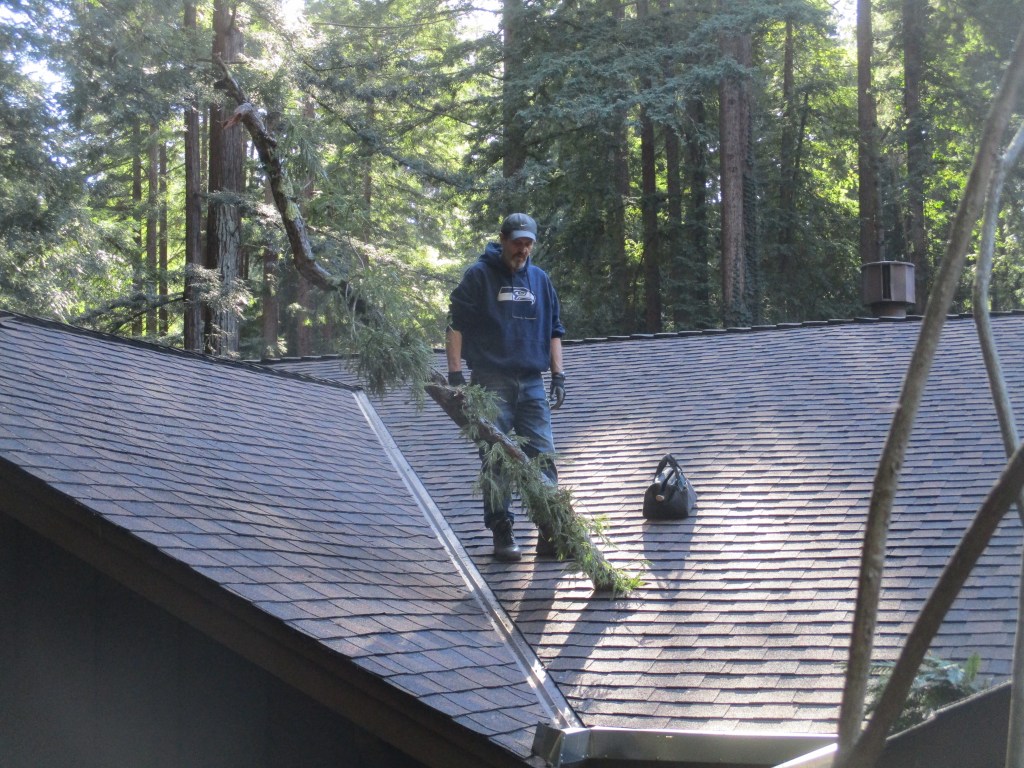
Tree surgeons maintain the big trees.

Arborists are very specialized horticulturists. They prefer to work with trees. Of course that is not as simple as it sounds. Some are nurserymen who grow trees. Some select appropriate trees for landscape design. Even some of the orchardists who work with many trees of a similar type have earned this prestigious designation. Decades ago, we still knew many of them as tree surgeons.

Arboriculture, which is the specialized horticulture of trees, has certainly evolved through the decades. Tree surgeons no longer graft fruit trees directly in home gardens. Nurserymen graft trees in production nurseries, to make them available from retail nurseries. However, modern tree surgeons now work with much more diversity of many species that were unknown to their predecessors.

As storms become more frequent through autumn and winter, the need for arboriculture becomes more apparent. More unstable trees fall. More structural deficient limbs break. Many trees prefer to be pruned while dormant through winter. In actuality though, arboriculture is important throughout the year. Some procedures, for some sorts of trees, should happen significantly earlier or later.

Trees are the most substantial features of home gardens. Once they grow beyond reach, they need to be maintained by qualified tree surgeons. Regardless of what most say, very few gardeners are qualified to perform major arboricultural procedures. Many tree surgeons will attest to finding that most damage that trees endure is caused by gardeners with minimal regard for arboriculture.

Tree surgeons who are Certified Arborists of the International Society of Arboriculture, or ‘ISA’, have demonstrated their proficiency with arboriculture. After passing their certification examination, Certified Arborists maintain their credentials by continued involvement with educational seminars, classes and workshops of the ISA. Not many other horticultural professionals are so dedicated.

More information about procuring the services of an ISA certified arborist can be found at www.isa-arbor.com.

Is That A Body?!

This happened back in the 1980s, but after all these years, is still funny. It is reblogged from three years ago.

tonytomeo's avatarTony Tomeo

P71118It seems that changes in fashion are sometimes partly motivated by rebellion against what they are changing from. The comfortably loose and pendulous ladies outfits of the 1920s that were so unflattering to the human form while revealing more of it than ever before were probably a rebellion to the impractically uncomfortable and strenuously refined ladies fashions of the late Victorian period that were designed to enhance the ideal of feminine form while also obscuring it. The simple and squared landscapes of the 1950s that were so neatly tailored that they would be considered to be bleak by modern standards were replaced through the 1970s and into the 1980s by a much more relaxed and curvaceous style with sculptural trees, shaggy foliar textures, hills and boulders. Ah, the boulders. They were still cool when Brent and I were studying horticulture at Cal Poly. We had to get some.

While Brent’s…

View original post 612 more words

Franklin Canyon Park

This is another recycled article from a few years ago. Goodness, it has been a long time since I have been in the Los Angeles region.

tonytomeo's avatarTony Tomeo

P71126Because I sometimes go to Brent’s jobs sites while in the Los Angeles area, people sometimes ask me if I see many famous actors. Well, I try to stay out of everyone’s way, so rarely see anyone at the sites. If I see anyone famous about town, I would not know it. I do not watch enough television or movies to recognize many of them.

However, I did recognize this famous actor from my childhood as the renowned Wile E. Coyote of Looney Tunes. He was just out for a stroll in Franklin Canyon Park in the Santa Monica Mountains above Beverly Hills. It happens to be one of my favorite places in the Los Angeles Area, and has an interesting history.

Even those who have never been to Franklin Canyon Park might have seen it on television and in movies. Franklin Canyon Reservoir was Myers Lake on which Opie…

View original post 229 more words

Six on Saturday: November 1, 2020 – Memorial Tree Update (on November 7)

These pictures are from a similar article with the same name at Felton League, which was linked to here last Wednesday. They demonstrate how efficiently the Memorial Tree is recovering from vandalism four months ago. Pointer . . . ‘thingies’ were added to more precisely identify what some of the pictures illustrate. The other two linked-to articles provide more information.

1. A gardener at Felton Covered Bridge Park installed this chicken wire cage around the Memorial Tree after it was vandalized. The protection is minimal, but the gesture is very thoughtful.

2. This now minimal damage is all that remains of of the formerly major vandalism. The worst of the damage to the left and right was very efficiently compartmentalized in just four months.

3. This scar is all that remains of formerly major damage. It is now completely compartmentalized. Growth above not only continued, but was unusually accelerated for so late in the season.

4. This damage was compartmentalized so efficiently that the scar is barely visible. Actually, I am not even certain if this is a scar. I remember only that the trunk was sliced in three places.

5. Growth for the season was adequate prior to the vandalism. The marker to the lower left shows where growth started early last spring. The marker to the upper right, near the center of the picture, shows where growth was decelerating and expected to blind out by the middle of summer. However, growth accelerated vigorously past that, as if stimulated by the vandalism.

6. Growth was unusually vigorous, especially for late summer. During winter, the stem designated by the marker to the left should be removed so that it does not develop into another major trunk. The stem designated by the marker to the right should probably be pruned back so that it does not compete with the two upper stems that are developing into the main lower limbs.

This is the link for Six on Saturday, for anyone else who would like to participate:

https://thepropagatorblog.wordpress.com/2017/09/18/six-on-saturday-a-participant-guide/

Coral Bells

Coral bells can bloom again in autumn. (This is not my picture.)

From Santa Barbara to Vancouver, and also in central Idaho, the humble native coral bells, Heuchera micrantha, is not much to look at, with compact rosettes of relatively small and bronzy rounded leaves with weird tomentum (hairs). In spring and early summer, and sometimes again in autumn, sparse trusses of minute brick red flowers hover about a foot above on wiry and slightly fuzzy stems. Old plants that get bare in the middle can be divided into several small plants in spring or autumn.

Modern cultivars are considerably more interesting, with more substantial foliage in various shades of green, gold, tan, brown, bronze and purplish bronze. The larger and variably lobed leaves can be two inches wide or slightly wider. The flowers stand as much as two feet high, but lack color. Most are pale greenish white. ‘Palace Purple’ has deep bronze or almost purplish foliage. ‘Ruffles’ has deeply lobed and ruffled green leaves. Unlike undemanding wild plants that can grow in cracks in exposed stone, modern cultivars like rich soil. Harsh exposure can scorch foliage, so a bit of partial shade is preferred.

Most coral bells are grown more for their colorful and low foliage than for their bloom. (Both pictures here were obtained online. I can not find my pictures.)

Many Perennials Want Seasonal Grooming

Peacock orchid bloom late, but eventually succumbs to frost and must be groomed.

Here on the west coast, autumn and winter weather is so mild that the native coral bells are already starting to develop new foliage on top of the old foliage from this last year. Technically, they are evergreen, so the old foliage does not need to be shed; but if it is not too much to ask, some types look better with a bit of grooming.

Other perennial plants that are from climates with stronger seasons and colder winters are not quite so evergreen. Many shed all of their foliage and are completely bare for at least part of the winter. Only a few, like cyclamen, are at their best through autumn and winter.

Dried watsonia foliage should be removed now if it has not been removed already. It is not so easy to pluck off like gladiola foliage is, so it should be cut off with shears. Because new foliage for next year develops before the old foliage of this past year is completely brown, it is often necessary to cut the old a few inches above the ground in order to avoid damaging the new.

The so called ‘evergreen’ daylilies can be even messier. New foliage is rather delicate, so it is easily tattered by the removal of old foliage. The ‘deciduous’ types may seem to be less appealing because they are bare for part of autumn and winter, but are so much easier to groom by simply removing all of the deteriorating old foliage as soon as it separates easily from the roots.

Deteriorating flowers can be removed from cannas; but their lush foliage can stay until it starts to deteriorate later in winter. Even if it survives winter, it should eventually be cut to the ground as it gets replaced by new growth in spring.

The many different iris have many different personalities. Most should be groomed sometime between summer and late autumn, although Dutch iris were groomed much earlier. Bearded iris that do not get divided can be groomed simply by plucking off big old leaves to expose smaller new shoots below.

Some dahlias bloom until they get frosted. Most though, are already finished. They do not need to be cut back all at once, but can be cut back in phases as leaves and stems dry and turn brown.

November 1, 2020 -Memorial Tree Update

Even If I had time to write an article for today, which I do not, I would like to share this article from my other blog at Felton League. It is a surprisingly pleasant update regarding an unpleasant incident that involved a Memorial Tree in Felton Covered Bridge Park. It incidentally complies with the ‘Horridculture’ meme for Wednesday.

tonytomeo's avatarFelton League

The Memorial Tree is remarkably healthy!

The Memorial Tree in Felton Covered Bridge Park was not expected to survive damage inflicted by a vandal last June. However, it recovered with unexpected efficiency and vigor, at a time of year when growth should have been decelerating prior to autumn. It is as if the vandalism never happened.

The worst of the damage is nearly healed.

After unsuccessfully attempting to poison the Memorial Tree with salt, the vandal sliced more than half way through the trunk in three places. The worst of these three slices in nearly healed. Another has already healed over. The third is so efficiently healed that the scar is barely visible.

This damage is already healed over.

A gardener who maintains Felton Covered Bridge Park installed a cage of chicken wire around the lower portion of the trunk to hopefully dissuade the vandal from attacking the Memorial Tree…

View original post 276 more words

Incense Cedar

Incense cedar produces delightfully aromatic wood.

Nowadays, the delightfully aromatic foliage is familiar primarily in garlands at Christmas time. Most of the foliage of old trees is too high up for direct contact. Young trees with low foliage are rare. Incense cedar, Calocedrus decurrens, is unfortunately not as popular as it was a century ago. At that time, it was as utilitarian as it was appealing for spacious but minimally irrigated landscapes.

Incense cedar wood made good shingles and laminate for closets and cedar chests. The wood is aromatic enough to repel moths from woolens and furs, which were still popular then. It was less expensive to import than Eastern red cedar. It grows wild relatively nearby, in the Sierra Nevada and Cascade Mountains. Incense cedar fence posts might resist decay as well as redwood posts.

If the wild, where they compete with other trees for sunlight, old trees can get almost two hundred feet tall. However, well exposed old trees in Victorian gardens are less than half as tall after more than a century. Their canopies are generally conical. Large limbs can curve upward like extra trunks. Flat foliar sprays resemble those of arborvitae. The deeply furrowed bark is cinnamon brown.

Leaf Litter Is Perfectly Natural

Mulch merely substitutes for leaf litter.

Forests lack gardeners. In the wild, there is no one to rake fallen leaves or blow them away. Foliage falls from trees and onto the ground, where it stays as it decomposes. It is the natural process. Raking and blowing leaf litter away is unnatural. It deprives the soil and organisms that inhabit it of significant organic matter that they crave. It also interferes with insulation and moisture retention.

Of course, there are some natural processes that are not so desirable in home gardens. After all, that is why raking and blowing is standard procedure. It is not practical to leave leaf litter on lawn, ground cover, pavement or roofs. Raking and blowing removes leaf litter from where it is unwanted, or at least moves it to where it is less visible. Leaf litter seems to be so useless and unwanted.

However, other procedures are necessary to compensate for the lack of leaf litter. Mulching insulates soil, retains soil moisture, and inhibits weed growth. Watering adjusts to deficient moisture in exposed soil. Weeding eliminates weeds that germinate and grow where there is nothing to inhibit them from doing so. Herbicide may be more practical. It is all so contrary to natural processes.

It is somewhat obvious why deciduous plants defoliate through autumn and winter. They do not need their foliage as much while days are shorter and sunlight is less intense. Also, they do not want to be battered by winter wind, or collect heavy snow. Yet, their desire to mulch their own soil is not so obvious. Evergreen plants do it also. They just do it slower, and generally throughout the year.

In fact, many evergreen plants are more efficient with their mulch than most deciduous plants are. Leaf litter of eucalypti, camphor, bay and nearly all conifers actually has a preemergent herbicidal effect. It inhibits germination of seed that can reach the soil. It can be a disadvantage for wildflowers, or an advantage for weed control. Incidentally, coniferous leaf litter is likely to be combustible.

Leaf litter, composted or left to its natural processes, is natural.