Oklahoma

tonytomeo's avatarTony Tomeo

P71119Standin’ on the corner in Winslow, Arizona, specifically on the corner of West Second Street and North Kinsley Avenue, there was this bronze statue of someone famous. I am still not certain who he was. A statue of Glenn Frey was added nearby later, and might have replaced this one, but I could not find much news about it. The new statue does not look anything like this statue, which was the only one there when we stopped to get our picture taken there five years ago on our way to Oklahoma.

We did not plan the trip very well. We did not plan it much at all. We were in a less than ideal situation at home, so loaded up a tired old Blazer and went on our way. I sort of planned on staying for a few days or maybe two weeks, and then returning alone to Felton…

View original post 382 more words

September 11 Remembrance Garden, Winslow, Arizona

tonytomeo's avatarTony Tomeo

P71118The main complaint about this Remembrance Garden is that there is no garden. Two steel girders from the destroyed World Trade Center stand vertically on pedestals within a concrete slab shaped like the site of the World Trade Center. The pedestals are set within squares of stones that correspond to the outlines and locations of the of the World Trade Center Twin Towers #1 and #2 within the World Trade Center Site. The outlines and locations of the other buildings of the World Trade Center are designated by darker concrete within the slab. There is no real synthetic landscape. Only a few ash, cottonwoods, pines and junipers are scattered about.

This might be the most perfect landscape I have ever seen.

Please don’t get me wrong. I appreciate good landscapes that do what they were designed to do. Most of the prettiest are designed to make spaces more appealing. They…

View original post 225 more words

Six on Saturday: There Goes The Neighborhood

The CZU Lightning Complex Fire started two and a half months ago, and finished five and a half weeks ago. I was already away in the Santa Clara Valley when the region here was evacuated ahead of the fire, and could not return for several days, but found that the fire got no closer than a mile and a half from here. Smoke from other fires continued to darken the skies for weeks.

Life here is very different is some ways, but surprisingly unchanged in others. I had managed to avoid two of my properties that are within the burn zone. I finally saw them last week. They are completely undamaged. However, some of the homes in the neighborhood are completely gone. It is so disheartening. There was nothing to lose on my properties, but they did not burn.

One of the properties is unused. It is inhabited by a circular clonal colony of redwoods, a few solitary redwoods, a few tan oaks, and very few miscellaneous trees such as bays and madrones. All of the trees that are not redwood should have been harvested for firewood. Vegetation management on a much larger scale decreases combustibility of formerly clear cut forests like this.

The other property is naturally inhabited by several mature tan oaks and many of their offspring, as well as a few bays, very few canyon live oaks, and only a few big redwoods. Exotic plants were added because it is a good place to grow them before relocating them to other gardens. I would prefer to harvest all trees that are not redwoods, for firewood, as for the other property.

With proper vegetation management, this second parcel could be used to grow bare root commodities, such as sycamores to be planted as street trees in Los Angeles. Fourteen or so fig stock trees already live there. They provide cuttings for propagation. A few are culturally significant cultivars of the Santa Clara Valley. A few species that I brought from Oklahoma live there too.

Nonetheless, these six pictures show a bit of how the neighborhood appears now. There is certainly not much remaining to see. Actually, there was not much to see prior to the fire. It is easy to see the forest, but not the trees. (That sounds backward.) I posted these pictures because a few readers had asked about the situation here. There is too much missing now for six pictures.

1. Below the middle of this picture, a road is barely visible. The parcel in the foreground burned. The foliage to the lower left is that of a tan oak that broke and fell across the road afterward. The scrawny stumps remain from burned tan oak saplings. I do not know who cut them, or why they were cut already. My property across the road did not burn, but is very ashy and gray. A home that was up on the ridge in the distant background, about where the sun shines through, is now gone. I do not know the condition of several homes beyond that. I did not go up there.

2. Tan oak saplings to the left were roasted but not incinerated as bramble burned below them. My property to the right did not burn. Only the rhubarb, which my great grandfather gave to me before I was in kindergarten, is missing. It might have been trampled by firefighters, or whomever installed these odd flexible water pipes that deliver water to surviving homes. Original pipes and associated infrastructure were damaged. If the rhubarb will not regenerate, I can get copies of the same from other gardens. This is the sunnier property where I can grow things.

3. Fig stock trees did not even wilt! The stock tree in the background to the right is one of the culturally significant cultivars of the Santa Clara Valley. I believe it is a ‘Honey’ fig of some sort. I should remove all the tan oaks and their many offspring from this site, both to decrease combustibility, and also to increase sunlight for the stock trees and other desirable vegetation here.

4. Stumps of burned tan oak saplings are already regenerating on another property. They do so very efficiently after fire. They will be combustible before the end of fire season of next year.

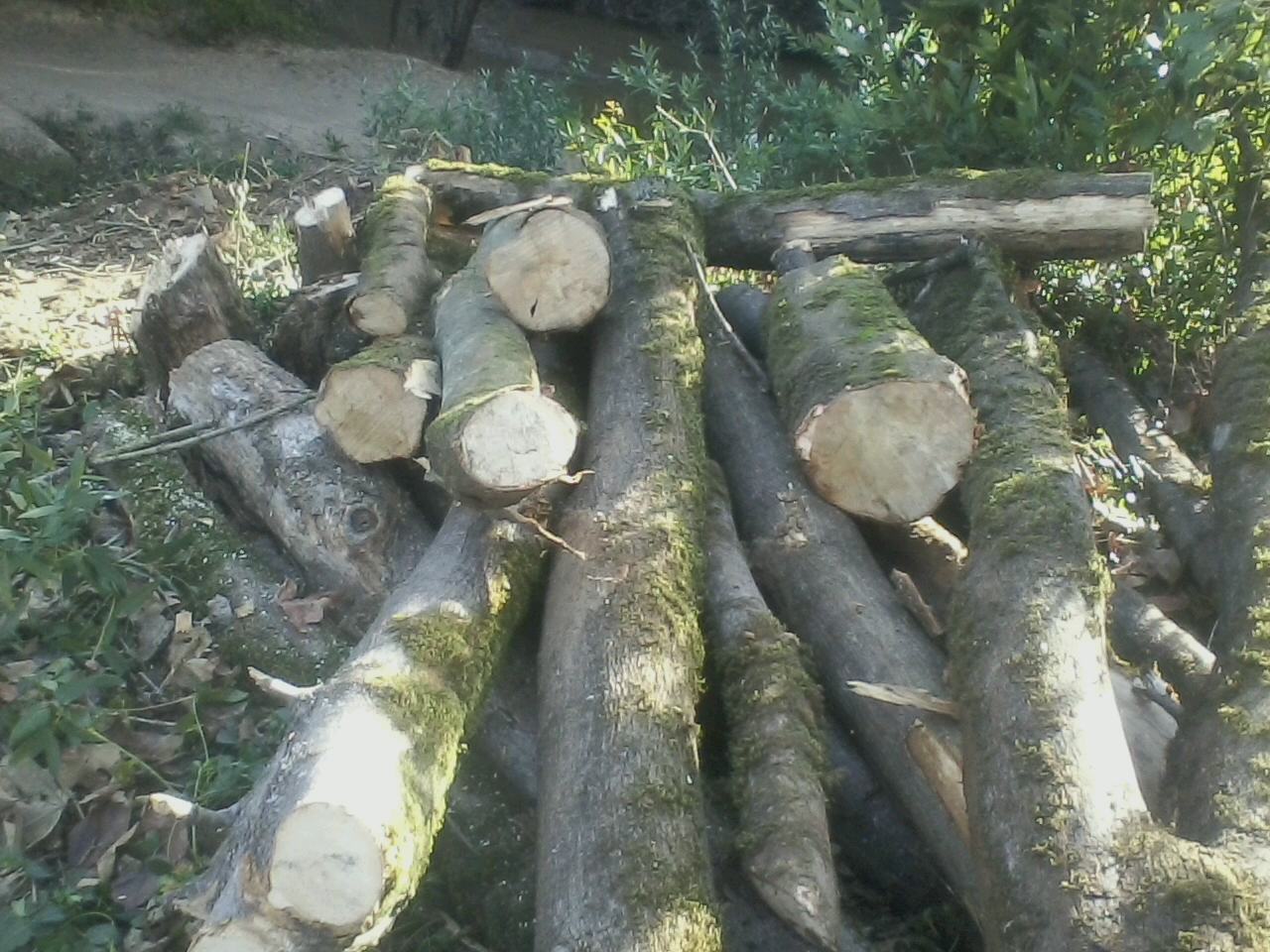
5. A neighbor lived here. Ironically, all that remains of his home is the unburned firewood to the left. Because the home was an old non-compliant lumberjack’s cabin, replacement is unlikely.

6. This is what remains of the same neighbor’s car. He must have been away prior to evacuation, like I was, but without the car. This was directly across the road from unburned vegetation.

This is the link for Six on Saturday, for anyone else who would like to participate:

https://thepropagatorblog.wordpress.com/2017/09/18/six-on-saturday-a-participant-guide/

Valley Oak

Valley oak is also known as ‘roble’.

From the north end of the Sacramento Valley to the San Fernando Valley, the valley oak, Quercus lobata, is among the most familiar and distinctive of native oaks. It is the largest oak of North America, reaching more than a hundred feet tall with trunks as wide as ten feet, which is why it is rare in urban gardens. The hundred fifty foot tall ‘Henley Oak’ of Covelo is the tallest hardwood tree in North America. The oldest trees are about six centuries old.

The two or three inch long leaves have deep and round lobes. The foliage turns only dingy yellow and then brown in autumn, and can be messy as it continues to fall through early winter, particularly since the trees have such big canopies. The gnarly limbs are strikingly sculptural while bare through the rest of winter. The gray bark is evenly furrowed.

Incidentally, Oakland, Thousand Oaks, Paso Robles and various other communities within their range are named for valley oaks. (‘Roble’ is the Spanish name.)

Collect Fallen Leaves Before Winter

Falling leaves will soon be accumulating in gutters.

The problem with all the colorful foliage that adorns so many of the deciduous trees in autumn is that it does not stay in the trees too long. Combined with all the other less colorful deciduous foliage, as well as whatever evergreen foliage happens to fall this time of year, it will become quite a mess by winter. Rainy and windy winter weather will only make it messier by bringing down even more foliage!

Contrary to popular belief, many evergreen trees are just as messy as deciduous trees are. Instead of dropping all their foliage in autumn or winter, most evergreens drop smaller volumes of foliage throughout the year. The mess is less obvious since it sneaks up slowly, but can accumulate over a few months. Only a few evergreen trees drop much of their foliage in more obvious seasonal phases.

Debris from evergreen trees is actually more likely to be a problem for plants below. Pines, cypresses, firs, spruces, cedars, eucalypti and many other evergreen trees produce natural herbicides that inhibit the emergence of seedlings of plants that would compete with them in the wild. In landscape situations, this unfortunately interferes with lawns, ground covers and annuals. Besides walnuts and deciduous oaks, not many deciduous trees use this tactic.

Regardless, any foliar debris can be a problem if allowed to accumulate too long. Large leaves, like those of sycamore, can accumulate and shade lawn, ground cover and some dense shrubbery, and can eventually cause mildew and rot. Finely textured foliage, like that of jacaranda or silk tree, can sift through most ground covers to the soil below, but can still make a mess on lawn.

Before rainy weather, debris should be cleaned from gutters and downspouts. Because some foliage continues to fall through winter, gutters will likely need to be cleaned again later. Flat roofs and awkward spots that collect debris, such as behind chimneys, should also be cleaned.

Gutters at the street are more visible and accessible, so do not often accumulate enough debris to be a problem, but may need to be cleaned if they become clogged with debris washed in by the earliest rains. Fallen leaves should be raked from pavement so that it does not get dangerously slippery, or stain concrete too much.

Epiphyte

This recycled article from three years ago does not comply with the traditional ‘Horridculture’ theme for Wednesday, but it probably should. Whoever ‘maintained’ this landscape should have removed this ‘epiphyte’ when it was just a seedling, instead of allowing it to ruin the sycamore street tree.

tonytomeo's avatarTony Tomeo

P71108A plant that clings to another plant for support without parasitizing it is an epiphyte. Some do it to get a bit more sunlight closer to the ceiling of a dense forest. Others do it to get up off of the forest floor to avoid competition with conventionally terrestrial plants. Maybe some just want to avoid grazing animals. It is often difficult to determine why plants do what they do.

Spider plants, ephiphyllums and many types of orchids, bromeliads and ferns are some of the more familiar epiphytes. Most do not actually cling to trees. They instead live in the crotches of limbs where debris from the foliar canopy above accumulates. Either way, they do not need much organic matter in which to disperse their roots, and some need none at all. Many collect what they need from the air and precipitation.

This is not about an epiphyte.

It is…

View original post 220 more words

Chrysanthemum

Chrysanthemum is famously diverse and colorful.

Chrysanthemum compensates for its lack of fragrance with rich color and variable form. Centuries of breeding have produced countless shades and tints within the yellow, orange and red range. This includes pink as a tint of red, cream as a tint of yellow, and bronze as a shade of orange. Some reds and pinks are precariously close to purple or lavender. There is, of course, white as well.

Flowers may be solitary big pom-poms, multiple small buttons, or anything in between. Many are daisy types, mostly with bright yellow centers. Spider chrysanthemums have strangely elongated and hooked ray florets, which are generally thought of as ‘petals’. Some chrysanthemums that would otherwise bloom with many small flowers can be groomed to bloom with fewer bigger flowers.

Chrysanthemums with compact growth and uniform bloom are popular as short term annuals for autumn. Their primary bloom phase is impressively profuse. Unfortunately, few get an opportunity to bloom again. Other cool season annuals replace most of them for winter. In ideal situation, with rich media and regular watering, chrysanthemums can actually perform as short term perennials.

Color Is Not Black And White

Annuls must change with the seasons.

Several months ago, warm season vegetable plants replaced cool season vegetable plants. More recently, new cool season vegetable plants began to grow from seed, to replace warm season vegetable plants. Annual vegetables grow only within specific seasons. As they finish, they relinquish their space to those that grow in the next season. Annual color operates in the same manner.

‘Color’ is another word for ‘annuals’ or bedding plants that provide colorful bloom. Those that grew earlier were warm season annuals or summer annuals. Those that replace them through autumn are cool season annuals or winter annuals. Of course, there is nothing black and white about color. Some color from last summer can linger late. Some for next winter prefers an early or late start.

Furthermore, much of the color that cycles through gardens as annuals actually has potential to perform as perennials. If cut back and obscured by more seasonable color through their dormancy, some types can regenerate when it is again their season to perform. For example, cut back busy Lizzie that bloomed last summer can overwinter underneath primrose, and start over next spring.

Marigold and chrysanthemum can start bloom early, before summer ends, but may not perform for long. Some chrysanthemum bloom only once, before vacating their space for other cool season color that does not mind starting later. Cyclamen and ornamental cabbage happen to prefer late planting, to avoid Indian summer. Warmth causes cabbage to bolt, and promotes rot of cyclamen.

Pansy, viola and various primrose have always been popular. Sweet William, Iceland poppy and stock are not as common. Stock should be, since it is so delightfully fragrant. Both nasturtium and alyssum bloom nicely through either summer or winter, depending on when they started to grow from directly sown seed. Some fibrous begonia can perform through winter if sheltered from frost.

Most color does well from cell packs. Nasturtium should only grow from seed. Chrysanthemum and cabbage might be better from four inch pots. Cyclamen may only be available in four inch pots.

Arachnophobia

tonytomeo's avatarTony Tomeo

70927lthumbsparePerhaps I should see this movie. I hear that it is pretty lame. I sort of wanted to see it because it was filmed in Cambria, about thirty miles to the northwest of where Brent and I were in our last year of studying horticulture at Cal Poly in San Luis Obispo at the time. Yet, I never select movies. I always leave that up to whomever I am seeing the particular movie with. None of my friends ever wanted to see Arachnophobia. The one friend who you would think would want to see it because of where and when it was filmed wanted nothing to do with it. You see, Brent, the famous horticulturist and landscape designer who works outside where spiders live, is afflicted with Arachnophobia.

About a year before the filming of Arachnophobia began, in early 1988, Brent lived in Sequoia Hall at Cal Poly to the…

View original post 482 more words

GREEN

tonytomeo's avatarTony Tomeo

P71112

GREEN – Greening Residential Environments Empowering Neighborhoods – allocates resources, procured from both municipal funding and private donations, to the installation, maintenance and protection of trees in public spaces within the collective urban forest of Los Angeles, and to the enforcement of environmental justice.

How is that for a mission statement?

It is no coincidence that GREEN is also Brent’s last name. He is quite vain. Really though, it works.

Brent has been planting street trees since we were in school in the 1980s, and did his first big project of thirty trees in the median of San Vicente Boulevard on his thirtieth birthday in 1998. This January, twenty years later, he will be planting fifty more trees.

Here and there, I will be writing more articles about these projects. They are too involved to write just one article about. For now, I would like to mention the Facebook page…

View original post 188 more words