Dormancy And Defoliation Are Advantageous

Kahili ginger is finished blooming, and should get cut back once the foliage succumbs to frost.

Many plants are deciduous in autumn and winter, which means that they defoliate or die back, and then refoliate or regenerate in spring. Many others are evergreen, which simply means that they are always foliated through all seasons. What many people do not realize is that evergreen plants replace their foliage just like deciduous plants do. They just do not do it in such distinct phases of defoliation, dormancy and refoliation.

Tropical plants like cannas and some of the various begonias really have no need for formal defoliation, since they are from climates that lack winter. In the wild, they continually and systematically shed old stems as they produce new stems. Locally, they tend to shed more than they grow during late autumn and winter. The large types of begonias tend to keep their canes for so many years that it is not so obvious. Where winters are colder, cannas freeze to the ground, only to regenerate from their thick rhizomes as winter ends.

Zonal geraniums may seem rather tired this time of year for the opposite reason. They expect late autumn weather to include frost that would kill them back to the ground where they would stay relatively dormant until warmer weather after winter. Just because their foliage is instead evergreen through winter does not mean that it should be. It lingers and often becomes infested with mildew and rust (fungal diseases) that proliferate in humid autumn weather.

However, zonal geraniums need not be pruned back just yet. Even if they eventually get damaged by frost, pruning should be delayed so that the already damaged older foliage and stems can shelter the even more sensitive new growth as it emerges below. They can get cut back after frost would be likely.

Evergreen pear can get very spotty once the warm weather runs out because the same damp and cool weather that inhibits its growth also promotes proliferation of the blight that damages and discolors the foliage. The damaged foliage eventually gets replaced as new foliage emerges in spring, but will remain spotty and discolored until then. Photinia does not get as spotty, but holds blighted foliage longer into the following summer. Ivy can be temporarily damaged by a visually similar blight.

Sculpture

This article from three years ago definitely conforms to the ‘Horridculture’ meme for Wednesday.

tonytomeo's avatarTony Tomeo

P71206

I use the term loosely. Okay, so maybe I use it mockingly in this context. This sort of thing really should have no connection to the works of Calder, Rodin or Brancusi. It might be worthy of a few fancy adjectives, such as ‘severe’, ‘unusual’, ‘dramatic’ and ‘bold’. Horticulturally though, we might be thinking more like ‘disgraceful’, ‘abhorrent’, ‘ridiculous’ or ‘just plain sad’.

There is nothing wrong with pollarding, that severe sort of pruning that almost all other arborists will tell you is wrong. It involves pruning trees back to the same distended terminal knuckles every winter. Only a few trees are adaptable to the technique, and technically, sweetgum happens to be one of those few trees.

The stipulation is that once pollarded, they MUST be cut back to the same knuckles EVERY winter. A small stub or maybe two can be left on knuckles to allow them to elongate…

View original post 470 more words

Curve Leaf Yucca

Curve leaf yucca can be variegated.

Some perennials are too easy to grow. Curve leaf yucca, Yucca recurvifolia (or Yucca gloriosa ‘Tristis’), is remarkably resilient. It migrates slowly but surely. If it becomes obtrusive, it is difficult to contain and remove. Removal of foliar rosettes above does nothing to slow the roots below. The roots merely produce new foliage. Of course that can be a distinct advantage for harsh conditions.

The striking foliar form resembles that of other species of Yucca, except that it reliably arches softly downward. Foliage is not as soft as it seems though. Each leaf terminates with a sharp spine. Sharp edges can cause wicked paper cuts. Foliar color is bluish gray. Although, variegated cultivars are increasingly popular. Old plants can develop trunks that slowly grow more than six feet tall.

Tall and elegant spikes of relatively small creamy white flowers stand grandly above the evergreen foliage in late spring or summer. Bloom is best with warm and sunny exposure, and lasts a long time. Viable seed is rare. Propagation by division of some of the many pups is simple though. Popular variegated cultivars exhibit more docile growth with fewer pups, but bloom less abundantly.

Dividing Perennials Equates To Multiplying

Yuccas can get divided after bloom.

This seems like bad algebra. Horticulturally, dividing and multiplying really are the same. Division is the separation of crowded perennials into smaller but more numerous portions. It multiplies the number of individual plants. The smaller portions perform better than they did while crowded. Division is both a method of vegetative (clonal) propagation, and a form of healthy social distancing.

Many perennials are ready for dividing about now. They finished blooming through spring or summer, and are going dormant for winter. Some defoliate. Division is not so disruptive to them while they rest. Cool and damp weather keeps them hydrated. They can disperse roots and resume growth as winter ends, as if nothing ever happened. They should bloom right on schedule next year.

The most popular perennials grow for many years before getting overgrown enough to benefit from division. Some may technically never need dividing. They manage to perform adequately even as dense thicket growth. For some, division is primarily for propagation. Only a few perennials appreciate annual division. Perennials that bloom in autumn or winter prefer division in early spring.

Pigsqueak will bloom later in winter. Dividing it now with other perennials would inhibit and retard the blooming process. It will be ready for dividing before winter ends, so can settle in with the last winter and spring rain. The same applies to Japanese anemone, which might still be blooming now. Dividing these two perennials is typically for propagation or containment, rather than crowding.

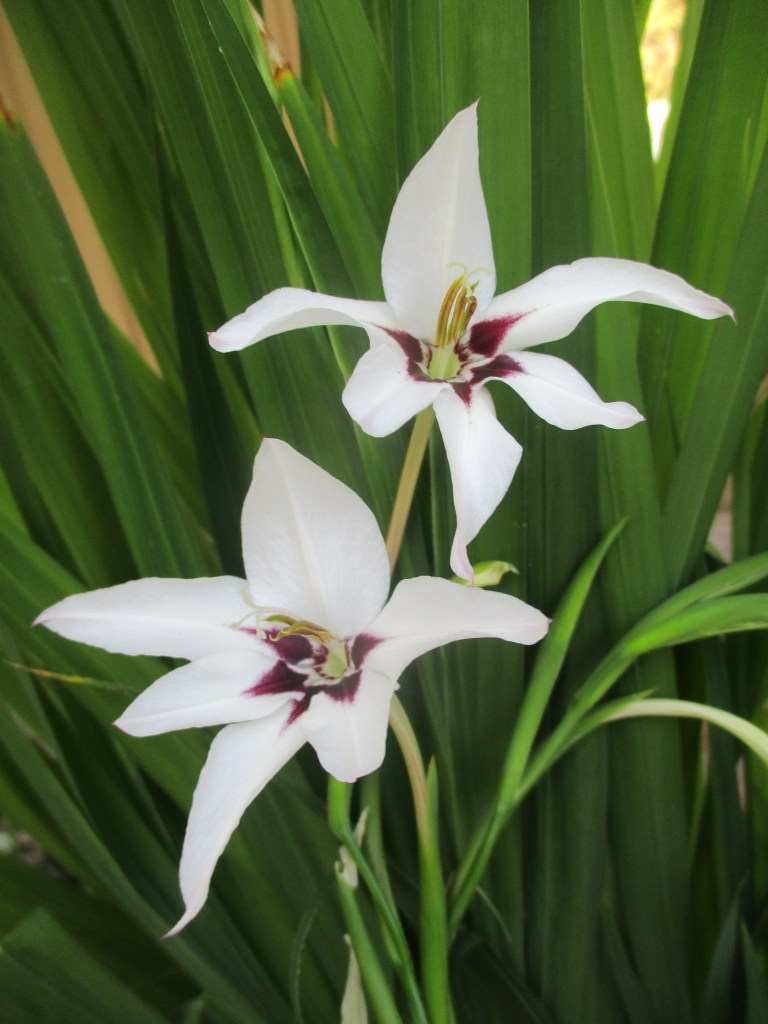
Lily of the Nile and African iris do not need dividing often, but when they do, it can be a major chore. For moderate crowding, it is relatively easy to pluck many individual shoots without disturbing remaining shoots. However, it is typically more practical to dig bulky colonies, divide them into individual shoots, and then plant the shoots. African iris shoots work best in groups of five to twelve.

Lily of the Nile, with dividing earlier than later, disperses roots in winter, to bloom for summer.

‘Green’: The ‘Other’ Autumn Color

The color is better this year than it was when this was written three years ago. Nonetheless, foliar color here is not as impressive as it is where weather is already cooler.

tonytomeo's avatarTony Tomeo

P71202After reading so much about the exquisite foliar color that most everyone else in the Northern Hemisphere gets this time of year, I must admit, I can get rather envious of those who experience four seasons instead of just two. The abundance of spring in the Southern Hemisphere does not help. Why have I not found a garden blog from Ecuador or Indonesia so that I have something to point and laugh at? It just isn’t fair.

Well, now I have something to brag about.

I found this bright red leaf on a crepe myrtle in town. Isn’t it pretty? Go ahead, you can tell me. It is gorgeous, RIGHT? Go on; say it! Say it NOW! LOUDER!

Soon, all the foliage behind it will be turning red and orange with maybe a bit of yellow. Can you see it? I think some of those leaves are starting to consider…

View original post 155 more words

This Is No Food Blog

Well, since writing this three years ago, and mentioning that I would not likely grow this squash again, . . . I grew it again. It is in the garden right now.

tonytomeo's avatarTony Tomeo

P71129There are not many things that will grow in my zone that I will not at least try to grow if I have the space and resources to do so. I really like to grow fruits and vegetables, particularly those that I am familiar with from when I was young. They are just as productive now as they were then. The only problem is that I do not know how to cook. I can freeze, can or pickle large quantities of produce, but cooking is something that I leave to experts.

I notice that almost all garden columns or blogs include recipes for the produce grown in home gardens. Mine does not. Except for a few recipes for pickles, jams and jellies, I just do not have any recipes that I would share.

When I get big winter squash, I really do not know what to do with them. I…

View original post 297 more words

Six on Saturday: Fan Club

Palms are not as popular here as they are in Southern California. Furthermore, they are less popular in the Santa Cruz Mountains than they are in the Santa Clara Valley below. There are so many more refined landscapes in the Santa Clara Valley, and they contain many more exotic species. In the Santa Cruz Mountains, cutting trees down is more of a priority than adding more.

Besides, palms look silly with redwoods. Of these palms, which are mostly fan palms, only the Mexican fan palm will get planted as the winter rain starts. The others remain canned for now.

These palms are quite the Fan Club.

1. Arecastrum (Syagrus) romanzoffianum, queen palm – is not eligible for membership in this exclusive Fan Club. It is ‘feather palm’, rather than a ‘fan palm’. Therefore, no queens allowed.

2. Brahea armata, hesper palm – is a most distinguished fan palm. It is quite rare. Like the California fan palm, it prefers warm and dry summers, so can languish if irrigated too frequently.

3. Trachycarpus fortunei, windmill palm – is the opposite. It is quite common, and could be even more common, since it is not at all discriminating, and is proportionate to compact gardens.

4. Washingtonia robusta, Mexican fan palm – had the been the most common palm locally prior to the queen palm fad of the 1990s. Unfortunately, it gets very tall. Notice the lingering ash.

5. Washingtonia filifera, California fan palm – is an aspiring member that recently grew from an old seed. It is also known as desert fan palm, and is the only palm that is native to California.

6. ‘A BIG STICK’ was the only ‘club’ I could find for this Fan Club. No one knows what it is, where it came from, . . . or anything about it. I think it is a wheelbarrow or post hole digger handle.

This is the link for Six on Saturday, for anyone else who would like to participate:

https://thepropagatorblog.wordpress.com/2017/09/18/six-on-saturday-a-participant-guide/

Statice

Statice is so popular as a cut flower that it should be more popular than it is in home gardens.

The papery flowers of annual statice, Limonium sinuatum, are so popular as seemingly synthetic dried flowers that many garden enthusiasts are surprised to find that they are happy to bloom naturally in home gardens. The clear shades of blue, purple, pink, orange, yellow and white seem to be dyed. The one or two foot tall flower stems are outfitted with odd papery ‘wings’ that make the stems seem wider than they actually are. Deeply lobed basal foliage forms shallow rosettes. Mature plants are about one or two feet tall, and a foot or so wide. Bloom begins late in summer, and continues into autumn. Good sun exposure and good drainage are preferred. Seed can be sown directly, or young plants can be added to the garden early in spring.

Dried Flowers Last All Year

These flowers were cut weeks ago, and will look just as fresh months later.

Statice, strawflower and globe thistle continue to bloom later than most other summer annuals, and hold their flowers longer. Even after bloom, the flowers are so stiff and ‘crispy’ that they remain intact and colorful until they succumb to exposure to weather. If cut and brought in from the weather soon enough, they will last as dried flowers at least until fresh flowers start to bloom in the garden next spring.

Strawflower and larger globe thistle tend to wilt and droop from the weight of the bulky flowers, so should be tied in small bunches and hung upside down to dry. Perennial statice (which has larger blooms than annual statice) tends to flop to the ground, but the stems often bend only at the base so that the rest of the stem length stays somewhat straight. Smaller globe thistle and annual statice often dry standing up while still out in the garden.

Yarrow and English lavender can be dried as well, but lose most of their color. Lavender dries naturally in the garden. Yarrow can likewise be allowed to dry in the garden, but probably keeps a bit more color if cut while still fresh and hung upside down. Because yarrow blooms are so wide, they should be hung individually or in small bundles. Queen Anne’s lace has even wider blooms that curl inward as they dry, so they really should be hung individually.

Old hydrangea flowers that are only beginning to fade can dry surprisingly well if cut and hung individually before they deteriorate too much or start to rot. Some varieties retain color better than others. Some fade almost completely to an appealing brown paper bag.

There are not many roses this time of year, but when they do bloom, even they can be cut and dried while beginning to unfurl. Only a few small and tightly budded roses can be dried when completely open. Because they droop right below the blooms, roses should be hung upside down to dry. Dark colored roses get very dark as they dry. White roses turn tan. Pink and yellow are probably the better colors.

Cat-tails and pampas grass flowers are big, bold and dated cut flowers. Yet, for situations where big flowers fit, they are just as practical now as they were in the 1970s. Because pampas grass flowers shed, and cat-tails can explode (to disperse their seed), they should be sprayed with hair spray or another fixative to keep them contained. Pampas grass foliage has dangerously serrate edges that can give nasty paper cuts, so should be handled carefully, and displayed out of the way.

Green Roof

This artice is from three years ago too, and the picture is a bit older. I sort of wonder if this tree is still there.

tonytomeo's avatarTony Tomeo

P71125Is this a bad idea for a green roof?

Is it a houseplant that got too big?

Is it a wheelchair accessible tree-house?

None of the above. It is just weird architecture, designed to preserve a rare Chilean wine palm. The tree was probably planted in the front garden of a Victorian home that was on this site before the site was redeveloped. Chilean wine palms were more popular back then; and this one seems to be about that age. Although it seems to be healthy now, the constriction in the trunk indicates that it had been stressed by the redevelopment, which undoubtedly covered much of the established root system. The time it took for the length of trunk above the constriction to grow coincides with the estimated age of the building below. The tree very likely had better access to rainwater before.

Because it is a palm, the trunk…

View original post 156 more words