Bear’s Breech

Bear’s breech can be a bit too sustainable, and difficult to get rid of.

Like some other Victorian perennials that are still happy after a century, bear’s breech, Acanthus mollis, can get to be too much of a good thing. It can become invasive where not contained. Once established, it is difficult to eradicate. The bold coarse foliage looks great while the weather is favorable, but then dies back after bloom when summer weather gets warm, leaving obvious voids where other plants were crowded out.

The good news is that bear’s breech does not require much attention at all. It is very easy to propagate by division or simply by digging a few thick roots while dormant or just as new foliage appears in autumn. Well watered plants can keep their foliage all year, so that they only need to be groomed of older foliage and spent flower stalks. Partial shade is not a problem; although snails can be.

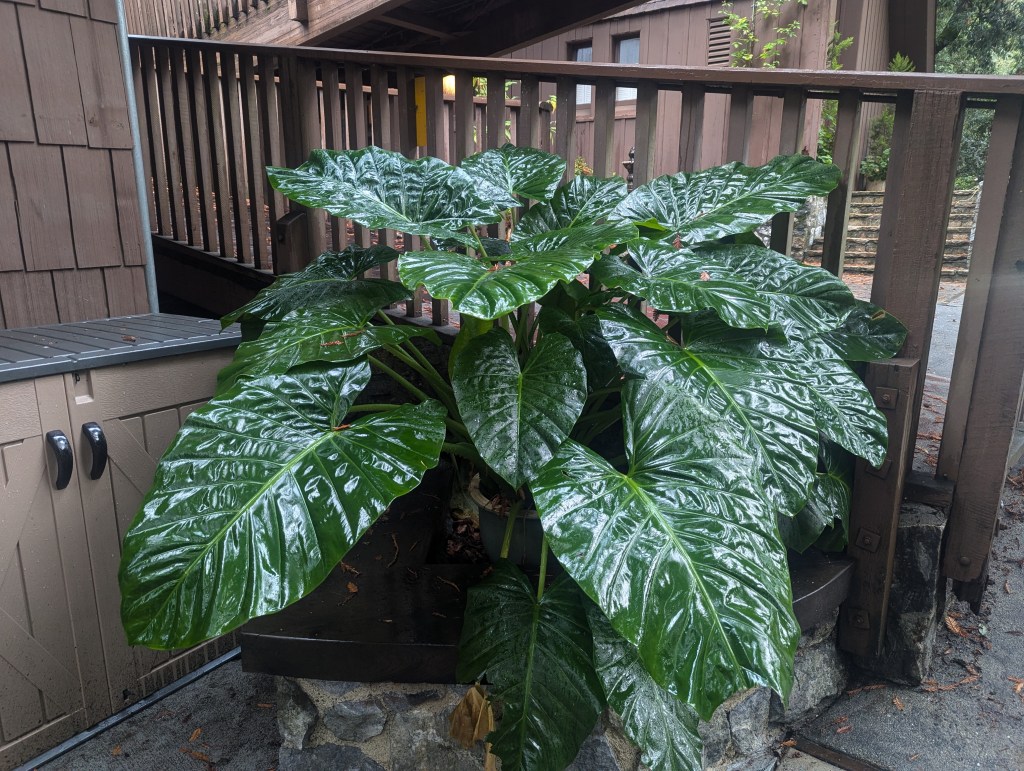
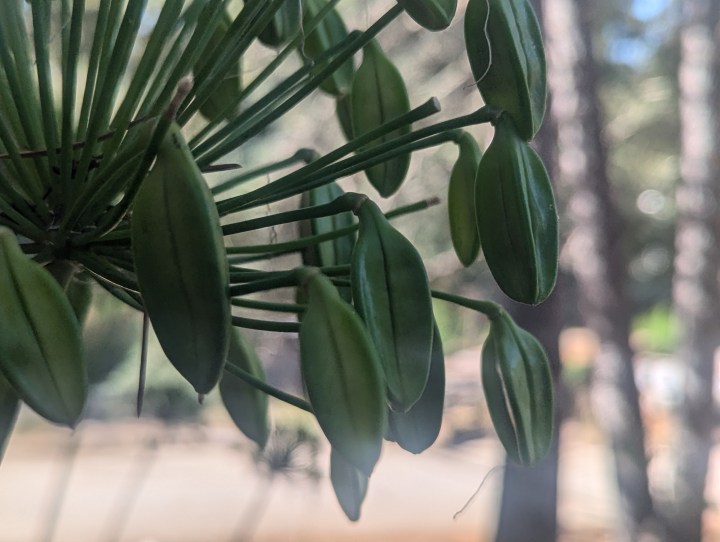
Big arching leaves form bold mounds of glossy foliage about three feet wide. The distinctively lobed and toothed foliage has an appealing texture and deep green color. Elegant mostly white flower spikes stand nearly five feet tall late in spring into summer. Acanthus balcanicus (illustrated) is more compact, with more intricately textured foliage.

Sun Scald

Vegetation needs sunlight, but sunlight can be excessive.

It was sad to see the removal of a rather mature but unstable Italian stone pine from the neighborhood. Fortunately, the arborist who removed it was careful to avoid damaging the garden below. Yet, after all the effort, the garden did not remain undamaged for long. The healthy bear’s breech (acanthus) and young Australian tree ferns that had been shaded by the dense canopy of the pine got roasted by the first warm weather.

These perennials got roasted because they were adapted to shade, but could not adapt soon enough to exposure to direct sunlight. This illustrates one of the main problems of topping trees and exposing the interiors of formerly shaded canopies. (‘Topping’ is the disfiguring removal of major portions of the upper canopies of trees.) Like perennials on the ground, foliage as well as stems and main limbs within the canopies of topped trees gets damaged by increased exposure. Although most perennials eventually adapt and recover, topped trees are often damaged too severely to recover.

Foliage can be replaced, but stems and limbs are not so expendable. Deciduous trees and most evergreen trees will replace damaged foliage within the first year. Deciduous trees that get topped while dormant in winter actually do not exhibit foliar damage, since foliage that emerges in spring will be adapted to the exposure that they grow into. However, formerly shaded stems that suddenly become exposed by topping are easily damaged by sun scald, which is like sunburn of the bark.

Sun scald deteriorates into open wounds which leave inner wood susceptible to decay. Minor sun scald of small limbs can eventually be compartmentalized (healed over) before it becomes too much of a problem. Major sun scald can destroy main limbs and even trunks, causing additional disfigurement to trees that were already disfigured by topping! Even if sun scald does not develop, the open wounds left from topping are often too large to be compartmentalized, so remain open to decay.

Regardless of sun scald, topping is more directly disfiguring, by removing well structured limbs and trunks, and causing the development of disfigured and structurally unsound limbs. Secondary growth that emerges in response to topping or severe pruning is weakly attached to the mature limbs that it emerges from because it did not grow together with the mature limbs. It breaks away easily in wind, or simply because it grows too vigorously and soon gets too heavy for weak unions.

Topping actually causes more problems than it is thought to remedy. In some situations, it is actually more practical to remove potentially hazardous trees than to make them more hazardous by topping them.

Which Mesquite?

Is this velvet mesquite, Prosopis velutina, or honey mesquite, Prosopis glandulosa? It is still too young to identify. I suspect that it is velvet mesquite because I found its seed in a landscape in Surprise, Arizona, and velvet mesquite is the most common species within landscapes there. Also, the foliage of the trees that provided the seed resembled that of velvet mesquite more than that of honey mesquite, with relatively smaller leaflets. The bark was medium brown, so was not quite as dark brown as I would expect for velvet mesquite, but more brown than tan, as I would expect for honey mesquite. This little seedling may not look like much now, but it is the only survivor of the many seed that I collected. Only a few germinated, and slugs ate them before they extended their first leave beyond their cotyledons. This seedling germinated last, and was promptly canned in a four inch pot that I brought inside at night for protection. I hope that, before the end of summer, it grows large enough to survive winter. It should. Regardless of its identity, I hope to eventually use its stems for smoking and, if it grows large enough, barbecuing.

Garden Phlox

Garden phlox can be surprisingly fragrant.

Several species of Phlox are native California wildflowers. Yet, the more popular garden phlox, Phlox paniculata, is native only east of Kansas. It can self sow where it gets water, and is naturalized in the Pacific Northwest. It prefers rather rich soil and sunny exposure but is not very discriminating. A bit of partial shade might promote taller stems for cutting.

Mature garden phlox can be as tall and wide as three feet. Some modern cultivars stay a bit more compact. Dense panicles of small flowers may be as wide as six inches. Bloom is most commonly white, but may be pink, red, lavender or pastel orange. It is a splendid cut flower, with an alluringly rich fragrance. Bloom might continue for a month of summer.

Garden phlox is deciduous, so all canes die to the ground for winter. Mature colonies are then easy to propagate by division. Similarly, feral specimens that appear where they are unwanted are easy to relocate. Garden phlox can perform nicely in proportionately large pots and planters. It is uncommonly available from nurseries, but grows easily from seed.

Feral Flowers Are Not Wildflowers

Most nasturtium varieties will eventually revert.

Feral flowers are technically not the same as wildflowers. As their designation suggests, wildflowers grow wild. They always have, without intervention. They are naturally native. Their native ranges can fluctuate, but do so naturally as associated ecosystems change. Their status as wildflowers does not change within home gardens or refined landscapes.

Feral flowers are progeny of cultivated flowers. Almost all are exotic, or nonnative. Some are true to type, which means that they are indistinguishable from the originals. However, because of extensive breeding, many revert to a more genetically stable state. Some can naturalize, or perpetuate without intervention. Then, they seem to behave as wildflowers.

For example, most home garden nasturtiums begin as garden varieties. They bloom with particular colors because of their breeding and selection. Their progeny, however, bloom with more natural floral color. After a few generations, they may bloom only basic orange and yellow. Such feral flowers can naturalize within riparian ecosystems like wildflowers.

Because they are not native, naturalized nasturtium are technically not wildflowers. They are merely naturalized feral flowers. Although they are rarely aggressively invasive, they can interfere with natural ecology. They might compete with native species for resources and space. They can sustain organisms that are pathogens to native vegetation species.

California poppy is a genuinely native wildflower. However, a few home garden varieties developed from selection and breeding. Initially, such varieties bloom with unusual floral colors like white, lavender, pink or red. After a few generations, though, their colors revert to their more natural orange. Although wildflowers, they are also technically feral flowers.

Many of the most noxious weeds here escaped from home gardens and naturalized. For example, common pink pampas grass became popular during the Victorian Period. Now, it is quite naturalized and compromising ecosystems throughout the West Coast. Its feral flowers are appealing, but perpetuate infestation. They are surely not native wildflowers. Water hyacinth and yellow flag are other examples.

Six on Saturday: Pestilence

Molluscs, rodents, insects, virus, fungal pathogens and an identified disease that causes gummosis; we have it all. I know that it is nothing to brag about, but it makes a good six.

1. Tamarindus indica, tamarind seedlings are popular with slugs. Not much else here is. Weirdly, slugs do not seem to consume the foliage. They only coat it with slime that does not rinse off. The foliage eventually deteriorates. What is the point of this odd behavior?

2. Prunus armeniaca, apricot trees sometimes exude gummosis as a symptom of disease or boring insect infestation. I can not see what caused this, and do not care to. I will just prune it out. I know that it will not be the last time. Gummosis is common with apricots.

3. Chamaedorea plumosa, baby queen palm was chewed so badly by some sort of rodent that it will not likely survive. I suspect that a squirrel did this. I have not seen any rats or their damage since Heather arrived. This is one of only two rare baby queen palms here.

4. Ensete ventricosum ‘Maurelii’ red Abyssinian banana was initially infested with aphid and associated mold. The aphid disappeared, as it typically does, but the mold remained and ruined the currently emerging leaf. I hope that the primary bud within does not rot.

5. Passiflora racemosa, red passion flower vine has been defoliated a few times just this year by a few of these unidentified caterpillars. The caterpillars leave after they consume all foliage, but then return shortly after the foliage regenerates, while I am not watching.

6. Canna indica ‘Australia’ canna is infected with canna mosaic virus. Several others are also, although they do not express symptoms as colorfully as ‘Australia’ does. Most other cannas are isolated from this virus within their landscapes. I am infuriated nonetheless.

This is the link for Six on Saturday, for anyone else who would like to participate: https://thepropagatorblog.wordpress.com/2017/09/18/six-on-saturday-a-participant-guide/

Honey Locust

Honey locust is not too shady.

Where it grows wild in the eastern half of North America, honey locust, Gleditsia triacanthos, may not seem like it would be such an appealing shade tree. It is too thorny and messy to make many friends. As it matures and grows nearly seventy feet tall and half as broad, the thorny stems stay overhead and out of the way. However, a larger canopy makes more messy and sometimes unsightly foot long seed pods.

Modern cultivars of the thornless form Gleditsia triacanthos inermis are friendlier and not so messy. Mature trees only grow about half as tall as wild trees. Their main problem is their buttressing roots, which can displace pavement, but stay tolerably low for lawns. Honey locust is actually a good shade tree for lawns (if minor buttressing is not a problem) because it makes just enough shade without getting too dark for a lawn or other shade tolerant plants below. Pods are rare.

The big eight inch long leaves are bipinnately compound, which means that each leaf is divided into smaller leaflets, which are also divided into even smaller leaflets that are about half an inch long. Although individual leaves are actually quite large, the collective foliage is pleasantly delicate and lacy. This foliage turns yellow early in autumn and disintegrates as it falls, leaving minimal debris to rake. New foliage develops somewhat late in spring, along with inconspicuous flowers.

Shade Trees

Trees are the most substantial components of a landscape.

Shady characters inhabit some of the best gardens. Actually, most of the best gardens have some sort of shade tree. There are so many to choose from for every sort of garden. Some stay small and compact enough to provide only a minimal shadow for a small atrium. Others are large enough to shade large areas of lawn.

Like every other plant in the garden, shade trees should be selected according to their appropriateness to particular applications. Favorite trees are of course welcome, but should be placed in appropriate locations where they will be less likely to cause problems later. For example, those of us who like silver maples should only plant them where they will not crowd other trees, and if there is sufficient area to accommodate them when mature. Southern magnolias are bold shade trees, but create too much mess for infrequently raked lawns, and create too much shade for many other plants around them.

Shade trees near to the home should be deciduous if possible. This means that they will drop their leaves to be not so shady when it would be good to get more sunlight through winter. Honey locust, red oak, Raywood ash, tulip tree and many varieties of maple (except Japanese maple) are some of the best. Silver maple gets a bit too large for small gardens, but is an elegant shade tree for large lawns. Japanese maple and smoke tree are small trees that fit nicely into an atrium or a small enclosed garden.

Evergreen trees also make good shade trees, but should be kept farther from the home if possible, in order to avoid shading too much through winter. Besides, most evergreen trees are messier than deciduous trees so are not so desirable over lawns, patios or roofs. Camphor tree and several of the well behaved eucalypti are delightful shade trees where their litter will not bother anyone. Mayten tree is a smaller tree for more confined areas. Strategically placed evergreen shade trees can also function to obscure unwanted views.

Every shade tree creates a specific flavor of shade. Honey locust makes just enough shade for summer weather without making the garden too dark for other plants and lawn grass. Silver maple is a bit shadier. The shade of redwood and Southern magnolia (when mature) though, is so dark that not many other plants want to get close to them.

Remember that appropriate shade trees may be in the garden for decades or even centuries. It is best to select them accordingly so there will be fewer problems in the future.

Archaeology

Working within landscapes is obviously very different from working on the farm. Actually, there are too many differences to mention. One difference is people. There are only a few on the farm, spread out over many acres. Conversely, the landscapes that I work in are designed for use and enjoyment by countless people who attend events there. I can rarely get away from all of them. Although it can be fun, it can also be challenging, and often interesting. On rare occasion, I find artifacts that make me wonder about whomever left them. This tiny terracotta pot with “Zoey” painted on it, for example, was found in a small landscape outside of a bookstore, quite a distance from the facility a which young children typically engage in such crafts. I hate to think that Zoey misplaced it there. I sort of hope that it was intentionally left there, perhaps containing a tiny plant that Zoey hoped a gardener would find and add to the landscapes. If so, I found it too late and empty. Zoey does not need to know that. Hopefully, if she returns, she finds something that she believes to be her plant growing happily in our landscapes.