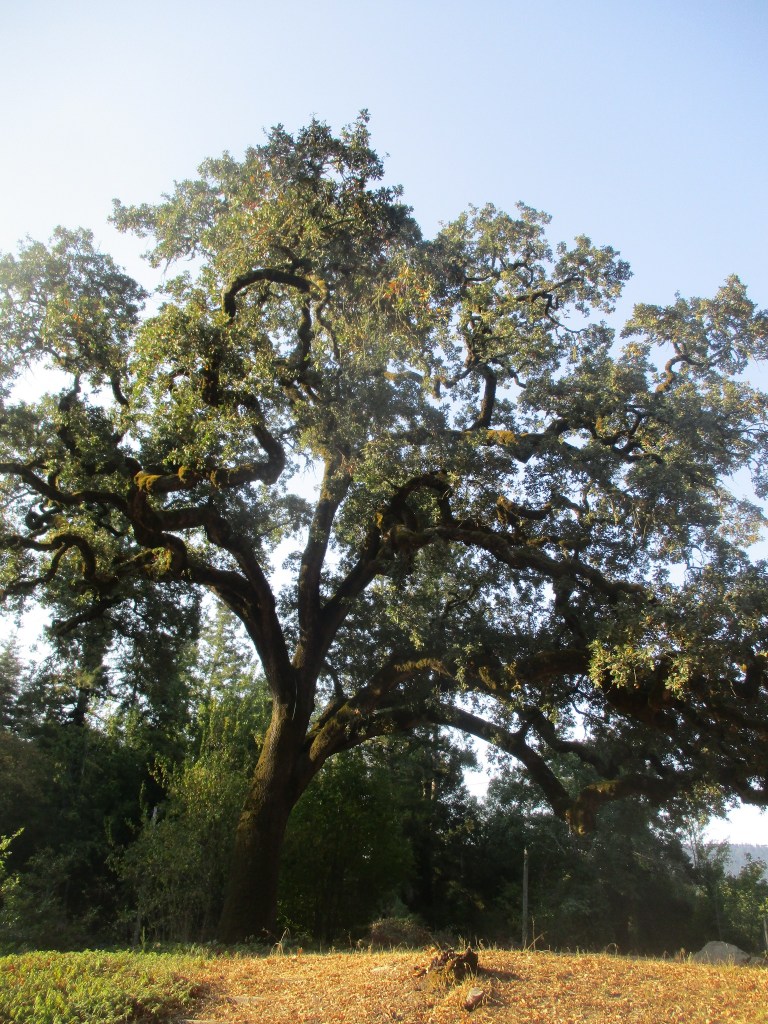
Bigleaf Maple

00729
A maple with unusually big leaves.

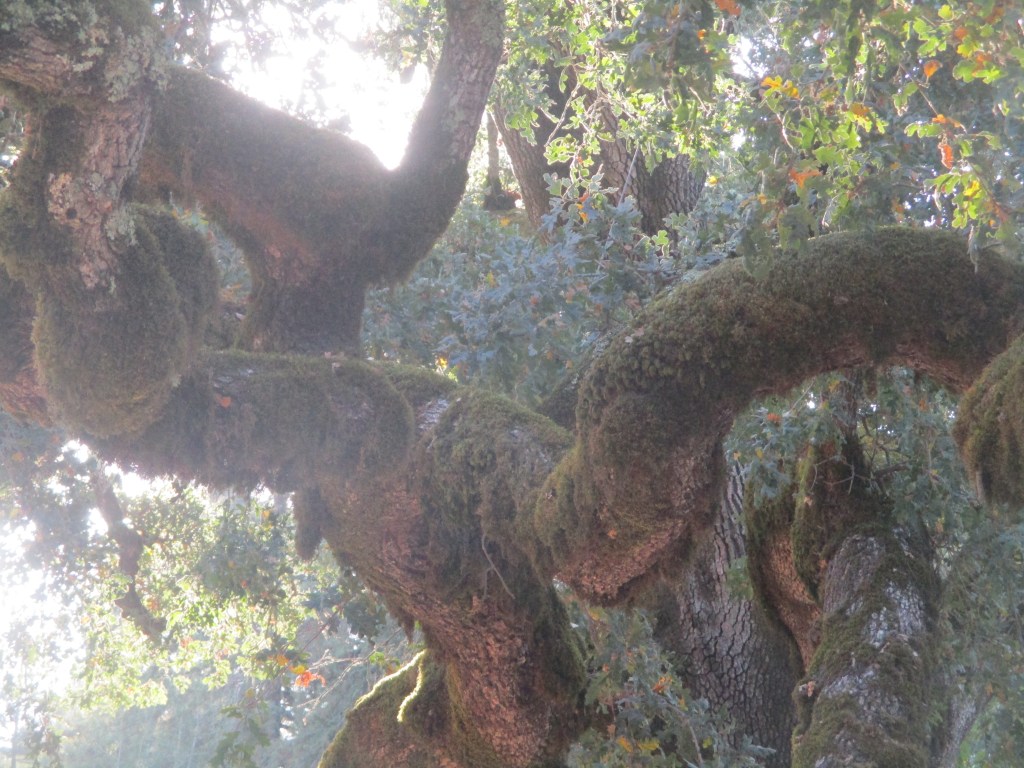
Its natural coastal range extends from the extreme southern corner of Alaska to the southwestern corner of California. Another inland range occupies foothills of the Sierra Nevada. Bigleaf maple, Acer macrophyllum, is the most common and prominent native maple here. However, it prefers the seclusion of forested riparian situations at higher elevations locally. It is rare in urban gardens.

Bigleaf maple is best in the wild anyway. It dislikes the aridity of most of the urban and suburban areas of California. (San Jose is in a chaparral climate. Los Angeles is in a desert climate.) Roots of bigleaf maple are potentially aggressive, especially if irrigated generously. They easily displace pavement. Nonetheless, where climate and circumstances allow, bigleaf maple is a grand tree.

Wild trees grow as tall as a hundred fifty feet within forests where they compete for sunlight. Well exposed suburban trees should stay lower than forty feet, while extending their canopies broader than tall. The big and palmately lobed leaves are mostly more than six inches wide. Foliage turns yellow in autumn, and is abundant as it falls. Self sown seedlings often grow under mature trees.

California Native Plants Exemplify Diversity

00729thumb
Redwoods are the grandest native trees.

California native plants are logical options for the gardens and landscapes of California. It is only natural. They are already happy with the climates and soils here. They do not need to adapt quite as much as plants from other regions and climates do. After all, they lived here long before anyone else was here to water and maintain them.

Unfortunately, it is not that easy. California is a very diverse place. There are more climates here than there are within many other states combined, over a much larger area. Plants that are native to the Mojave Desert would not be happy in a rainforest of the Siskiyou Mountains. Coastal plants would be no happier high in the Sierra Nevada.

Within reason, California native plants for landscapes and home gardens should be either locally native, or native to similar climates. Plants from very different climates within California are about as exotic as plants from other continents. Just like foreign exotic plants, they may require special accommodation, such as irrigation, to survive here.

All plants need irrigation when first installed. Irrigation can be slightly complicated for plants that are native to climates with long and dry summers. They certainly need irrigation until they disperse their roots. However, a bit too much can rot their roots. California native plants can be sensitive like that. After all, they do not expect to be moist through summer.

Then, once established, many California native plants do not want frequent irrigation. Many want none at all. Chaparral plants like oak, manzanita, toyon, ceanothus and coyote brush tend to rot with too much watering. Plants that are native to riparian or coastal regions, like redwood, bigleaf maple, willow, cottonwood, elderberry and ferns, tolerate more irrigation.

Most California native plants that are from chaparral or desert climates do not perform well within the confinement of pots or planters. They prefer to disperse roots very extensively and directly into the soil, just like they do in the wild. Once established, they do not transplant easily.

Bad Wine

P00719
I believe that this is a young Chilean wine palm, although I am not certain.

Italian Americans, particularly Californians, are expected to be experts in regard to wine. I am not. I can not explain it. I dislike wine, especially the best of it. It smells and tastes like rotten grapes. When I learned that Chilean wine palms were, and might still be, decapitated for the collection of their sap, from which wine is made, I learned yet another reason to dislike wine.

This little Chilean wine palm, Jubaea chilensis, pictured above, lives just a block or so away from the bad date palm that I wrote about last Sunday. No one here will try to make wine from its sap. The utility cables that seem to be too close in the background actually pass with plenty of clearance to the right, so will not be a problem in the future. This young palm should be safe.

Although I have encountered too few of the species in my career to be completely certain that this little palm is a well bred Chilean wine palm, it is very convincing. I see no indication that it is a hybrid of another species. About half of the Chilean wine palms that I encounter are hybrids. Most of these are hybrids of queen palm. Others are hybrids of pindo palm. Both look weird.

Of course, well bred Chilean wine palms are not much better. The specimen pictured below demonstrates that, regardless of how bold and striking they are, they are still rather weird palms. That is probably why they are so rare now. They were rare even during the Victorian Period, when weird species were trendy. Yet to many, their distinctive weirdness is part of their allure.

I can not help but wonder where this Chilean wine palm came from. Someone must really appreciate it to put it here.

P00719-2
Chilean wine palm is not a good houseplant.

Fine China

P00718K-1
Before: There was not much hope for the Chinese maple underneath this mess.

It will be just fine. The Chinese maple that I mentioned earlier this morning sustained surprisingly minimal damage when part of a bay tree fell onto it. The situation initially seemed hopeless prior to the removal the heavy debris that was pressing the diminutive Chinese maple downward. Yet, the little tree somehow regained its composure, and is expected to recover.

The little Chinese maple was always rather sparse in the shade of the surrounding forest. Also, it exhibited an asymmetrically sculptural form. That is likely normal for the species within its natural environment, where it lives as an understory tree (within the shade or partial shade of larger forest trees). The distinctive form and open canopy were part of its allure.

As the debris was removed, most of the stems of the Chinese maple sprang back into their original positions. Only two major limbs were fractured and needed to be pruned away. Some of the minor twiggy growth was groomed in the process. The main trunk was somewhat destabilized, but not too detrimentally so.

It probably should be no surprise that the little tree was so resilient to the altercation. It is, after all, an understory tree. Within its natural environment, it likely contends with the same sort of abuse. Chinese forests are likely just as messy as forests here are. Gravity pulls all that mess in the same direction.

The little Chines maple may not look like much now that it has been groomed and pruned to be even more sparse than it originally was, but it should be fine. By this time next year, foliar density should be comparable to what it was prior to the incident. The form will remain sculptural, as it grows away from the shade of the forest, and out over the stream below.

P00718K-2
After: After a bit of grooming, this little Chinese maple is not so badly disfigured.

Six on Saturday: Timber! III

At the end of May, Six on Saturday – Timber! II, ended with a precariously disfigured bay tree. Timber!, on May 10, mentioned that most of the tree had previously broken apart and fallen on top of a big Douglas fir tree that had fallen earlier. Prior to this big mess, the bay tree had been leaning on the Douglas fir tree. Now, it just continues to deteriorate. The precariously disfigured limb that remained last May was the most recent victim of gravity. Not much of the tree remains.

1. This was what we were concerned about. The disfigured and fractured trunk twisted from leverage exerted onto it by an upper limb, which is now extended downward instead of upward.P00718-1

2. Damage was impressively minimal. An exemplary specimen of Chinese maple sustained a direct hit from the main limb of the bay tree, but also sustained only minor structural damage.P00718-2

3. The trail somehow remained passable, although closed because of the big fallen limb dangling above. As the limb was dismantled, the fractured portion of the trunk broke away and fell.P00718-3

4. This big piece of the twisted and fractured portion of the trunk looks like a canoe, and is about as big. This was suspended more than twenty-five feet up, which is why the trail was closed.P00718-4

5. What remains of the bay tree is still severely disfigured, but is not so dangerously structurally compromised. It can remain until another arborist can get here to remove it and other trees.P00718-5

6. It looks worse up close. Nonetheless, there is not much we can do about it now. The limb to the far right originates from the same trunk. The big gray trunk in the background is a tan oak.P00718-6

This is the link for Six on Saturday, for anyone else who would like to participate:

https://thepropagatorblog.wordpress.com/2017/09/18/six-on-saturday-a-participant-guide/

Water Lily

50715+
Water lily bloom emerges from the depths.

The fragrant flowers of water lily are unreal! They either float on the surface of the water, or hover just above. Abundant pointed petals radiate outward from central tufts of pronounced stamens. Most flowers are soft hues of yellow, pink, blue, lavender, peachy orange or white. Some are brighter yellow or pink, or richer shades of red or purple. Some open in the morning. Others open in the evening.

The rubbery leaves that float on the surface of the water are nearly circular. Some are symmetrically cleft to the center, like Pac-Man or a pizza with a slice taken out. The thick rhizomes that the foliage and flowers emerge from stay buried in pots or mud under the ponds that they live in. Rhizomes can be divided to propagate, but take a year or so to recover and bloom.

Ponds Cannot Conserve Water

50715+
Aquatic plants provide shelter for goldfish who eat mosquitoes.

During a drought, there really is no way to use less water in a garden pond. Aquatic plants can not survive without adequate water; not to mention fish! Pumps that circulate water must stay submerged to operate properly, and to not get damaged by operating without water. Some degree of water needs to be added regularly to compensate for evaporation.

Water does not evaporate from below the surface of the water. Therefore, depth is irrelevant to water loss. The area of the surface of the water is more important. Sunlight and wind accelerate evaporation. So do fountains or pumps that broadcast water through the air for circulation. Aquatic plants that stand above the surface of the water lose water to evaporation from foliar surfaces.

Yet, most of us who enjoy gardening cannot resist growing aquatic plants if a pond is available. Not only do they provide distinctive foliage and bloom, they also provide shelter for goldfish or minnows that control mosquitoes. They keep water clearer by competing with algae.

Submerged aquatic plants, like anacharis, do everything in the water. Some do not even need soil to root into. Because they do not come above the surface of the water, they do not affect evaporation. None of the floating plants, like water hyacinth, water lettuce and duck weed, have any use for soil either, although some of the leafiest sorts can accelerate evaporation.

Water lilies and lotus are emergent aquatic plants, which naturally live in mud on the bottom of ponds, but develop foliage and flowers that emerge and float on the surface. Although they have the potential to affect evaporation, most are more likely to inhibit evaporation by keeping water shaded. In garden ponds, they must be potted, and should be under at least a foot of water.

Relative to other aquatic plants, bog plants such as cattails, aquatic cannnas, and blue or yellow flag iris consume the most water from saturated soil at or just below the surface of a pond. They produce the most foliage that stands well above the water. Like water lilies and lotus, bog plants need to be potted, but with the tops of their soil barely below the surface of the water.

Pots should be low and wide, and obviously do not need drainage holes. Unnecessary holes only spill a bit of soil, and allow roots to escape and grab onto the bottom of a pond. Good old fashioned soil (yes, dirt from the garden) is fine. Good quality potting soil merely floats away.

Horridculture – Solar Power

P00715
This gives a new meaning to ‘shade tree’.

Leaves are the original solar panels. They collect solar energy, and convert into useful resources. Some of those resources get converted into other resources that are good for human consumption, such as fruit, vegetables, lumber, firewood and oxygen. However, one resource that leaves do not produce is electricity.

That is why the big solar array pictured above was installed over a big parking lot. There are a few of these arrays in this parking lot, and more in other nearby parking lots. Many trees were cut down to accommodate them. People who work nearby can use the electricity more than they could use vegetation, or anything that vegetation could produce within this area.

Shade trees are nice over parking lots, but are not necessary over a parking lot that is shaded so thoroughly by such big solar arrays. After parking during rainy weather, an umbrella is only necessary between the solar arrays and the adjacent office buildings. There are no more fallen leaves to clean up. Pavement and curbs will no longer be displaced by growing roots.

The red gum that is also pictured above, under the solar array, is not so impressed. It likely grew from a root of a red gum that was removed so that the solar array could be constructed. Sadly, it must be cut down again, not only because it is under the solar array, but also because it is against the sidewalk. It has clearance problems both above and below.

It is rather ironic that even after all the trees that formerly shaded this parking lot were cut down for the installation of this solar array, this young red gum that is so determined to survive can not stay. I can not help but wonder what this young red gum thinks of green energy.

Shiny Xylosma

00722
Shiny xylosma should get more respect.

As a backdrop for more interesting plants, shiny xylosma, Xylosma congestum, may not get the respect that it deserves. If it seems to be a bit too common in some big landscapes, it is probably because it is so practical. It can function like the strictly shorn hedges that were popular decades earlier, but is a bit more adaptable to modern landscape styles. It can be formal or quite informal.

Formal hedges of shiny xylosma are typically no taller than eight feet, and a bit more plump than old fashioned privet hedges. They can get a bit sparse if kept too lean. Informal hedges are mostly lower and plumper, with casually irregular surfaces and no corners. Old shiny xylosma can grow as a small tree more than eight feet tall. Younger specimens are of the shorter cultivar, ‘Compacta’.

Established shiny xylosma is surprisingly resilient. Roots disperse impressive distances to reach moisture so that old specimens can survive without direct irrigation. Although, they prefer regular watering. Overgrown specimens can eventually regenerate nicely from coppicing or pollarding. The main disadvantage is that vigorous new growth will likely develop concealed but sharp thorns.

Nursery Cans Are Only Temporary

00722thumb
Nursery cans are not permanent pots.

Garden enthusiasts would understand the temporary nature of nursery cans better if they knew more about how plants grow in nurseries. Few plants actually grow in the retail nurseries that market them. They grow in production nurseries, where efficiency is a priority. Nursery cans, which retailers and consumers refer to as ‘pots’, are the most efficient means with which to contain the crops.

Most nursery cans are thin black vinyl. While plants are small, crowded ‘can to can’ arrangement shades the black vinyl so that it does not get too hot from sunlight exposure. Those on the western and southern edges of a crop might get shade from a temporary row of empty cans or a plank leaned against them. As plants mature and need more space, their growing foliage shades the vinyl.

As plants become marketable, they go from production nurseries to retail and wholesale nurseries. From there, they go to new landscapes and home gardens. Only then do they finally escape the nursery cans that they grew up in, to disperse their roots into real soil. The nursery cans have finished their job. Plants can not live in them forever, even if they continue to live in other types of pots.

Nursery cans are efficient, but not necessarily comfortable. By the time they are marketable, the plants that they contain are generally about as big as they can get within their cans. If they get any bigger, their roots will be crowded. If too exposed to sunshine, the black vinyl gets hot enough to cook the roots within. Plants prefer to be in the ground, or at least pots that are more comfortable.

Potted plants that will grow bigger should live in pots, planters or other containers that are bigger than the nursery cans that they grew in. Some will want even larger containers as they grow more later. Annuals and plants that will not grow much bigger are not so critical. However, all potted plants that will not shade their own pots appreciate containers that are better insulated than thin vinyl.

Clay pots, wooden planters and even concrete urns are as practical as they are appealing.