This article from three years ago is always relevant in our chaparral climate, with or without rain.
via Rain!
This article from three years ago is always relevant in our chaparral climate, with or without rain.
via Rain!
This posted in the middle of October three years ago. At the time, it seemed early. It seems to be even early in September. However, because of the weather this last summer, it is actually rather timely.
via The Trees Know
Since the Fire, my Six on Saturday posts have been rather gloomy. Titles such as ‘Pompeii‘, ‘Revelation‘ and ‘Revelation II‘ are appropriately descriptive. More color is in order.
1. Silvery bark of a silver maple is sort of colorful. Hey, the next five really are more colorful. I planted this tree as a young twigling in the Santa Clara Valley when I was in high school. It had a second trunk, which I layered as another tree for the front garden. This tree is in back. I would like to get a copy for my own garden. This is now an old picture that I got during evacuation.

2. Orangish red bloom is that of ‘Pollack’ zonal geranium, which is grown more for its very variegated foliage. However, this bonus bloom is on a specimen that reverted to be less variegated.

3. Peachy Peruvian lily looks pink to me, but is not quite as pink as the pink sort. There is a yellow sort here too. They certainly are prolific. In 1986, I worked with these as a cut flower crop.

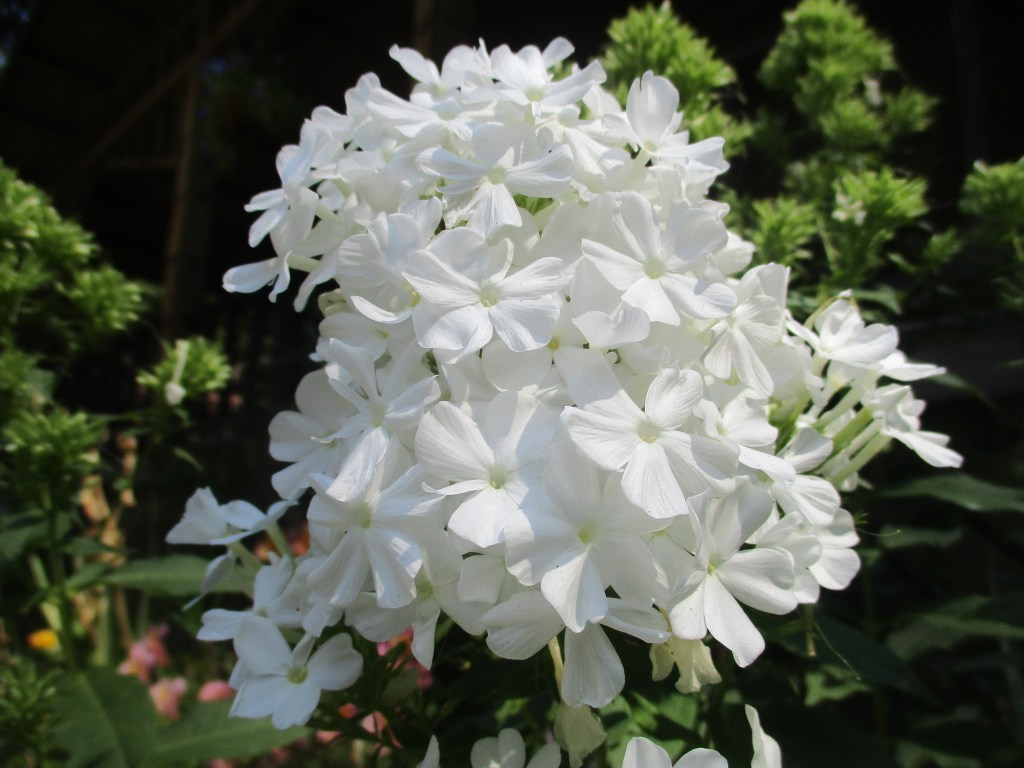
4. White phlox self sowed here last year or earlier, and have performed splendidly. There are more this year than there were last year. It would be excellent to get a few more for next year.
5. Blue annual morning glory grew up with my tomatoes. Oddly, they did not do so well where their seed were actually sown intentionally, in pots on the deck up above the vegetable garden.

6. This is my favorite picture this week. I can not read what, if anything, is written in paint on this rock. It looks like someone enjoyed painting it, and placing it to be found out in the garden.

This is the link for Six on Saturday, for anyone else who would like to participate:
https://thepropagatorblog.wordpress.com/2017/09/18/six-on-saturday-a-participant-guide/

‘A Tree Grows In Brooklyn’ documents the resiliency and invasiveness of the common but typically undesirable tree of Heaven, Ailanthus altissima. Once a single female tree get established, the extremely prolific seeds get everywhere, including cracks in concrete. The resulting seedlings conquer wherever they are not dug out. If cut down, they just resprout from the roots.
Male trees smell horrible while blooming for about a month in spring or summer. They are pollinated by flies, so naturally smell like what flies like. The tiny yellowish or tan flowers hang on panicles that can be a foot and a half long. Female blooms are not as big, prolific or objectionably fragrant. However, stems, leaves and all other parts of both genders smell rotten when handled.
Tree of Heaven, which has earned the alternative names of ‘tree of Hell’, ‘stink tree’, ‘ghetto elm’ and ‘ghetto palm’, is no longer a tree that gets planted by choice. It is typically a tree that plants itself, and on rare occasion, happens to grow into a good situation. They should not be allowed to overwhelm more desirable trees, or get too close to concrete or other damageable features.
Young trees grow very fast to about forty feet tall. Older and slower trees do not get much taller, although sheltered trees can get twice as tall, with elegant gray bark. They do not live much more than fifty years. The big pinnately compound leaves are surprisingly pretty. On vigorous shoots, individual leaves can get as long as two and a half feet, with leaflets as long as six inches.
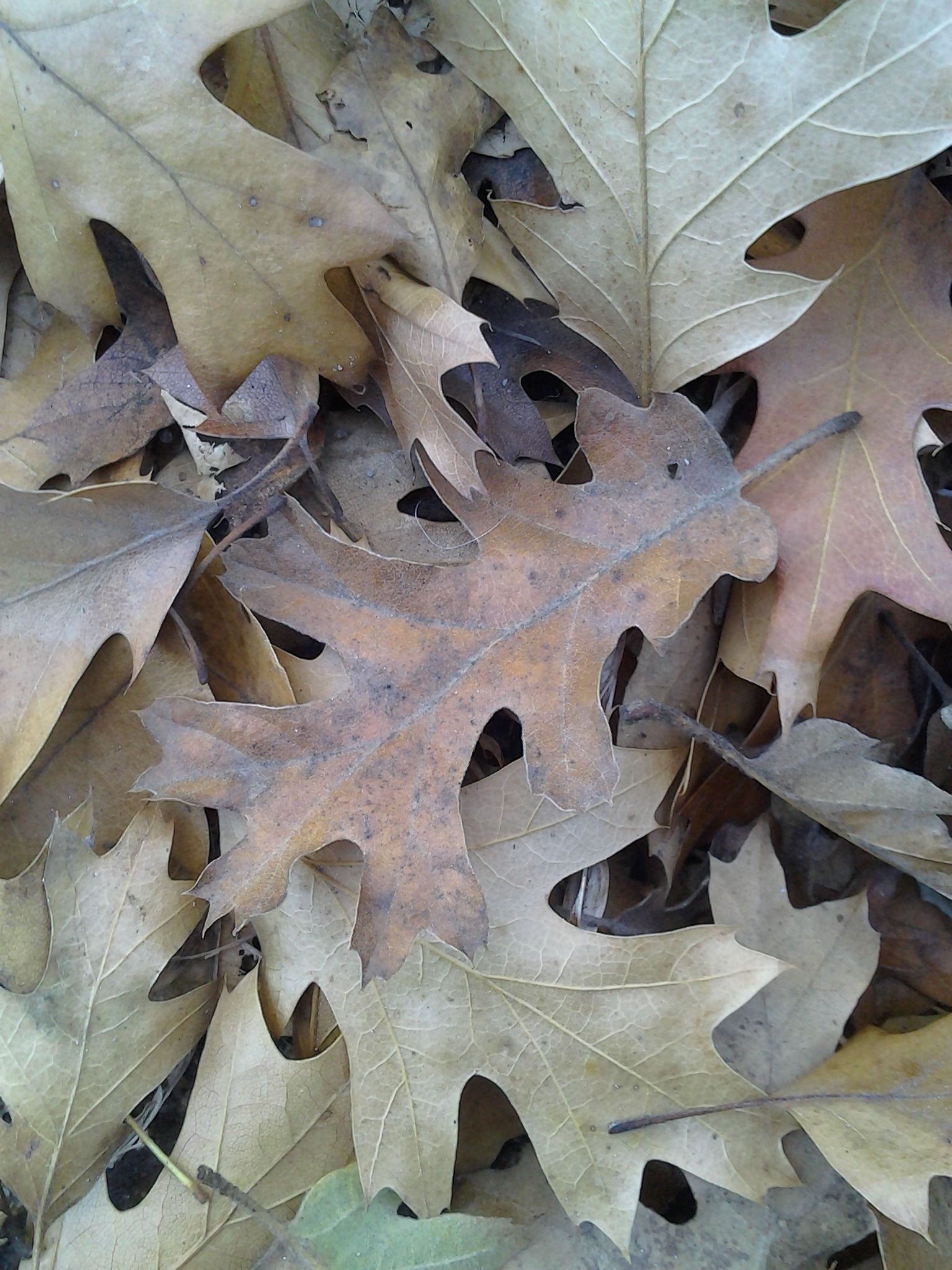
Autumn color is different every year. Sometimes, early and sudden cool weather after a mild summer promotes good foliar color that lingers longer while relaxed trees slowly realize that they should probably start to defoliate. Sometimes, early wind and rain accelerate defoliation of otherwise good color. There are a few variables that trees must adapt their performance to.
Warm and arid weather two weeks ago started the process of defoliation suddenly and a maybe slightly early this year. Even before the weather gets cool, deciduous trees are already starting to shed the oldest of their foliage that they do not need in order to hold their youngest foliage a bit later into autumn. Evergreen trees do the same to limit desiccation.
Slightly breezy weather that was so pleasant after such heat was just enough to start dislodging deteriorating foliage. Now, leaves are already starting to fall before they develop much color. Redwoods and pines are likewise dropping browned needles. Fortunately, trees that are the most colorful in autumn tend to hold their foliage better until the weather gets cooler.
It is impossible to predict how colorful trees will be this autumn; although if storms are as healthy as predicted, the mild temperatures may inhibit color, while wind and rain dislodge colorful foliage. Regardless, it is already time to start raking falling leaves and needles. They can get messy, and when the rain starts, they can stain pavement and clog gutters.
When more foliage falls later in autumn, it will need to be raked from ground cover, surviving portions of lawn, and any other plants that collect it, so that it does not shade out the sunlight.
For those of us who like white, this topic ‘almost’ conforms to the ‘Horridculture’ meme that I typically write for on Wednesdays.
via White Trash
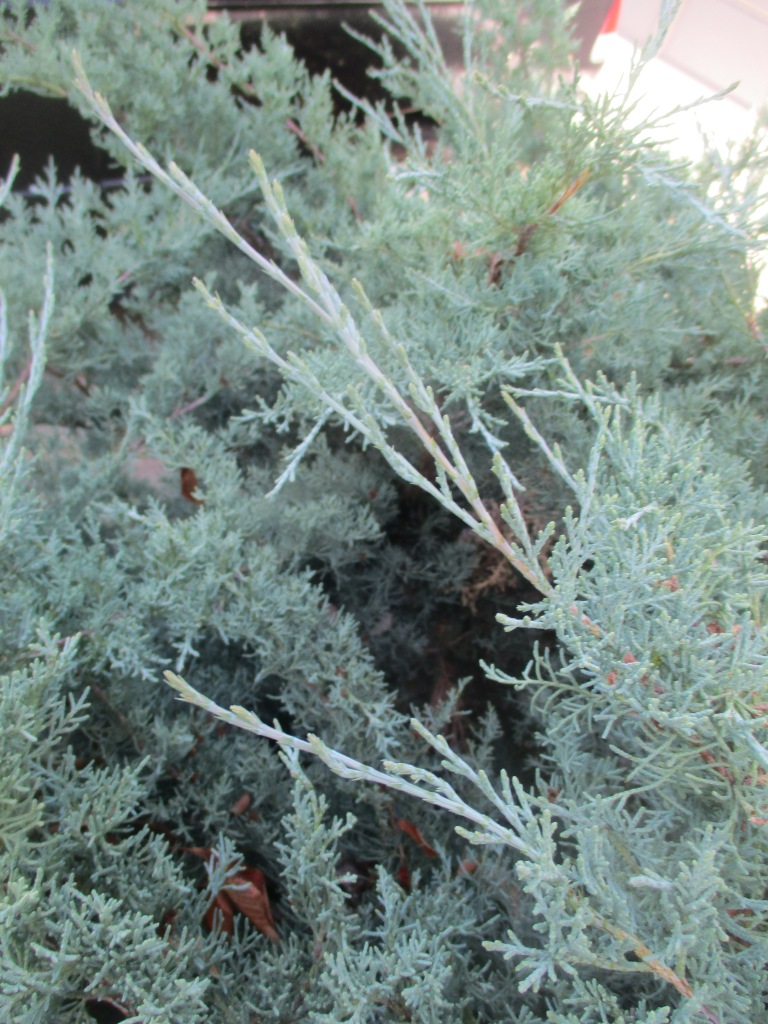
Some junipers that were so popular in the 1950s are now somewhat rare, or redundant to modern cultivars. Although not as common as it once was, Hetz blue juniper, Juniperus chinensis ‘Hetzii Glauca’ is still practical for modern gardens. Most junipers with such bluish gray foliage are either low and sprawling, or upright and tall. Hetz blue juniper exhibits an elegant outwardly flaring form.
Mature specimens can get taller than six feet, and as broad as ten feet. The dense evergreen foliage is not quite as blue as that of blue spruce, but is nonetheless striking amongst deeper green. Straight stems point sharply outward at about the same low angle, but in all directions. Removal of lower growth from old and overgrown specimens might reveal peeling bark and sculptural limbs.
Established Hetz blue juniper with warm and sunny exposure is nicely undemanding. Occasional irrigation through the warmest summer weather maintains color and foliar density. However, color naturally fades slightly and slowly through summer. If possible, selective pruning should completely remove obtrusive stems from their origins. Otherwise, stubs might compromise the natural form.
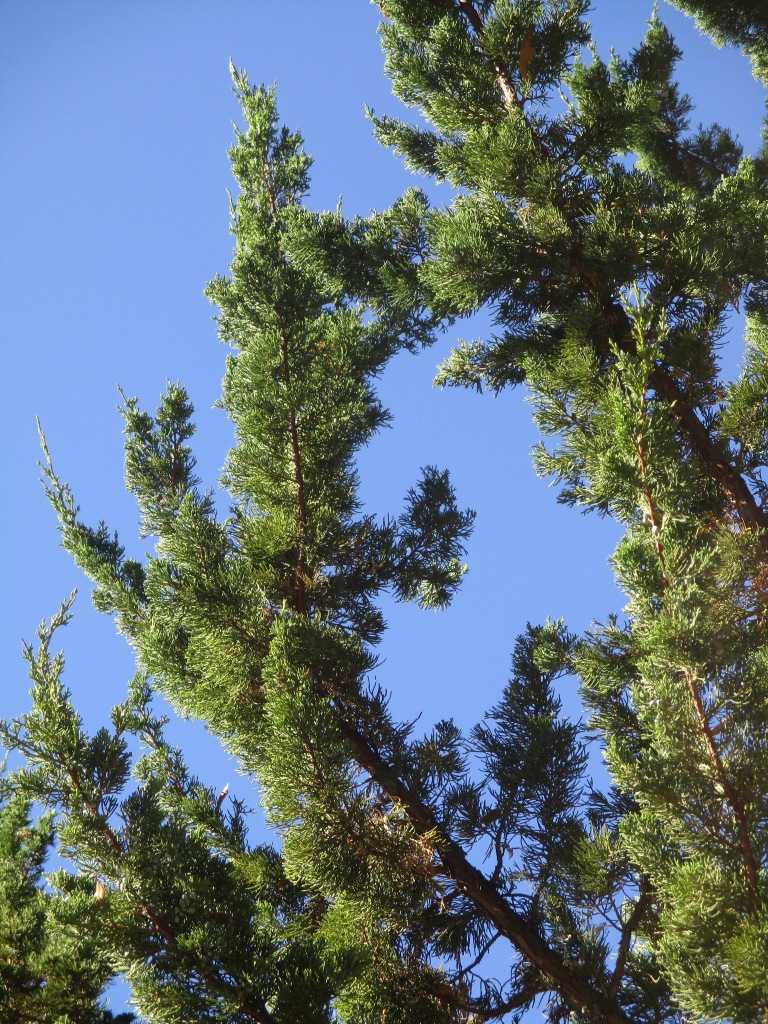
Juniperus, which is the entire genus of juniper, had been languishing in a bad reputation for too long. The problem likely began nearly three quarters of a century ago. More people than ever were enjoying leisurely suburban gardening. Many appreciated the resiliency of juniper cultivars. At that time, a few species of juniper were gaining popularity. Evolving cultivars sustained new demand.
Unfortunately, these modern and once distinctive cultivars of juniper eventually became passe and too common. As practical and resilient as they truly are, they collectively shared the stigma of a minority that were problematic. Their problems were disproportionately evident merely because of their commonness. Many matured at the same time, so developed problems at the same time.
Realistically though, the majority of the garden varieties of juniper that grew during that time were quite practical. Those that started in the 1950s, but developed problems in the 1990s, performed satisfactorily for four decades. Not many other types of plants perform as reliably for as long. Many problems resulted from selection of cultivars that were inappropriate for particular applications.
Although all junipers are evergreen foliar plants that provide no obvious bloom, they are remarkably diverse. The most popular sorts are low and dense shrubbery. Others are lower and sprawling ground cover. Some are small trees. A few species grow more than thirty feet tall! Branch structure is mostly densely compact, but can be sculpturally irregular, rigidly upright or gracefully arching.
Foliage is generally rich deep green. Some cultivars exhibit yellowish new foliage that fades to green through summer. A few are variegated with creamy white. Several popular cultivars are gray or bluish gray. Leaves of almost all popular cultivars are scale like. Some have needle like leaves. A few have both. Even without prominent bloom, a few cultivars produce appealing tiny berries.
It is time for the many cultivars of juniper to grow beyond their former bad reputation and turn a new scale or needle.
California really does have the most excellent state tree!
via Redwoods
This posted more than three years ago, but was relevant only recently. I just had no time to write about the CZU Lightning Complex Fire while it was actively burning so much in this region.

