Six on Saturday: Rhody’s Rhodies II


As mentioned last week, the first five of these pictures are now two weeks old. They are too pretty to discard for lack of punctuality. However, it was necessary to delete one so that the most important, although less horticultural, sixth picture could be included. Not much of the bloom remains now.

1. Color seems odd for this one. It did not seem so greenish to me when I got the picture. In fact, it seemed more pale, and almost white. I know the camera sees it more accurately than I do.P00523-1

2. #1 from last week, which may have been ‘Mrs. G. W. Leak’, looks like this. I did not notice earlier. I would have otherwise deleted this instead of what I deleted to leave room for #6 below.P00523-2

3. If #4 from last week did not look like ‘Anah Kruschke’, it is because this one is. I knew I got a picture of it, but somehow switched the two. This is the only one that I can identify this week.P00523-3

4. Color is something that I am not proficient with. I do happen to prefer this color to other purple rhododendrons. I do not know if it is purple or lavender, or if lavender is just pastel purple.P00523-4

5. Of all the rhododendrons here, only a few are as richly red as this one. Of those few, this one is the second largest specimen, and most prolific in bloom. It is usually one of the last to bloom.P00523-5

6. Rhody! It is not much, but it proves that I at least tried to get a picture of what we all came here for. I deleted a good picture of another rhododendron to do it! Rhody would not cooperate.P00523-6

This is the link for Six on Saturday, for anyone else who would like to participate:

https://thepropagatorblog.wordpress.com/2017/09/18/six-on-saturday-a-participant-guide/

Pin Oak

50520
Pin oak is not drought tolerant.

There are several oaks, especially natives, that do not need much more water than they get from rain. Pin oak, Quercus palustris, is not one of them. It is naturally endemic to areas that are damp or swampy for part of the year. It is more tolerant than others are to lawn irrigation, but is also more sensitive to drought.

Compared to other oaks, pin oak grows fast while young. It can get two stories tall in about ten years. Then, it takes more than twice as long to double in size. Old trees do not get much more than fifty feet tall, with trunks nearly three feet wide.

The deciduous foliage turns as brown as a grocery bag in autumn, and may linger late into winter, or until it gets replaced by new foliage in spring. The distinctively deeply lobed leaves are about two to five inches long, and about two thirds as wide. Each leaf has five or seven lobes. Each lobe has five to seven teeth.

Streets Are Cooler With Shade

P91124+
Parked cars stay cooler in shade.

There really is no such thing as a perfect tree. Some are not quite as messy as others. Some have better structural integrity than others. Some have gentle roots; and some stay proportionate to tight spots. However, without exception, all trees grow, drop leaves, and disperse roots.

This is an important consideration when selecting any tree, and especially when selecting a street tree for the narrow space between the curb and the sidewalk (which is commonly known as a park strip). Even where there is no sidewalk, or where the sidewalk is at the curb, most of the obstacles are the same.

Street trees should have reasonably complaisant roots that should not be likely to damage curbs, sidewalks or roadways, at least for several years. They should naturally develop reasonably high branches. They will need to be pruned higher than trucks that may park at the curb. Street trees must also tolerate harsh exposure.

Wider park strips can of course accommodate larger trees. Those that are only two feet wide or narrower are probably not wide enough for any tree larger than photinia, purple-leaf plum or English hawthorn, which are difficult to prune for clearance over roadways and sidewalks.

Messy leaves, flowers or fruit that might not be a problem within the garden might be more of a problem at the curb. It is not so easy to rake such debris if cars park over it. Trees that are commonly infested with scale or aphid are likely to drop sticky honeydew (scale and aphid poop) onto parked cars.

Unfortunately, those who get street trees do not always get to select them. Many municipalities assign specific trees to specific streets. Some streets have a few trees to choose from. Others have only one option. Home Owners’ Associations (HOAs) decide if and where new trees get planted.

Crape myrtle is probably the most common choice for a new street tree because the roots do not get big enough to damage pavement. However, the canopies are not very big either. They stay too low to be pruned above trucks. Crape myrtle is susceptible to scale infestation that can get bad enough to make sidewalks sticky.

For many years, London plane (sycamore) had been another popular street tree. Unfortunately, the voracious roots can damage pavement within only a few years. The messy foliage discolors and starts to fall before autumn.

Horridculture – Dust Bowl

P00520
Cimarron County in 1940 or the road out back last Wednesday?


In a commotion that an Okie would flee from, the road out back got blown last week. What a mess! Dust was everywhere, and I mean, except for the road from which it was blown, it went ‘everywhere’. The engines of the two blowers at full throttle echoed loudly against pavement, the cinder block and metallic walls of the industrial buildings, and under the broad eaves above.

Fortunately, no one else was here to be bothered by it. Actually, no one would have been as bothered by it as we were by the crud that was on the road prior to getting blown. We know that blowing is sometimes necessary. There are only a few windows on the industrial buildings, and they were all closed. The few vehicles that happened to be parked nearby were already dirty.

Where I lived in town many years ago, the apartment buildings to the north and south were ‘maintained’ by so-called mow-blow-and-go ‘gardeners’. The building to the south lacked a lawn, but there was plenty of shrubbery there to be destroyed, even though the name of the technique does not rhyme with the rest of the routine. For both buildings, blowing dust was extreme.

There was no attempt to be tactful about it. The so-called ‘gardeners’ operated their blowers very loudly at full throttle, with no regard for where all the crud went from the pavement. Much of it went onto cars in the carports. Much went into the washrooms. Almost monthly, I needed to ignite the blown out pilot for the water heater in the washroom of the building to the north.

Both back corners of my garden were paved. There was a small paved laundry yard to the north, and a small paved trash yard to the south. The so-called ‘gardeners’ on both sides removed the kickboards from below the rear panels of those dreadful fences that I disliked so much, and blew the detritus from the neighboring properties into may back yard as if I would not notice.

When I replaced the kickboards, the so-called ‘gardeners’ broke pieces of them out, and continued with their technique. There was not much detritus from pavement that got blown weekly, but it was enough for me to collect and show to the property management of the adjacent apartments. It put the ‘go’ in ‘mow-blow-and-go’. It was the same technique only a few years apart.

As necessary as they are, and even though they can be used properly and tactfully, blowers still annoy me. The noise, the dust, and the seemingly innate disregard for others are not justified by their efficiency. I have used them, so I know that a practical degree of tact does not compromise efficiency. They exemplify the worst of what a formerly respectable industry has become.

Rockrose

00527
Rockrose is just beginning to bloom.

The first bloom is the best. At least it is purported to be. Many of us who are familiar with any cultivar of rockrose, Cistus, might disagree. Bloom begins in spring and continues through summer. The most profuse bloom can be anytime within that range. Some cultivars bloom sporadically but continually. Others bloom in more distinct phases. Cultivars that start later can bloom into autumn.

Bloom is white, pale pink, rich pink or purplish pink. Individual flowers have five petals and fuzzy centers. Flowers of some of the older cultivars have a prominent rusty red spot at the base of each petal. Smaller flowers are more profuse than larger flowers. The small evergreen leaves of most rockrose are somewhat grayish, with a matte finish. Foliage is aromatic when disturbed or warm.

Most rockrose are appreciated for their low and mounding form. If arranged in a row, they can grow into an artificial berm. Most get at least three times broader than tall. Few get taller than three feet. They all appreciate warm exposure. Once established they do not need much watering. Unfortunately, most rockrose do not live much longer than five years. Few survive more than ten years.

Multi Trunk Trees Seem Natural

00527thumb
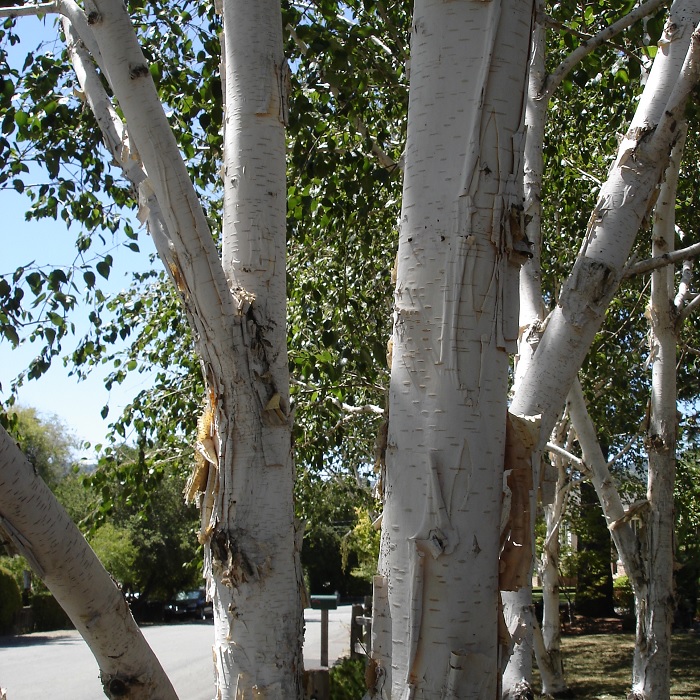
Overgrown shrubbery becomes multi trunk trees.

For several years in the late 1960 and early 1970s, European white birch were trendy. Most lived in ubiquitous groups of three. Where three did not fit, a single multi trunk tree, typically with three trunks, was a popular option. Each multi trunk tree provided as many trunks as a few single trunk trees. For these particular white birch, the elegant white trunks were their most appealing feature.

Multi trunk trees, which are popularly known as ‘multis’, are only structurally different from their counterparts with single trunks. Multi trunk crape myrtle are genetically identical to crape myrtle of the same cultivar, but with single trunks. The only difference is that multi trunk trees branch at ground level, instead of at the top of a single straight trunk. Each needs to be pruned to the desired form.

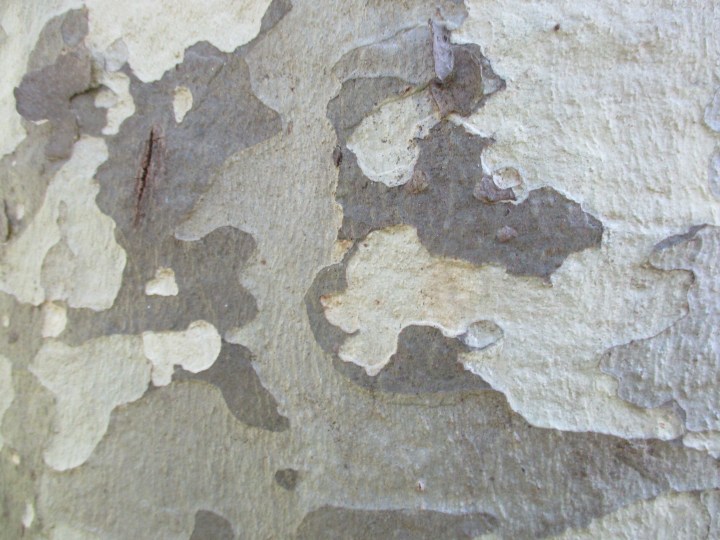
Multi trunk birch, paperbark and lemon gum exhibit appealing bark. More trunks display more bark than single trunks. Multi trunk strawberry tree, olive and oak exhibit appealingly sculptural form. Cork oak and crape myrtle provide both appealing bark and sculptural form. Silk tree, acacia and deciduous magnolia display their bloom more effectively with lower and broader multi trunk form.

Trees get help to develop into a desired form. European white birch, lemon gum and silk tree are more likely to develop single trunks naturally. Coppicing compels them to regenerate with several trunks. Conversely, olive, crape myrtle and strawberry tree develop a few trunks naturally. Single trunk trees need thinning to remove the superfluous trunks, and staking to straighten a single trunk.

In home gardens, multi trunk trees sometimes evolve from overgrown shrubbery. Pineapple guava may be shrubby for may years before lower growth gets pruned away to reveal sculptural trunks within. English laurel that gets too overgrown for containment pruning might become a delightful multi trunk tree instead. It will be pleased to grow freely from the top if lower growth gets pruned off.

Multi trunk trees are no more natural than trees with single trunks are, but they seem to be.

Too Much Oregano

P00517
Herbs should do so well in an herb garden.

Vegetation management after several weeks of neglect has been . . . interesting. While we were unable to work, and during their most active growth of the year, weeds proliferated more than they had ever gotten away with before. As most get cut down by weed whackers, I pull those that mingled with desirable plants that weed whackers must avoid. It is a tedious process.

One of the more tedious of these projects, and perhaps the most tedious so far, required the removal of abundant weeds from a dense row of carpet roses. Fortunately, it was not as bad as I expected it to be. They young man who weeded this area during winter had done a remarkably thorough job, and eradicated most of the dreaded oxalis and tougher perennial grassy weeds.

The weeds that I pulled were big and impressive, but pulled out relatively easily. A few thistles were unpleasant to handle, but even they came out easily. Mock strawberry between some of the roses was still in good condition after the weeds that mingled with them were gone. I realize that I do not adequately appreciate all the weeding that happens here that I am not aware of.

Besides mock strawberry, another species that gets to stay in parts of the area that it spreads into is some sort of oregano. It seems to be common Italian oregano, but also seems to develop leaves that are slightly larger than they should be. It is too docile to be a problem for the roses, but occupies space that would otherwise be taken by weeds. Besides, it is nice to have around.

Even oregano needs to be managed sometimes. Quite a bit of it got pulled from the roses along with the weeds. I suppose it must be dried now.

While You Were Out

P00516K
It’s a jungle out there!

Our work is the sort that could potentially continue as essential. Distancing is not a problem for us, since we generally work individually, and there are no guests here. However, work needed to be discontinued due to lack of revenue. A conference center can not generate revenue without big groups of guests. Even when groups can return, many potential guests can not afford to.

The chronology of this situation should have been documented more efficiently. We had been unable to work here for several weeks. I do not remember how long it had been. Work resumed two weeks ago, and can continue for six more weeks, for a total to two months. We will start no new projects during this time, but will primarily try to catch up on what was neglected earlier.

Salvage and preparation for resumption of neglect are presently the priorities. This entails vegetation management after weeds had been left to grow wild during their most active season. It is extreme. Most weeds either had dispersed their seed, or did so as they got removed. This is not much of a problem for areas that are not landscaped, but will be trouble within landscapes.

Weeds in areas that are not landscaped get cut down by weed whackers, and mostly left where they fall. Roots that remain within the soil, and debris dispersed over the surface, should limit dustiness later in the summer. Weeds in landscaped areas and where weed whackers can not get into must be pulled. We do not want young desirable plants to be ruined by weed whackers.

It is discouraging that no one is here to enjoy the landscapes that we put so much effort into while we can work. It is also discouraging to see how easily the landscapes can fall into disrepair.

Six on Saturday: Rhody’s Rhodies I


Rhody actually had nothing to do with the rhododendrons. They have been her for decades. The youngest were added in the late 1990s. We know none of their identities. It does not matter. Bloom is spectacular. These pictures are from last Friday, so are a week old already. Six more will be two weeks old for next week. I just can not miss sharing them here for Six on Saturday.

1. Mrs. G. W. Leak – The spots are not pronounced enough. The foliage is not a good match either. Otherwise, the floral color and form are about right. Branch structure seems to match too.P00516-1

2. Trude Webster – This is just a guess. The leaves are not big enough. Bloom is a bit too brightly colored, and its spots are a bit too pronounced, although floral form seems to be about right.P00516-2

3. Lem’s Monarch – This one is questionable. Flowers are usually more white with reddish pink edge. However, they do not look quite like the real thing. Foliage happens to be a good match.P00516-3

4. Anah Kruschke – Like the others, the color is off for this one this year. It is normally a bit richer purple. I am fairly certain about its identity. The foliage and branch structure conform too.P00516-4

5. Rhododendron catawbiense – I am rather certain about the identity of this one. Everything about it is as it should be, even the foliage. This is probably my favorite of these particular six.P00516-5

6. Taurus – Of all of these six, this one is the least likely to be what I refer to it as. Only the floral color is correct. Floral form, foliage and branch structure are not. I do like the name though.P00516-6

This is the link for Six on Saturday, for anyone else who would like to participate:

https://thepropagatorblog.wordpress.com/2017/09/18/six-on-saturday-a-participant-guide/

Bugle Lily

50513
Bugle lilies are like lean gladioli.

It would be accurate to guess that bugle lily, Watsonia pyramidata, is related to gladiola. It is not as impressive as gladiola is, but it is much more reliable. The relatively simple blooms become more abundant as bulbs multiply each year. Conversely, after blooming so flamboyantly in their first year, only a few gladiola bloom for a second year.

New bugle lily bulbs (corms) that were planted early last autumn grew through winter to bloom about now, in white and pastel hues of pink, rosy pink, lavender, orange and almost red. The small flowers are neatly arranged on narrow floral spikes that stand about three or four feet tall. The upright and narrow leaves get only about two or three feet tall.

After bloom, foliage slowly browns through warming summer weather, so should be cut to the ground when it becomes unsightly. While bulbs are dormant through summer, they do not need to be watered much, and can rot if soil stays too damp. Crowded colonies of bulbs can be divided and spread around as summer ends.