Like last Saturday and Sunday, the post for today is recycled from more than three years ago. I will be doing quite a bit of this for at least the next month. This one complies with the ‘Horridculture’ meme for Wednesday.
via No Respect
Like last Saturday and Sunday, the post for today is recycled from more than three years ago. I will be doing quite a bit of this for at least the next month. This one complies with the ‘Horridculture’ meme for Wednesday.
via No Respect

It is no lily, but it does live on the banks of the Nile River. Lily of the Nile, Agapanthus africanus, endures both long dry summers and winter flooding. While inundated, it clings to the silty soil with a sturdy network of rubbery roots. Densely mounding foliage regenerates as floodwater recedes. If conditions get exceptionally warm and dry, foliage may eventually shrivel after midsummer bloom.
Home gardens are certainly more hospitable than the floodplains of the Nile River. The luxuriant foliage of lily of the Nile is evergreen locally, even if irrigation is minimal. The rubbery leaves get as long as two feet, arching outward from basal rosettes. New foliage obscures deteriorating old foliage. Plants that get too congested to bloom well might benefit from division of individual rosettes.
Lily of the Nile blooms around Independence Day, with round floral trusses that resemble exploding fireworks. Each blue or white bloom stands about two to four feet high, on slim and bare stems. Individual florets are small and tubular. ‘Storm Cloud’ blooms with darker blue or purple. Agapanthus orientalis may exhibit bigger blooms and coarser foliage. ‘Peter Pan’ stays low and compact.
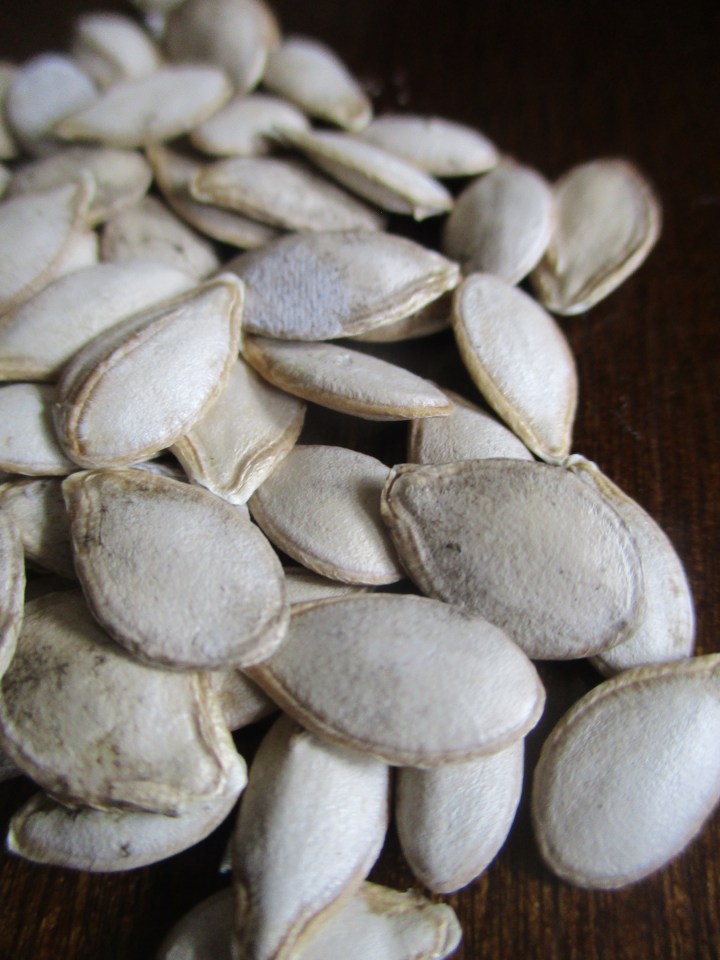
Seed that is available in hardware stores and nurseries came from somewhere. Plants just like those that such seed grows into produced it. Someone, or many someones, collected all that seed to make it available to others. Similarly, several plants in our own gardens produce seed. Anyone who is interested in collecting seed to grow more of the same plants could make good use of it.
After bloom, most flowers deteriorate and disappear into the landscape. Some leave behind desirable developing fruits or vegetables. Many of the flashiest flowers are too extensively hybridized to produce seed. Many produce some sort of seed structure that typically gets removed, or ‘deadheaded’. This diverts resources from seed production to subsequent bloom or vegetative growth.
If not removed, such seed structures can mature to produce viable seed. Those who enjoy collecting seed often intentionally leave a few seed structures for that purpose, instead of deadheading completely. For plants with long bloom seasons, this technique should involve the latest blooms. The same applies to vegetables that normally do not mature prior to harvest, like summer squash.
Such seed or fruiting structures, including vegetables, must be completely mature before collecting ripened seed from them.
Sunflower, cosmos, calendula, marigold, campion, morning glory, columbine, hollyhock and snapdragon are some of the easiest flowers for collecting seed from. California poppy, alyssum, phlox, and several other annuals are happy to self sow their seed, although collecting seed from them is not so easy. Nasturtium and honesty (money plant) seed is easy to collect, but self sows as well.
Collecting seed is limited only by practicality. Some plants, particularly hybrids and exotics (which are not native and may lack pollinators), produce no viable seed. Extensively bred varieties are likely to produce progeny that are more similar to the basic species than the parent. Once collected, some seed need special treatment in order to germinate. All seed should be sown in season.
As I mentioned yesterday, I will be recycling old articles for at least the next month. This was one of the earliest articles on this blog.
As I mentioned months ago, I will be unable to write as frequently as I had been writing, although I had continued with the same schedule since then. Now, I really must write less, and recycle more. This article is almost three years old.
Horticulture can be such a bad habit. (Where have I heard that before?) Once one learns how to grow horticultural commodities, it is difficult to stop. Pruning scraps get processed into more cuttings. Self sown seedlings get relocated instead of discarded. Extra pups (divisions) get salvaged as if the garden can accommodate more. There are several acres of landscapes here, but it is not enough for what we could grow.
1. While dividing a bunch of Morea bicolor, I found a single shoot of Morea iridioides. How did that get in there? I should have discarded it. Perhaps it will grow to become something useful.
2. Pruning scraps of zonal geraniums got plugged as cuttings, but then did not get separated as they grew. There may be a dozen in there. They are nice, but we really do not need any more.
3. When composting just is not good enough, plug cuttings instead. There may be a dozen Ponderosa lemon cuttings here. One is too many. They are not grafted, so will be on their own roots.
4. Boston ivy is fortunately not as abundant as I thought it would be. We wanted four, so I plugged a hundred cuttings. It seemed to make sense at the time. Most did not survive. Plenty did.
5. This self sown bigleaf maple is not in the nursery, but I want it to be. It should not remain where it is. I may dig and can it this autumn, as if there is a situation into which to install it later. 
6. These summer squash are not from the nursery, but from right downstairs. They are happy with all the runoff they get from above. Neighbors have been getting many pounds of squash.
This is the link for Six on Saturday, for anyone else who would like to participate:
https://thepropagatorblog.wordpress.com/2017/09/18/six-on-saturday-a-participant-guide/

Taro was grown as a vegetable in ancient Egypt. It was grown in India before that. A few hundred varieties were cultivated in precolonial Hawaii. Taro was likely native to southeast Asia, but has been in cultivation for so long that it is difficult to know where it originated from. In modern American gardens, it is known as elephant ears, Calocasia esculenta, and grown for its striking foliage.
The big and broad leaves are held as high as six feet on long petioles (leaf stalks), and flare out as broadly as three feet, although many varieties get half as tall and broad. Some varieties have weirdly dark foliage. Others have green leaves with colorful veins. A few are simply jade green. Any of the deciduous foliage that lingers into winter should be cut back before spring.
Since they are naturally bog plants, elephant ears likes very rich potting soil and plenty of water. Muddy clay soil that will not float away works fine for pots submerged in ponds. (Ick!) Partial shade is important. Leaves can get roasted if too exposed. To propagate, corms can be divided while dormant in winter. All parts of elephant ears are toxic until cooked.
Early American settlers from Europe had a lot to learn about the plants of North America. After their first harsh winter without much food, many were eager to eat the first fresh greens of spring, which was sometimes the very poisonous jimson weed. Those who were not lethally poisoned right away might have hallucinated and told their friends that they could fly, and consequently got burned as witches.
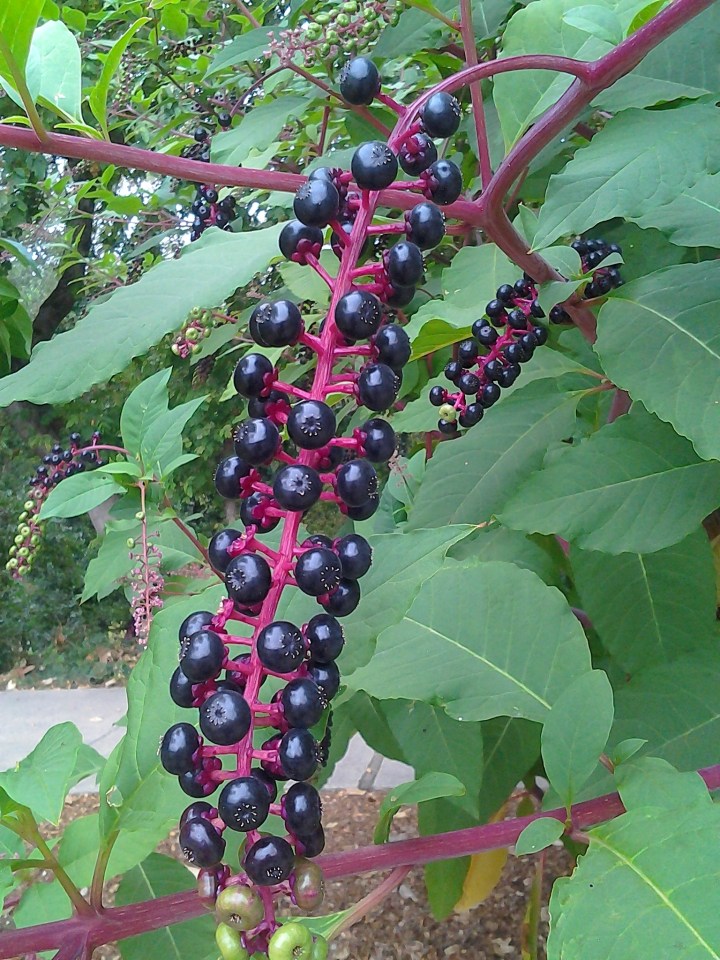
It should be no wonder that some early Americans were hesitant to try tomatoes, which are related to jimson weed. Potatoes are also related, and their fruit, foliage and stems actually are toxic. Pokeweed (unrelated) was probably riskier, since the same young shoots that can be cooked as greens become toxic as they mature. Their poisonous berries, which were used as ink back then, look delicious.
There were other potentially dangerous edibles brought from Europe and other places as well. Rhubarb, which makes such great pies, is petioles (leaf stalks) for toxic leaves. Both American and European elderberries are slightly toxic before getting cooked into jelly or pie. Elderberry juice must be cooked and then given yeast to make wine. Figs and mulberries can be eaten right off their trees, but their sap is caustic enough to be irritating to the skin.
The seeds of apples, pears, peaches, nectarines and apricots can be toxic if too many are eaten. They are not a problem only because they are not eaten. However, apricot kernels can be roasted and eaten like almonds because the cooking process denatures the toxins. Separating the small kernels from the hard shells is much more work than it is for almonds, but they supposedly have great flavor.
Just like for apricot kernels, pokeweed and elderberries, the heat of cooking makes taro edible. The foliage can be eaten as stewed greens. The big and starchy corms (bulb-like stems) are something like potatoes. All parts of taro are toxic while raw. There are actually a few toxic plants that are edible once cooked. For a few others, it is important to know what parts are edible, and what parts are toxic.
Rather than addresses, most of the guest cabins at the conference center where I work for part of the week, have delightfully horticultural names; such as Camellia, Lupine, Holly, Dogwood, Huckleberry, Strawberry and Cottonwood. Others have names that are suggestive of idyllic locations, such as Meadowbrook, Creekwood and Rustic Dell. Then, . . . there is ‘Dumpster View’.
Dumpster View is not actually a guest cabin, or a lodge, or any building that any of the guests would ever see. It is part of our maintenance shops buildings. Although large, these building are outfitted with only a few windows. The largest building has only a single window for an office. The smaller building has only four windows. Two of the windows have a view only of dumpsters.
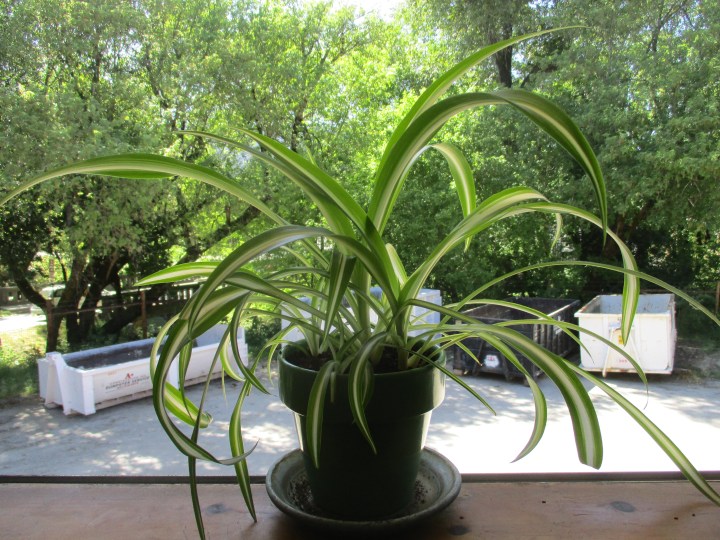
The picture above shows the view from the window in the galley. It was what I saw as I made coffee for the crew in the mornings back when we all were still working. As many as fifteen big dumpsters have congregated in that herd, right outside, beyond the spider plant. Because the area is a paved driveway with significant traffic, I can not even plant a tree to obscure the view.
No amount of houseplants bigger than the spider plant can obscure this view without becoming obtrusive. Hanging pots outside the window might detract from the outer scenery, but would require more attention than I want to devote to them. Curtains would be the most practical solution, but would get grungy in this particular situation. Besides, no one else here really notices.
Horticulture is not for everyone, and can not fix everything. No one stays in the shops buildings long enough to notice how horrid the views are anyway. We all leave to go to work in scenery that others vacation in.

Its natural coastal range extends from the extreme southern corner of Alaska to the southwestern corner of California. Another inland range occupies foothills of the Sierra Nevada. Bigleaf maple, Acer macrophyllum, is the most common and prominent native maple here. However, it prefers the seclusion of forested riparian situations at higher elevations locally. It is rare in urban gardens.
Bigleaf maple is best in the wild anyway. It dislikes the aridity of most of the urban and suburban areas of California. (San Jose is in a chaparral climate. Los Angeles is in a desert climate.) Roots of bigleaf maple are potentially aggressive, especially if irrigated generously. They easily displace pavement. Nonetheless, where climate and circumstances allow, bigleaf maple is a grand tree.
Wild trees grow as tall as a hundred fifty feet within forests where they compete for sunlight. Well exposed suburban trees should stay lower than forty feet, while extending their canopies broader than tall. The big and palmately lobed leaves are mostly more than six inches wide. Foliage turns yellow in autumn, and is abundant as it falls. Self sown seedlings often grow under mature trees.

