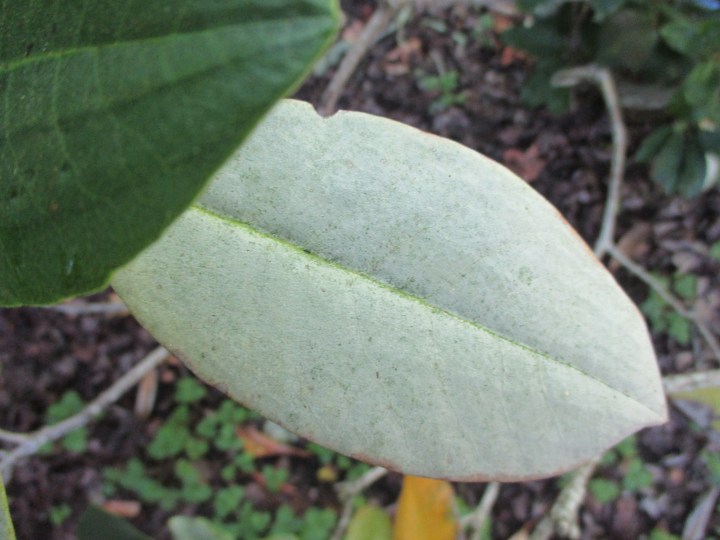
This is getting close to the in-between time for annuals. Warm season annuals that bloomed through summer will soon be getting replaced with cool season annuals that will perform through winter. Of course, our seasons are neither as distinct nor as severe as they are elsewhere. Many annuals are actually perennial here. Some stay later than they should, just because they can.
Aging annuals and perennials can get somewhat trashy if they are not pruned back or replaced soon enough. Their replacements might not be very impressive until they get established and start to grow. So far, only a few violas have been installed here for autumn, and only because the petunias that were where they are now were getting tired prematurely. There will be more.
There is certainly much more color in the landscapes than what these pictures show. White just happens to be my favorite color.
1. Alyssum is supposed to be a cool season annual for spring or autumn. It does not like cold winter weather or warm summer weather. In our mild climate though, it does well in any season. In sunny spots, it self sows to replace itself before it gets old and deteriorates. This batch will eventually get removed, just so we can put something else here. It is prettier in sunnier spots.
2. Dianthus, like alyssum, is supposed to be a cool season annual. It just does not succumb to the minor summer warmth here. Nor does it succumb to the mildly cool winter weather. It could grow as a short term perennial if we did not need to remove it to plants something else later. It also would perform better with better sun exposure. Here, bloom is not as full as it should be.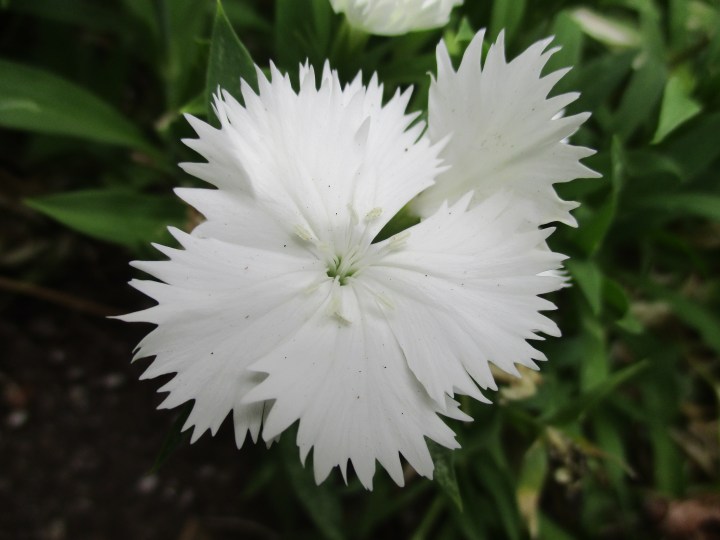
3. Viola is one of the cool season annuals that does not do well through summer here. Some survived from last spring, but they were not happy about it. A few of the many might survive and regenerate if we cut them back, but it is easier to plant something new. These white violas, as well as some comparable yellow ones, got planted early to replace prematurely fading petunias.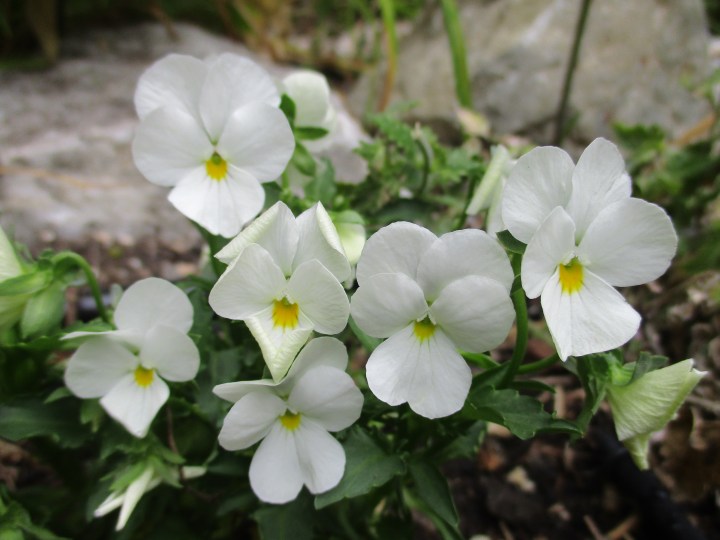
4. Petunia is a warm season annual that did well through most of the summer, but is now fading a bit early. Some have already been replaced with violas. Others probably should be. These are still mostly presentable, so can remain for now. If possible, it is better to not replace them with violas too early. Violas that grow too much before autumn can get floppy through winter.
5. Phlox was not planted. A single plant grew in an already crowded bed of flashy annuals and perennials two springs ago. There were a few more last year, and even more this year. They all land in good situations, where they unobtrusively grow through spring, bloom in summer, and die back through autumn. They are warm season annuals, but are expected back next spring.
6. Geranium, which are really pelargonium, are perennial here, rather than annual like they are in climates with cooler winters. They can be damaged or even killed by frost where they are more exposed, but this particular geranium is sheltered by an eave and trees. They will probably get cut back at the end of next winter, just to stimulate fresh new growth to replace the old.
This is the link for Six on Saturday, for anyone else who would like to participate:
https://thepropagatorblog.wordpress.com/2017/09/18/six-on-saturday-a-participant-guide/
 A flower that is so prominent in American culture should have a more appealing name than black-eyed Susan. Even the Latin name, Rudbeckia hirta, sounds bad. Is Becky really so rude? Did she hirt Susan? Well, black-eyed Susan is good enough to be the state flower of Maryland, and is one of the most popular of flowers for prairie style gardens of the Midwest. After all, it naturally grows wild in every state east of Colorado. Here in the West, it is a light-duty perennial that is more often grown as an annual. As a cut flower, it can last more than a week.
 Black-eyed Susan, sunflowers and a few of the late warm season annuals and perennials are still blooming, and a few will continue into autumn. By that time, cool season annuals can move in; and some of the deciduous trees, shrubs and vines that turn color for autumn will be doing so. Realistically though, this can be the leanest time of year for color in the garden. Even some of the foliage that is colorful through spring and summer has faded.
 This is not about North and South. It is about a utility pole and a pole that remained from a redwood tree that was too close to it. One is there to support a variety of cables and a streetlamp. The other just wanted to grow into a redwood tree to join the rest of the forest. One has been deceased for many years or decades. The other was alive just recently, but is now only a stump.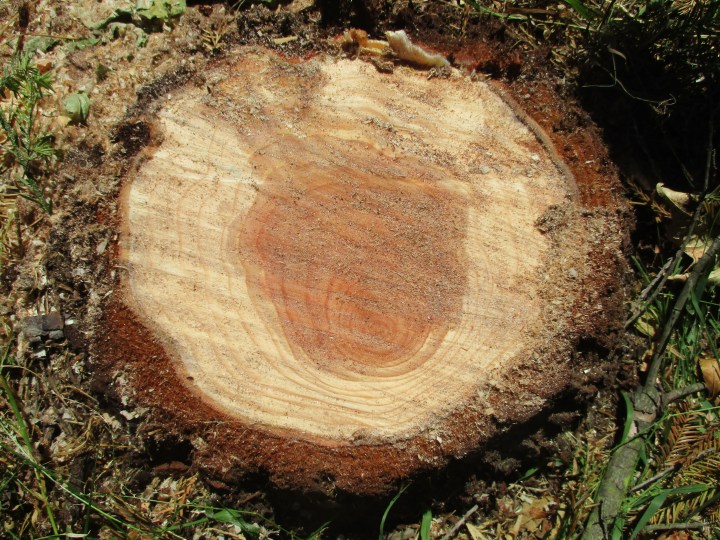

 Within its natural range on the West Coast between the southern extremity of Alaska and the southern extremity of California, Western sword fern, Polystichum munitum, is the most common of the native ferns. A few disjunctive wild colonies live as far inland as the Black Hills of South Dakota. Yet, with few exceptions, Western sword fern is difficult to cultivate outside of the natural range.
 Just about every home garden has some sort of shade. Even if there are no substantial trees or shrubbery, there are northern walls of homes and garages, and they likely have eaves that extend their shadows a bit farther. Fences to the south create shade to the north. Gardens of modern homes are smaller, and surrounded by higher homes and fences, so are shadier than older gardens.
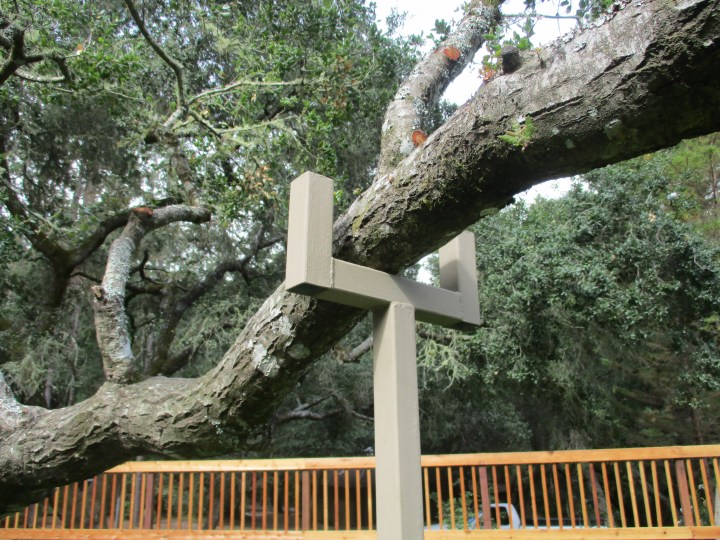 It has been almost a month since one of three small but sculptural and very prominent coast live oaks at work was destabilized by . . . well, children. They were climbing on it, as most good children should do. There were a few of them; and the tree is old and deteriorating. All three of the trees actually grew from the same rotten stump of a tree that was cut down decades ago.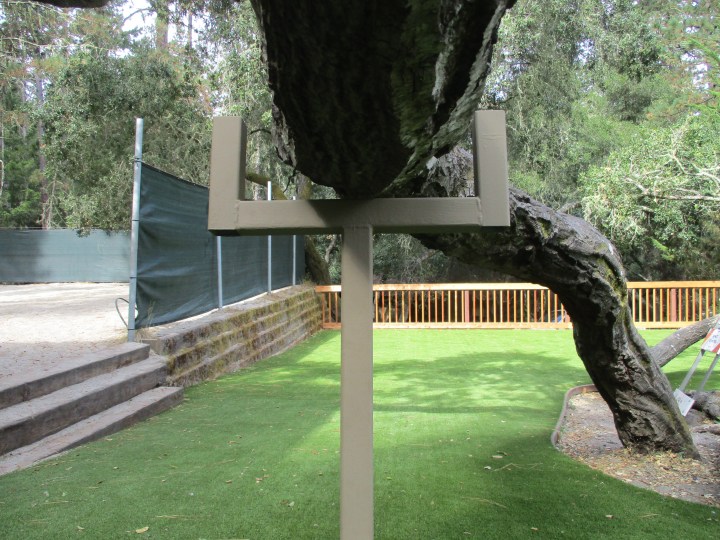
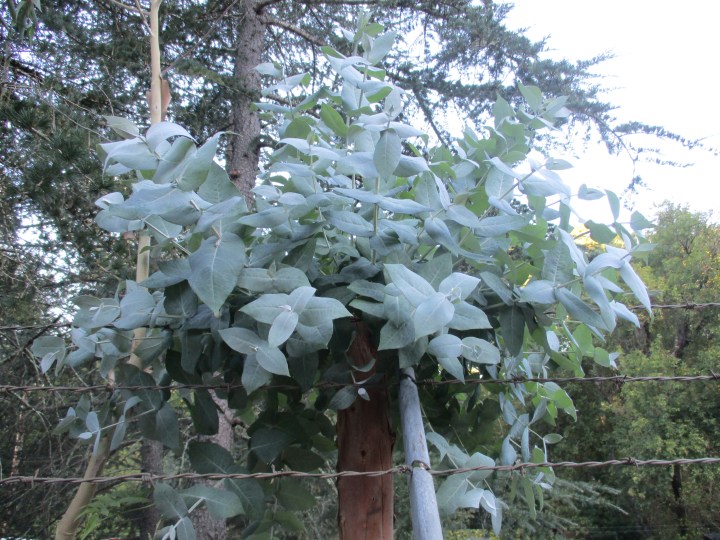 Just about any other arborist will insist that any pollard is a bad pollard. I am not any other arborist. I have no issue with pollarding certain trees properly.
 If you’re going to San Francisco, be sure to wear some flowers in your hair. In the 1960s and 1970s, such accessorizing with Paris daisy, Argyranthemum frutescens (which was at the time, Chrysanthemum frutescens), was a fad. The white flowers with yellow centers were about two or three inches wide. Modern cultivars have smaller flowers that might be light pink or pastel yellow.
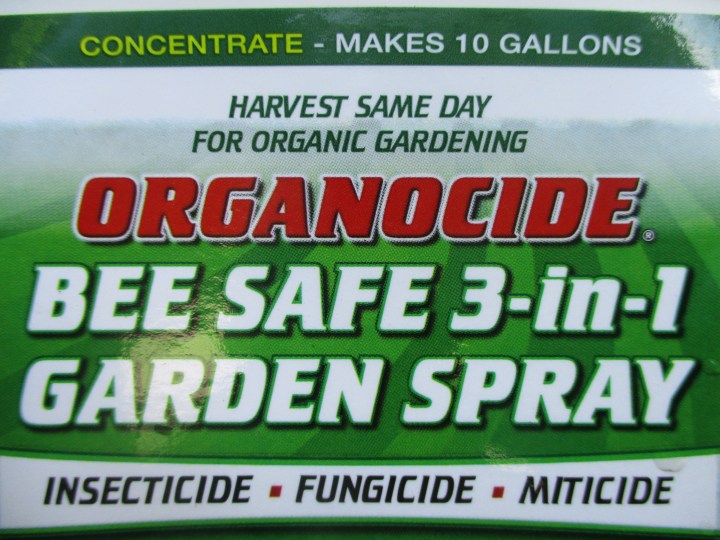 Pesticides are a topic that I do not talk much about. There really is not much to say about them. Only a few are used at the farm, and only while certain destructive insects or perhaps mites are active. Even less pesticides are used in the landscape. It is not that I have serious issue with them. They are just not as useful for controlling pests as proper horticultural techniques are.