‘Shiners’ have nothing to do with Rudbeckia hirta, which is commonly known as ‘black eyed Susan’. (Why did rude Becky hurt Susan like that anyway?) Shiners are the wounds left from pruning significant limbs from their supporting limbs or main trunks. They shine most blatantly when fresh, and then fade in the weather.
The best shiners are those that will be compartmentalized (healed over) most efficiently. They should not be cut too deeply, or be left with stubs that interfere with compartmentalization. There is quite a bit of science to shiners.
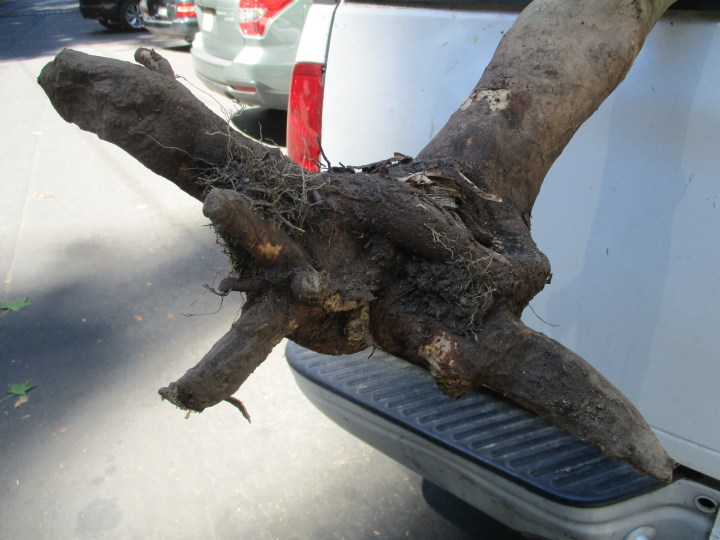
1. This is a good example of a bad shiner. (I could have gotten a better picture of it, but thought that the sun shining from behind was appropriate to the topic.) This shiner was not made by pruning a limb away from a main trunk, but by pruning a main trunk away from a limb. The main trunk leans over so much that most of it needed to be removed to maintain minimal clearance over a driveway. The only two options were to prune it back the the limb on the left, or remove the entire tree. Because the shiner is wider than the remaining limb, which will become the main trunk, it will take several years to be compartmentalized. By that time, decay will have extended downward from the shiner into the main trunk below.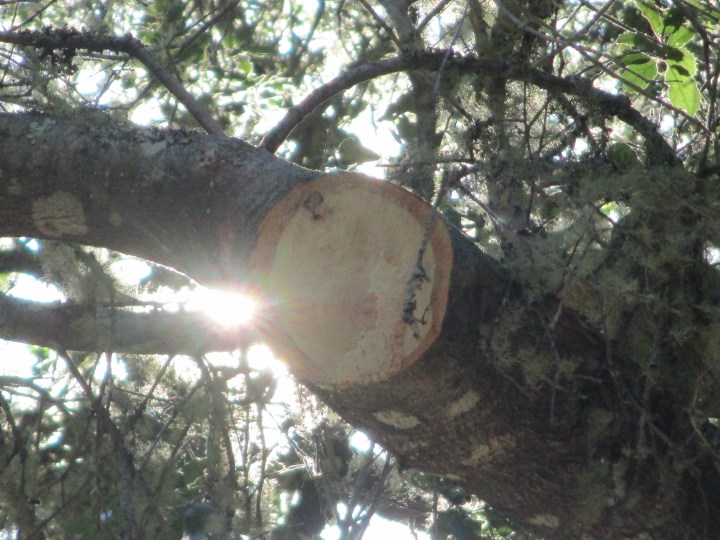
2. Removal of a limb that was battering the topsides of delivery trucks left the shiner above and left of the center of the picture. The scar to the lower left of the shiner, and another scar farther the lower right, closer to the lower right corner of the picture, were caused by a single altercation with one truck that drove off the edge of the driveway. Since it is not really encroaching into the driveway, or interfering with minimal clearance, this particular damaged limb remains.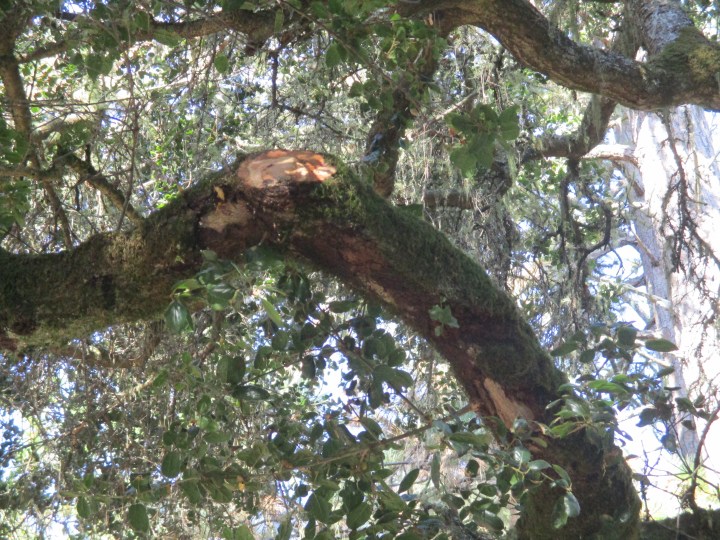
3. This is the thrashed limb that was removed from the limb in the #2 picture above. The freshest damage is still red. This limb had been up above minimal clearance for a few years before the supporting limb sagged with the weight of the growing canopy above. Damage to the trucks is more of a concern than the limbs, so it had to go.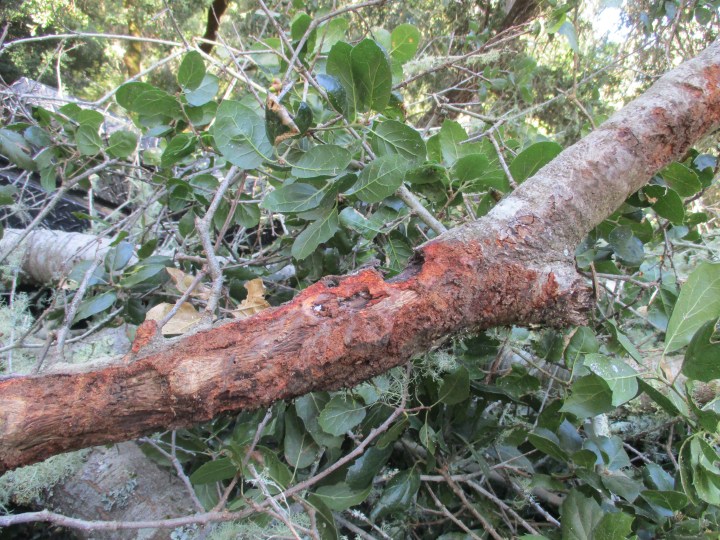
4. This is another good example of a bad shiner. The main trunk to the right would not have been able to compartmentalize over the stub until it grew out past it, or the stub rotted and fell away. The stub was partly rotten, but also partly viable, with a small branch growing from it. The viable portion would have taken more time to rot away. The whole mess was cut away after this picture was taken; but the resulting shiner that I did not get pictures of has another problem. This picture shows how the stub wraps around the main trunk from behind. The bark compressed between the stub and the main trunk, which is known as ‘included bark’ or ‘bark inclusion’, will temporarily be in the way of compartmentalization of the shiner. Fortunately, the tree is young and vigorous enough to figure it all out.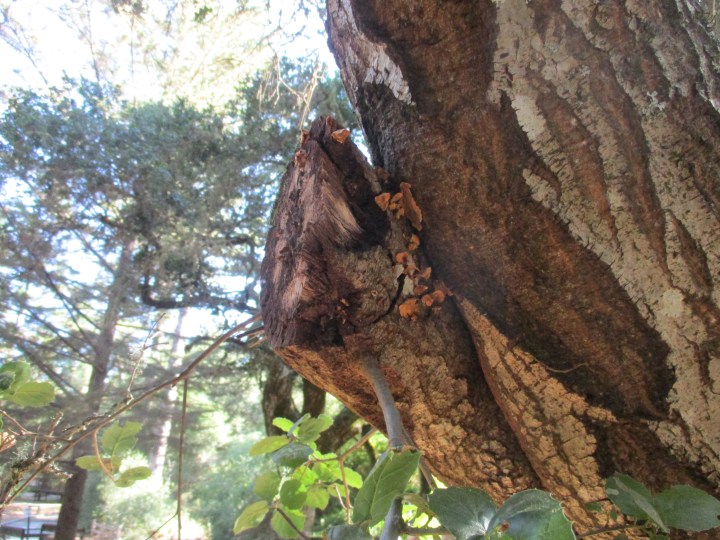
5. What looks like shark jaw bones without the teeth is the callus growth that once surrounded a well cut shiner. After the shiner was cut, and the tree started to compartmentalize over it, the tree died suddenly. As the trunk decayed, this dense callus growth that started to compartmentalize the shiner decayed slower. The uniformity of the callus growth shows how evenly the shiner was cut. I believe that the bottom of the shiner is to the left, but that could be backward. I can only say that the shiner is sideways in this picture.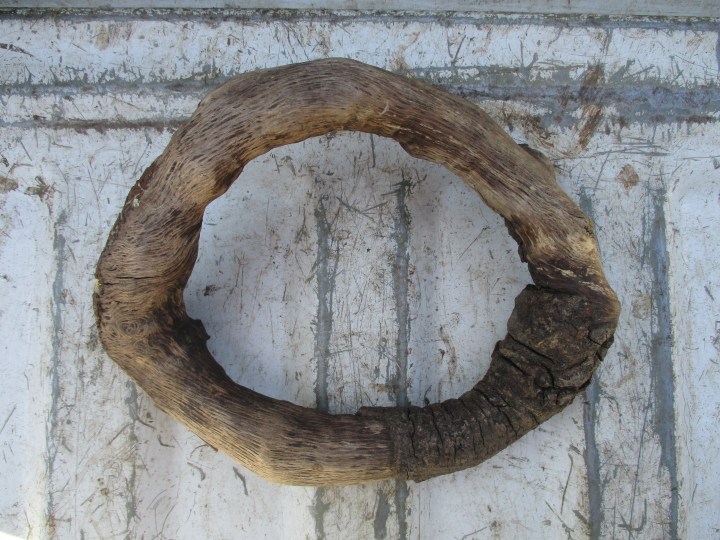
6. Coast live oak, Quercus agrifolia, is the only species in all five of the pictures above, and also provided the biscuits to the lower left and the upper right in this picture. ‘Biscuits’ are sometimes cut to adjust a shiner after the main part of a limb is pruned away, or perhaps to cut a stump slighter lower after a tree is cut down. I really do not remember why I saved the biscuit to the lower left, although I can remember the tree that it came from. The fresher one to the upper right is from the shiner in the first picture #1 above. I kept the Hollywood juniper biscuit to the upper left because I thought it would smell like the related Eastern red cedar (which is actually a juniper rather than a cedar) that cedar chests and closets are made with. The deteriorating biscuit to the lower right is from a very dead white fir that needed to be cut down. I kept it because I happen to be very fond of white firs, but so rarely see them here.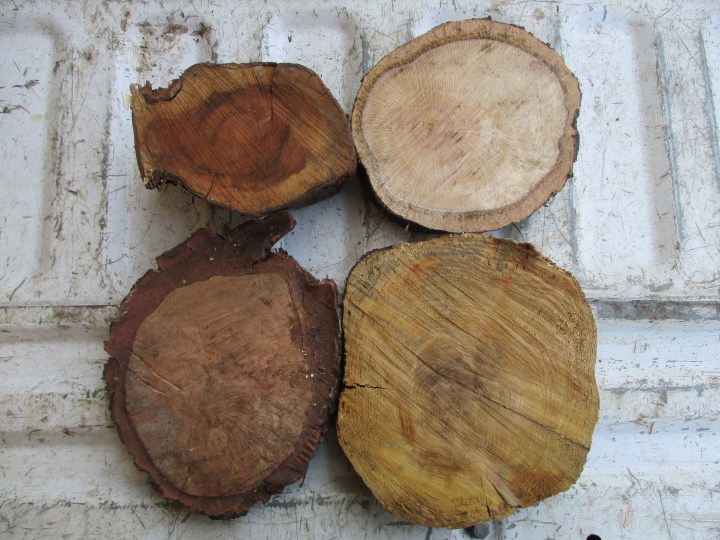
This is the link for Six on Saturday, for anyone else who would like to participate:
https://thepropagatorblog.wordpress.com/2017/09/18/six-on-saturday-a-participant-guide/
 The original Dodge Dart, with the slant-six engine, was not much to look at, but was built to last. While cars were expected to last ten years or a hundred thousand miles, Darts easily lasted twice as long or twice as far. A few are still going now! Such resiliency really made a reputation for Dodge. The problem was that those who bought Darts had no need to buy another car for a long time.
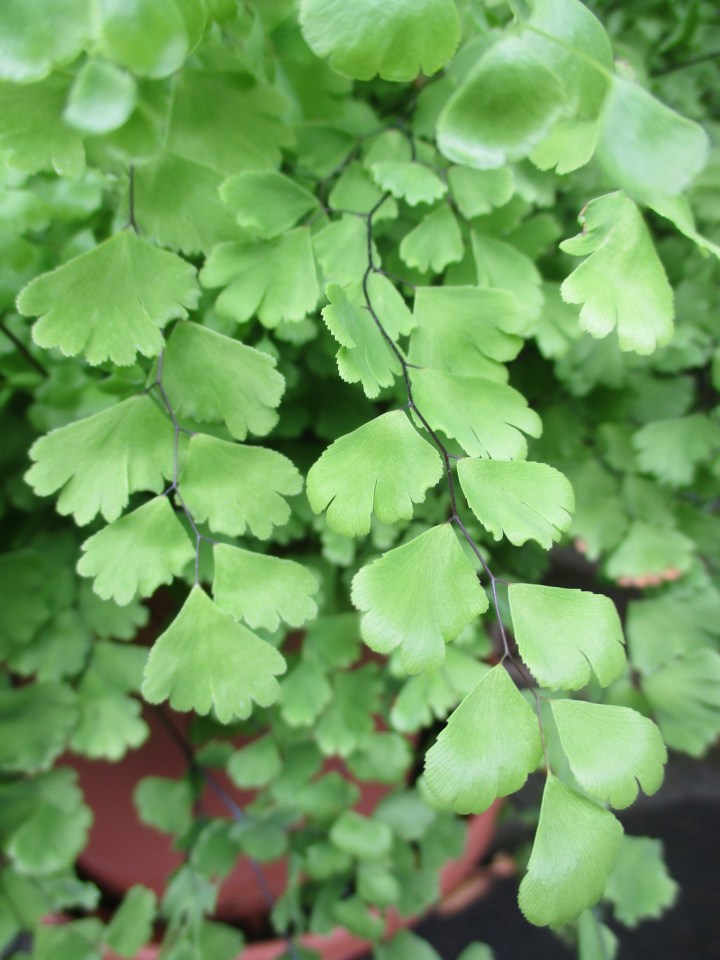 Some of us might remember Delta maidenhair fern, Adiantum raddianum, as a houseplant that was popular for terrariums in the 1970s and into the 1980s. Although quite happy in terrariums, it eventually gets big enough to crowd other plants in such tight spaces. It prefers to be potted on a porch, or in a regularly watered and sheltered spot in the garden. It tolerates quite a bit of shade.
 Many of the most popular plants are expected to bloom to add color and fragrance to the garden. Many others are grown to produce fruit or vegetables. Some are appreciated for their foliar color in autumn. Big trees are grown for shade. Turf grasses are grown as lawn. Evergreen shrubbery makes hedges. It seems that all plants perform particular tasks in the gardens which they inhabit.
 If this looks familiar, it is because it is the second big
 The weather here is excellent for growing all sorts of fruits and vegetables, but is not exactly ideal for bell peppers. Cool nights between warm days are comfortable for us, but limit production of even the healthiest and most robust of plants. Although they like warm nights, the fruit can be sensitive to hot days, and can even get scalded. Bell pepper plants like rich soil and regular watering.
 ’Zucchini’ is Italian for ‘little squash.’ They certainly can grow to become big squash, but by then, they do not taste so good. They are best before they get to about six inches long. As they mature, they get bitter and tough, and the seedy pulp within develop an unappealing texture. Maturing zucchini also waste resources that would otherwise go to the development of more younger zucchini.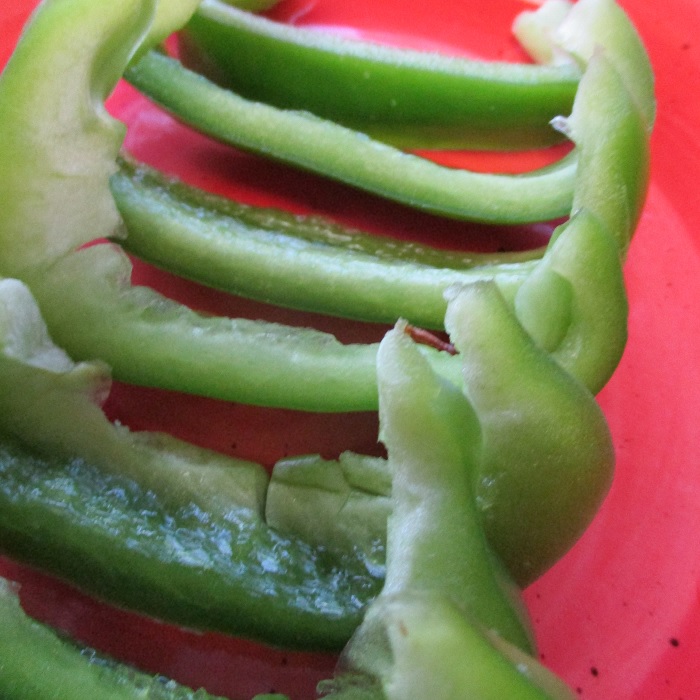
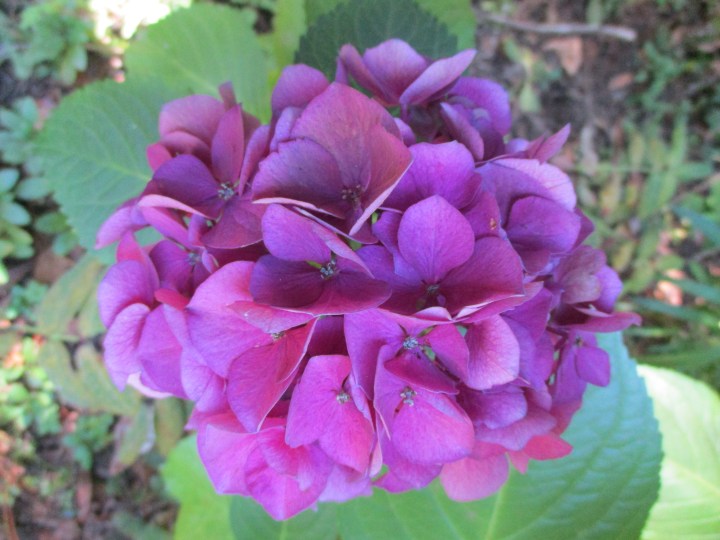 Bearded iris can bloom in almost any color. It is expected of them. There is not much they can do to surprise us.
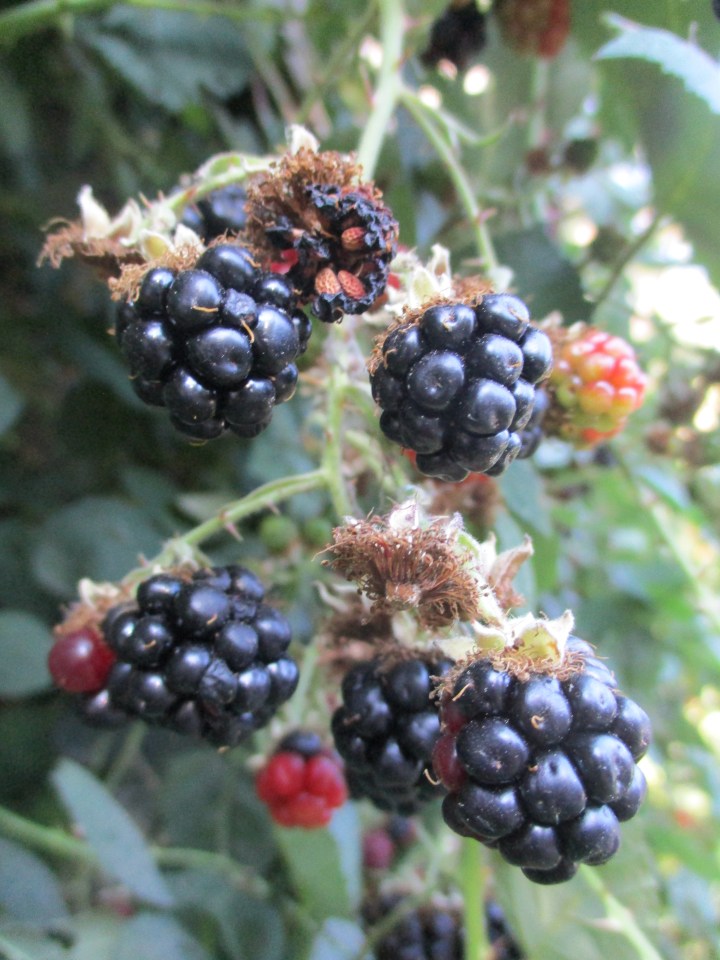 Of all the aggressively invasive exotic species on the West Coast, Himalayan blackberry, Rubus armeniacus, could be the nastiest! It seems to be impossible to kill. It forms dense thickets of wickedly thorny canes that develop roots where they touch the ground. Even if canes are cut to the ground, and the roots are pulled out, new plants regenerate quickly from remaining bits of roots.
