I do try. I prefer to submit pictures that conform at least somewhat to a particular theme. It just did not work out that way for this week. The only thing in common with these pictures is that they are from the same garden. It is garden at work, but one that I do not do much in.
1. Grape, which I still think of as dago wisteria, was planted here years ago, by someone who is no longer here to take care of it. The established vine grows like big voracious weed. I pruned it back last winter, and pulled up several stems that rooted where they flopped onto the ground. There are still six copies left at the storage nursery. I would like to plant some of them this winter, but the one original is already too much work. The grapes are somewhat tart when ripe, which makes me suspect that it is not quite warm enough here for them. It gets warm during the day, but cools off at night.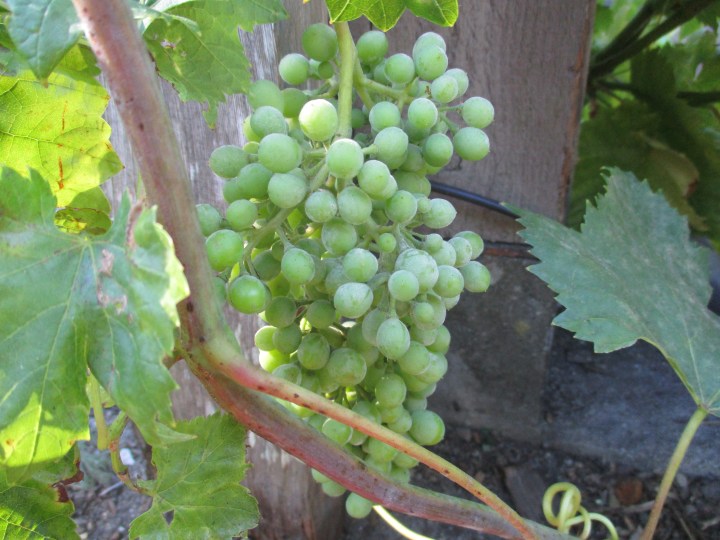
2. Succulent of an unknown species grows so close to the grapevine that it was overwhelmed before I pruned the vine back. This is a common exotic succulent that has been around in the region for a long time. I remember that it grew on the sides of some of the roads in Montara, along with other vegetation that naturalized from the gardens of homes that had been there during the Victorian period. I suppose that it is naturalized also in some spots, but does not seem to be aggressive or invasive about it. This particular specimen was likely put here intentionally. The foliage is always yellowish.
3. Tillandsia, along with a few other epiphytic bromeliads, were added to this garden just this year. They are wired onto this branch from the Eucalyptus cinerea that I mentioned in ‘Silver‘ last week. The branch is a scrap from pruning that was just propped up in the landscape for the ephiphytes. The big gray limbs in the background are of an old ‘Kwanzan’ flowering cherry tree. The epiphyllums that I mentioned two weeks ago on Sunday in ‘Epiphyllum Surprise‘ get hung from the cherry tree while they are in bloom, and then sent back to the storage nursery for recovery when they finish.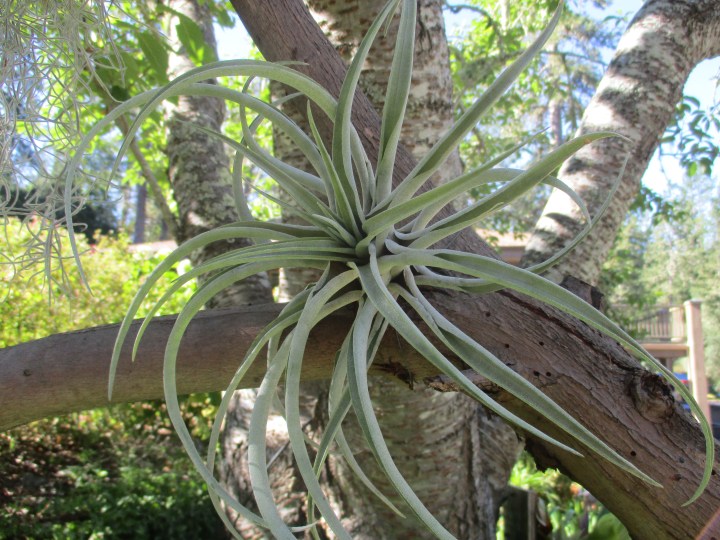
4. Spanish moss hangs with the tillandsias on the same branch of the Eucalyptus cinerea. It does not grow here naturally of course. It would probably prefer a significantly more humid situation. It gets watered and misted automatically from above. So far all the epiphytes seem to be happy here, and do not see to mind that the stem that they are clinging to is from a eucalyptus. Mosses that cling to native oaks do not cling to eucalyptus trees until the trees are old. While viable, young eucalyptus bark is toxic to mosses and other epiphytes, and exfoliates too regularly for much to cling to it anyway.
5. Alyssum happens to be one of my favorite wildflowers in this garden. When I was little kid, I found a small envelope of mixed wildflowers seed in a Sunset Magazine in a waiting room in a hospital. It is a long story, but to be brief, I ‘borrowed’ the seed, and put it out in my mother’s garden. The alyssum from that mix naturalized and self sowed quite nicely for decades. The original plants might have bloomed more colorfully, but eventually reverted to basic white, just like these that grow wild here. I still believe that white is the best, but would not mind other colors if I ever grew it intentionally.
6. Morning Glory is another favorite, but for a different reason. I like it here because it is so much prettier than it ever was in any of my gardens. I sowed the seed, and cared for it, but morning glory was never very happy for me. In this garden, it sows its own seed, and does reasonably well. The vines are not as voracious as they are supposed to be, but the flowers are pretty. That is probably a good thing. These vines happen to be next to the grapevine, so could make quite a mess on top of the mess of the grapevine if they grew as well as they are supposed to. This is a good compromise.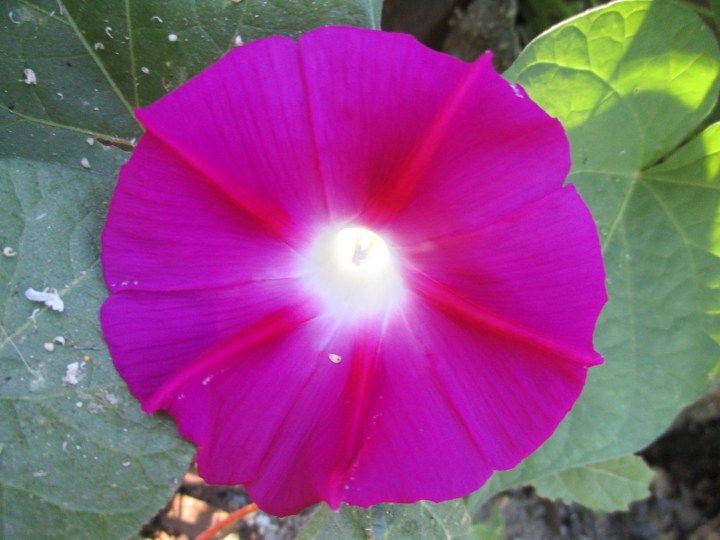
This is the link for Six on Saturday, for anyone else who would like to participate:
https://thepropagatorblog.wordpress.com/2017/09/18/six-on-saturday-a-participant-guide/
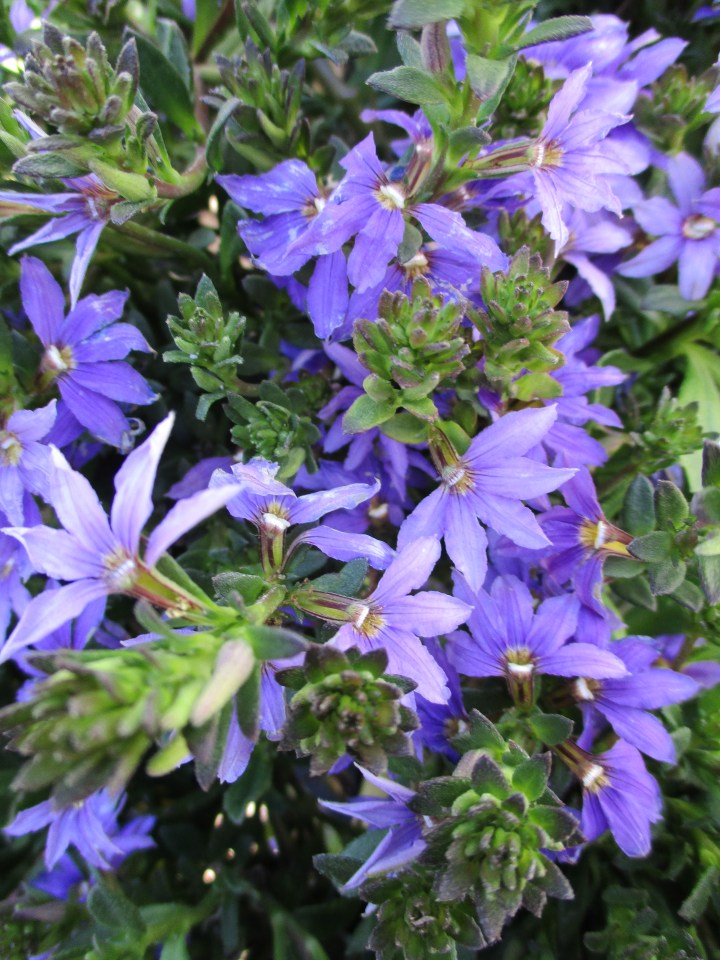 Only a few flowers are true blue. A few more are nearly blue, but slightly blushed with lavender. Of the latter group, fan flower, Scaevola albida, which is usually more lavender than blue, can be quite convincingly blue if conditions are just so. The semi-circular flowers (which are actually wide bilateral flowers) are most abundant in spring and summer, but can bloom sporadically all year.
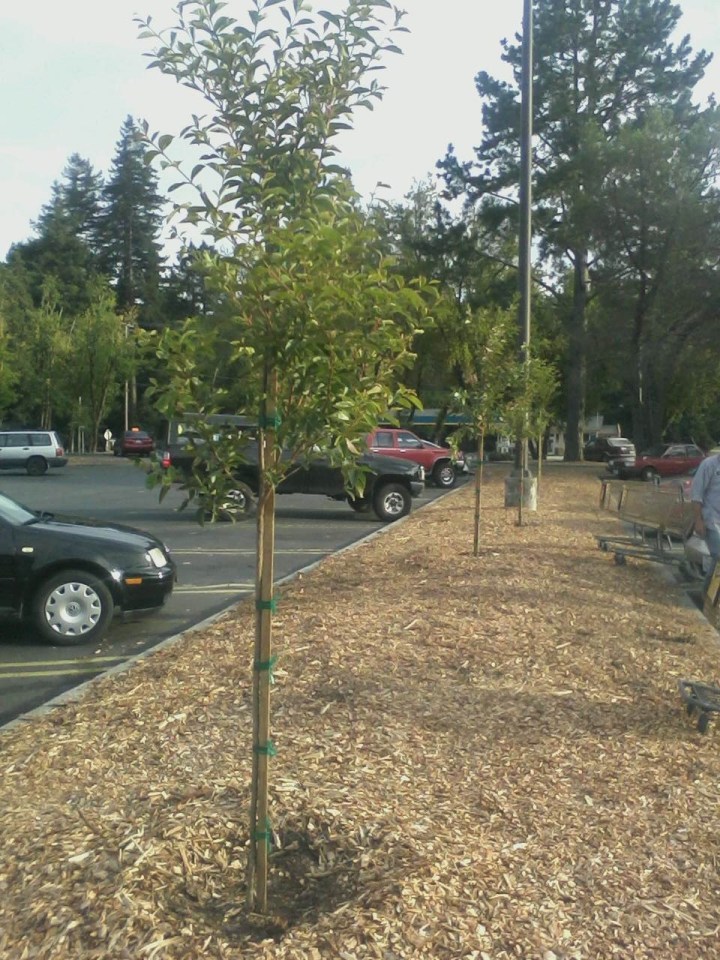 Most plants would prefer the real thing; how they do it in the wild. They drop their leaves, flowers and twigs. Deciduous plants do it mostly in autumn. Evergreens might spread it out through the year. The debris accumulates on the ground below, and decomposes at about the same rate as it accumulates. There is no one there to clean it up. Yet, the natural ecosystems know what to do.
 Growing fruit trees is quite a bit of work. While producing, some of the fruit trees need nearly as much attention as annual vegetable plants in the vegetable garden. Then, while dormant, they need meticulous and specialized pruning. Some fruit trees get damaged by insect or disease infestation, or severe weather. Some fruit can get taken by wildlife. Yet, for most of us, the reward of fresh fruit is worth all the hard work that goes into growing it.
 It is gratifying to see renewed interest in this old fashioned flower. Naturally occurring varieties of some of the nearly three dozen species of Iochroma were popular decades ago. Some might actually be naturally occurring hybrids that have yet to be identified. Many modern cultivars (cultivated varieties) were intentionally bred or hybridized for more compact growth and profuse bloom.
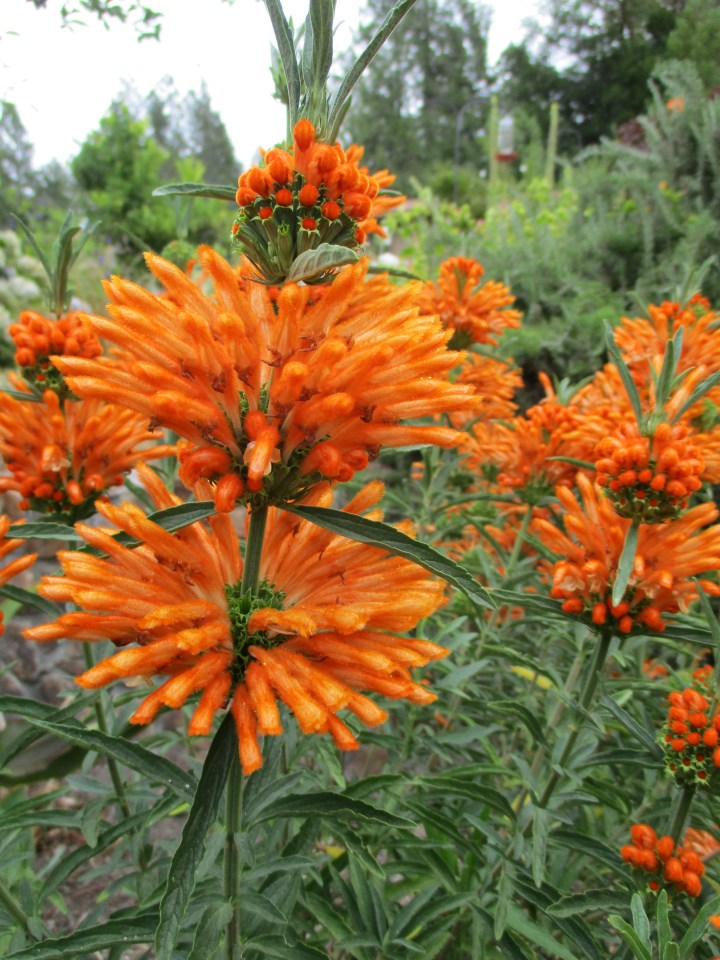 Are warm season annuals really the most colorful flowers for summer? Perhaps. They have their limits though. They are also very demanding. They need to be watered very regularly, and should probably be fertilized too. Many need to be deadheaded frequently. After all that, they are only temporary, and will get replaced with cool season annuals in autumn. Perennials are more practical.
 Just a short distance from the
  Because redwoods live for centuries, their bark gets very thick. They do not shed their bark as they grow. Old giant redwoods in the Sierra Nevada have bark that is a few feet thick and thousands of years old. Their bark is thicker than the trunks of what most of us consider to be large trees! Even much younger coastal redwoods that have regenerated here since clear cut harvesting about a century ago have bark that is a few inches thick.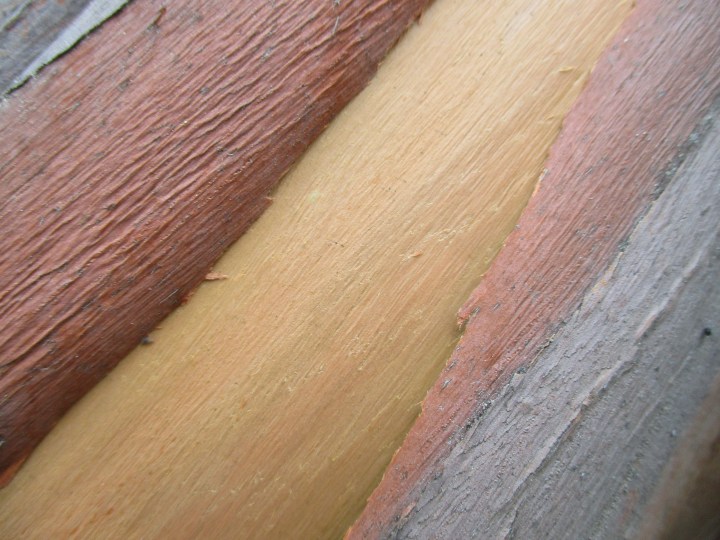
 Unlike the common bird of Paradise that is grown for striking bright orange flowers, the giant bird of Paradise, Strelitzia nicolai, is grown for strikingly lush foliage. The big rich green leaves get nearly six feet long, and flare outward from leaning trunks that can eventually reach upstairs eaves. Foliage is healthiest if sheltered from harsh sunlight (such as hot reflected glare), wind and frost.
