Vines For Better Or Worse

90619thumbVines in the wild are downright exploitative. They do not support their own weight, so instead climb or sprawl over shrubbery and trees. Some are satisfied staying down below the canopy of the hosts who support them, as if aware that a healthy host will support them for a good long time. Many vines climb aggressively to the top and overwhelm their hosts, even if it eventually kills them.

There is nothing civil about the technique of the strangler figs, which incidentally includes two popular houseplants, fiddle-leaf fig (Ficus lyrata) and creeping fig (Ficus pumila). They wrap their hosts in networks of stems and roots that strangle the hosts as both the hosts and the clinging vines grow and expand. As the hosts die and rot, the vines develops into self supporting tree trunks.

That is how fiddle-leaf fig, as it is known as a houseplant, grows as a free standing tree rather than as a creeping vine. It is grown from cuttings from the self supporting adult growth rather than the creeping juvenile growth. Conversely, creeping fig is grown from juvenile vines, which find a support to cling to, and ultimately develop shrubby adult growth when they get to the top of the support.

English and Algerian ivies are not quite as aggressive, since they do not intend to kill their hosts. They are not often intentionally grown as vines, and are almost never planted anymore, but their juvenile growth still works as ground cover in many mature landscapes. One of the main problems with ivy is that it is constantly trying to climb walls and trees so that it can bloom and toss seed.

That is not such a problem on concrete walls, but ruins wooden and painted surfaces, and makes a mess of trees. Boston ivy (which is not really an ivy) lacks a juvenile ‘ground cover’ phase, but if kept off of painted and wooden surfaces, happens to work better on concrete infrastructures. It is important to know how a particular vine will behave before selecting it for a particular application.

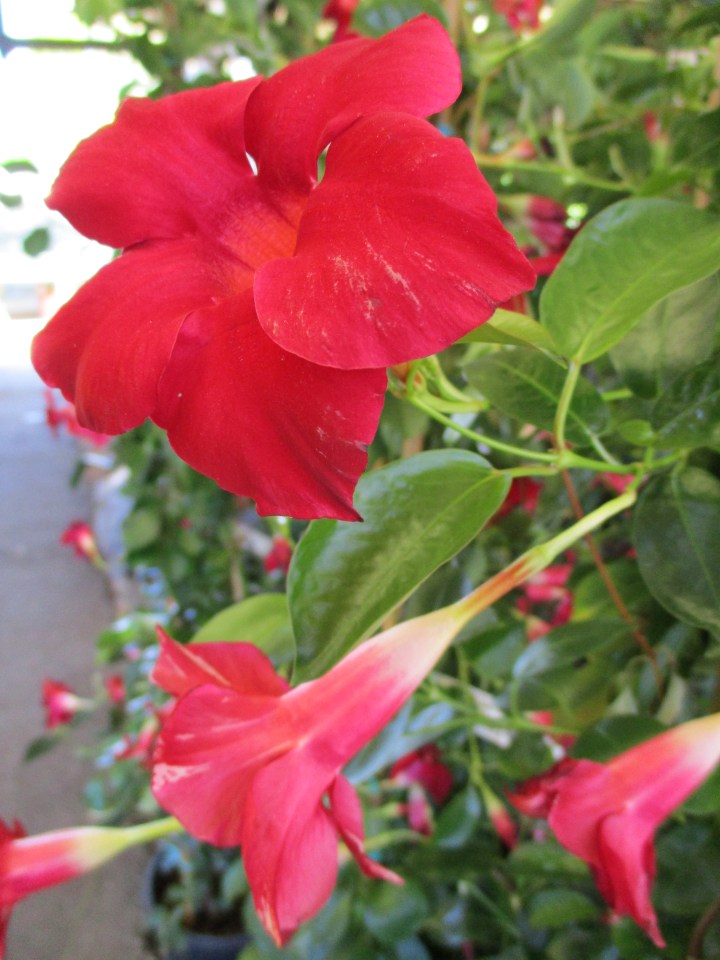
Carolina jessamine, mandevilla, lilac vine and star jasmine are a few complaisant vines.

A Bee See

P90609They were impossible to miss. They came at a weird time too.
As guests were arriving for a big event, a fire alarm was activated, and compelled everyone to leave the building that they were gathering in. The swarming bees met the guests as they came outside. The bees just happened to show up in the same place and at the same time as the guests were forced outside. Fortunately, no one seemed to mind, and some found the swarming bees to be compelling enough to stop and take pictures.
Initially, all the bees were flying in a big swarm. Those closest to the middle of the swarm were flying fast, sort of like angry wasps. No one saw the queen that the swarm was centered around, but she apparently landed on this redwood limb about forty feet up. The swarming bees slowly collected in this mass around the queen. By the time I took this picture, almost all were attached to the mass, with only a few still flying about.
At least three swarms started to establish new hives in buildings near here last year, and needed to be removed by beekeepers. One hive started to develop where another had just been removed. Another swarm was removed before establishing a new hive.
Bees seem to be attracted here. Perhaps they appreciate all the flowers in the landscapes. It is unfortunate that they can not stay where they typically try to move in. Most of us really like them.
This swarm was still here when I left, so I do not know what happened to it afterward. Hopefully, it either left the area, or at least moved into a place where it will not be problem, such as in a rotten tree trunk out in the forest where bees belong.


Paris Daisy

P90608KNo, this is not a Paris daisy. It is a common euryops daisy, Euryops pectinatus. It is obviously related, but the flowers are bright yellow rather than clear white with yellow centers, and the foliage is darker green. It is more resilient, so became more common in landscapes as quickly as mow, blow and go ‘gardeners’ replaced real gardeners who actually know something of horticulture. There is certainly nothing wrong with it. It is just cliché.

The few remaining Paris daisies are fancier cultivars of the old fashioned traditional sort anyway. Some bloom pale pink. Some bloom pale yellow. Flowers might have fluffy centers of the same color. Foliage might be pale grayish green. Plants are more compact. The cultivar that most closely resembles the old Paris daisy has more profuse, but smaller flowers. The cultivars are all quite nice, but are not quite the same as what we remember.

The original Paris daisy, Chrysanthemum frutescens, which is now known as Argyranthemum frutescens, was the sort of flower you wore in your hair if you were going to San Francisco in the late 1960s, or according to my memory, in the very early 1970s. It looked just like the three plastic daisies in the upper right (or lower left) corner of those cool AstroTurf door mats that were so popular. Perhaps they were cliché for their time too.

Cuttings rooted in half pint mason jars on kitchen windowsills to replace older plants. Our mothers grew them in the garden, supposedly to repel the bad insects, and attract the good insects to eat the bad ones who did not take the hint. In that regard, Paris daisies were how young horticulturists learned about vegetative propagation and ‘integrated pest management’ (IPM). They were so familiar back then; but then disappeared by the 1990s.

Only recently, Brent, my colleague in the Los Angeles region who I so frequently mention (typically in a disparaging manner) found just two specimens at a nursery in Southern California, and promptly procured both. One if for his garden, and one is for mine!

Six on Saturday: Off Schedule


Every year is different. The weather is different. Bloom times are different. Growth rates are different.

1. Asiatic lily. This is one of five that were planted late enough last winter to be blooming right now, after others have finished. I would not have planted them so late, but that was when one of the neighbors shared them. They are a different color of the same sort of lily as the rose lily that was also blooming late last week.P90608

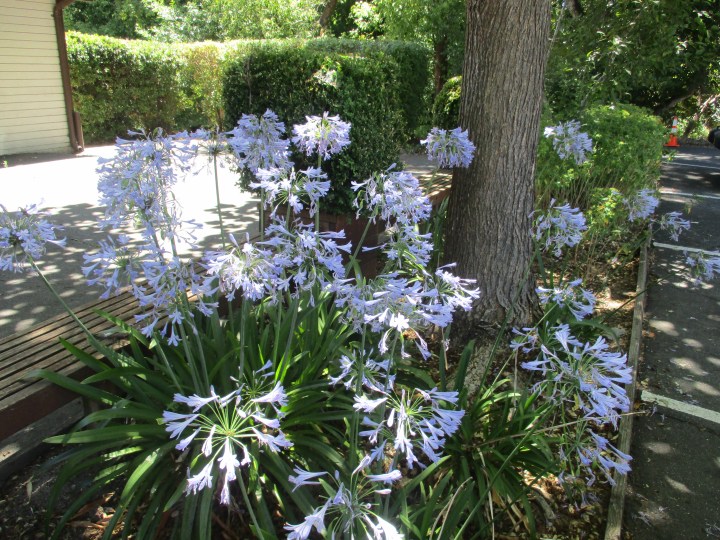
2. Peruvian lily. It seems to me that they were only beginning to bloom by this time last year. This year, they started blooming sparsely more than a month ago, and were blooming as profusely as they are now more than two weeks ago. There are pink and peach Peruvian lilies here too. I showed them off last years. (A peach flower can be seen out of focus at the bottom of the picture. A pink flower can be seen out of focus at the lower left corner of the previous picture #1 of Asiatic lily.P90608+

3. Rhododendron. Some bloom early and get battered by winter weather. Some bloom late and might get slightly roasted in the arid air of late spring. This one always bloom late like this, and has no problem with the weather. I do not know what cultivar it is. It certainly seems happy.P90608++

4. Dahlia. #1 Asiatic lily bloomed late. #2 Peruvian lily bloomed early. #3 rhododendron bloomed late. This dahlia did both. Dahlias typically only begin to bloom late in June. As you can see, this one already bloomed. I would not have shared this bad picture of a deteriorating early bloom, but was impressed that it bloomed at all. You see, it was dug and stored TWO winters ago, and then forgotten about. It somehow survived in storage through last year. I found it late last winter, and after determining that part of it was actually still viable, buried it right behind the lilies #1. It grew as if nothing had ever happened, and bloomed a year late and a month early. It has nice buds on in, so should resume bloom right on schedule, and continue to frost.P90608+++

5. Boston ivy. Four were planted over winter to climb a concrete retaining wall and a pair of concrete pillars supporting a bridge. The plan is to remove the Algerian ivy that hangs down over the retaining wall as it is replaced by the Boston ivy climbing up from below. I do not want to remove the Algerian ivy until necessary. I just want to keep it out of the way. I did not expect the Boston ivy to start growing like a weed so early. I cut the Algerian ivy farther to the left after getting this picture.P90608++++

6. Flowering cherry. Two plants; above were early. Two were late. One was both early and late. Well, this one won’t break the tie. These flowering cherries bloomed on time and are well foliated as they should be. In fact, they are better foliated and healthier than they have been in several years. They were so unhealthy last year that we had planned to cut them down and replace them by now. We just have not done so because we have not found replacements for them yet. Therefore, we are late; but it is not their fault. If it were at all possible, I would not remove them.P90608+++++

This is the link for Six on Saturday, for anyone else who would like to participate:

https://thepropagatorblog.wordpress.com/2017/09/18/six-on-saturday-a-participant-guide/
Mugo Pine

60608‘Shrubbery’ sounds so unflattering for a pine; but mugo pine, Pinus mugo, is not really much of a tree. The tallest trees do not reach eaves. Most old trees are only a few feet tall and about twice as broad, with strictly rounded form, and dense forest green foliage. The stout paired needles are only about one or two inches long. The plump cones, which are rarely seen, are not much longer.

Although very rare in other types of landscapes, and originally from the Austrian and Italian Alps, mugo pine is one of the most popular and traditional features in Japanese gardens. Even though it grows very slowly, it should have enough room to do so without competing with other more aggressive plants that might overwhelm it. It should neither be shorn nor pruned back too aggressively.

The Wrong Time For Pruning

80801thumbNot many plants are sensitive to mere heat alone. Actually, many plants prefer warm weather. The difficulty that some plants have with heat locally is that it typically accompanies aridity, and often accompanies afternoon breezes. As appealing as breezes and minimal humidity are to us while the weather is warm, they promote and accelerate desiccation of exposed sensitive foliage.

Pruning, which obviously becomes necessary while warm weather promotes growth, can make plants more sensitive to damage caused by warm, sunny, arid and perhaps breezy weather. It exposes formerly sheltered stems and inner foliage, which are more sensitive than outer foliage is, to more sunlight and drying breezes. Exposed foliage can either desiccate or roast, or both!

A bit of unsightly but relatively minor foliar damage on the extremities of the outer canopy might be only superficial, but major damage can be dangerous. Superficial damage often gets replaced by fresh new growth before it deteriorates enough to expose more foliage and stems below. However, recovery from major damage can be delayed by the distress associated with the damage.

Japanese maple, aralia, philodendron, rhododendron and all sorts of ferns can easily get damaged by increased exposure. Low ferns are not likely to become too exposed by any loss of their own foliage, but often become more exposed by the pruning of plants above them. Like frost damage, foliar scorch might need to be left to shelter remaining foliage until new growth develops.

The bark of many plants, although not susceptible to desiccation, is very sensitive to sun-scald if too exposed. Young and smooth bark is the most sensitive, particularly if it had always been shaded. Scald kills bark and the vascular tissue below. As it decays, it exposes interior wood to more decay that is likely to compromise the structural integrity of the affected stems and trunks.

Pruning during relatively cool weather and while there are a few relatively cool days in the forecast allows foliage a bit of time to adapt to a new exposure before the weather gets dangerous. Through summer, pruning should not be so aggressive that too much sensitive foliage or bark are exposed, even if it is necessary to leave a bit of unwanted sloppy growth to partly shade bark. Aggressive pruning of exposed and sensitive plants should be delayed until autumn, when sunlight is not so intense, and weather is cooler and wetter.

Horridculture – Fruity Fads

90417Pluots, plumcots, apriums and peacharines! Who comes up with this stuff?! Aren’t good old fashioned plums, apricots, peaches and nectarines good enough? Who decides that these weird hybrids are somehow better than their parents? Some of them are actually quite weird, or downright ugly. Several do not even look like they would taste good. It may be an acquired taste; but I have all the good taste that I need without acquiring any more.
Some old classic cultivars (cultivated varieties) of fruit were develop centuries ago. More have been evolving from those ancestors since then. Some were intentionally bred from parents with desirable qualities. Others just grew incidentally where their seed fell, and were found to be somehow better than their parents. Some were merely discovered as natural occurring mutants, and perpetuated for their superior qualities. It is a slow process.
So, putting two different kinds of fruits together, or finding an aberration of a single type of fruit, is nothing new. Tangelos were created by hybridizing Mandarin oranges with pomelos or grapefruits. Ever-bearing ‘Eureka’ lemon was perpetuated from a mutant of the seasonally bearing ‘Lisbon’ lemon. This is how cultivars evolve and develop. Generally, newer cultivars become popular because they are somehow superior to their ancestors.
Yes, somehow ‘superior’ to their ancestors. Who decided that a hideous hybrid of a plum and an apricot was somehow better than either a perfectly good plum or apricot? Furthermore, what evidence was there for such a weird claim? Even farthermore (if that is a word) how and why do so many people believe this evidence?
I was still growing citrus (trees not fruit) back in the early 1990s when the ‘Cara Cara’ pink orange was popularized. Yeah, a ‘pink’ ‘orange’. It is really just a pink mutant of the formerly more popular ‘Washington’ navel orange. We could not grow enough of it. It was just too popular. Some people really seem to believe that it is somehow better than ‘Washington’ and other navel oranges. I can’t argue. They certainly know what they like.
To me, it has a milder flavor than ‘Washington’. Yes, it tastes about as bland as it looks; pink.90320thumb

Shasta Daisy

90612It just might be one of the most popular daisies nowadays, but Shasta daisy, Leucanthemum X superbum, is not a naturally occurring species. It was developed by Luther Burbank in 1890, as a complicated hybrid of four different species, one of which is of a different genus. Yet, it is somehow genetically stable enough to produce viable seed, although seed of cultivars is not true-to-type.

Shasta daisy is an herbaceous perennial that forms a substantial network of sturdy rhizomes that mostly stay close to the ground, with blooming stems that can get almost three feet tall. Primary bloom begins in late spring or early summer, and continues until autumn, either in minor subsequent phases or as sporadic bloom. Flowers are big classic white daisies with bright yellow centers.

Although it can survive neglect and lapses of watering, Shasta daisy prefers to be watered at least occasionally, and is much more appealing if flower stalks are pruned away as they finish. It likes full sun, but will tolerate a bit of shade through part of the day. Mature plants are easy to divide for propagation. If the odd aroma is not too objectionable, Shasta daisies are delightful cut flowers.

Deadheading Promotes And Prolongs Bloom

90612thumbApril showers bring May flowers. May flowers make a mess. Well, some of them do. Most simply disintegrate and fall from the trees, shrubs and vines that produced them, and decompose into the soil below. Some might have needed to be swept off of pavement and decks. Regardless, most of us do not notice the very minor consequences for the majority of spectacular spring bloom.

However, there are some flowers that demand a bit more attention after they finish blooming. They linger after the show is over, and can look shabby as they deteriorate. Small ones can simply be plucked. Larger blooms might need to be pruned out. The process of removing deteriorating blooms is known as ‘deadheading’, and it is done for more reasons than just to keep plants groomed.

Plants bloom to produce seed, and the production of seed takes resources. Removal of seed structures not only diverts resources to more useful functions, but for many plants, it also stimulates subsequent bloom in response to interrupted seed production. They literally keep trying until they are able to produce viable seed, even if they must continue all season until late autumn dormancy.

Most plants that benefit from deadheading are perennials. Shasta daisy, black-eyed Susan, blanket flower, cone flower, yarrow, lavender and beard tongue (penstemon) bloom more abundantly and for a longer time with regular deadheading. The various lavenders, as well as other perennials that are comparably shrubby, are easily deadheaded by shearing after profuse bloom phases.

For bulbs and bulb like perennials that bloom only once annually, deadheading will not promote subsequent bloom during the same year, but conserves resources for the following year. Daffodil, lily, clivia, various iris and, during summer, gladiolus and dahlia, all appreciate diligent deadheading.

Petunia and marigold are two annuals that happen to bloom better with regularly deadheading. They bloom so profusely that deadheading can be quite a chore. Plants that can be invasive, such as salsify, should be deadheaded before dispersing seed.

Aw NUTS!

P90602Not just any nuts, but precisely the sort that I recently discussed with a colleague, as I explained how they do not grow here. The nuts that is. The big thicket forming shrubs that are supposed to produce them not only grow here, but are a relatively common native. I just rarely see even a single nut on them. I sort of wondered how they mange to procreate with such rare seeds that invariably get taken by unconcerned rodents or birds.
They are the beaked hazelnut, Corylus cornuta. You can see why they are known as such. The elongated nut husks look like Big Bird. The very rare nuts within are quite small with good rich flavor, like hazelnut concentrate, and develop only on the biggest and most distressed old hazelnut shrubs.
However, the young and healthy hazelnut shrub that produced the nut in this picture actually produced quite a few. They were just not close enough to each other for me to get more than one in a picture. A few other young and healthy hazelnut shrubs are doing the same at the same time. There are more hazelnuts now than I have seen collectively in many years. I can not explain why.
Some species of oak tend to produce an overwhelming abundance of acorns every several years or so, only to limit acorn production for the several years in between such abundance. All trees of the same species within a region somehow know to do this collectively at the same time. They do not do it often, but when they do, they do it together.
The oaks who do this supposedly produce just enough acorn to sustain a healthy squirrel population without promoting overpopulation. When they occasionally produce an excess of acorns, the squirrels instinctively bury many more acorns than they normally would, just because the acorns happen to be available. Since the squirrels can not consume all that they bury, many more stay buried to germinate and grow into trees later.