Fake environmentalism is a HUGE topic, so for now, will be limited to fake environmentalism as justification for the eviction of homeless encampments.
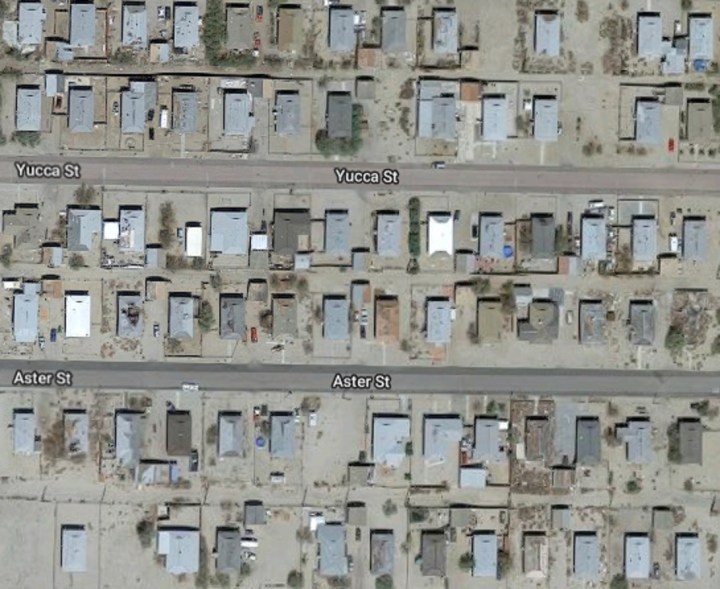
The yellow triangle in the picture above was the site of the Hero’s Camp, which was more commonly known as Ross Camp, and located behind Ross Dress For Less in Gateway Plaza in Santa Cruz. It is gone now. This satellite image was taken by Google Maps prior to the development of the Camp. I did not get pictures of the camp while inhabited, but you have likely seen enough other camps in the news to imagine what it looked like.
It really was as big as it looks, and really did exhibit all the problems that you hear about in the news, although not to such an exaggerated degree. Not everyone there used syringes to inject illicit narcotics. Not everyone there was an alcoholic. Not everyone was violent, from somewhere else, or a criminal. This is not about such issues anyway. It is about how the two hundred or so unhoused people who lived here affected the environment.
Was there trash? Of course there was. Was it more than what two hundred people who live in homes generate? No. Houseless people do not generate as much trash as the housed, simply because they lack resources to purchase the commodities from which so much trash is generated. The houseless certainly do not waste as much as the housed. Their trash just happens to be more visible for outsiders who do not know any better to see.
Furthermore, what is so typically described and perceived as trash is actually the belongings of those who live in such camps. Without closets, cabinets or furniture, our belongings would look about the same, except much more voluminous. When we take just some of the belongings that we don’t want or need and put them out in front of our homes, it is a garage sale, and likely amounts to much more than individual homeless people own.
The satellite image from Google Maps below shows the neighborhood where my grandparents lived in Felton, less than seven miles north of where the picture above was taken. Their old home is right in the middle of the picture. There were not so many other homes there when they arrived, just as World War II was ending. They lived a relatively modest lifestyle, on a small suburban parcel. They were not concerned about the environment.
Why should they have been? Even now, the people who live in homes here can generate as much trash as they want to, and no one will complain about it. They can fill their homes with their belongings, and put them neatly away in closets, cabinets and drawers. There are alcoholics in this neighborhood, as well as a few who are addicted to illicit narcotics. Some are criminals. Some are violent. Few are native. Again, this is off the main topic.
None of that is visible in this satellite image anyway. What it shows instead is how the lifestyles of those who live in homes are more detrimental to the environment than the lifestyles of those who lack homes. This picture is the same scale as the picture above, so you can see that only a few homes would fit into an area comparable to that in which about two hundred unhoused people lived. Only a few people live in each of these few homes.
What that means is that two hundred people like those who lived at the Hero’s Camp live dispersed over a much larger area, on land from which trees and vegetation needed to be removed. They all live in homes that are made of wood derived from trees that grew in forests. These homes are furnished with synthetic plaster, carpet, paint, glass, vinyl, metals and all sorts of materials that needed to be quarried, processed or manufactured.
It doesn’t end there. These homes consume energy for heating, lighting and whatever else that gas and electricity are used for. Cars driven by those who live in homes are also constructed from raw materials, and then need fuel to function. Water is consumed as if it were not a very limited resource. Much of it gets mixed with soaps and detergents before going back into the environment. Chlorine volatilizes from chlorinated swimming pools.
Then there are the landscapes and gardens, the parts of domestic lifestyles that we actually believe to be beneficial to the environment. They contain exotic (non-native) plants that compete with native species, and interfere with natural ecological processes. Irrigation of the landscapes stimulates redwoods and accelerated decay of oaks. Soil amendments, fertilizers and some of the pesticides change the chemistry of the soil and ground water.
Just compare these two pictures. As bad as the mess at Hero’s Camp was, the two hundred people who lived there were less detrimental to the environment and the local ecosystem than those who live in just a few of the homes visible in the picture below. Those who claim to be concerned about the environment should be more concerned about the ecologically detrimental lifestyles of those who live in homes than those who lack homes.
Coast Live Oak
The valley oak of the Sacramento Valley, San Joaquin Valley, and coastal valleys to the west, is the grandest oak of North America. Within the coastal half of that range, and extending down past San Diego, the coat live oak, Quercus agrifolia, is a nearly comparable second grandest. The biggest subjects may be as tall as seventy feet, and nearly as wide, with trunks wider than ten feet!
However, there is significant variability. Trees in forest situations do not get as big, and may stay lower than twenty five feet, with shrubby branch structure. While the biggest can get older than two centuries, smaller trees may not live half as long. The canopies of exposed solitary trees might reach the ground, while more social or sheltered trees are likely to shed lower growth with maturity.
Coast live oaks are typically pretty gnarly, and many have multiple flaring trunks. The dark evergreen leaves are only about an inch or two long, and half as wide, with bristly teeth on convex edges. The narrow inch long acorns can be messy. Roots are very sensitive to excavation and excessive irrigation. Sudden Oak Death Syndrome prevents new trees for getting planted in many regions.
Fake New Lawn
A new lawn is getting installed at work. Yes, installed. It will not be grown like lawns were decades ago. It will be unrolled and fastened into place, not like sod, but more like carpet. It will be synthetic artificial turf. After considerable deliberation, it was determined to be the most practical option for the particular application. The real turf that was there before succumbed to excessive traffic above and very sandy soil below.
The contractor who will be installing this lawn sent a sample piece of it prior to the final installation. We actually do not know why we got a sample, since we already know what the particular artificial turf is like. There was some concern that it would get too warm in sunlight, but it arrived with no explanation. It was unrolled onto the asphalt driveway at our maintenance shops, and surrounded with cones to protect it from getting driven on.
Rhody wasted no time in trying it out. Obviously, he found it to be quite satisfactory. He rolls around on it and tried to dig into it like it is real grass. With all the fallen locust flowers and cottonwood fuzz, it even looks like a real lawn in need of raking. I certainly hope that it does not expect to be watered and mowed as well.
You might think that all horticulturists would automatically dislike artificial turf. Yet, I am not the only one who prefers it to real turf grass in some situations. You see, real turf takes so much effort that those of us who enjoy horticulture would rather put into other more interesting and productive chores. After all, lawn is the most demanding feature of most landscapes, but is also the most monotonous and boring. Many of the best get no use.
By the way, this article was intended for yesterday. The article that should have posted today got posted yesterday instead. I am sorry for the glitch of chronology.
Mighty Oaks From Little Acorns
Oak, which might seem to be obvious to many of us, was identified by the Arbor Day Foundation as the People’s Choice for American’s National Tree. We certainly like our redwoods and exotic palms in California. Quaking aspen and blue spruce are probably favorites in Colorado. Sugar maple must be the most popular in Vermont. Yet, everyone appreciates the mighty American oaks.
Connecticut, Georgia, Illinois, Iowa, Maryland, New Jersey and the District of Columbia each have an oak as the official state tree. ‘Oak’ is one of the more traditional names for streets and roads throughout America. Just in California, at least eight towns are named after oaks, both in English and Spanish. Oaks put the ‘oak’ in Oaklahoma! (Oakay, maybe that last one is an exaggeration.)
So, now that we know that oak is what most Americans want to be the National Tree, does anyone know what species the oak should be? Well, that will take a bit more work. There are so many in America. There are too many to select from just in California! They are each so unique too. Some grow into grand trees. Others are shrubby scrub oaks. They might be deciduous or evergreen.
It is important to be aware that, just because oaks are the most popular trees in America, they are not necessarily appropriate for home gardens. Some, particularly in California, are best in the wild outside of landscaped areas. Some get too big. Some are too messy with acorns and leaves that fall slowly for a long time, either evergreen or deciduous. Some are susceptible to disease.
It is also important to be aware that big mature oaks, as rugged as the seem to be, are remarkably sensitive to modifications to their environment. Wild oaks that matured in areas that were not landscaped can succumb to rot in only a few years if the ground below them gets landscaped and regularly watered. Oaks planted into new landscapes adapt to the watering they get while young.
For landscapes that can accommodate them, oaks are grand and elegant shade trees that last a lifetime. There are many good reasons for their popularity.
Apologies for posting tomorrow’s article today. Today’s article will be posted tomorrow.
The Seventh On Saturday
This is the one that got away; or actually, the one that was never caught. It bloomed after I got the pictures for the ‘Six on Saturday’ post for this morning. It could be the same unopened bud in picture #3 of the Six on Saturday post, as it is now blooming. If not the same bud, it is on the same plant, and now looks even more like the common ‘Simplicity’ rose. It is not my favorite, but I did not select it.
That is how the recovery nursery works. It is where we bring salvageable plants that need to be removed from their landscapes. Some were in the way of other projects. Some were not the right plants for their particular situations. Some were even donated by neighbors who thought we might be able to utilize them somewhere in the landscapes.
Some of plants brought in are not there long. They might get groomed and then moved directly to a more appropriate situation. That happens more during winter, when we dig up dormant plants and relocate them while the weather is still cool and rainy. We did this with a big overgrown forsythia that was dug and divided into five or so new plants before getting relocated into a new landscape. It helps is we can delay relocation until winter.
There are many potentially salvageable plants that must be moved at a particular time, even if it is not while they are dormant. They get groomed and canned (potted), and can take their time to recover before we put them back into the landscapes. Unfortunately, many do not recover adequately. Some end up staying too long because we can not find homes for them. After several years, the roses will finally be going to a new home soon.
Six on Saturday: The Yard
This is no home garden. It is the yard outside the various shops of the Maintenance Department where I work part time. It contains some of the salvageable plant material that we try to recycle from some of the landscapes from which it must be removed. Over winter, some plants get dug and relocated directly, rather than come to the yard. Otherwise, plants come here to get canned (potted) to recover, and then find a home.
Because no one sees our yard, we need not maintain it like we maintain the rest of the landscapes. Consequently, it collects a few weeds. Also, because there are other shops in the same buildings, there are a few unexpected odds and ends left strewn about by other types of professionals, such as the electrician. Hence, #6.
1. You know, when I took this picture, I though that the annual grassy weeds somehow looked pretty in front of the wild cucumber vine on the cyclone fence. I’m not the artsy sort; so will not try to explain it.
2. Mixed in with the wild cucumber vine, which incidentally makes not edible cucumbers, this potato vine blooms, but incidentally makes not potatoes. Of course, I never dug it up to confirm that claim.
3. This rose, which might be ‘Simplicity’, has been here for a few years. No one remembers where it came from. It was supposed to get planted into a landscape while it was still dormant. Too late now.
4. This rose might be ‘Medallion’, but it is hard to say for certain. It is not as big as it should be. It was supposed to get planted while dormant too. There actually is a landscape that can use both of them.
5. Shasta daisy has been blooming for a while now. You would think that it would be easy to find a home for this one, but it is still in the yard. It is big enough to divide into more plants if still here this winter.
6. Spring bulbs are done now.
This is the link for Six on Saturday, for anyone else who would like to participate:
https://thepropagatorblog.wordpress.com/2017/09/18/six-on-saturday-a-participant-guide/
Scented Geranium
Window boxes were supposedly invented in Venice to contain aromatic plants that repelled mosquitoes (and probably because garden space was so minimal in Venice). Hanging plants like nasturtium and ivy geranium are traditional window box plants because they do not obscure scenery or sunlight. Scented geraniums are also popular because they are be so strongly aromatic.
Scented geraniums are of the Pelargoniuim genus, so are related to ivy and common geraniums, but are a mix of a few different specie and hybrids. Their foliage can smell like rose, lemon, orange, apple, strawberry, ginger, mint or other herbs or spices. Specialty geranium growers may have nearly a hundred varieties to choose from, which is less than half of the known varieties.
Not many scented geraniums bloom with impressively colorful flowers. However, many have interestingly textured, colorful and lobed foliage that might be velvety or even raspy. The more compact varieties stay less than a foot tall, and spread laterally very slowly. Others have longer but limber stems that lay low as they spread like sloppy ground cover. A few stand upright as tall as five feet.
Fire Is Part Of Nature
Plants have very different priorities from those who enjoy growing them. The colors and fragrances of flowers that we find so appealing are really designed to guide pollinators. The appealingly aromatic foliage of scented geranium and other herbs is actually designed to repel hungry insects and animals. Many tasty fruits are designed for seed dispersion by animals who enjoy them too.
Pollination, dispersion of seed and self defense are all part of what plants do in nature. They must also know how to survive in their respective natural environments. Many plants survive cold arctic weather. Others survive arid deserts. Many native plants want a bit of water through winter, but know how to survive through long dry summers. Many or most natives know how to survive wildfires.
As unpleasant as it seems to us, wildfires are very natural here. Native plants lack the mobility to get out of the way, so use other techniques to survive. A few, such as the two specie of redwood, survive by not being very flammable. More know how to resprout from their roots after they burn. Even more simply regrow from new seedlings. Then there those that use fire to their advantage.
Monterey pine trees tend to accumulate combustible debris. They also produce more seed-containing cones as they age and deteriorate. When they burn, all the debris burns so hotly that most of the other competing vegetation gets incinerated. However, the dense cones of Monterey pine protect the seed within, only to open to disperse the seed afterward. It is a rather ingenious plan!
Ungroomed desert fan palms burn at least as hotly, but survive because the hefty trunks protect the buds within. Each technique works for the specie that use it, but is not safe for home gardens! This is why combustible vegetation needs to be managed around the home. The rules are different in urban areas than they are where wildfires are a concern, but they are important everywhere. Even the most combustible of native plants, as well as exotics, can be reasonably safe with proper pruning and maintenance.
Horridculture – Bad Pollarding And Coppicing
Pollarding and coppicing are proper pruning techniques. If you think you are an arborist who believes otherwise, do not waste my time arguing about it. More than likely, you are neither as educated nor as experienced as I am with such matters, or you work exclusively with trees for which such procedures would be very inappropriate.
Well, yes, pollarding and coppicing are very inappropriate for the vast majority of trees and shrubs out there. Furthermore, even for those trees and shrubs that they are appropriate for, such procedures are very rarely done properly here in California. Most attempts at pollarding and coppicing are really horrid!
Take these blue elderberries and mock oranges for examples. They were mutilated last summer to improve the view of the historic Felton Covered Bridge. It sort of accomplished that objective, although the improved view of the Bridge was then cluttered with the disfigured and mostly bare trunks and limbs of the brutalized shrubbery below. Because they were chopped back too late in summer to grow much, they stayed that way until now.
So it is spring, and the shrubbery is growing from the tops of the mutilated but tall trunks and limbs, right back to obstructing the view of the Bridge. They will likely get chopped when they get to be too overwhelming, which again, will be in late summer, repeating the process. It would be better to just remove the shrubbery not only because it would be less work, but also because the shrubbery is so unsightly when it gets chopped!
OR; the shrubbery could get coppiced. Both blue elderberry and mock orange respond favorably to the procedure. If coppiced, or in other words, if pruned back to the ground annually each winter, they could regenerate fresh new growth each spring, but not get big enough to crowd the view of the Bridge by the following winter, when they get coppiced again. The elderberry would not bloom or fruit; but that is not important here anyway.
Coppicing takes advantage of the natural dormancy and regenerative processes of the plants. Starting over fresh each spring and growing uninterrupted through summer is more natural for them than trying to recover from getting brutalized while they are actively growing in summer. Since they start the process at ground level, they have room to grow without interruption. If cut back only as much as necessary, they have no room to grow.
Wax Begonia
Oh, how breeding complicates things. Many years ago, there were only six basic types of wax begonia, Begonia semperflorens-cultorum, with three choices for floral color, and two choices for foliar color. Bloom was white, pink or red. Foliage was either green or dark bronze. Although these choices have not changed, some modern hybrids are difficult to distinguish from other species.
Wax begonia can be either a cool season annual or a warm season annual, depending on when it gets planted. It can be grown as a short term perennial if pruned back in both early spring and early autumn. By spring, winter growth is tired of the cold. By autumn, summer growth is worn out from warmth. Exposed plants can get lethally frosted in winter or roasted by sunlight in summer.
Therefore, wax begonia prefers to be somewhat sheltered. It is more tolerant of full sun exposure in summer if mixed with other annuals or perennials. Too much shade compromises bloom. Wax begonia expects richly amended soil and regular watering, and is just as happy in pots as other annuals are. Potted plants can be moved to sheltered spots when the weather gets too hot or cold.