 From a distance, this landscape does not look so bad. It seems to have been only recently installed, and features the sort of material that was likely intended to not necessarily obscure the sleek architecture of the building behind it, but to eventually soften the starkness of it.
Let’s analyze the landscape. A glossy privet hedge in back should grow up into an informal screen to provide some substantial green against the wall, but with a bit of proper pruning, should not become too obtrusive. A lower hedge of variegated tobira (Pittosporum tobira ‘Variegata’) in front can be pruned into a semi-formal hedge to obscure the bases of the trunks of the glossy privets, which will undoubtedly shed lower growth as they mature. The lightly colored variegated foliage of the tobira contrasts nicely against that of the dark green privets. The blue festuca in front of the variegated tobira hedge provides even more contrast of color, as well as contrast of form, and also ties in with the same blue festuca elsewhere in the landscape. The only two ‘intentional’ interruptions of the simple sleekness of this landscape is where a pair of grapevines flanking a doorway await the installation of an arbor, and a single ‘Icee Blue’ yellowwood is expected to provide additional contrast of form and color in front of the glossy privets. Both features are well situated, and balanced within the symmetry of the landscape. Yes, it is all quite well designed.
And yes, this is Wednesday; the day for my ‘Horridculture’ rant. So, let’s look closer.
Firstly, this is not a new landscape. It has been here long enough to mature better than it has so far. The so-called ‘gardeners’ know that allowing the material to grow means that they will need to put more effort into maintaining it. They would prefer to just keep the glossy privet hedge down low where it does not produce much debris, rather than allow it to grow most of the way up the wall, where it should be by now. A row of cinder block painted green would work just as well, and not need to be shorn at all. The ‘Icee Blue’ yellowwood should likewise be larger than it is now, and looking like a small and neat but informal tree. It actually seems to be growing slowly, which is no fault of the so-called ‘gardeners’.
The pair of grapevines have the opposite problem of the privet hedge. They are not being contained enough. Without the arbor that has yet to be built, they have no place to go, so are just being pruned as rampant and fat shrubs that will fall over as soon as their old stakes rot at the ground. If an arbor is ever built, all that congested and disfigured growth should be cut to the ground in winter, and started over from the ground up. However, it is unlikely that the so-called ‘gardeners’ would maintain them any better on an arbor than they do with them within reach; so it is probably just as well that they are in the ridiculous situation they are in.
That low spherical shrub in the front and center of the landscape, which is just to the left of the lower center of the picture, and is the unintentional interruption to the simplicity of the otherwise well designed variegated tobira hedge that I alluded to earlier, is a variegated Pittosporum tenuifolium. It is so ridiculously shorn and abused that I can not identify the cultivar. I can only guess that it is the common and overly popular ‘Marjorie Channon’. Apparently, one of the variegated tobiras died and needed to be replaced. Hey, it happens. A so-called ‘gardener’ knew that the necessary replacement plant needed to be variegated. He also knew that it needed to be a pittosporum, which is probably more than most so-called ‘gardeners’ could ascertain. The problem was that he went to a nursery and grabbed the first variegated pittosporum that he found, which, as you can plainly see, does not match the tobiras. It assumed a different form, flopped forward as they often do when shorn in such an inappropriate manner, and continues to be shorn into the ‘shape’ seen here now . . . as if it is somehow an asset to this otherwise well designed landscape. The blue festuca that it landed on gets shorn right along with it.
The only feature in this well designed landscape that does not have a serious problem, except for its one member that was clobbered by the single disfigured pittosporum, is the blue festuca, and that is only because the so-called ‘gardeners’ do nothing to it.
 There may not be exceptions to every rule, but there are a few exceptions to the rule that winter is the best time for pruning. It is generally true that most plants are the most dormant through the coolest part of winter. It is also true that while they are the most dormant, most plants are less sensitive to pruning, as well as other horticultural techniques that interfere with their normal function.
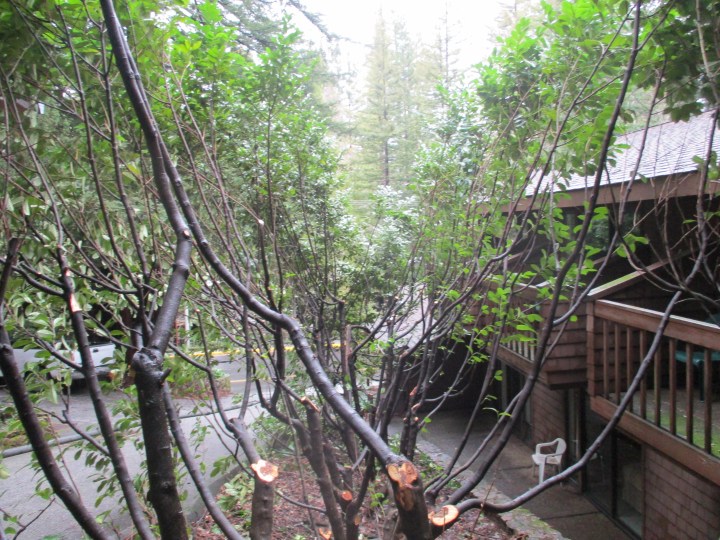 What makes this Bullwinkle worse than most is that I pruned it like this myself. What makes it worse than worse is that it did not need to be pruned in this disfiguring manner for clearance from utility cables like the last one I wrote about was.
 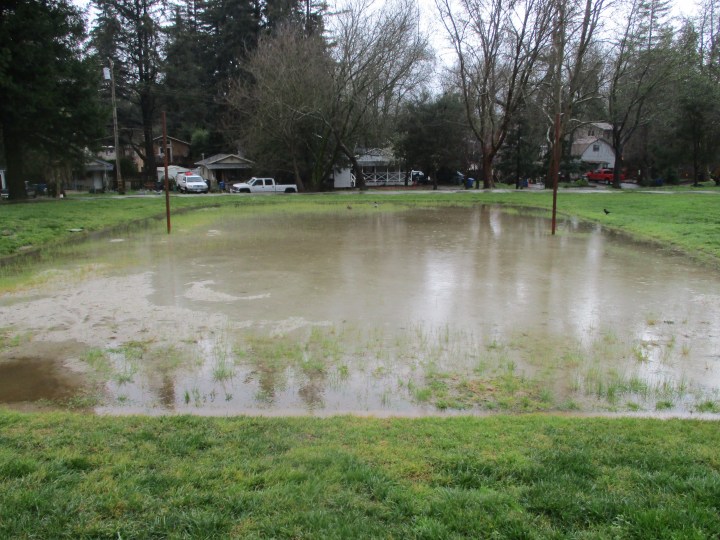 Supposedly, all this rain has not been too terribly excessive. It seems to have been raining more frequently than it normally does, with only a few days without rain in between, and more often, many consecutive days of rain. The rain also seems to be heavier than it normally is. Yet, the total rainfall is not too much more than what is average for this time of year, and well within a normal range.



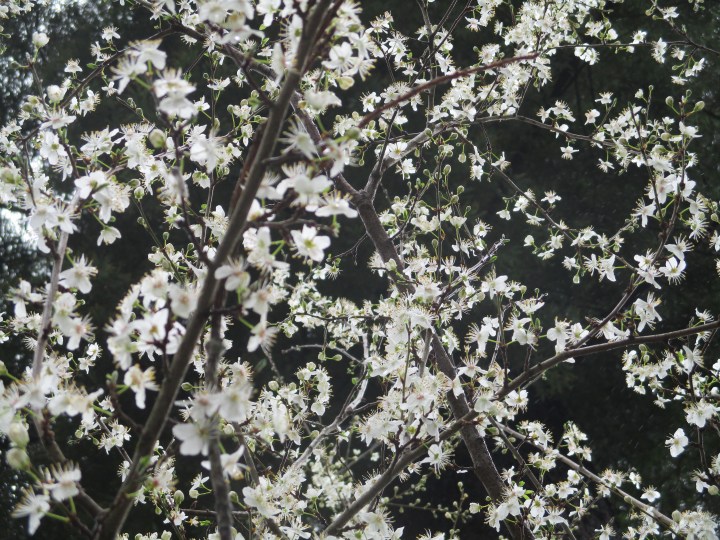

 Those of us who appreciate olive trees for their fruit production or distinctively gnarly trunks probably would not understand the popularity of the Little Ollie olive, Olea europaea ‘Little Ollie’. Not only is is completely fruitless, but it lacks sculptural trunks and limbs. It is instead a short and and shrubby plant that gets only about three or four feet tall, with very dense grayish green foliage. Only the narrow evergreen leaves are recognizable as those of an olive tree.
 Nomenclature is a standardized technology of naming. It dictates the universal ‘botanical’ names of all plants, so that everyone everywhere can communicate more efficiently about horticulture. Botanical names might seem confusing, and maybe even unflattering, but they eliminate the confusion associated with regional common names that are as variable as languages and cultures.
 While flashier but typically weaker modern cultivars of so many other specie are being developed, the most popular of the many cultivars of English boxwood, Buxus sempervirens, remain the same. There is not much to improve on. Most cultivars get only a few feet tall, and are densely foliated with inch long evergreen leaves that are excellent for topiary and low formally shorn hedges.
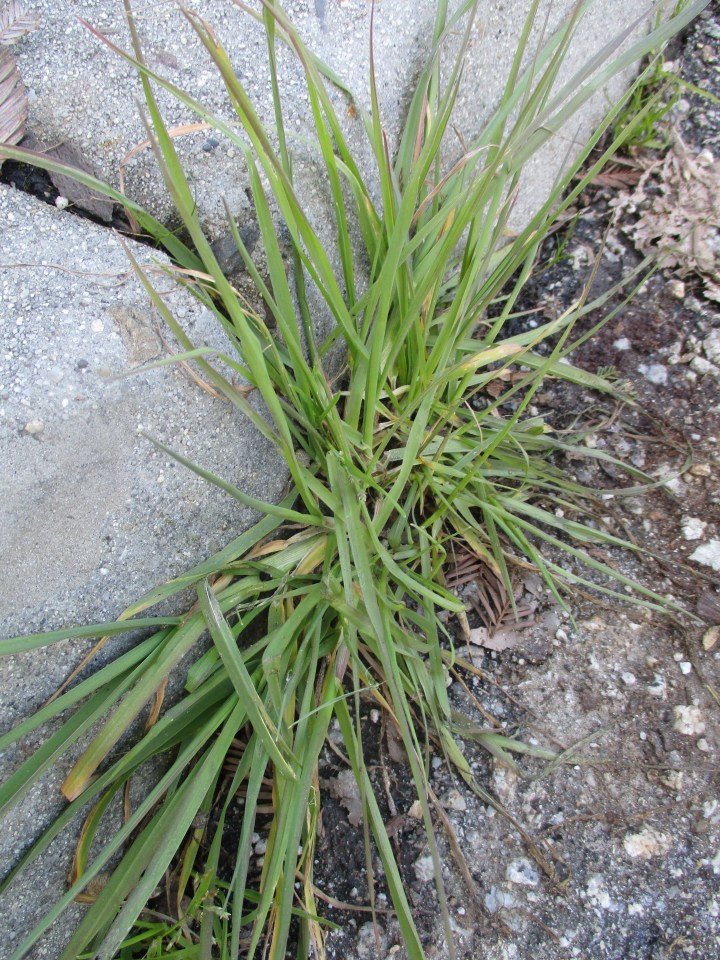 Not many of our favorite plants grow like weeds. We must help most of them along, and give them what they want. A few might naturalize and perform well on their own, but if they do too well and become aggressive or invasive, they too become known as weeds. Although we might prefer some of our favorites to be easier to grow, we are probably fortunate that more do not do too well.
 This is a relatively new development. The first few arrived here only two years ago. By last year, a few more arrived to make a significant herd that split into two smaller herds. Now these two smaller herds are quite significant. If they continue to proliferate as they have been, they will become more of a problem. They are already shredding flowers and colorful berries that are within their reach, and digging up flexible irrigation hoses.

