Deodar Cedar

81205Some of us may remember deodar cedar, Cedrus deodara, from the opening scene of the Andy Griffith Show. They were in the background as Andy Taylor and his son Opie skipped stones on Myers Lake near Mayberry in North Carolina. Those well established and naturalized trees and the pond are actually in Franklin Canyon Park in the Santa Monica Mountains above Beverly Hills.

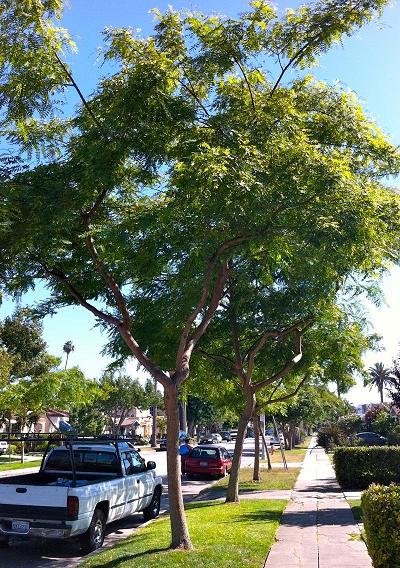
If only it did not get big enough to shade most of a compact home garden, deodar cedar would be better than most other evergreen coniferous trees used in California landscapes. It enjoys the warmth and sunshine here, and does not require any more water than what most regions that are not desert get from rain. It eventually gets fifty feet tall and thirty feet wide, and might get bigger.

The glaucous grayish needle leaves are about an inch or two long, and are arranged either in tight terminal clusters on the tips of short and stout stems, or singly on longer and pendulous shoots. Ideally, trees develop conical canopies with horizontal limbs that droop at the tips. Some trees develop a few main trunks down low, or big structurally deficient limbs that curve irregularly upward.

Arborists Are Very Specialized Horticulturists

81205thumbThe first storm of the year has a way of reminding us if our trees need attention. Whether then need to be worked on this year or not, we tend to notice how they blow in the wind, or if they are full of dead and deteriorating debris that falls into the garden or onto the roof. As deciduous trees defoliate, they are less likely to be damaged by wind, but their structural deficiencies become visible.
This is when some of us will contact arborists to inspect and perform necessary arboricultural procedures for trees that have grown to big for us to maintain. We do not want trees to be damaged by the wind. Nor do we want them dropping limbs or falling onto whatever is within their reach. Those that are biggest and most beyond our reach have the most potential to cause major damage.
Arborists are horticulturists who specialize in the horticulture of trees, which is known as arboriculture. They assess the healthy, stability and structural integrity of trees, then prescribe necessary corrective arboricultural procedures, and if necessary, prescribe the best time for such procedures. Most arborists work with a tree service that is equipped to perform the prescribed procedures.
Arborists who are certified by the International Society of Arboriculture, or ISA, have passed an examination of their arboricultural expertise, and maintain their credential by continued involvement with the educational seminars, classes and workshops of the ISA. More information about the ISA, local certified arborists and even arboriculture, can be found at the website http://www.isa-arbor.com.
As mentioned earlier, arboriculture is specialized horticulture of trees. It is not something that gardeners should be expected to perform; particularly mow, blow and go gardeners who are not even proficient with simple gardening. Many arborists can concur that unqualified gardeners sometimes kill trees, and cause much of the damage to trees that arborists must later correct. Besides, arboriculture is the sort of work that can be very dangerous to those who lack training, experience or the necessary equipment.

Frost

P81125We do not get much frost here. This picture of the view through the windshield of one of the work vehicles was taken more than a week ago, while the humidity and the temperatures were still quite low. The sparse and angular pattern of the frost on the windshield is a result of the minimal humidity. There will be more frost later in winter, although there will not be nearly as much as most other climates get.
After a cool Monday morning last week, the weather got a bit warmer, or really just less cool. Rain started about midnight between Tuesday and Wednesday, and continued through the day and into the night. More rain is predicted to start after noon next Tuesday, and continue through Thursday. There will be no frost during this weather pattern. Frost happens here only between rainy weather. One might think that since we do not get much rain, there would be plenty of time in between for frost. Really though, much of our winter weather is simply quite pleasant, neither rainy nor frosty.
As appealing as this might be to those in harsher climates, it has certain disadvantages.
So far, there was just enough chill to start defoliation of the black locusts and box elders in the background of the picture, and just enough rain to almost finish it. Trees that need more of a chill to start this process are not so impressed with the weather. Many of the crape myrtles have not even started to color yet. Cottonwoods are starting to defoliate, but are doing so while still only dingy greenish yellow because they did not get enough chill for better color.
Spring bulbs that got planted earlier or are being planted about now will bloom next spring because they were so optimal and primed to do so before they were planted. However, many will not get enough chill in their second winter to bloom again. Consequently, many of the bulbs that would be perennial in other climates are grown as expensive annuals here. Likewise, seed of certain specie that self sow may not get enough chill through winter to germinate next spring.
So again, what is comfortable for us is not so ideal for everything in the garden.

Time Travel

P81124KOne never knows what strange artifacts might be found out in public landscapes. It is amusing enough to find items discarded or simply misplaced long ago by former occupants of a home out in a private home garden. Public landscapes are even more interesting, since they collect debris and artifacts from many more people. Some landscapes have been doing so for a long time.
Besides litter, the most commonly found artifacts are sporting equipment. Frisbees, baseballs, tennis balls, soccer balls, volleyballs and such are commonly lost in dense vegetation. Golf clubs, baseball bats and tennis rackets sort of make one wonder. Chew toys are sometimes left by dogs who go after them, but then return with something they perceive to be more interesting.
Landscapes that are near roadways often feature car parts that might have fallen out of cars as they drove by, as well as a few that cars could not have driven by without. Obviously stolen items, such as purses and wallets, often surrounded by a few credit cards that they likely contained sometimes appear. Stolen mail might fit into that category.
I have yet to find anything as interesting as tickets to a San Jose Sharks game, a big bag of money, Elvis, a purple dinosaur from another plant or a flying saucer that brought it here. However, I have found evidence of time travel!
A retaining wall that holds back an embankment above a parking lot at work was apparently constructed by Mike Menard in 1982, who left his name and the date inscribed into the concrete on top of the wall. That by itself is nothing too remarkable. What IS remarkable is that an adjacent retaining wall was constructed four hundred years later, and three hundred and sixty-four years from now, in 2382!P81124K+

Six on Saturday: More Unknown Succulents


This is not as simple as it looks. It is something of a guessing game for me. I am rather certain that #1 and #2 are identified correctly. I am not so certain about #3 and #5. The name of #4 is merely a guess. #6 is the only one that I know the name of for certain, although the name that I know it as is now outdated.

The lack of a species name for the two species of Sedum #1 and #2 seems like a cop out to me. I might have discussed it in one of my Wednesday rants, or will do so soon enough. All species should be described as a ‘species’, not merely as a genus with a cultivar name tossed in as if it adequately designates the identity. I sometimes write about how the nomenclature of plants is like that of cars. Both plants and cars are distinguished by genus AND species, with some specie divided into separate cultivars and varieties. (Cultivars are merely ‘cultivated varieties’.) Depriving a plant of a species name is like describing a car as a Buick ‘Convertible’, or a Chrysler ‘Sedan’. There is a big difference between a convertible Electra and a convertible Skylark, although both are Buicks. There is also a big difference between an Imperial sedan and a LeBaron sedan, although both are Chryslers. I may not have identified the two Sedum with their correct names, but even their correct names are not very correct anyway.

Echeveria glauca #3 seems too simple. Shouldn’t it have a cultivar name too? I really do not know. I really do not even know what species it is.

The same goes for Graptopetalum paraguayense #4. Really, I do not even know what genus it is. This is merely a guess. How embarrassing.

Aloe brevifolia #5 has a different issue with its name. It seems that all aloes are known simply as Aloe vera, even though not many of us would recognize Aloe vera if we actually saw it. This makes it easier to identify unknown aloes, but complicates the identification of familiar aloes.

Then there is the easily identifiable Bulbine caulescens #6. Seriously, I recognize it, but somehow, the name got changed. The first name is how I know it. The second name is the newer correct name.

1. Sedum ‘Angelina’P81124

2. Sedum ‘Blue Spruce’P81124+

3. Echeveria glaucaP81124++

4. Graptopetalum paraguayenseP81124+++

5. Aloe brevifoliaP81124++++

6. Bulbine caulescens or Bulbine frutescensP81124+++++

This is the link for Six on Saturday, for anyone else who would like to participate:

https://thepropagatorblog.wordpress.com/2017/09/18/six-on-saturday-a-participant-guide/

Firethorn

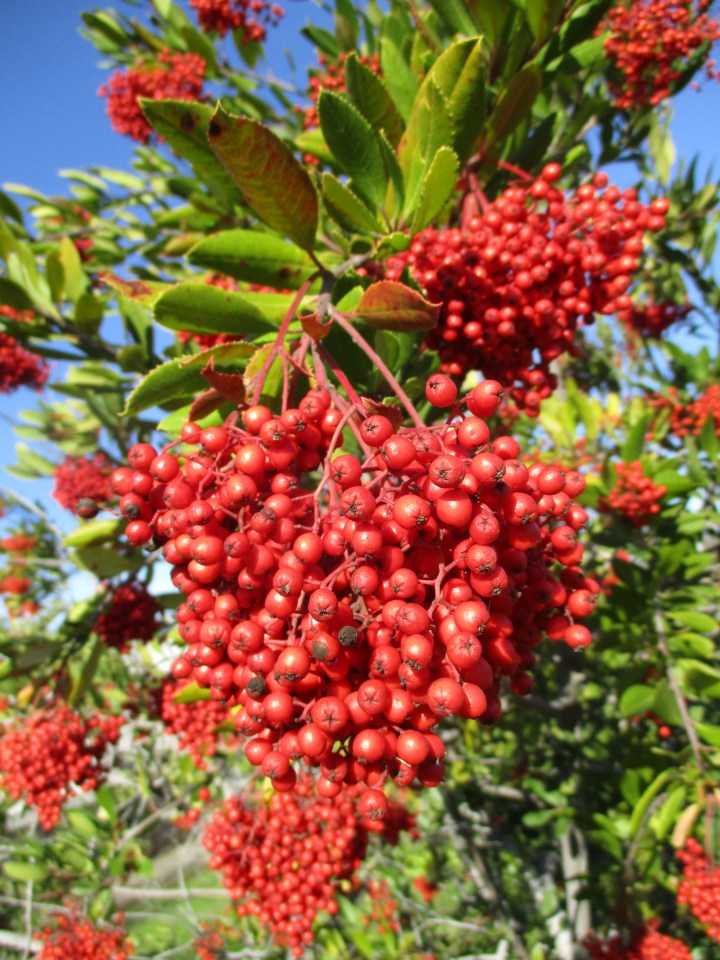
51125Of all the colorful berries that ripen in autumn, firethorn, Pyracantha coccinea, is the most colorful, and also the most familiar. The berries are almost always bright red, deep red or reddish orange. Cultivars with orange berries have become rare. Those with yellow berries are even more rare, and are weaker plants anyway. The berries can linger through winter, but typically get eaten by birds half way through.

Firethorn earns its name with formidable thorns. A hedge of firethorn is more impenetrable than a fence topped with barbed wire, but much more appealing with glossy evergreen foliage. The only problem is that no one wants to prune such a nasty hedge! The arching stems can get taller than ten feet, and without adequate pruning, can easily get as broad. Young plants are limber enough to be espaliered.

The fragrance of the profuse clusters of tiny white flowers that bloom in spring and summer may be objectionable to some. Shade inhibits bloom and subsequent development of berries. Feral seedlings sometimes appear, but they are wimpier, thornier, and less prolific with berries than their modern cultivar parents are.

Colorful Berries Linger Through Winter

51125thumbJust as many flowers attract pollinators with color, some types of fruit employ color to get the attention of birds and other animals. Just as many flowers reward their pollinators with nectar, fruit is its own reward to the animals that eat it. The only catch is that those who want the fruit must disperse the seed within. For both the hungry animals and the fruiting plants that lack mobility, it is a rather equitable arrangement.

Much of the fruit that uses this technique ripens in autumn, and linger through winter, when there is not much other fruit. It is available to migratory birds and animals that want to fatten up for winter. Unlike nuts and large seeds that get buried locally by squirrels, the tiny seeds of winter berries typically get eaten and ‘dispersed’ more remotely. Some actually need to be scarified by digestion before they will germinate.

Because they put as much effort into attracting vectors to disperse their seed as flowers put into attracting pollinators, fruit and berries can add significant color to the home garden. Oranges, mandarins, lemons, grapefruits and other citrus are quite colorful, even though they do not expect to be taken away by birds, To attract crows, persimmon fruits get as colorful for winter as their foliage was through autumn.

Firethorn (pyracantha) is probably the most colorful and profuse of the ornamental berries. Various specie and cultivars of cotoneaster produce similar berries, but not quite so prolifically. They are popular for their resiliency. Toyon, which is the native ‘California holly’ that Hollywood is named for, is a bit too finicky for irrigated and refined gardens, but can be quite colorful with berries in wild or casual landscapes.

Firethorn, cotoneaster and toyon, as well as English hawthorn, all produce similar ‘pomme’ fruits, which are actually more like tiny apples than real berries. They are so popular with the birds that they are not very messy; although the birds may be if they loiter. English hawthorn is a small deciduous tree, so yellows and defoliates as the bright red fruit ripens.

FINALLY! We have RAIN!

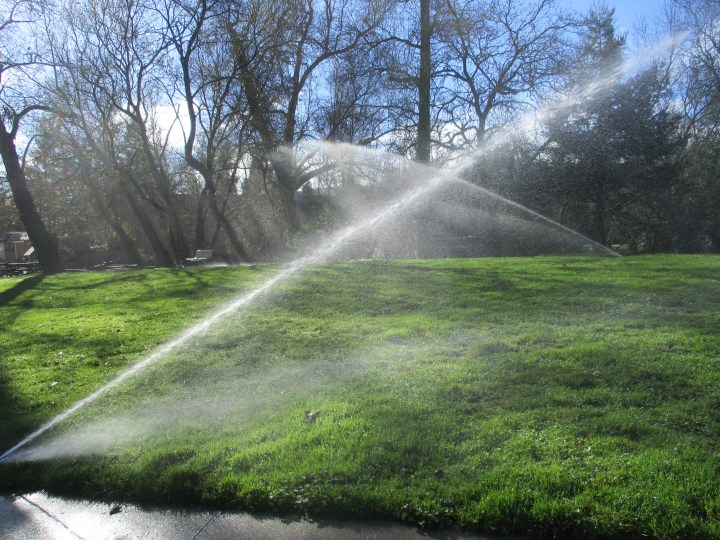
P80103+For those who do not remember what ‘rain’ is, it is, it is those odd drops of water that fall so mysteriously from the sky in other regions. We get it here too, just very rarely, and almost exclusively within a limited season centered around winter. Rain tends to be affiliated with storms. The last storm moved through here last spring.
Rain may not be much to look at, and is nearly impossible to get a picture of, but it adds up to become a very important commodity known as ‘water’. Some believe that California does not have enough water. We natives know that there is actually plenty of water, but merely too many people in need of it, and a few of those many who capitalize on that need. Anyway, I did not even try to get a picture of the rain that is falling so nicely now, but recycled this old picture of a small volume of water in what is known as a puddle, which is merely an accumulation of water within a low spot on a flat surface.
As unpleasant as rain is to work in, we are very pleased to get it. The sky is rinsed of smoke, and despite the unpleasant news that rain will interfere with searching for remains of those killed by the Camp Fire, there is also the excellent news that the rain is falling over a large area, and making forests significantly less combustible. The formerly crispy forest is again lush and damp and sloppy. What had been a Dust Bowl down where we dump greenwaste is now an epic mud pit! Everyone here is delaying other work to clear drains on roads and roofs. The first storm of the season is always something to celebrate.

Horridculture – Just When You Thought It Couldn’t Get Any Sillier . . .

P81121Two others have already written about this far more proficiently than I would have:
https://sweetgumandpines.wordpress.com/2018/11/18/abomination/
Amaryllis, Queen of the Forced Bulbs
These two articles say it all. I would not have bothered to write about it too if I had not already taken the picture above. I did not read the label to learn what one of these articles said about why these bulbs were waxed. It seals in moisture, so that the bulbs do not desiccate while they bloom without water or moist media. They at least get water when forced by the conventional manner.
I suppose to many who force amaryllis bulbs, there is no problem with waxing them like this, since they are typically discarded as their forced bloom deteriorates. There is no expectation for the bulbs to survive the process to regenerate and bloom the following year.
We can at least pretend that we intend to nurture amaryllis bulbs that bloom in a ‘forcing kit’ that includes a small volume of potting media that sort of sustains the fleshy roots through the process. After all, they can survive the process and get potted into larger volumes of media to recover and bloom again. Some of us have actually sustained such bulbs for a few years Bulbs that are purchased bare and then potted directly into more reasonable volumes of media are of course more sustainable from the beginning.
Poinsettias and living Christmas trees are no better than forced amaryllis. Nor are the Easter lilies in spring.
Like amaryllis bulbs, Easter lilies can be purchased bare and grown directly out in the garden. Those that are forced in pots can be planted out in the garden afterward to possibly recover. Otherwise, they too get discarded after bloom.
Poinsettias can technically be grown as houseplants, but rarely survive that long. Those that do not get tossed after they shed their colorful bracts are likely to get tossed as they languish in recovery from the process of forcing them to bloom in a very contrived greenhouse environment.
Living Christmas trees are actually more of a problem if the ‘do’ survive. They so often get planted into small gardens, and often next to foundations of homes, with the belief that they will always stay small and innocent. The problem is that most are seedlings of the Italian stone pine, which grows very big and very fast, and soon becomes a problem that is very expensive to remove. If not planted in a garden and allowed to destroy all within reach, they die from neglect and confinement within their own pots, often within their first year.

Japanese Anemone

81128Here it is, three quarters of the way through November, and this Japanese anemone, Anemone hupehensis or Anemone X hybrida, is finally finishing bloom. It should have finished a month ago, but does not always stay on schedule here. Each cultivar exhibits a distinct responsiveness to the seasons, so others finished a while ago. The deciduous foliage will eventually succumb to frost.

Once they get going in a spot that they like, Japanese anemone slowly spread. Although not considered to be invasive, they can be difficult to get rid of if they creep into spots where they are not wanted. Because they bloom so late in summer and autumn, they get divided in spring. Even old colonies may never need to be divided, but can be divided if more plants are desired elsewhere.

The elegance of the foot high foliage seems contrary to its woodsy and unrefined compatibility with taller shrubbery and small trees, like rhododendrons, Japanese maples and hydrangeas. It is an excellent seasonal understory. The limber stems of the white or pale pink flowers get about twice as high as the foliage. The one and a half to two inch wide flowers are either single or double.

Japanese anemone wants rich soil, partial shade and regular watering. It can be happy in full sun exposure if it does not get too warm and dry.