 I really believed that I had something special here. A few fruit trees that are either remnants or descendants of remnants of fruit trees of the old Zayante Rancho have survived on a vacant parcel east of town.
There are two pear trees, a prune tree and an apple tree. The pear and prune trees are too overgrown to make much fruit. Almost all of the fruit that they manage to produce is too high to reach, and of inferior quality. They could be renovated, but the process would require severe winter pruning for several years.
However, the apple tree is still somewhat compact and quite productive. Much of the fruit is within reach for the ground. Much of the rest can be shaken from the tree without damaging it too much. Although abandoned for decades, someone actually put the effort into pruning the apple tree a few years ago. It still needs some major pruning, but would be easier to renovate and restore than the other trees.
I can not identify the cultivar of the apple, or even the type. The fruit looked and tasted like some sort of Pippin apple earlier in the season, but is now slightly more blushed than other familiar Pippin apples in the region. It could of course be another cultivar of Pippin. It is not very juicy, but is quite richly flavored. Winter pruning to concentrate resources would probably improve the quality of the fruit.
Until recently, anyone who wanted to forage for a bit of fruit from these few fruit trees had open access to them. Both prunes and pears needed to be knocked out of their trees, and collected from the ground. Timing was critical for the prunes. They would be unripe if a few days early, or squishy and on the ground if a few days late. Apples were the most popular because they were more abundant and easiest to collect from the tree.
Unfortunately, the vacant parcel needed to be fenced. Only those who are involved with maintenance of the parcel have access to the trees now.
Well, I happen to occasionally work for one of those privileged few, which indirectly gives me access to the distinguished trees.
Of course, I could not resist bragging to my Pa about my privileged access to these now private heritage trees, especially the apple tree. As I said earlier, I really believed that I had something special here.
To my surprise, and perhaps disappointment, my Pa is very familiar with my special apple tree! I had nothing to brag about that he could not also claim! He actually picked apples from it with his mother when he was a little tyke living on Ashley Street in town!
Winter Squash Last For Months
 With all the talk about replacing warm season vegetables and bedding plants with their cool season counterparts this time of year, we should also address the irony of summer squash and winter squash. Their designations suggest that they too grow in specific seasons; summer and winter. Duh. It would make sense that summer squash would be replaced by winter squash during autumn.
However, both groups are warm season vegetables that can get planted or sown as seed in early spring. The vines of both summer and winter squash grow through spring and summer, and then eventually succumb to the first frost. The difference is that summer squash start producing early and abundantly, and continue to produce through summer. Winter squash ripen slowly in autumn.
Summer squash, like zucchini, pattypan and crookneck squash, are very prolific. Zucchini can be overwhelmingly so. However, their fruits, which are incidentally considered by most to be culinary ‘vegetables’, are best fresh. Otherwise, they are quite perishable. They can be frozen or canned, but do not hold up well. Consequently, good summer squash are unavailable after the first frost.
Winter squash, like Hubbard, acorn, butternut, turban and spaghetti squash, as well as pumpkins, are not nearly as productive. Individual plants might produce only single large fruits, or only a few small fruits, depending on variety. These fruits develop and ripen so slowly that they are not ready until autumn, as the vines are withering. Supposedly, exposure to slight frost improves their flavor.
The advantage of winter squash is that the fruits are tough enough to be stored for months into winter, hence their designation as winter squash. Some pumpkins can be stored out of the weather for months after winter, although flavor and nutritional quality slowly deteriorate. If that is not long enough, the flesh of winter squash can be peeled, and then frozen or canned. Unfortunately, winter squash are no substitute for summer squash, and take more work to cook, but they are certainly worth growing.
Vahz, Vawz or Voz
 ‘V-A-S-E ‘ is probably how it is spelled, just like that which is pronounced exactly as it looks, or ‘vays’. ‘Vahz’, ‘vawz’ or ‘voz’ just sounds fancier, . . . or bigger.
That is how I learned it. ‘Vays’ is the smaller version that is designed to contain one or only a few flowers and maybe some foliage. ‘Vahz’, ‘vawz’ or ‘voz’ is the much larger version that is designed to contain entire bouquets or ‘floral arrangements’. Those that contain only dried flowers and foliage do not even need to hold water.
I learned this from those who were experts on the subject. My Aunt Betsy and her best friend Cathy were ‘flower children’. They rented an apartment in a hip and trendy neighborhood in western San Jose back in the early 1970s. The neighborhood was so trendy and hip that the neighbors were known as ‘hippies’. Aunt Betsy and Cathy outfitted their apartment accordingly, with wicker, shaggy rugs, and a big spider plant hanging from beaded macrame.
Of course, there was also a rather big ‘vahz’, ‘vawz’ or ‘voz’. It was cheap molded plaster painted glossy chocolaty brown. It contained a billowy abundance of only two species of dried cut flowers, cattails and pampas grass, that had been sprayed with hair spray to prevent them from sharing their seed. It was as gloriously hideous as it sounds, and more than adequately expressed impeccable cultural refinement and a keen appreciation for the remarkably distinctive and exquisitely tacky style of home decor that was so prevalent at the time.
The cattails might have been collected on the side of Highway 80 in Auburn, near the home of Aunt Betsy’s Great Aunt Mamie. The pampas grass might have been found in Vasona Lake County Park in Los Gatos.
Six on Saturday: Expect The Unexpected
There will be no more bragging about how late the nice summer weather continued into autumn here. Foliage and berries are already coloring for autumn. During this past week, there were a few other unexpected discoveries in the garden, and one that was not in the garden.
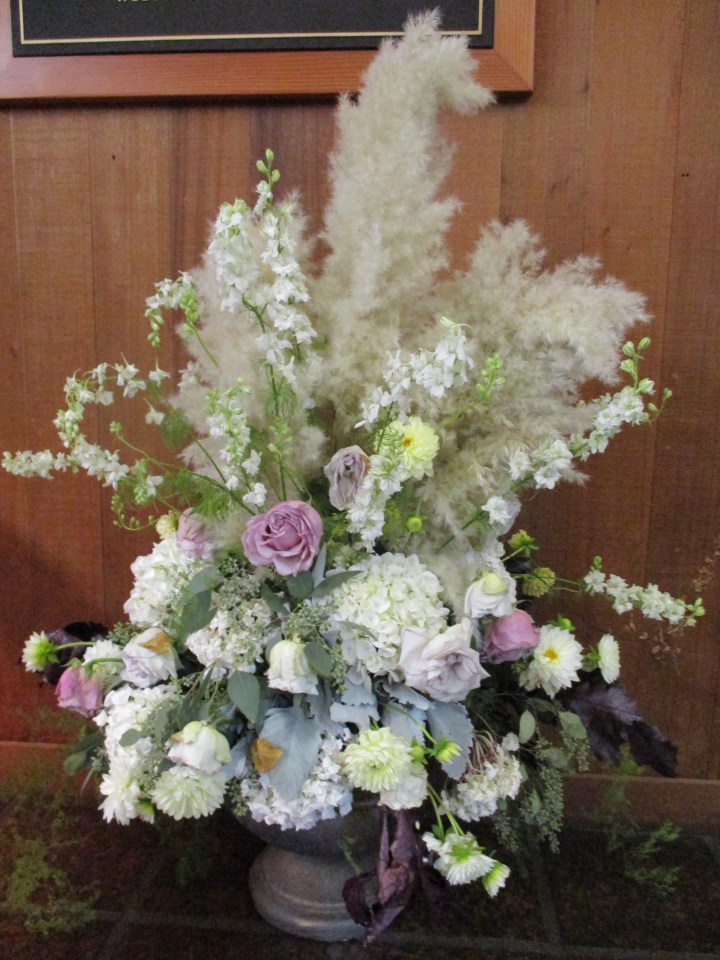
1. Pampas grass is an old fashioned cut flower that was popular when I was a kid in the early 1970s. It lost popularity as the style of floral design became less informal and more refined. The pampas grass plants that produce the blooms were beginning to be recognized as seriously invasive exotic specie at about the same time. Those that produce the biggest and most billowy white blooms are not as invasive as those that produce the leaner pinkish tan blooms. Well, I could write another article about pampas grass; but presently, I only need to say is that I did not expect to see these big billowy pampas grass flowers up above and in the background of this big floral display that was left at work from a wedding there last Saturday.
2. Red hydrangea is too modern for my taste. Deep blue or deep purple are no better. I believe that hydrangeas should be white or pastel hues of pink or blue, or perhaps lavender. You can’t improve on perfection. I did not expect to take a liking to this rich maroon hydrangea.
3. Dogwood foliage, as well as other foliage that colors in autumn, should develop color later here in our mild climate that in most of America. I did not expect to find such bright red foliage on a dogwood tree already.
4. Cotoneaster berries should likewise develop color as they ripen a bit later than they do elsewhere. I did not expect to find such ripe red cotoneaster berries already.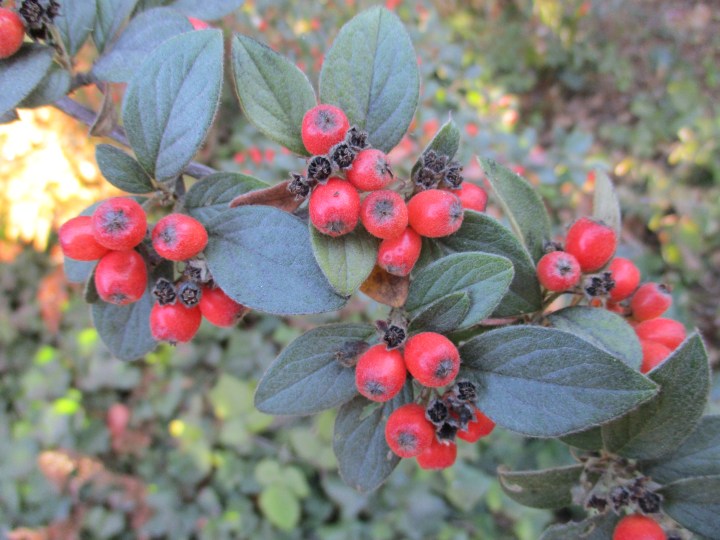
5. Star magnolia was in rough condition after being relocated over summer. It was in an area that was in the process of being landscaped, so the relocation could not have been delayed until after defoliation in autumn or winter. The little magnolia initially seemed to tolerate the process rather well, but about two weeks later, started to wilt and discolor in warm weather. Subsequent defoliation was a slow process that continued into the end of summer. Axillary buds swelled slightly, as if the tree was getting ready for premature autumn dormancy. That was what I was hoping for. I did not expect the now seemingly happy little star magnolia to develop a second phase of new foliage that it will now need to shed later in autumn.
6. Apples ripen at various times. Some cultivars finish as early as late July. Others are just finishing now, and might hang on the trees until early November! These apples are from an old tree on a vacant parcel that I do not get to very often. I intend to prune the tree over winter so that it can be renovated and cultivated as such a distinguished old tree should be. I will be recycling this picture tomorrow, and writing more about it. You will understand why if you read that article. Because I do not know what cultivar this tree is, I did know what to expect from it, but after ignoring it for a while, I did not expect that there would be so many apples remaining.
This is the link for Six on Saturday, for anyone else who would like to participate:
https://thepropagatorblog.wordpress.com/2017/09/18/six-on-saturday-a-participant-guide/
Chrysanthemum
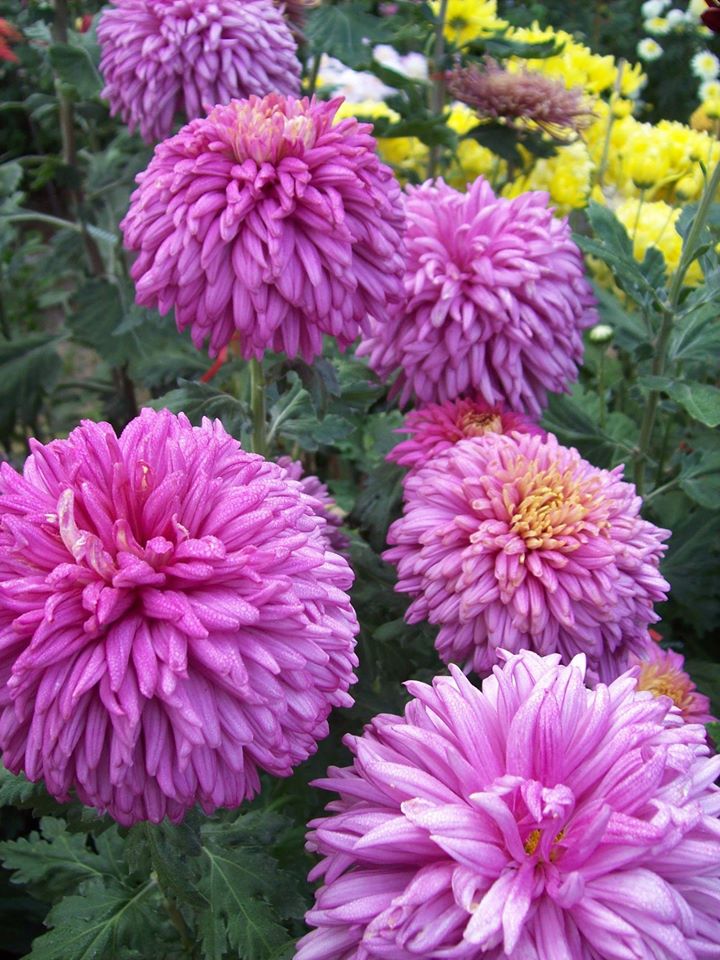 It is impossible to fit enough information about chrysanthemums into just a few sentences. Centuries of breeding have produced too many cultivars to document. Flower color ranges through many shades and hues of yellow, orange, red, pink, bronze, cream, lavender and almost purple, as well as white. (True purple is purportedly lacking.) Many have yellow centers. The deeply lobed leaves are strongly aromatic.
Flower form is as variable as color is. Some are small domed buttons that bloom in sprays of many blooms. Others are round pom-poms. There are all sorts of daisy types. Spider mums have weirdly elongated ‘petals’, (which are actually ‘ray’ florets). Those that bloom singly are bigger than those in sprays. Some of biggest and most billowy seem to be too heavy for their own stems!
If they get what they want, chrysanthemums can be surprisingly reliable and easy to grow. They do want regular watering, regular application of fertilizer, and richly organic media, such as potting soil. In fact, they are popularly grown in pots because they prefer potting media to garden soil. Potted plants can be brought in while blooming, and then retired to the garden between bloom phases.
Chrysanthe-Mum Is The Word
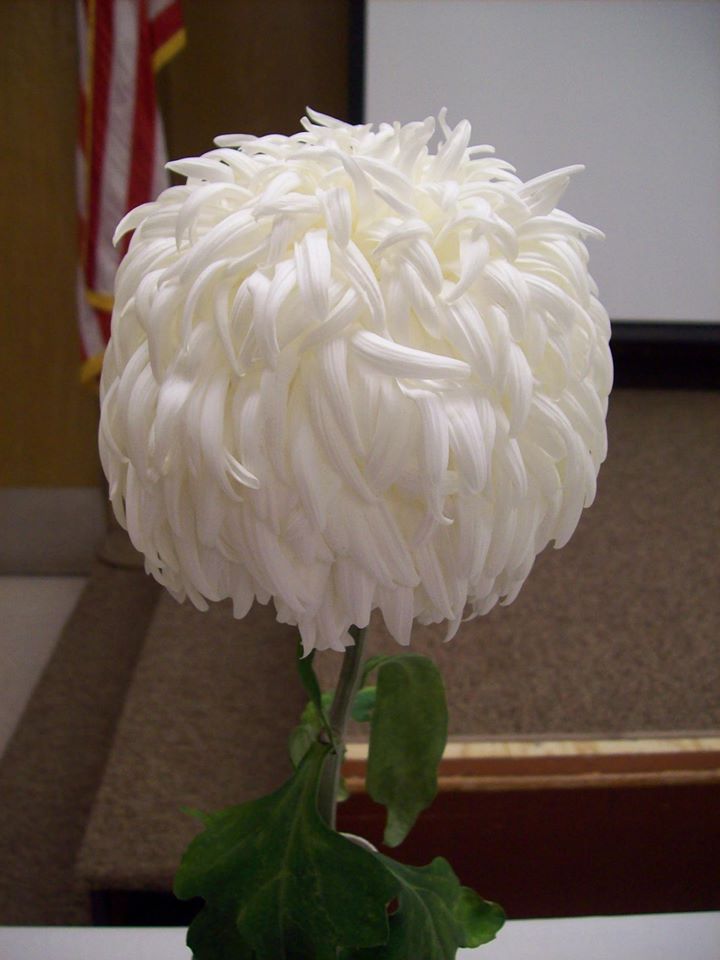 Only a few decades ago, when horticulture was taken more seriously, potted blooming plants like chrysanthemums, orchids, azaleas, hydrangeas, lilies and even poinsettias, got the respect that they really deserve. Now they are more commonly purchased in full bloom, enjoyed only as long as their bloom lasts, and then discarded as their blooms deteriorate.
Some get put outside, but often die before they actually get repotted or planted into the garden. Many of those that do get planted, die when their sensitive greenhouse-grown foliage gets scorched by real sun exposure. Others succumb to desiccation before they can disperse their roots. Only orchids want to stay in their original pots for a while, but they rarely get the attention and regular watering that they crave.
Chrysanthemums happen to be in season now, both as potted plants for the interior of the home, and as autumn annuals in the garden. Yet, they are quite sustainable as perennials that can live for quite a few years. They only need to be groomed accordingly so that they can bloom in season, and new stems can replace the old. When they get planted into the garden, multiple plants in a single pot should be separated.
Many chrysanthemums get tall enough to require staking. If left to perform naturally, they bloom profusely. Hobbyists who want to grow larger flowers remove axillary flower buds (sideshoots) to concentrate resources into single terminal (top) flowers that most effectively display their distinctive colors, textures and forms. Sadly, many of the most impressive chrysanthemums have become rare as more profuse bloomers have become more popular.
The Chrysanthemum Society, which can be found on Facebook, is one of the most reliable resources for anyone wanting to grow some of the rare but really fancy exhibition types of Chrysanthemums. The internet makes it possible to get involved with regional chapters well beyond their designated regions. Chrysanthemum fanatics are more than happy to show off and talk about their favorite flowers.
Horridculture – Arborists Are . . . Unique.
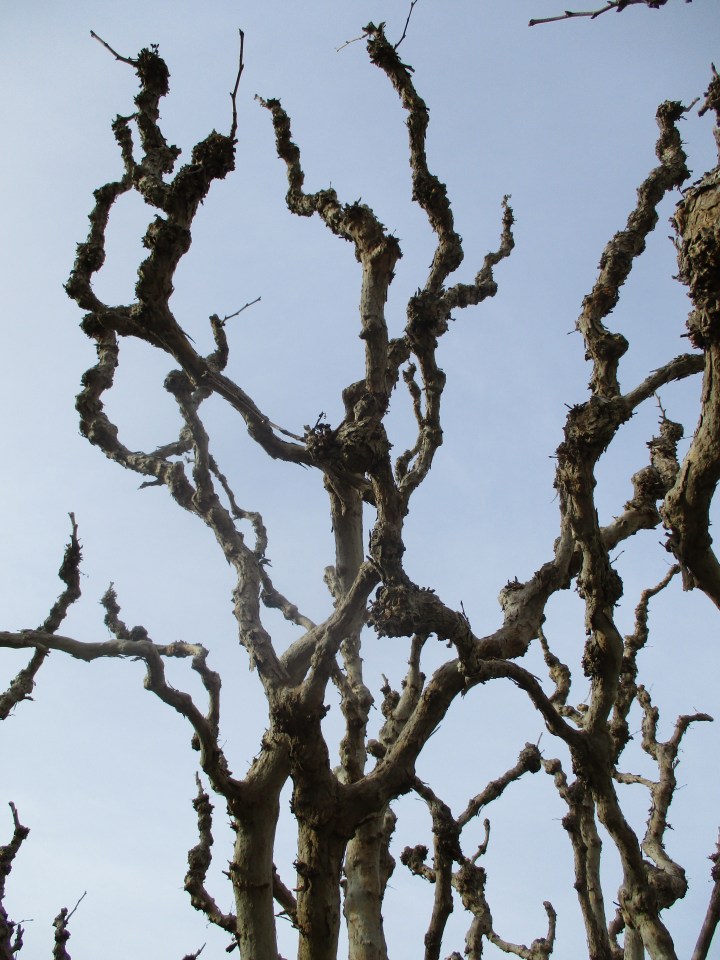 There are many different types of horticulturists. We are all unique, both individually as well as collectively within our respective professional group classifications. For some of us, individuality interferes with conformity to the collective generalizations that are so commonly associated with our collective groups. For some of us, the stereotypes are a perfect fit.
‘Primarily’, I am a nurseryman. We are the intellectual ones. Well, at least we get most of the credit for being the intellectual ones. Most of us really are quite intellectual. Most of us are rather humble about it.
My excuse for nonconformity to the latter is that I am ‘secondarily’ an arborist. Arboriculture is something that I have never been able to get away from. I did an internship with the most excellent arborists in the entire universe in the summer of 1988. After all these years of mostly growing horticultural commodities, I still sometimes conduct inspections and compile reports for trees that other arborists and their clients are concerned about.
You see, arborists are the passionate ones. One might say that we are enthusiastic, fanatical and zealous. Nurseryman might say that we lack restraint and cultural refinement. It is not such a simple task to distinguish between exuberant dedication and primitive efficiency. Regardless, most arborists do not like to write reports. It is easier to get a nurseryman to do it.
In fact, arborists do not like to write much of anything. There are several elaborate blogs that are written by nurserymen; but blogs written by arborists are rare, with brief and infrequently posted articles.
The irony of this is that it is more important for arborists to express professionalism with clients than it is for nurserymen. Arborists are out in the real world, working directly with clients. Nurserymen work on the farm, isolated from those who purchase the horticultural commodities that are grown there.
Arborists are horticulturists who specialize in the horticulture of trees. The best are just as educated and experienced as nurserymen are. In fact, much of my education was derived from arborists. Yet, arborists are so often regarded as mere gardeners who go up trees.
That is where I get offended. Yes, I am aware that there are hackers out there. I am also aware of what clearance pruning of utility cables entails. I also know how serious my arborist colleagues are about their profession. They are not to be compared to gardeners.
There are many gardeners who are just as educated, experienced and proficient with horticulture as arborists and nurserymen. However, the majority of gardeners are not. I will not elaborate on this presently. It will be the subject of other rants. I have written articles about my professional experience with gardeners already, and none of them go well. (I lack experience with good gardeners simply because they have no need for my expertise.)
The picture above is an example of a sycamore that is pollarded in the traditional English style. The work is exemplary, and is repeated annually every winter. It is no simple task. I certainly would not want to do it. I can not think of any other nurseryman who would know how to do it properly. It is the work of a very skilled and very experienced arborist.
Bigleaf Maple
 It is native from the extreme southern tip of Alaska to the extreme southwestern corner of California, but not many of us will see bigleaf maple, Acer macrophyllum, in our neighborhoods. It is planted only rarely, particularly where winters are mild. Relative to other maples, its roots can be more aggressive, and its shade can be darker, so is likely to interfere with lawn and other plants.
Mature trees in exposed situations can get more than fifty feet tall and quite broad. Old wild trees that compete with other trees in a forest can get three times as tall! The big palmate leaves from which the name is derived are about half a foot to a foot wide, and can get a two feet wide on the most vigorous or shaded growth. They turn a nice golden yellow in autumn, even in mild climates.
Bigleaf maple is like the sugar maple of the West. The sap can be processed into maple syrup and sugar. The wood is made into furniture and musical instruments. The very ornamental wood known as bird’s eye maple is derived from burl growth of various maple specie, particularly bigleaf maple. Bigleaf maple is uncommon in landscapes only because it is so aggressive and big.
Autumn Is For Planting – Especially Bulbs
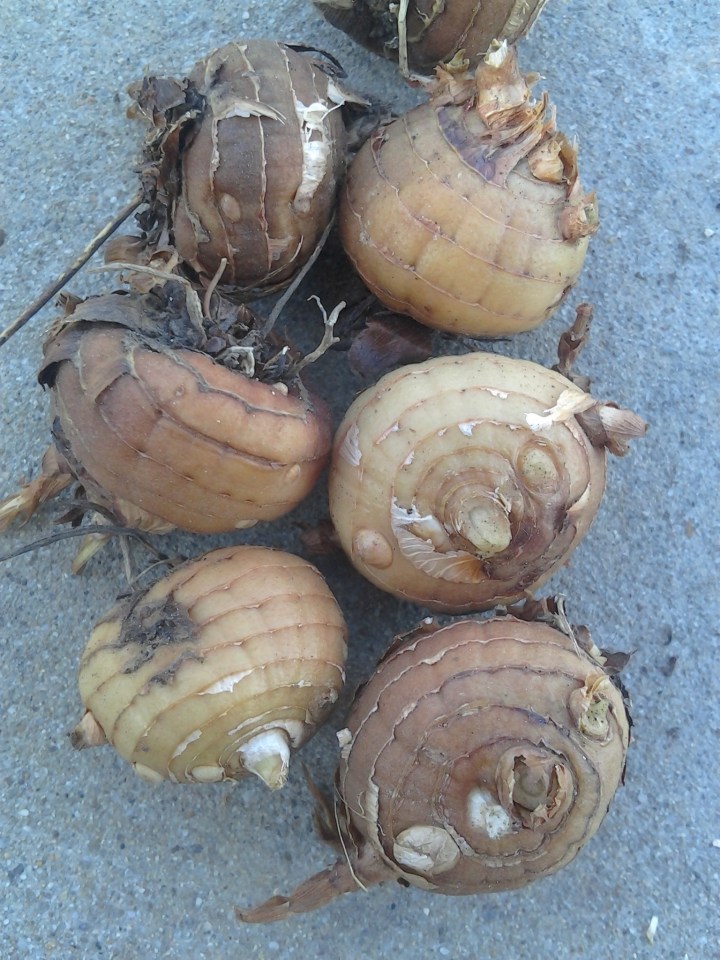 Autumn is for planting. Cliche? Yes; but true. Autumn is when most plants are beginning dormancy, and are therefore not so bothered by the discomforts associated with transplant. The weather is cooler and wetter, so that even if they are bothered, such discomforts are not as discomforting as they would be in summer. Once in the ground, plants have a few months to recover before spring.
The two main exceptions to the rule that ‘autumn is for planting’ are plants that are sensitive to frost, and bare root plants. Plants that are sensitive to frost should obviously be planted after the last frost date, at the far end of winter. Bare roots plants do not wait that long, but should wait until they are completely dormant in mid winter before being dug, separated from their soil, and relocated.
Dormant bulbs and bulb like plants, including corms, rhizomes, tubers and tuberous roots, epitomize the autumn planting rule. They must be planted while dormant in autumn or winter. They arrive in nurseries about the same time that they should be planted into the garden. Spring blooming bulbs become available and should be planted earliest. Summer bulbs become available a bit later.
Daffodil, narcissus, tulip, crocus, hyacinth, grape hyacinth, freesia, anemone, ranunculus, montbretia, crocosmia, most lily and some types of iris will all want to get into the ground when the rain starts. Rain leaching through the soil around them, as well as cooler temperatures through winter, tell them what time of year it is, so that they will be ready to bloom when weather warms in spring.
Each type of bulb prefers to be planted at a particular depth. Bearded iris rhizomes want to be buried horizontally, just below the soil surface. As long as the latest get planted within their respective planting season, some types of bulbs can be planted in phases every week or two, so that a later phase starts to bloom as an earlier phase finishes. Daffodil, narcissus and especially grape hyacinth have the potential to naturalize and bloom annually. Montbretia and crocosmia can be downright invasive.
Indian Laurel
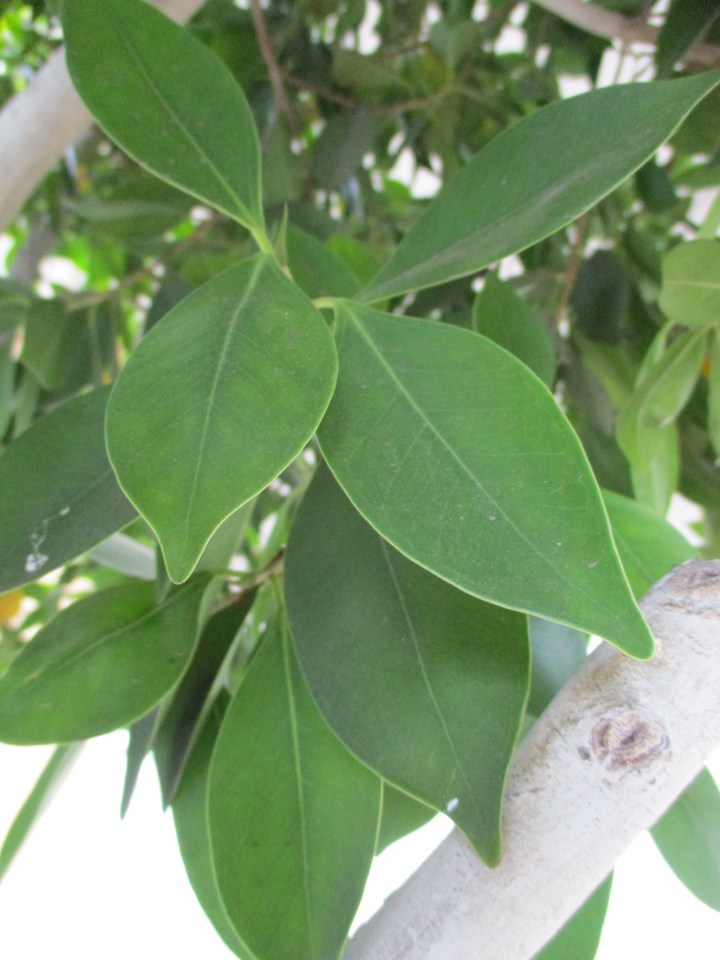 It is hard to believe that such a delightfully robust and luxuriant tree like the Indian laurel, Ficus microcarpa nitida, can be so problematic. It looks so perfect, with lustrous evergreen foliage, like something that would be seen on Sesame Street. The broad and dense canopy is very symmetrical and neat. The stout trunk and limbs, outfitted with whitish gray bark, are bold and sculptural.
The problem is that the roots are so extremely aggressive. Buttressed roots elevate curbs, sidewalks and anything else that they can get under. Fibrous roots clog drainage, and strangle roots of more complaisant plants. Indian laurel is a tree that really needs room to grow. The canopy can get wider than fifty feet, and roots will spread much farther if they want to. Fortunately, Indian laurel shorn as a hedge has less foliage, so does not need to disperse roots so extensively.

