 Straight out of college, I worked briefly for a wholesale nursery that grew landscape stock, which included boxed trees. We also recycled a few trees, particularly from the abandoned homes in the neighborhood around the nursery. (The neighborhood, including the nursery, were in the easement of the Norman Mineta Freeway, which in the process of being constructed at the time.) I had believed that the boxed and recycled trees were for ‘instant’ landscapes, the sort that were for clients who did not want to wait for things to grow. It made sense, particularly in our region where so few stay in the same home long enough for trees to mature.
Many trees were good candidates for growing in boxes. Some were naturally small trees. Others had fibrous root systems that did not mind the confinement. Japanese maple, crape myrtle, purple leaf plum, flowering cherry, flowering crabapple, magnolia and various specie of podocarpus all grew well for us, and probably adapted well to their new landscape homes.
Other trees were not such good candidates. We also grew a few specie of oak, pine and eucalyptus that did not want their roots to be confined to boxes. They wanted to disperse their roots as soon as they could. They had no problem doing so while young. However, mature boxed trees needed so many years to recover from their confinement that by the time they recovered, if they ever recovered at all, small trees that were planted at the same time had grown larger. Yet, people paid tens of thousands of dollars for some of the larger boxed trees.
Some clients did not care if the trees died. Some just wanted them to live long enough for their home to sell. Those who purchased the homes often did not care either. Many purchasers just demolished such homes and landscapes to build new monster homes on the sites. Many landscapers only needed such trees to live long enough for their client’s cheque to clear.
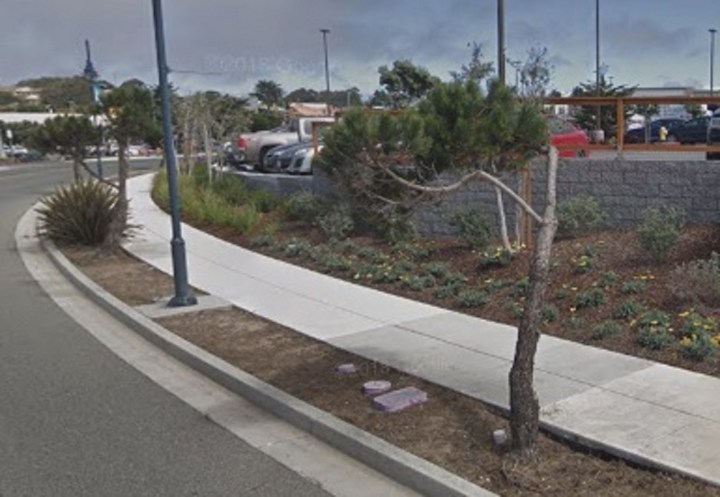
For example, the same ‘landscape company’ that was involved with the ‘Shady’ incident ( https://tonytomeo.com/2018/03/18/shady/ ) installed several boxed Italian stone pines nearby, on General Stillwell Drive, also in Marina. The client presented us with a picture of a very mature Italian Stone pine, and instructed us to install the exact same ‘native’ pines. I tried to explain that ‘Italian’ meant that they were not native. I tried to explain that they would take at least half a century to look like the old tree in the picture. I tried to explain that after only twenty years, the trunks of the trees could be wider than the two foot wide parkstrips that they were to be installed into. The client was an idiot; a demeaning and spoiled rotten idiot. We should have walked off the job (after giving him a good spanking and sending him to his room) when he insisted that we “do it”.
We did not walk off the job of course. There was too much money involved. However, I was conveniently not invited to subsequent meeting, and did not return to the site until after the trees had been installed and were developing some very serious problems.
The biggest trees that were available in 36” boxes were procured. No grower wanted to be liable for larger pines. Because of the innately shrubby structure of the species, the trees were not very tall at all, but were quite plump. They were a special cultivar of Italian stone pine that is native to the central coast of California. (?!)
You can imagine what needed to be done to get each 36” wide root system into a 24” wide parkstrip. Yes, the ‘landscapers’ sliced about half a foot off of opposite sides of the already distressed and unhappily confined root systems of each tree. Because the fluffy canopies obstructed the sidewalks and extended out over the curbs, each tree was severely disfigured by clearance pruning that removed about a third of the branch structure and foliage. In the end, only about two thirds of each of the trees that cost $500 each remained, and the client was furious that they were not as big as that half century old tree in the picture that he found online.
Each tree was outfitted with a pair of root barriers, one for the curb and one for the sidewalk, not to prevent the roots from elevating the pavement, but because the ‘landscaper company’ could earn a bit more money by adding them to the bill. If the trees were to survive, their big trunks would push the curb and sidewalk laterally before the roots elevated them vertically.
That was in about 2008, about ten years ago. Miraculously, several of the trees survived! I found their pictures online. (These two pictures look the same, but are actually in two different locations.) The trees have not yet damaged the curbs or sidewalks, but only because they are not much bigger than they were ten years ago.
 They sure took their time getting this far along. The bluish green succulent foliage of showy stonecrop, Hylotelephium spectabile, (formerly Sedum spectabile) first appeared at ground level in early spring, and has been growing into rounded mounds so slowly that it now stands less than three feet high and wide. Smaller types are half as big. Blooms are only now beginning to turn color.
 Twice a year, it becomes necessary to discuss the unpleasantries of pulling up the flowering annuals (as well as vegetable plants) of one season, to relinquish space for those of the next season. Just a few months ago, cool season annuals got replaced with warm season annuals. Now, those same warm season annuals will get replaced with cool season annuals for the next few months.
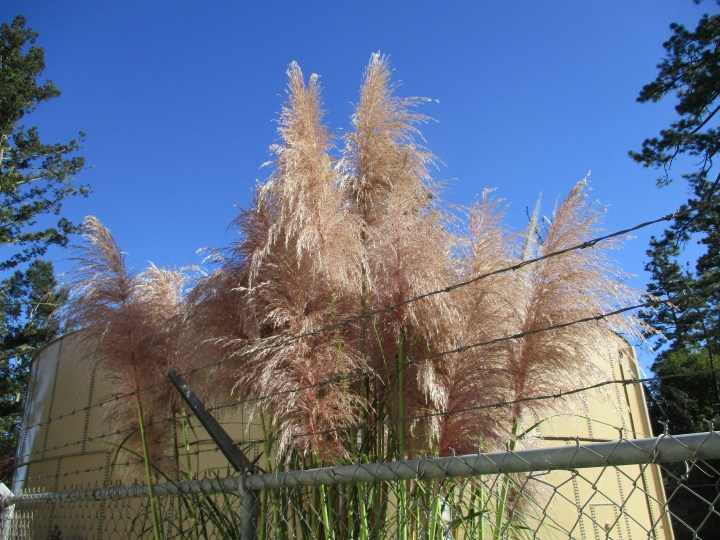 Just about everything in this picture is icky! This species of pampas grass, Cortaderia jubata, is one of the most aggressive and noxious of the invasive exotic specie that have naturalized here. It seems to be incarcerated behind the weathered cyclone fence with barbed wire on top. The big water tank is is a harshly stark background. The tired old Douglas firs and ponderosa pines to the left and right seem to be unhappy here. The small coast live oak that is at least trying to make a more cheerful appearance is only oppressed by the surroundings. Only the clear blue sky above lacks the ick factor.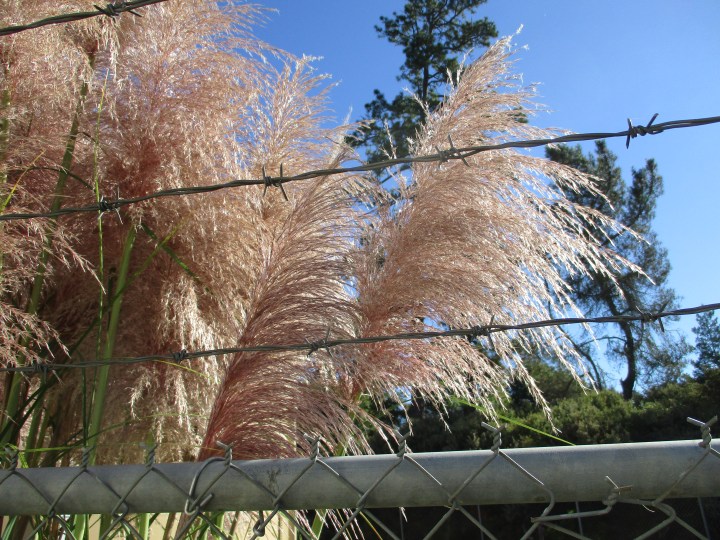
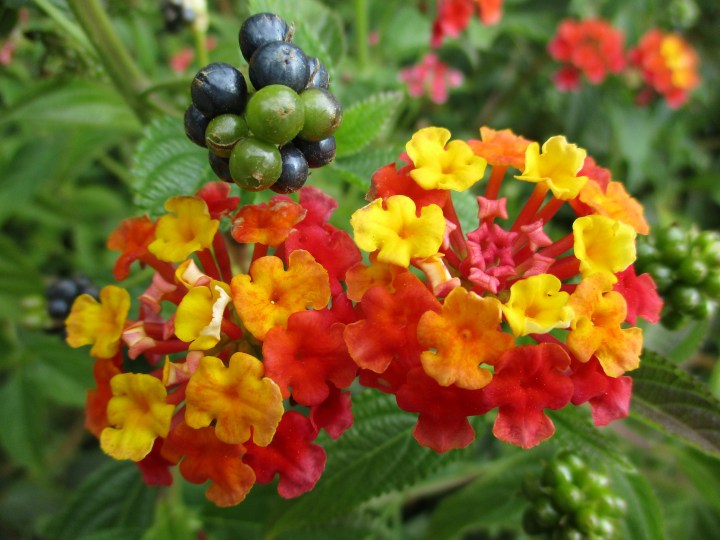
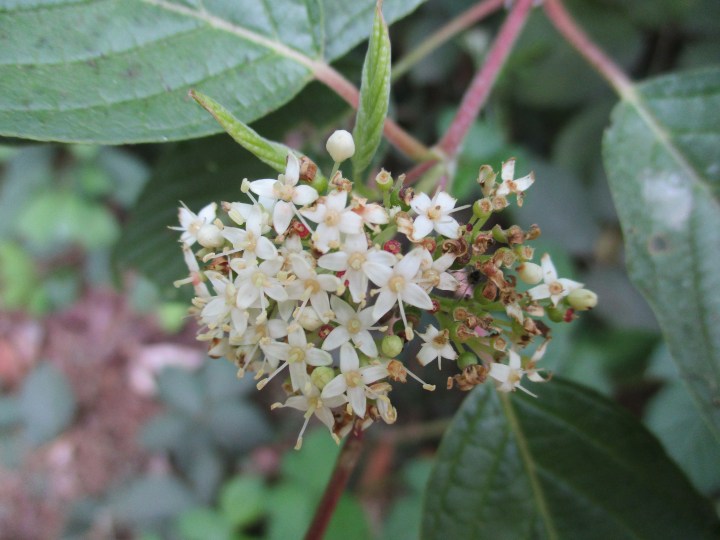

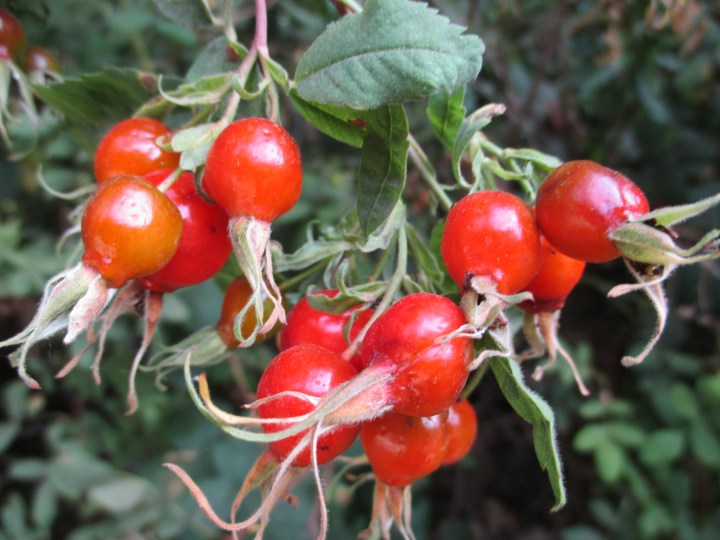
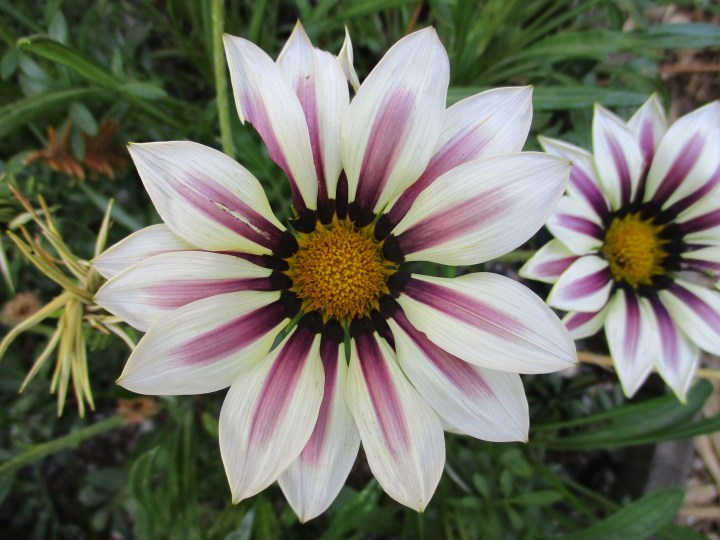
 With indiscriminate pruning, glossy abelia, Abelia X grandiflora, will never develop its natural form, with elegantly long and thin stems that arch gracefully outward. Sadly, almost all get shorn into tight shrubbery or hedges that rarely bloom. If only old stems get selectively pruned out as they get replaced by fresh new stems, mature shrubs can get eight feet tall and twelve feet wide.
 Heavenly bamboo, or simply ‘nandina’, is one of those many plants that almost never performs like it should. The intricately lacy foliage is so appealing while plants are young, and changes color with the seasons. The red berries can be comparable to those of holly. Unfortunately, healthy plants grow, and then ultimately get shorn into globs of disfigured leaves and stems.
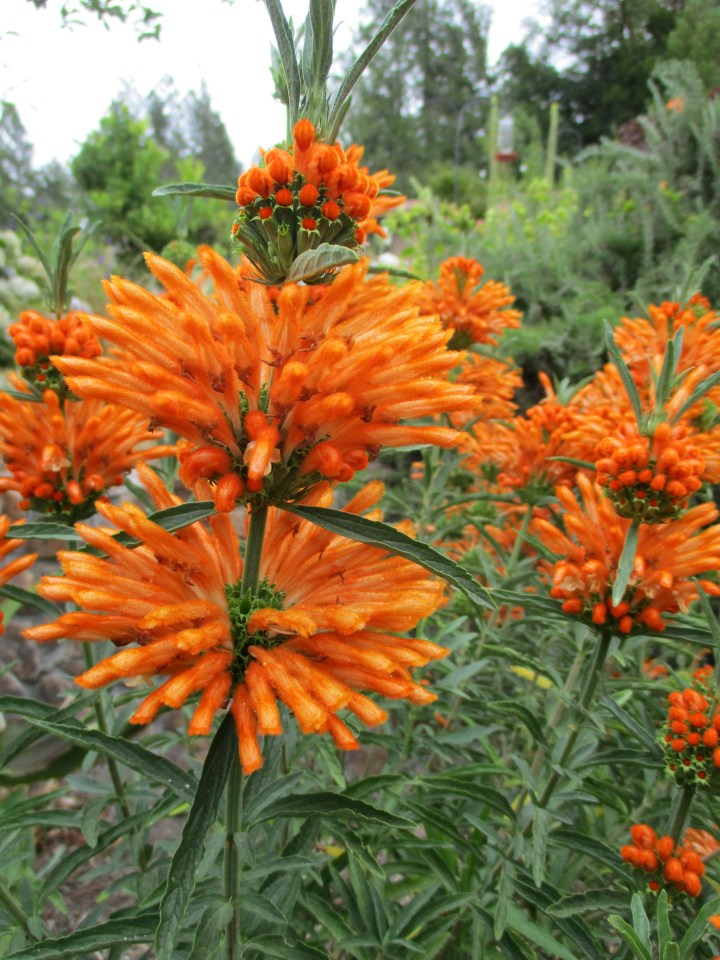 It does not get much more orange than this. Lion’s tail, Leonotis leonurus, tends to start with a relatively light duty bloom phase in the middle of spring, and then continue blooming in increasingly prolific phases until it finally culminates with the most spectacular bloom phase of the year about now, late in summer or early in autumn. The bloom is about as bright orange as California poppy!
 The popular definition of ‘Indian summer’ suggests that it is unseasonably warm and dry weather in spring or autumn, and that it typically happens after frost. Well, that definition just does not work here. It makes about as much sense as our so-called drought, which is actually the normal weather for our chaparral climate. Weather that repeats annually is neither unseasonable nor abnormal.
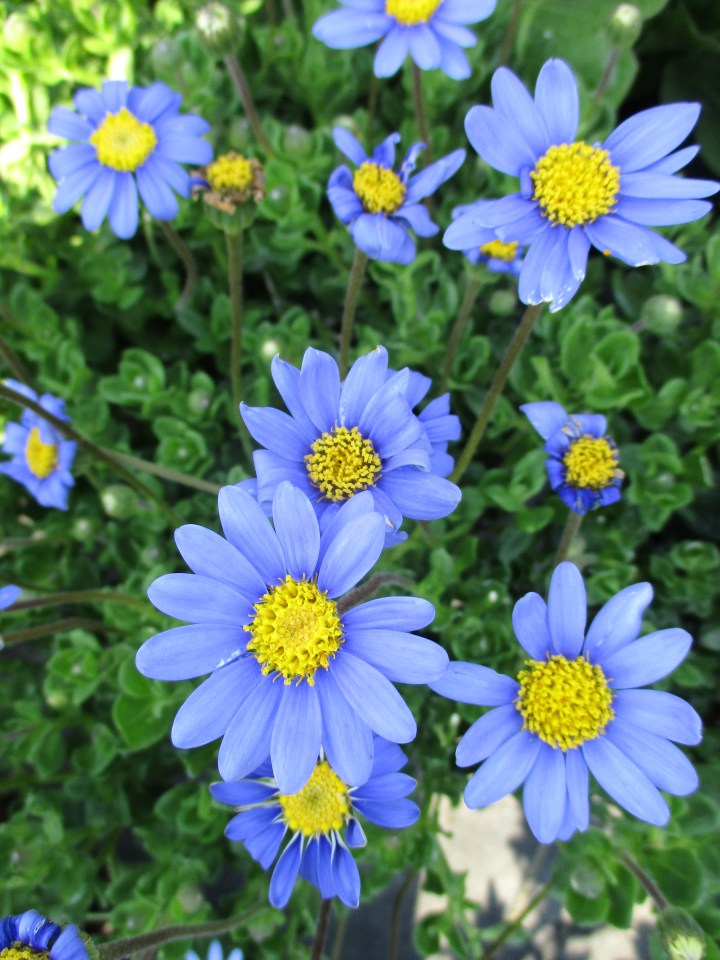 Most blue flowers are blushed with purple to some degree. Except for lily of the Nile, true blue flowers are quite uncommon. Even with their yellow centers, the tiny daisy flowers of blue marguerite, Felicia amelloides, seem to be too blue to be real. They are almost expected to fade to lavender. Bloom may not be as full as it was a month ago, but continues as long as the weather is warm.
