Horticulturists are by nature, nonconforming. I happen to find it difficult to conform to what makes us nonconforming. Trends are fleeting. Old technology that has worked for decades or centuries is still best. Although I am not totally against chemicals, I find that almost all are unnecessary for responsible home gardening. Pruning is underappreciated, and fixes many problems.
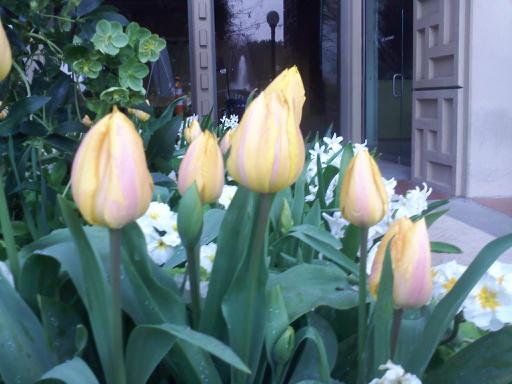
The soft pastel shades of these tulips brighten this somewhat shady landscape.
The mild winters that are so comfortable for us are not so desirable to tulip bulbs, which need to be chilled to perform as perennials. Consequently, they behave as brief season annuals locally. The most popular varieties have simple single flowers in white, yellow, pink, red, purple or pinkish orange. Double tulips are rather ruffled. Parrot tulips are larger and even more ruffled. As the names imply, lily-flowered tulips are shaped like small lilies, with pointy flared petals; and fringed tulips have finely serrate petals. Tulips stand between half a foot to two feet tall. Early types are already finished blooming. Late types, particularly if planted late, may bloom as late as early May.
Daffodil bloom from bulbs that were installed last autumn.
The elegant white callas that are just about to bloom in my garden have their origins in the ‘old country’. I obtained them from the garden of my great grandfather Tomeo in my ancestral homeland; Sunnyvale, near San Jose. I am told that my great grandfather planted them decades ago, and had been trying to get rid of them almost as long. I suppose that means that these callas are easy to grow.
My belladonna lilies that got planted two autumns ago are about as old, since they came from the garden of my mother’s mother in Santa Clara, right near Sunnyvale, and were in her mother’s garden prior to that. These bulbs just keep on growing, blooming and multiplying. Although I do not like their bright pink color much, I can not argue with their reliability.
Bulbs and bulb like plants that can take care of themselves and thrive with minimal or no attention are always welcome in my garden. Bright orange crocosmia is perhaps just as reliable, or should I say ‘persistent’, as callas are, and like callas, should be planted about now. Yellow, red, and orange with red flowering varieties are also available. Pink, red, orange, yellow and salmon cannas are in season too. They are easier to contain, but are likewise prolific.
Some of my other favorites that get planted about now for summer bloom want more attention, but are certainly worth it. Dahlias can naturalize if conditions are right for them, but will more likely do better if dug, divided and replanted in enriched soil at least every few winters. They are remarkably easy to propagate. Asiatic lilies likewise prefer to be dug and replanted as their soil becomes depleted, but are not likely to regenerate year after year if ignored.
Honestly though, some of the other summer blooming bulbs and bulb like plants that get planted about now are rather risky. I like to grow gladiolus because they happen to be among my favorite flowers. However, unless they get well amended soil and fertilizer, they do not perform very well, if at all, after their first year. Liatris is not much more reliable. Tuberous begonia is still a mystery to me, since I have not been able to prevent them from rotting in their first year!
Of the many bulbs and bulb like plants that get planted in autumn that are now blooming, grape hyacinth, snowdrop, watsonia, bearded iris, daffodil and narcissus are the most reliable and likely to naturalize, particularly with rich soil and regular watering. Daffodil and narcissus do not spread as well as the others, but are probably the most resilient. With a bit more effort, freesia and crocus can be persistent. In some situations, freesias have actually been known to naturalize as effectively as grape hyacinth.
Other early bloomers (that get planted in autumn) are more demanding. The anemones that I planted in about 1990 survived neglected in my garden for nearly a decade, but probably produced more flowers in their first year than in all subsequent years combined. Ranunculus and hyacinth may do the same if conditions are not just right for them. Tulips are perhaps the most profusely colorful of spring bulbs, but are sadly grown mostly as annuals, since they rarely do much more than produce foliage after their first year.
Wild cucumber is not a particularly substantial vine. Except for its tubers, it is quite delicate.
Wild cucumber, Marah fabacea, is also known as manroot because it develops massive tubers that can weigh as much as a man. Such tubers can supposedly weigh more than two hundred pounds, and some sources claim that they can weigh twice as much. That is a lot of storage.
Their thin leaves, slender vines, tiny flowers and fleshy fruit are not very substantial, and can not be very consumptive. They are quite watery, and leave minimal debris when cut and dried, or when they die back after frost.
So, why does wild cucumber store so much resources within their massive tubers? I have no idea. I realize that it is a survival technique, but this is major overkill. No winter is long enough to justify such extreme storage. No summer is dry enough. No wildlife is voracious enough. No forest fire burns the same place more than once in a season. Furthermore, no gardener is diligent enough.
Seriously, these things are impossible to kill. The vines pull up quite easily, with no resistance. The tuber simply makes more. Secondary vines pull up as easily as the first. The tuber simply makes more. No matter how many times the vines get pulled up, the tuber simply makes more. It never exhausts its resources. Removal of the vines deprives it of its ability to accumulate more resources, or replenish what is used to generate the vines, but it has enough to generate vines for many years.
The only way to eliminate these weeds is to dig up their massive tubers, which are fortunately not very deep underground. Even then, the tubers do not die. This one sat around through last summer, and is still viable. I suppose that we should dispose of it with the trash, since we can not compost it.
This wild cucumber tuber is bigger and much heavier than Rhody, but is smaller than average.
Warm season vegetables are replacing cool season vegetables about now. Technically, lettuce, Lactuca sativa, is a cool season vegetable. It grows through spring and autumn though. The last of it can continue almost until May. Within the mildest coastal climates, it can continue later. By the time it finishes there, it is almost time to plant more for autumn.
After thousands of years of cultivation and breeding, lettuce is now remarkably diverse. Most popular varieties are leaf, head or romaine types. Leaf lettuce is mostly green, but can be bronze, reddish or irregularly blotched. Most varieties develop loosely ruffly foliar texture. Romaine and head lettuce is denser but larger. Some grow a foot high and wide.
One commonality among lettuce varieties is that they tolerate neither frost nor arid heat. Some are a bit more tolerant of one or the other, which can prolong their season. Some of the larger romaine and head types need nearly four months to mature, though. Only a single phase matures within each season. Smaller types might mature in about a month.
Vegetables are greedy as they grow. They crave rich soil. They exploit it and abandon it at the end of their season. Nutrient depletion can be a problem for subsequent phases of similar vegetables. In other words, vegetables of any particular family consume the same nutrients. Each phase leaves a bit less for the next. Crop rotation disrupts this process.
Different types of vegetables deplete different types of nutrients. This is an advantage for a vegetable garden. Tomatoes can deplete soil nutrients for subsequent tomatoes. Corn, however, may not notice such depletion. It craves different nutrients, so may be content with what tomatoes did not consume. This is how and why crop rotation is so effective.
Crop rotation is simply a technique of not growing vegetables where similar types grew. Vegetables grow better where different types grew previously. Their formerly depleted but vacated soil can recuperate in their absence. They can return to the same soil after three years or so. Other vegetables that grow there for that time accelerate recuperation.
Warm season vegetables are generally more consumptive than cool season vegetables. That is because so many of them are actually fruits, such as tomatoes, corn and squash. More cool season vegetables are truly vegetative, such as lettuce, cabbage and carrots. Because they produce no bloom, seed or fruit prior to harvest, they need less resources.
Therefore, warm season vegetables are more responsive to crop rotation. Most are not relatives of the cool season vegetables that they are now replacing. Similar vegetables of the previous few summers are more of a concern. Tomatoes, eggplants and chilis are all of the Solanaceae family. They should avoid soil that their relatives used previously.
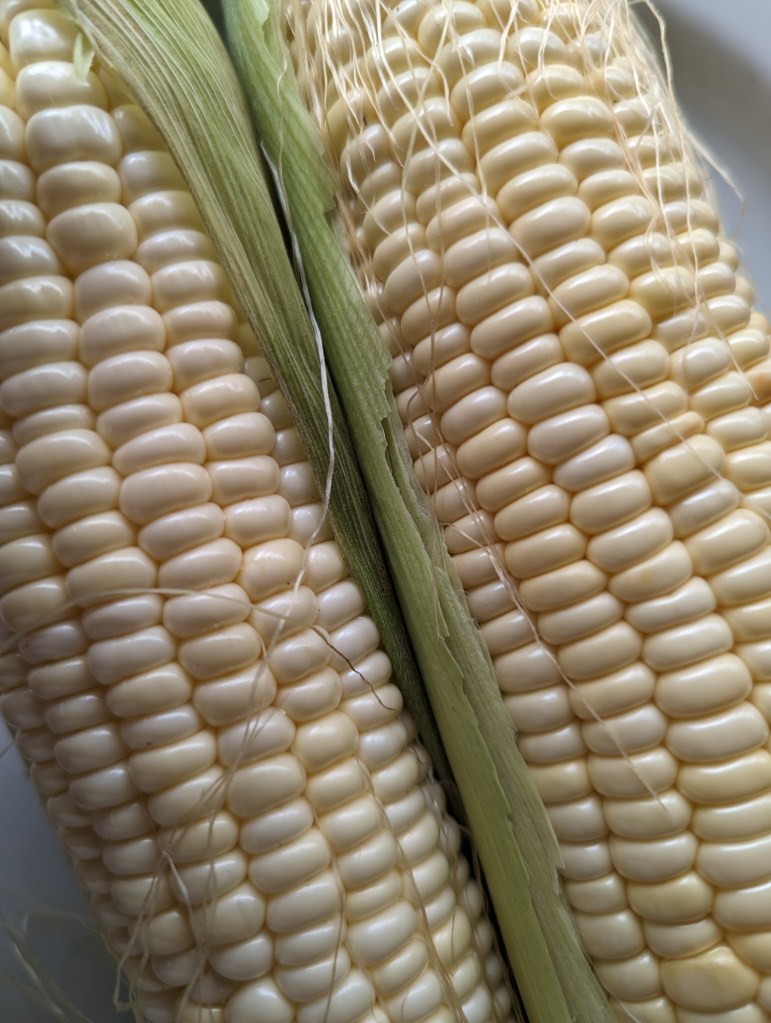
Similarly, if possible, corn should not grow where it grew within the past few years. Nor should beans. Fertilizer can compensate somewhat for soil depletion where rotation is impractical. For example, a fence may perpetually be the ideal support for pole beans. Spring lettuce, carrots and other vegetative vegetables may be less reliant on rotation. Although most squash benefit from rotation, zucchini seems to be productive regardless.
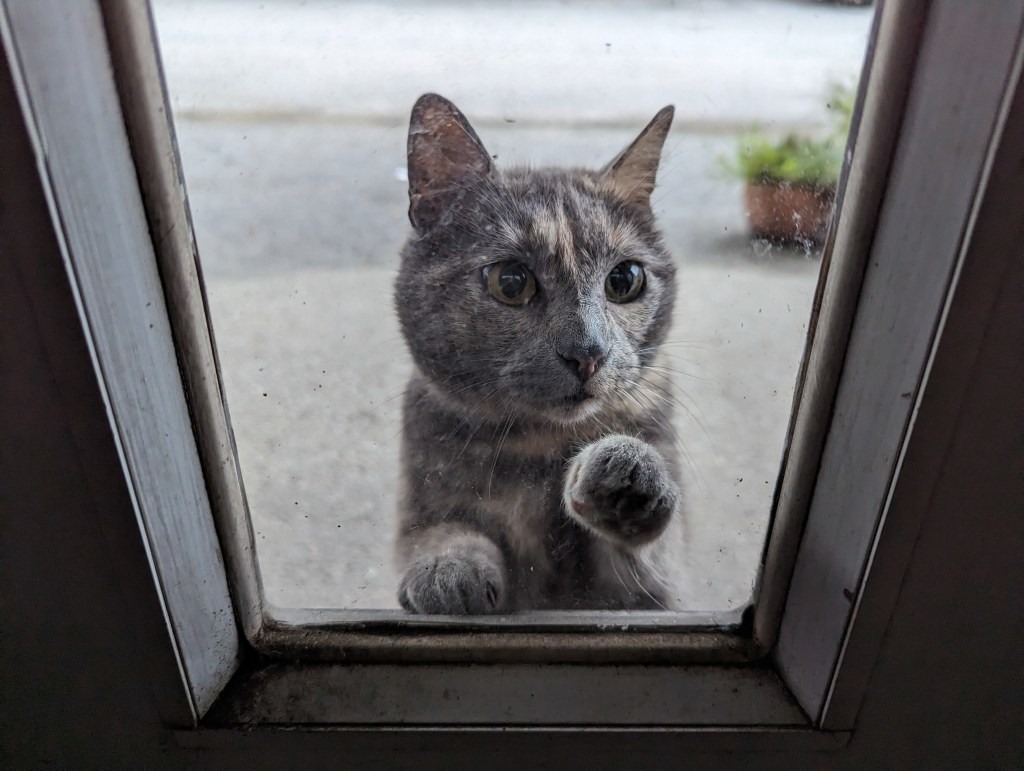
Heather is not related to Calluna vulgaris. She is feline, since she is a kitty, who is employed here as the only mouser within the maintenance shops. We did not hire her as such. She merely assumed the job. At the time, after Darla retired, we were in desperate need of a mouser. We do not know where Heather came from, and she can not tell us. She seems pleased to remain employed here. We are pleased to be without rodents.
Her technique is as mysterious as her origin. No one knows how she prevents rodent infestation. She does not seem to catch any. Instead, she seems to passively repel them, as if rodents vacated and will not return because of here presence. Skunks, opossums and raccoons are also notably absent since her arrival, and the raccoons were vicious.
Heather temporarily lived within the nursery when she first arrived and decided to stay. Shortly afterward, and after being named, she decided that she preferred the automotive shop across the road. If she had settled there originally, she might have gotten a lame name, such as Lexus, Tesla or Mercedes. Now, she is quite established here, and lives in a luxurious penthouse in the automotive shop mezzanine above the locksmith shop. She does not seem to venture away from the safety of the shop buildings or the surrounding fenced yard. She has several friends here, including Rhody.
Fortunately, Heather does not seem to need anything more than she can figure out on her own. I know nothing about providing for a kitty. She does not seem to mind at all. Actually, she seems quite happy here, and purrs when petted. She seems to enjoy looking cute for those whom she meets for the first time, and for pictures such as this.
Actually, this blood was not contributed by someone else. No one else was involved. Perhaps that was the problem.
I can not sharpen blades. I tried for a long time years ago, before eventually realizing that it would be best to rely on someone else to sharpen my blades. Those who know how to do it make it seem so easy. I have no idea how they do it so well, but I know that they do because it is how my blades get sharpened. It is an enviable ability.
Well, I neglected to get someone to sharpen my blades for a very long time. Naturally, my overused and worn pruning shears are beyond mildly dull. As most of us know, “A dull blade is more dangerous than a sharp blade.”.
The blade did not cause this damage directly. As I wrestled with the dull shears, they unexpectedly slipped past the stem that I was cutting so suddenly that I bashed my thumb against the accordingly damaged latch on the opposing handle. The injury was not bad; but I was too annoyed by it to stop what I was doing, which is why the blood continued to get messy.
I only took this picture so that I could later brag about rescuing a school bus full of Girl Scouts from an attacking polar bear, or something like that. I just have not gotten around to doing so yet. It might have been a grizzly bear.
Because these particular pruning shears are so worn, with a broken latch and a chipped blade, they really should be replaced rather than sharpened. They are the cheapie sort that can not be repaired. The blade can not be replaced. They performed exemplarily longer than they should have.
This should have been done earlier. While most who participate in Six on Saturday have been posting pictures of early spring bloom, I have been posting less colorful pictures of dormant corms, their barely visible new spring growth, some windmill palm foliage and a sliced weirdly yellow beet. Some of the few flowers that I posted pictures of were oddly pallid, which was sort of why I thought they might be interesting. Now that I am posting floral pictures, early spring flowers are beginning to deteriorate. The first two are rather shabby. The third has not been quite right for a few months. I should have found fresher flowers.
1. Eucalyptus cinerea or pulverulenta, florist silver dollar got an identity crisis. I learned it as cinerea. I am now told that it is pulverulenta. Regardless of its name, bees enjoy it. We thought we added another tree of the same species nearby, but it is the other species.
2. Tecomaria capensis, cape honeysuckle really was prettier earlier. Its bloom is not too profuse, but it is distinctly orange. Goodness, I really should have taken a better picture.
3. Rosmarinus officinalis, rosemary is badly infested with mites, but blooms regardless. It is right across the road from the silver dollar, and just as popular with the honeybees.
4. Lavandula stoechas, Spanish lavender is the only lavender that self sows here. It does not become invasive though. Its bloom may be blue, pink, white or, obviously, lavender.
5. Tulbaghia violacea, society garlic is one of my least favorite of perennials. It stinks! It is not so much to look at either. It has been here for many years though, and will not die.
6. Grevillea rosmarinifolia, rosemary grevillea seems as popular with hummingbirds as rosemary and silver dollar is with bees. Hummingbirds are prettier than this odd bloom.
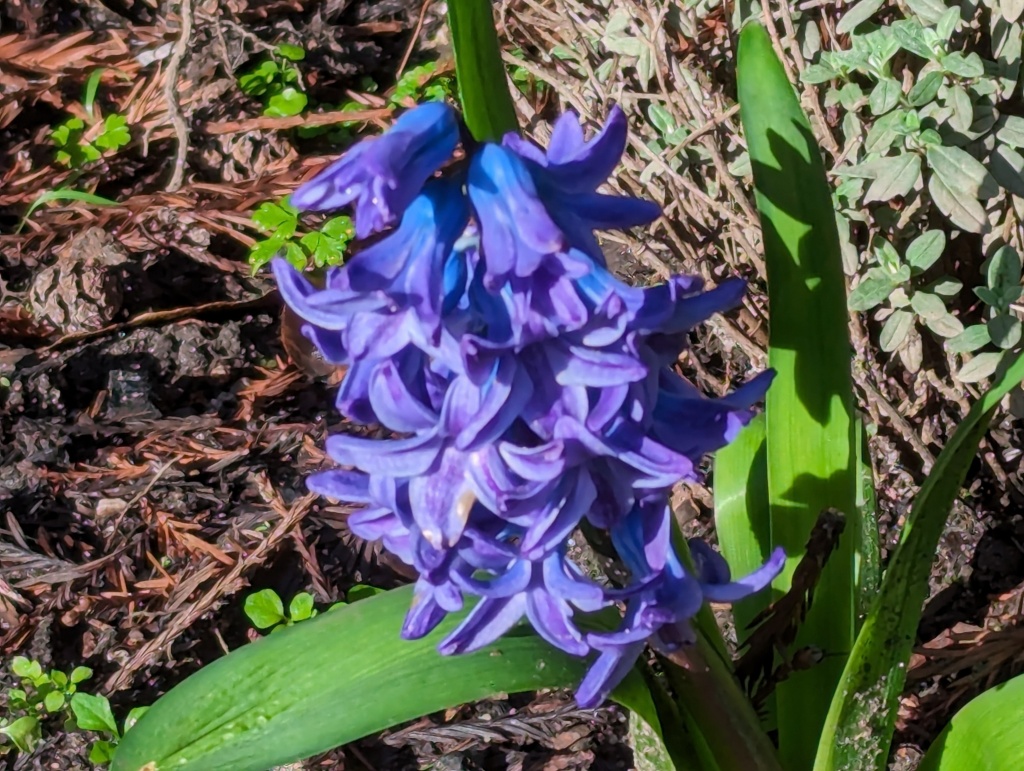
Hyacinth is one of the earliest of spring bulbs, and is notably fragrant.
If their bulbs got into the garden early enough last autumn, Dutch hyacinth, which are hybrids of Hyacinthus orientalis, are now blooming with cartoon shades of red, blue, yellow, purple, pinkish orange, pink and white. The small, surprisingly fragrant flowers are neatly arranged on plump, bottle-brush shaped flower trusses up to eight inches tall. Their typically arching, rubbery, strap shaped leaves look like small lily-of-the-Nile leaves. Some types have more vertical foliage.
Like many bulbs and bulb like plants, hyacinth are unfortunately not reliably perennial in such mild climates. They prefer cooler winters. Consequently, they are typically grown only as annuals. However, I am aware of hyacinth that not only bloom annually, but have been multiplying nicely over the years in a few local gardens. Their flowers spikes are never as full as they were in their first season, but are appealing nonetheless. I actually prefer the less refined style of naturalized hyacinth.
French Roman or Roman hyacinth, Hyacinthus orientalis albulus, are still somewhat rare, but should be more common since they naturalize more reliably without cold winters. Each bulb produces a few flower stems with smaller and more loosely arranged pink, pale blue or white flowers.
Large hyacinth bulbs are easily forced to bloom suspended just above water by small stones in bowls, or individually in hyacinth glasses (vases that hold bulbs just above water). Forced bulbs should be kept in the dark until rooted, and can be moved out as foliage appears. They are as colorful as tulips and as fragrant as narcissus; but sadly, are not likely to survive after being forced.
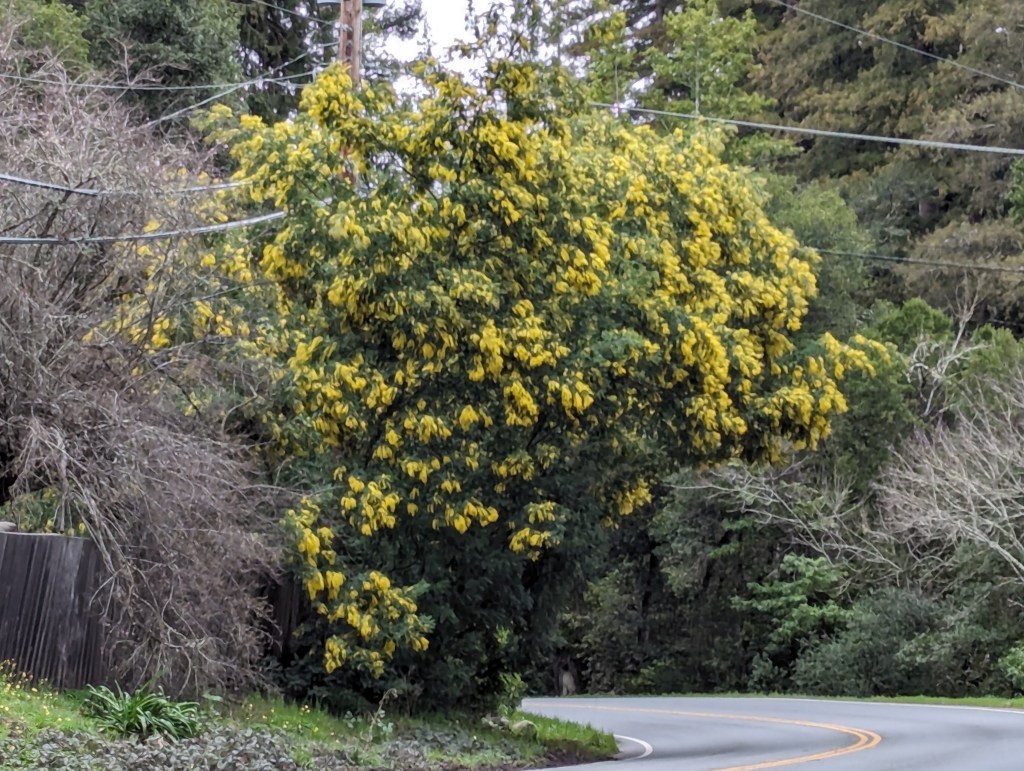
Silver wattle is an aggressively invasive exotic species, but certainly is pretty in bloom!
From my window, I can see across the way to one of my all time favorite weeds in my neighbor’s garden. A healthy acacia tree is nearly in full bloom! Throughout the year, I occasionally remind my neighbor that we really should cut the tree down before its seedlings overwhelm the neighborhood. This time of year though, I am secretly glad that we have not gotten around to it yet.
Even though most people find the fragrance objectionable, I actually find it appealing. It reminds me of Southern California, perhaps because, even on a cool wintry day, it smells like a sun roasted freeway on a hot smoggy day. I suppose that its pollen is a problem for anyone with even mild allergies; and after all, it is still a major weed.
Other trees that are now blooming are not so problematic, or equipped with a petroleum based fragrance. Shrubby forsythia and flowering quince were the first to bloom. Forsythia is the best bright yellow besides acacia. The most popular flowering quince are rich pinkish orange. Apricot, cherry, peach, plum, prune, nectarine, almond and a few other fruit trees, as well as their fruitless ‘flowering’ counterparts, including purple leaf plum, are blooming about now. (Flowering apricot, peach, nectarine and almond are rare.) Fruiting pear and apple trees typically bloom a bit later; but flowering pear and some flowering crabapple are already blooming. Later, redbuds bloom bright purplish pink.
When pruning fruit trees during winter, I sometimes leave a few branches to cut and bring inside while in bloom. Fruitless flowering trees do not need to be pruned like fruiting trees, so can provide even more flowering stems with more flower variation. Stems of forsythia, flowering quince and flowering cherry are often ‘forced’ into bloom by getting cut and brought in just as flower color start to become visible, so that they can finish their bloom inside. Except for redbud, any of the other spring bloomers can also be forced, but are more likely to get desiccated by the dry air inside.
As red maple and red oak begin to break dormancy, they develop delicate pendulous ‘blooms’ that are not very colorful, but might be interesting enough to add to more colorful cut flowers. Of course, pussy willows are always traditional.





 Tony Tomeo