Live Christmas Trees Eventually Grow Up

Small coniferous trees do not stay small for long.

One of the problems with driving my favorite vehicles that were old long before I learned to drive them is that I spend considerable time waiting for a bus or walking. The cool thing about that is that I get to seem so much scenery that I would otherwise drive past. While waiting nearly an hour for a bus at the Cavallero Bus Terminal in Scott’s Valley, I went across the street to see the landscape of the somewhat new Post Office, which has actually been there for many years now.

The landscape is a bit sparse in front (I think because of architectural modifications after the landscape was designed), so was outfitted with recycled live Christmas trees. Although none of these particular trees seem happy in the local climate or sandy soil, I had wanted to get better acquainted with them for some time. They are an odd assortment of spruce and fir that are rare here.

The more typical concern with the more common live Christmas trees is not that they are not well suited to local climates and soils, but that they actually do too well and grow much larger than expected. Except for the small rosemary, holly and English ivy ‘trees’, most coniferous evergreen live Christmas trees are young pines that get remarkably large; and some waste no time doing it! The most common live Christmas trees are Italian stone pines, which happen to be the two very large and broad trees in Blaney Plaza in downtown Saratoga!

Canary Island pines, which had been more common than they are now, do not get quite as broad, but do get very tall and messy. Years ago, Aleppo, Eldarica and Monterey pines all took their turns being popular live Christmas trees. Each of them grows large enough to require significant garden space.

This is of course not a problem for the few live Christmas trees that happen to get planted where they have plenty of space. However, those that get planted where they do not have room to grow can cause serious problems. Because they seem so cute and innocent while they are young, and are so often expected to stay cute and innocent, many often get planted dangerously close to houses, where they can displace porches, walkways and even foundations! Large pines, particularly Italian stone pines, are also too messy and potentially combustible (if not pruned and groomed regularly) to be too close to houses.

Sadly, large pines do not like to stay in containers too long. They can be pruned for a few years, but eventually get congested roots. (Bonsai techniques of root pruning can maintain even the largest types of pines in containers indefinitely, but not many of us know these techniques.) Small pines, like Austrian black, Japanese black and Scott’s pine (which has no relation to Scott’s Valley), as well as other small coniferous evergreens, like certain junipers, can stay in containers much longer, but these are the sort that are small enough to get planted in the garden, so do not necessarily need to stay in containers anyway.

If space is not sufficient, pines and other live Christmas trees that eventually get too large really should be given to friends and neighbors who have space to accommodate them. Fortunately, most do not require much attention once they get established after two years or so.

Bare-Root Stock Arrives For Winter

Bare roots might fail to impress.

Spring is overrated. It is obviously the best season for planting warm season vegetables and bedding plants. It is the most colorful season with more flowers in bloom. There is so much more to gardening though. Most plants prefer autumn planting. Some prefer winter planting. That is why this present bare-root season will be so relevant all through winter.

Dormancy is an advantage to stressful procedures such as planting. Spring bulbs prefer autumn or early winter planting while they are most dormant. For the same reason and to avoid late frost, summer bulbs prefer later winter planting. It should be no surprise that so many deciduous woody plants likewise prefer dormant planting during bare-root season.

Bare-root season is simply when bare-root stock becomes available for planting through winter. Unlike more familiar canned (potted) stock, bare-root stock lacks the medium that it grew in. Their roots are literally bare. Most bare-root stock awaits purchase at nurseries with its roots resting within damp sand. Roots of some are bagged within damp sawdust.

Bare-root stock is innately more practical than typical canned stock. It is significantly less expensive. It is much less cumbersome, and therefore easier to transport from nurseries. Planting is easier within much smaller planting holes. Formerly bare roots disperse new roots into their garden soils more efficiently than crowded formerly canned root systems.

Deciduous fruit trees and roses are the most popular of bare-root stock. Most of such fruit trees are stone fruits and pomme fruits. Stone fruits include almond, apricot, cherry, plum, prune, peach and nectarine, as well as their unusual hybrids. All stone fruits are species of the genus, Prunus. Pomme fruits include apple, pear, Asian pear and perhaps quince.

Fig, pomegranate and persimmon trees should also be available. So should grapevines, currants, gooseberries, blueberries and various cane berries. Strawberries, rhubarb and asparagus are perennials that are available bare-root. Except for almond, most nut trees, including English walnut, pecan, filbert or chestnut, may be available only by mail order. Most mail order catalogs are online now.

Arborists Are Physicians Of Trees

This specimen would be a challenge for an arborist.

(This article is recycled from a decade ago.)

Pasadena sustained the worst of the damage caused by the strongest Santa Ana Winds in three decades. Huge piles of debris from broken trees are much more than can be removed any time soon. Falling debris and trees damaged many roofs, cars and anything else that happened to get in the way.

Other towns and neighborhoods throughout the area, particularly those at the base of mountains, also sustained major damage. At the same time, severe winds ravaged the San Francisco and Monterey Bay Areas as well, particularly in the Santa Cruz Mountains and the hills of the East Bay.

Some of the damage caused by wind in urban areas might have been less disastrous if trees had gotten the respect and attention that they deserve. Some trees develop structural deficiencies that need to be corrected by pruning, either to eliminate the problems, or at least to decrease the strain exerted onto the structurally deficient parts. A few trees that become unstable as they mature may likewise need to be pruned or even removed.

It is not always possible to prune trees to remove all structural deficiencies without damaging the affected trees more, or causing more structural problems to develop. For example, major pruning to remove all parts that may get blown down by wind, such as pollarding or ‘topping’, may seem to be effective for the short term, but actually stimulates the development of vigorous secondary growth or watersprouts that are disproportionately heavy and even more likely to tear off from the older limbs.

Structural pruning more often involves thorough reduction of weight and wind resistance. Weight of foliage and stems directly applies leverage against unions where smaller stems are attached to the larger stems from which they originate. Wind resistance adds more leverage as foliage gets blown about by wind. Thinning obviously removes significant weight, and also decreases wind resistance to allow wind to blow though the affected canopies.

Besides helping to compensate for structural deficiency, structural pruning is also beneficial to potentially unstable trees for the same reasons. However, unstable trees typically need even more reduction of weight and wind resistance. Some of the most unstable trees and those that are deteriorating need to be removed because their instability cannot be accommodated.

During winter, while deciduous trees are bare, evergreen trees are more susceptible to wind damage, obviously because they retain their weight and wind resistance through winter while the weather is the most severe. Unstable trees become even more destabilized as rain softens the soil. Regardless of the potential for susceptibility to wind damage, this would be a good time of year to get any needed tree maintenance done, prior to any more windy and rainy winter weather.

Arborists certified by the International Society of Arboriculture are the most qualified to identify potential structural problems or instability, and to prescribe corrective procedures. A list of certified arborists can be found at the website of the International Society of Arboriculture at http://www.isaarbor.com.

Rain Initiates The Rainy Season

Weather generally conforms to the seasons.

Seasons here may seem to be less extreme than they are within other climates. Summer warmth is rarely too hot, and when it is, it does not continue for too long. Winter chill may be insufficient for some plants that rely on it to sustain their winter dormancy. Autumn and spring are as notable for the first and last seasonal rain as for colorful foliage and bloom.

This is actually very relevant within local chaparral climates. Rain and lack of rain define seasons here as much as extremes of temperature. Where the traditional four seasons of winter, spring, summer and autumn merge so softly, the rainy season and the dry season generally do not. Rain begins abruptly in autumn, and ends almost as abruptly in spring.

Consequently, home gardens can get inhospitably dry without adequate irrigation during more than half of the year. Then, they may require no irrigation for almost half of the year. Warm weather that coincides with the dry season enhances aridness. Cool weather that coincides with the rainy season enhances dampness. Mild climates can get extreme too.

Recent rain ended both the dry season and the fire season, and began the rainy season. For many plants, irrigation will be unnecessary until the dry season resumes next spring. Plants that continue to require irrigation will require much less, and only as their soil gets dry during prolonged lapses of rain. Therefore, automated irrigation requires adjustment.

Potted plants, bedding plants and young plants with minimal root dispersion will be more likely to want watering during warm lapses of rain. Substantial foundation plants beneath eaves generally extend roots beyond sheltered soil, but some do not. Also, potted plants under eaves of porches are unable to reach rain moistened soil with their confined roots.

While diminishing the need for irrigation, rain can be messy. It is, of course, wet. It makes soil muddy. Runoff can cause erosion. Stormy weather, which typically involves both rain and wind, dislodges copious foliar debris. Such debris accumulates while no one wants to go outside during stormy weather to rake it. Inconvenient timing seems to be a pattern. Yet, rain is undeniably gratifying.

Deciduous Trees Are Not Necessarily The Messiest

This weird Euphorbia is one of the few small evergreen trees that drops no foliage.

Contrary to popular belief, most deciduous trees, those that drop all their leaves in autumn, are not as messy as most evergreen trees. There are of course a few exception; such as cacti that lack foliage completely, or Italian cypress that drop their finely textured foliage straight down within a very narrow drip-zone, where it decomposes and disappears unnoticed. Very few leaves fall from a big silver maple through winter, spring and summer, so that almost all of the raking is done when almost all the leaves get shed in autumn. However, a big Southern magnolia generally drops leaves throughout the year, so that raking is always necessary.

The problem is that when deciduous trees get to be messy, they are very messy. Also, they get to be messy at the worst time of year, when their leaves mix with rain to clog drains and gutters. Unraked leaves become hazardously slippery when they get wet and start to decompose. It is amazing how something that can be so appealingly colorful through autumn can so quickly become such a nuisance.

Leaves of deciduous trees somehow seem to be better for composting than those of some of the evergreen trees. Anyone with a Southern magnolia knows how slow the foliage is to decompose. Foliage of camphor, bay, carob and various eucalyptus certainly decompose slower than various maple, ash, poplar and birch. Many of us outfitted with green waste bins or curbside collection of green waste prefer to recycle the less desirable evergreen foliage, and compost primarily deciduous foliage. Those of us who do not compost but need to rake under large or many deciduous trees may fill bins for several weeks, or leave very big piles of leaves at the curb.

Small leaves, such as those of most elms, or finely textured compound leaves, such as those of silk tree, jacaranda or locust, may not need to be raked if they fall onto lower shrubbery or ground cover. Small leaves or the small leaflets of disintegrating compound leaves simply sift through the lower plant material to decompose below. However, large elms may produce such an abundance of foliage that some may need to be removed. Maple and other large leaves are not so easy to ignore. They can shade lawns, ground cover or bedding plants, so need to be raked as they fall.

Frost Damage Makes Its Appearance

Frost damage of canna looks shabby.

Exotic plants are not native. They are from someplace else. Yet, most plants within most home gardens are exotic. Most are capable of tolerating the more extreme climates from which they originated. Some tropical or subtropical plants actually prefer milder climates. After the recent cool weather, some vulnerable plants exhibit symptoms of frost damage.

Vulnerability is relative though. Honeybush and elderberry can be mostly evergreen with minimal chill, or deciduous with more pronounced chill. Both tolerate more chill than they can experience here. What may seem to be frost damage of specimens that are normally evergreen could be a normal deciduous response to slightly abnormally cooler weather.

Frost damage is also relative. Partial defoliation of Mexican lime might happen annually after minor frost, so may not be alarming. However, such seemingly minor damage could involve stems or entire trees. Luxuriant canna foliage that so instantly becomes unsightly after minor frost can be more alarming. However, dormant rhizomes are safe until spring.

The simplest means to avoid frost damage is to not grow plants that are susceptible to it. Obviously, that is quite limiting. Besides, plants that were not susceptible last winter may be susceptible this winter or sometime in the future. Weather is annually variable. Some susceptible plants can grow in pots that are portable enough to relocate to winter shelter.

Small but immobile plants that are vulnerable to frost damage may appreciate temporary shelter during frosty weather. Any sort of sheeting or cardboard suspended by any sort of stakes and strings should be adequate. Ideally, the sheeting should not touch the foliage below. Incandescent Christmas lights under such sheeting radiate a slight bit of warmth. Frost occurs only at nighttime locally.

Frost protection can be unsightly, but it is less unsightly than frost damage. Fortunately, it is temporary during frost. If not too unsightly, most frost damage should remain until after the last frost date. It insulates other vulnerable vegetation within. Furthermore, premature grooming or pruning stimulates new growth that is more vulnerable to subsequent frosts.

Grafting fact and fiction

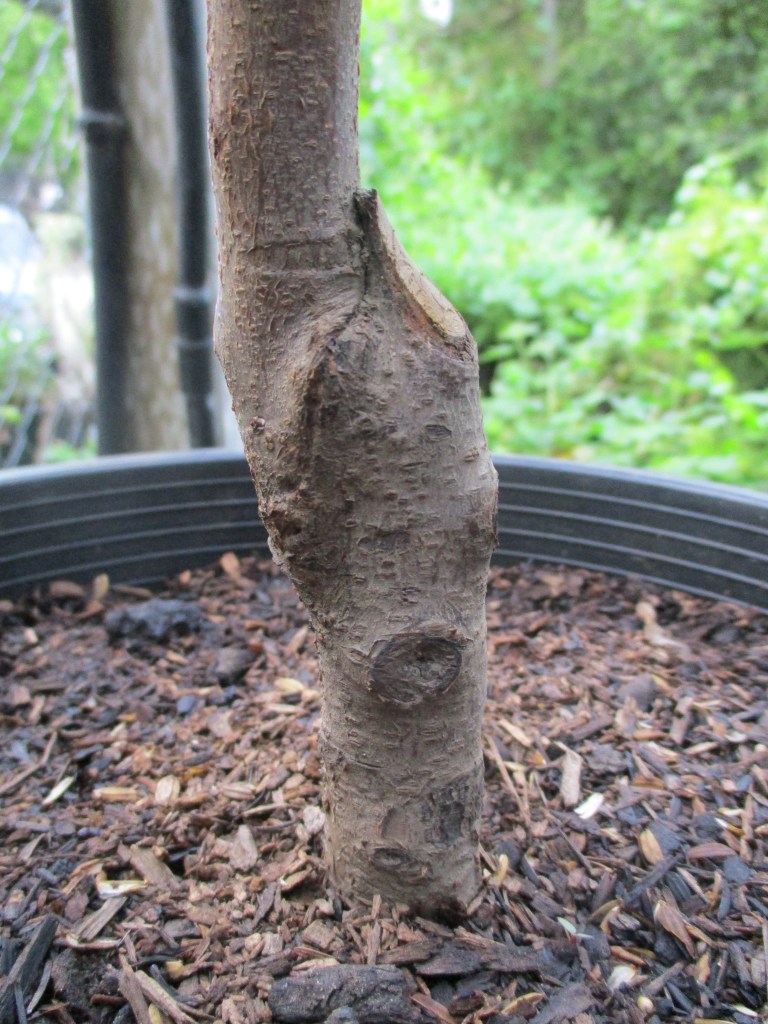
The scion is above this graft union. The rootstock is below.

There are not many Californians of my generation who do not remember growing avocado trees from seeds when we were kids. We simply impaled the big seeds around the middle with three evenly spaced toothpicks to suspend them from the rims of Dixie cups partly full of water. If just the bottoms of these seeds remained properly submerged, they grew roots and a stem with a few leaves, all they needed to grow into trees that were producing too many avocados by the time we got to high school.

Yet, I and others of my generation have always heard that avocado trees need to be grafted to produce fruit. (Grafting is the union of two or more compatible but different plants. The ‘scion’ is the upper portion that forms a trunk, branches and foliage. The ‘rootstock’ is the lower portion that provides roots.) Well, this is obviously not true, but does make us wonder about the advantages of grafted trees.

They myth of seed grown trees being unproductive probably originates from the tendency for seed grown avocado trees to be unproductive for the first few years during the juvenile stage. Scions of grafted trees are taken from adult growth that is ready to bloom and fruit immediately; although even grafted trees need a few years to grow large enough to produce more than just a few avocados.

Many plants are juvenile while young, in order to better compete in the wild. While juvenile, avocado tree seedlings grow vigorously enough to compete with other trees. Adult habits of blooming and fruiting would only slow them down. Besides being fruitless for many years, citrus seedlings are very thorny through their juvenile phase, to avoid getting eaten by grazing animals. Scions of grafted citrus trees are from relatively thornless adult growth that is immediately ready to produce fruit.

The primary advantage of grafting fruit trees though, is keeping the many different cultivars (cultivated varieties) ‘true to type’, since many seed grown plants exhibit at least some degree of genetic variation from their parents. For example, avocados from seed grown (ungrafted) trees tend to be much larger, but often less flavorful than the fruit that the original seed came from. No one really knows what the fruit will be like until it actually develops. Some seed grown peaches are indistinguishable from their parents, but most are very different. However, most pecans and chestnuts are actually produced from ungrafted seed grown trees.

The secondary advantage of grafting fruit trees is the ability to graft onto dwarfing rootstock. Although few avocado trees are dwarf trees, almost all citrus trees for home gardens are grafted onto dwarfing rootstock that keeps them more compact and proportionate to home gardens. Most deciduous fruit trees are similarly grafted onto semi-dwarf rootstock.

Live Christmas Trees Eventually Mature

Most conifers are not so compact.

Christmas trees grow on farms. They are an agricultural commodity. Their unnatural and intensive cultivation is no asset to any associated natural ecosystem. Their harvest does not deprive ecosystems of natural components. Live Christmas trees are at least equally as unnatural. Their cultivation involves more synthetic materials and unnatural irrigation.

There should be no shame associated with the procurement of cut Christmas trees. They are merely cut foliage that is significantly more substantial than that which accompanies cut flowers. Furthermore, live Christmas trees are not an ecologically responsible option. They are merely potted plants that can be difficult to accommodate within home gardens.

That certainly should not invalidate the appeal and potential practicality of live Christmas trees. With proper maintenance, other potted plants, such as houseplants, can grow and perform for many years. Since live Christmas trees are coniferous species that get rather large, they demand more attention. All are not necessarily totally unmanageable though.

Some compact conifers, such as dwarf Alberta spruce and compact cultivars of Colorado blue spruce, can remain within pots for many years. They need either larger pots as they grow, or occasional root trimming if they stay within their same pots for a few years. Their roots outgrow pots as slowly as their canopies grow. They also require diligent watering.

Unfortunately, the most common of decorated live Christmas trees that are available from supermarkets are also the most problematic. Most are either Canary Island pine or Italian stone pine, which grow surprisingly large for such seemingly innocent small evergreens. They very often go into compact gardens, where their bulky roots displace infrastructure, such as pavement and turf grass.

Contrary to popular belief, planting live Christmas trees in the wild after Christmas is not a practical option. Because their roots were confined to pots, they rely on irrigation while they disperse roots into the ground. They can not survive without irrigation after the rainy season. Besides, trees that are not native could be detrimental to the native ecosystems.

Getting an early start to winter pruning may have certain advantages

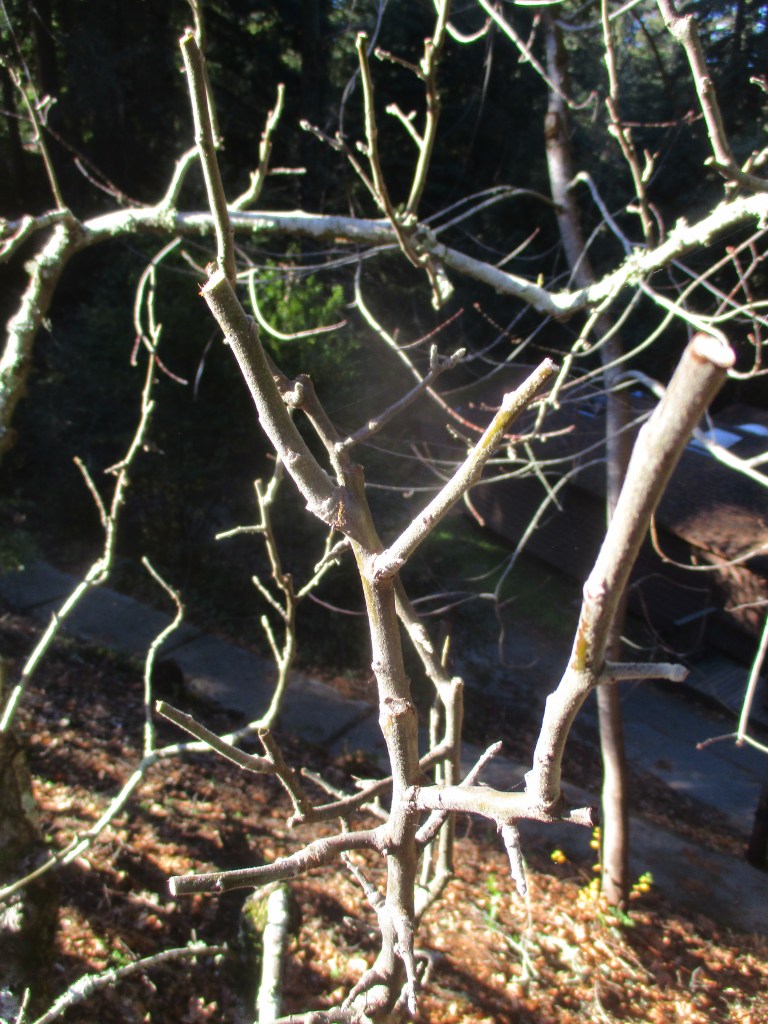
Without specialized pruning, fruit trees become sloppy and unable to sustain all of their fruit.

As long as it gets done well before buds begin to swell late in winter, the meticulous and specialized pruning that deciduous fruit trees and roses require during winter dormancy does not need to be done immediately. Here where the climate is so mild, some roses may still be blooming. The main advantage to getting an early start is that those of us who have many fruit trees and roses in need of pruning have more time to get them all done within the proper time.

If it helps to start pruning early, it is best to prune fruit trees and roses in the same order that they go dormant and defoliate. The ‘stone’ fruits (those of the genus Prunus, that have large pits known as ‘stones’), like apricots, cherries, nectarines and peaches typically defoliate earlier than the ‘pomme’ fruits, like apples, pears and quinces. Modern ‘carpet’ roses may not defoliate completely, so can be delayed until after all the bare roses get pruned, but may eventually need to get pruned while still partially foliated.

The specialized pruning that deciduous fruit trees and roses need is serious business. Those who do not know how to do it properly should learn about it before actually doing it. Improper pruning of fruit trees can inhibit production and damage the trees. Roses are not so easily damaged, but will get overgrown and not bloom as well if not pruned aggressively enough. (This sort of pruning will be a topic later in the season.)

Like fruit trees and roses, other trees and shrubs that need pruning prefer to be pruned while dormant through autumn and winter. Deciduous trees and shrubs are obviously dormant while bare, but realistically, are ready to be pruned when their foliage is no longer green.

Evergreen plants are not so obviously dormant, but will be as dormant as they get through winter. This would therefore be a good time to prune to eliminate pine limbs that are too low. If pruned a bit early, the pruning wounds will get weathered more through winter and consequently bleed less through spring.

Winter Berries Attract Migrating Birds

English hawthorn is like deciduous firethorn.

Bloom and colorful foliage provide most of the color besides green within home gardens during spring and summer. Deciduous foliage becomes more colorful for autumn. Winter berries and a few other lingering fruits become more colorful as deciduous foliage sheds through winter. All this color adheres to precise schedules within a collective ecosystem.

Many plants exploit wildlife. It is how they compensate for their immobility. Many provide incentive for the services that they desire from the wildlife that they exploit. For example, after enticing pollinators with fragrance or color, flowers happily exchange extra pollen or nectar for pollination. Many plants provide edible fruits in exchange for seed distribution.

It is no coincidence that so many different winter berries ripen through autumn for winter. They provide sustenance to many migratory birds who rely on them. Overwintering birds who compete with migratory birds appreciate their efforts as well. Such winter berries are small but abundant, for ‘grab and go’ convenience. Bright color is the best advertisement.

Some people appreciate how winter berries attract birds and squirrels into their gardens. Some appreciate the seasonal color of such berries more than the wildlife. Unfortunately, wildlife decides the outcome, and such outcomes are variable. It is impossible to predict if berries will disappear as they ripen, or linger as they deteriorate through most of winter.

Firethorn is likely the most familiar of the winter berries here. It seems to be more prolific with its brilliant red berries than any other species. Some old fashioned cultivars produce bright orange or perhaps even bright yellow berries. Some sorts of cotoneaster resemble firethorn, but with subdued rusty or orangish red display for less refined woodsy gardens.

Toyon, or California holly, is most prolific with winter berries where it grows wildly without pruning. It gets big though. Real hollies, which are more popular in other regions, do not produce many berries locally, particularly since male pollinators are uncommon. English Hawthorn is a small deciduous tree that displays berries that resemble those of firethorn, but on bare stems.