Why Cyclamen Are So Popular

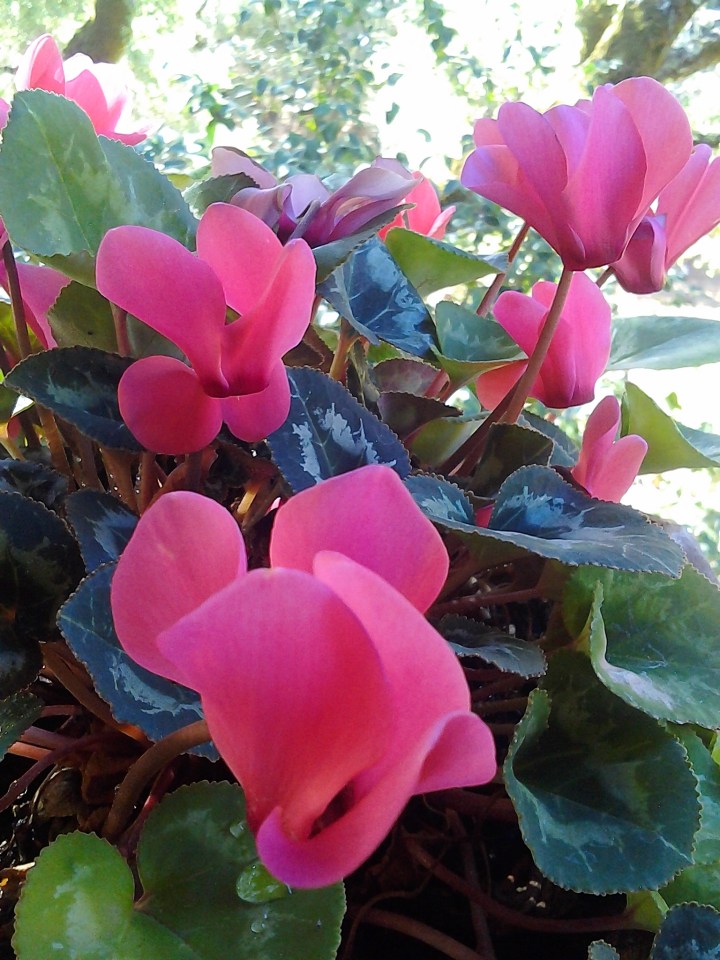
41224thumbCyclamen are everywhere! Some nurseries have more cyclamen than all other cool season annuals combined. Not all cyclamen are represented though. Almost all are white or simple red. Pink, salmon and other shades of red are noticeable scarce because they are not traditional colors of Christmas. The plants are mostly of impeccable quality, and outfitted with abundant flowers. While there is not much else blooming, the popularity of cyclamen is impossible to ignore.

The problem with cyclamen is the expense. Relative to other cool season annuals, they are large plants that are only available in four inch and larger pots, so naturally cost more. They can not be purchased in less expensive cell packs. Even though they are perennials that can last for many years, they are almost always used as disposable cool season annuals that get replaced when warm season annuals come into season. It can be difficult to justify such an expense for something that lasts only a few months.

The advantage to cyclamen is that they look good instantly, even if they do not perform as reliably during the next few months. This is something that the other cool season annuals have difficulty with. Only larger and more expensive annuals in four inch pots are so immediately colorful, and even they need some time to fluff out and get established in the garden. They just do not grow as fast now as they did earlier in autumn. The weather is now cooler. The days are now shorter.

This is why it was important to replace warm season annuals with cool season annuals earlier instead of later, even if some of the warm season annuals had still been blooming somewhat well. It gave the cool season annuals some time to mature before winter really slowed everything down. Even though they do not grow as actively now, they are already big enough to bloom impressively.

Pansy, viola, stock, Iceland poppy, nemesia, various primroses and ornamental cabbage and kale can certainly get planted now, but will grow a bit slower than they would have if they had been planted earlier in autumn. If necessary, it might be worth planting them a bit more densely than typical, or planting larger plants from four inch pots.

Winter Is For Dormant Pruning

P90316++++The internet makes it possible to communicate with people who enjoy gardening all over the World. It can be amusing to hear what garden enthusiasts in Australia are doing now in early summer. Is it always summer in Ecuador? A common theme in much of America is that there is not much gardening to do right now. It might be more accurate to say that no one wants to go out in the cold.
Where winter weather is too unpleasantly cold to work in the garden, many winter chores can either be done earlier in late autumn, or delayed until early spring. Such scheduling is not a problem, since the plants involved are so deeply dormant through such cold weather anyway. Until the weather warms a bit, they do not want to work in their gardens either. Scheduling is very different here.

Not only does mild weather facilitate gardening chores, but it necessitates the completion of certain chores before the end of winter. Many plants that are mostly dormant while the weather is cool are actually dispersing their roots now that the soil is moistened by winter rain. They will be ready to break dormancy weeks before they would where winters are colder. There is no time for delay.

With a few exceptions, winter is the season for pruning here. Maples and birches should have been pruned earlier, or should be pruned later, so that they do not bleed sap. Citrus get pruned and groomed after the last frost because pruning stimulates new growth that is sensitive to frost. Early blooming flowering crabapples, flowering cherries and forsythias should get pruned after bloom.

Otherwise, most deciduous plants and many evergreen plants should be pruned in winter, while they are as dormant as they get. Pruning now will be less disruptive than it would be while they are more active. They wake up in spring and resume growth as if nothing happened, but relieved of the superfluous growth that was pruned away. Winter pruning is what fits best into their schedules.

Of all plants in the garden, deciduous fruit trees and roses rely on specialized pruning more than most others.

Not All Evergreens Are Conifers

41217thumb‘Conifer’ and ‘evergreen’ are almost synonymous. Of the two, ‘evergreen’ is the more familiar term. Some people do not know what a ‘conifer’ is. Simply speaking, an evergreen is a plant that retains foliage throughout the year, even while deciduous plants defoliate through winter. A conifer is a plant that produces seeds in cones, such as pine cones, although many are not easy to recognize as such. Actually though, not all evergreens are conifers; and not all conifers are evergreens.

Southern magnolia, glossy privet, lily of the Nile, all sorts of eucalyptus and all sorts of palms retain their foliage through winter, but none are conifers. Larch, dawn redwood and bald cypress are conifers, but are also deciduous. This can be quite a surprise for anyone expecting them to be evergreen. The foliage turns brown enough to resemble death before defoliation, although larch can get quite colorful in autumn where winters are cooler.

Now that flowers for cutting are scarce, evergreen foliage is popularly cut and brought into the home instead. Here in California, not many of us have fir or spruce out in the garden. Redwood, pine, cypress and cedar (deodar and Atlas) are more common. Leyland cypress, Western red cedar, incense cedar and the various chamaecyparis are not as common, but are just as effective. Incense cedar as well as some of the junipers (unshorn) are particularly aromatic.

Since the various hollies are uncommon here, Californians prefer other evergreens with berries, such as firethorn (pyracantha), contoneaster and toyon. Incidentally, toyon had been so recognized as a substitute for holly that it had historically been known as California holly, and is the origin of the name of Hollywood. Magnolia grenades (fruiting structures) can function like weird pine cones. Southern magnolia has big and glossy leaves with rusty orange undersides. They can provide bold color and texture, even if they have dried to a rich brown.

There are of course no rules for cut foliage. Anything that is still foliated and appealing in the garden may work nicely in the home. Ferns are an obvious choice, although some drop spores that stain fabric. Various pittosporums, podocarpus, eucalyptus, New Zealand flax and even the leaves of bird of paradise are all worth a try.

Evergreens From Our Home Gardens

91225thumbEvergreens are popular for home décor through winter because there is not much blooming so late in most other American climates. The tradition endures, even though cut flowers of all sorts can easily be purchased from common supermarkets nowadays. Here on the West Coast, where several varieties of flowers can bloom through winter, evergreen foliage is as popular as it ever was.
Christmas trees are the most substantial form of traditional seasonal evergreens. The biggest wreaths occupy less space, and are mostly confined to walls rather than floors. Garlands can be big too, but their less defined form fits more neatly into limited space. For many of us, neatness is not a priority. Displays of evergreens and all the associated ornamentation can get quite elaborate.

Not many of us grow our own Christmas trees. It is more practical to purchase them as if they are very large cut flowers. Most but not all of us who hang garland likewise procure it already made. Some purchase prefabricated wreathes too. However, it is possible that more of us create our own. Other bits and pieces of evergreens are unlikely purchased. Most are from our home gardens.

Most of the pine, spruce, fir, hemlock, yew, arborvitae, and various genera known collectively as cedar, that are traditional evergreens in other regions are scarce here. A few other exotic species of pine, as well as natives, are more common in some landscapes. There are also different cedar and arborvitae. Blue spruce can sometimes be found. Douglas fir is native to nearby mountains.

Other regions lack the abundance of various cypress and juniper that are common here, as well as coastal redwood. (Redwood foliage is perishable once cut.)

There are no rules about cut evergreens anyway. Within reason, we can cut and bring in whatever we happen to find to be appealing in our gardens. We should cut the foliage properly though, as if pruning. Also, we should not cut too much from any particular spot, but instead harvest evenly over a large area. It helps to take pieces that are out of view, or that need to be pruned out anyway.

Some Plants Need To Chill

41210thumbIt is easy to snivel about the weather when it gets uncomfortable for us. The rain gets too wet. The temperature gets too cool. Even here on the west coast, without the cold of Minnesota, the heat of Arizona, the humidity of Louisiana or the rain of the west coast of Washington, we tend to think about weather by limited human standards. What we fail to consider is that many other organisms rely on a variety of weather conditions for their survival.

Deciduous plants make it obvious that they know how to deal with cool winter weather. What is not so obvious that that many deciduous plants actually need specific wintry conditions to be convinced that it really is winter. If the weather does not get cool enough, or stay cool long enough, some plants do not go dormant long enough to get the rest that they need in order to perform adequately the following spring and summer.

For example, the reason that only a few of the many different varieties of apple can be grown locally is that most have chill requirements that exceed what they get here. A chill requirement is a specific duration of cool winter weather. Only a minority of all varieties were bred for their minimal chill requirements, so that they will produce reliably even where winters are innately mild.

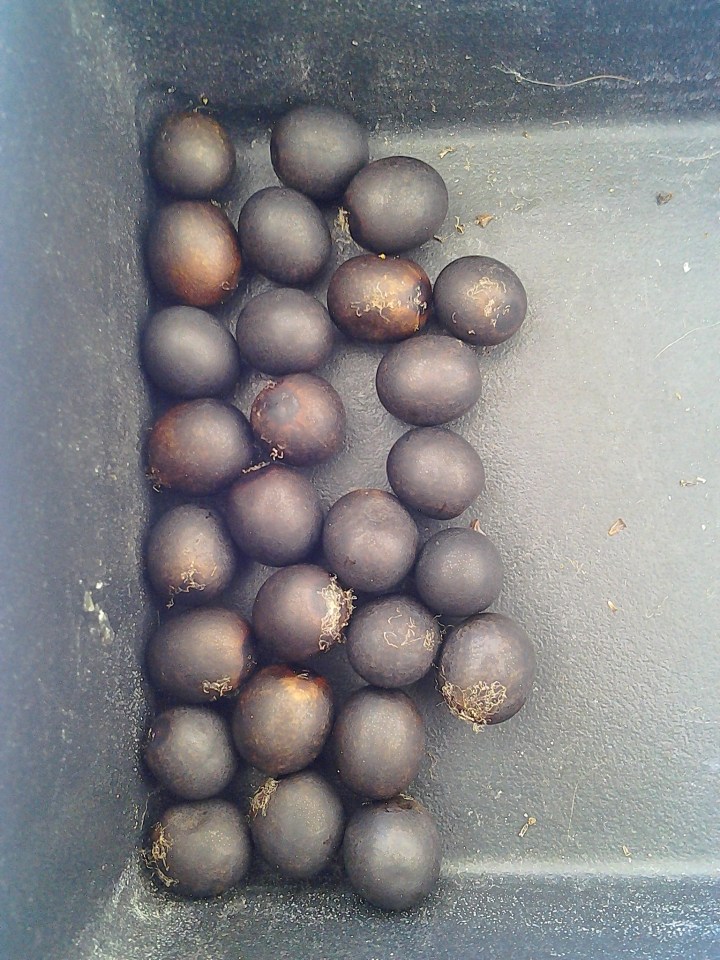
Besides chill requirements, some seeds like to be soaked in moist soil before they germinate the following spring. This lets them know that it is raining, like it typically does in winter. Pecans, for example, can be soaked for a while inside before sowing, bur really prefer to be out in the garden through winter, where they can tell than rain water is actually flowing past them through the soil, and the microorganisms in the soil help to break down their shells.

It is all about timing. Chill requirements get apple trees to bloom in spring, only after they were convinced that it was already winter. If they were not so specific, they might bloom after a brief cool spell in autumn, leaving their blossoms or developing fruit vulnerable to later frost. Pecans germinate and grow only after the danger of frost, but before the weather gets too dry. If they start too early, they may not survive frost. If they start too late, they may desiccate through summer.

Seasonal Potted Plants For Christmas

91218thumb‘Tis the season for seasonal potted plants. These are not well established houseplant or potted plants that live out on porches and patios through the year. Seasonal potted plants are those that are purchased at their prime, allowed to live in our homes and offices while they continue to bloom or maintain their foliage, and then most likely get discarded when no longer visually appealing.
Poinsettia epitomizes winter seasonal potted plants. Florists’ cyclamen, azalea, holly, amaryllis, Christmas cactus and small living Christmas trees are other overly popular choices. All are grown in very synthetic environments designed to force optimal performance, with no regard to survival afterward. They are like cut flowers that are not yet dead. They are true aberrations of horticulture.

Technically, any of them can survive as potted plants, or out in the garden after they serve their purpose as appealing seasonal potted plants. Their main difficulty is that it is not so easy for them to recover from their prior cultivation, and adapt to more realistic environmental conditions. For now, it is best to enjoy them at their best, and try to maintain them at their best for as long as possible.

Eventually, they all experience a phase in which their original growth deteriorates to some extent, while they start to generate new growth that is adapted to the situation that they are in at the time. Christmas cactus are probably the most proficient at adapting, and becoming delightful houseplants. They are even likely to bloom occasionally, although not on any particular schedule for winter.

Holly, azalea and cyclamen can eventually get planted out in the garden. Most hollies grow into large evergreen shrubbery, but do not produce as many berries as they originally did. Azaleas are cultivars that were developed to be seasonal potted plants, so are a bit more finicky than those developed more for landscapes. Cyclamen can be added to pots of mixed annuals and perennials.

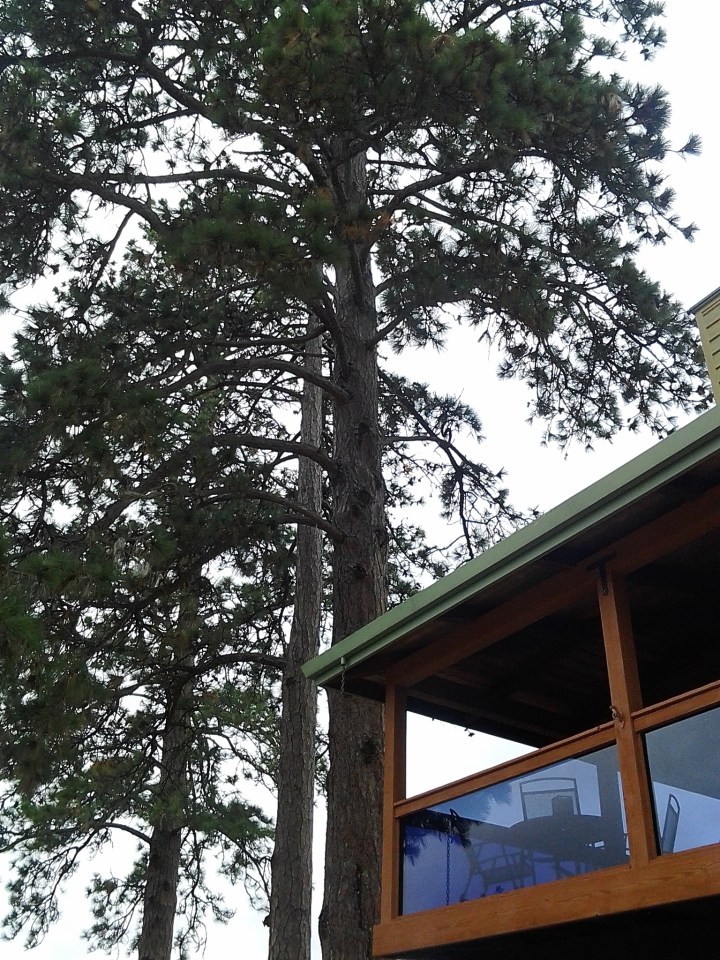
Living Christmas trees are not so easy to accommodate. Most are pines that need their space.

Christmas Trees – Dead Or Alive

41203thumbChristmas trees are like vegetables. Really, they are like big vegetables that do not get eaten. They are grown on farms, and then harvested and sent off to consumers. Although they smell like a forest, and they are descendents of trees that naturally grow in the wild somewhere, there is nothing natural about their cultivation. In fact, most are grown a very long way from where their kind are from. Therefore, bringing a cut Christmas tree into the home takes nothing from the wild, and does not interfere with nature any more than eating vegetables does.
Firs, particularly Douglas fir, are the most popular of Christmas trees. Pines are probably the second most popular. Redwoods, spruces, cedars, cypresses or even Junipers can also work. They each have their own distinct color, texture and aroma. Healthy and well hydrated trees that continue to get watered as needed should have no problem lasting through Christmas. Ultimately though, cut Christmas trees are not good for much after Christmas, and eventually get composted or otherwise disposed of.

Living Christmas trees might seem like a better option to cut Christmas trees because they dispel any unfounded guilt associated with cut Christmas trees, and initially seem to be less disposable. The problem is that they have problems of their own. Simply purchasing one is a big expense. Even the big ones are smaller than cut trees, but much heavier and unwieldy. Contrary to popular belief, only a few types that grow slowly, such as some spruce, can actually live in a tub for more than one or two years, and even they can be finicky.

The main problem is where to plant a living Christmas tree when it outgrows its container. Conifers innately do not like to be confined for too long. Yet, in the ground, most grow into substantial trees. The common little Christmas trees that are already decorated are actually the worst since they are juvenile Italian stone pines or Canary Island pines, which grow big and fast. Potted trees can not be planted out in the wild because their confined roots need to be watered until new roots can disperse. Even if they could survive, non-native trees should not go into natural ecosystems.

Winter Berries Are Showing Color

91211thumbNothing lasts forever. Spring flowers fade. Summer fruit gets eaten. Fall color falls from the trees and gets raked away. Berries and other small fruits that ripen to provide a bit of color through late autumn get eaten by birds and squirrels through winter. Every type of berry and every season is unique. It is impossible to predict how long particular berries will last through any particular season.
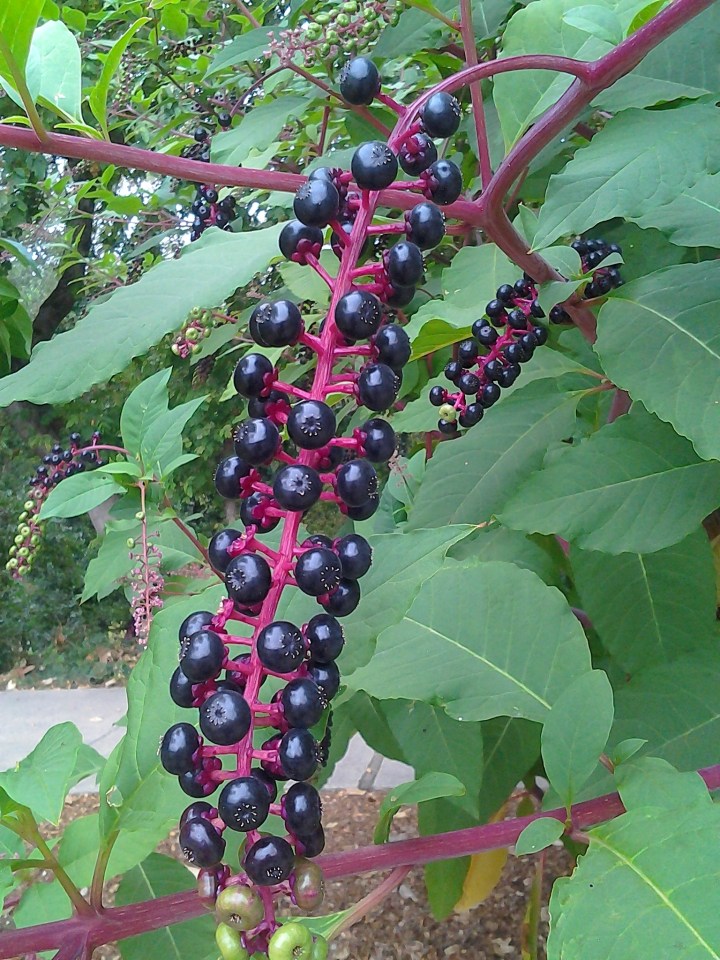
It would be presumptuous to believe that colorful berries should remain uneaten in our gardens until they decay. After all, they are produced specially for the birds and rodents who consume them. Their visually appealing bright colors are more culinarily appealing to overwintering wildlife. It is no free lunch though. Well fed wildlife is expected to disperse the seed within the berries they eat.

It is an ingenious system. Wildlife might think that they exploit the inanimate flora who produces the berries and small fruit for them. The associated flora could think that they exploit the mobility of the wildlife who eats their seed laden fruit. Those of us who grow plants who utilize this technique get to enjoy the color of the fruit while it lasts. Some of us prefer to enjoy the wildlife attracted to it.

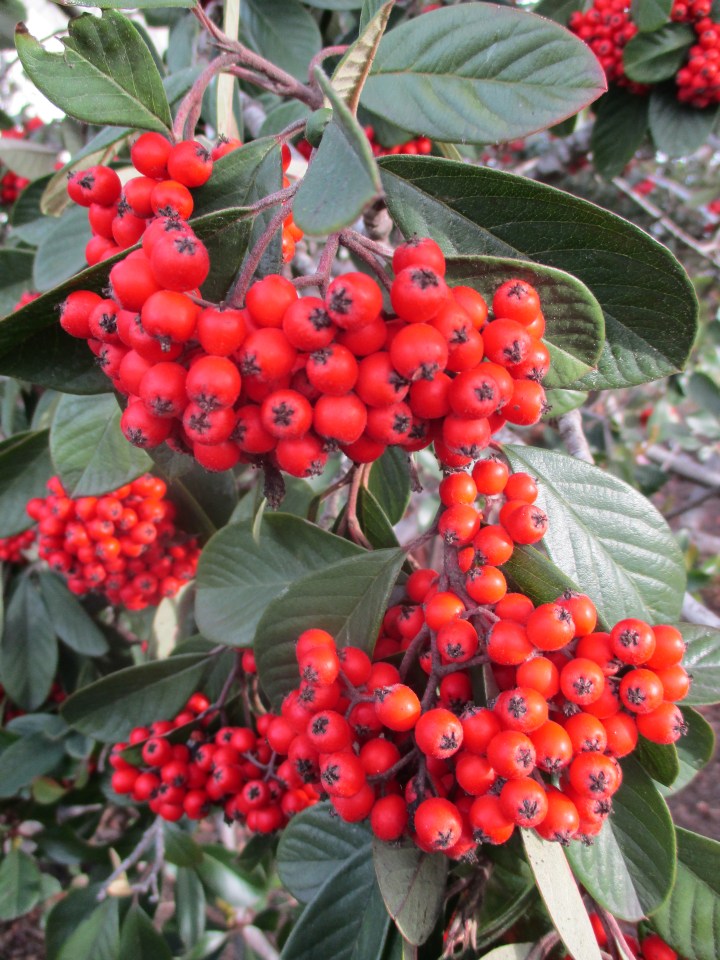
Firethorn (pyracantha), toyon, cotoneaster and English hawthorn are the best for colorful red berries in late autumn and winter. All are of the family Rosaceae, and produce similar clusters of small bright red or maybe reddish orange berries. Yellow firethorn is rare here. Cotoneaster can be tall shrubbery, sprawling shrubbery, or groundcover. Only English hawthorn is a deciduous small tree.

The many species and cultivars of holly are unrelated to the family Rosaceae. In other regions, some are famous for producing seemingly similar berries. However, those that are the most prolific with berries are unpopular here. Those that are somewhat popular produce only a few berries due to a lack of pollinators. (They are dioecious, so female plants must be pollinated by rare males.)

This is the time of year to appreciate the colorful berries while they last.

Colorful Autumn And Winter Berries

41126thumbBefore the colorful foliage of autumn falls and gets raked away, a few types of berries and fruit start to provide a bit of color to last into winter, or at least until birds and other wildlife eat them. Technically, the most colorful berries are actually intended for the birds, both those that overwinter and those that migrate south for the winter. The berries are designed by the plants that produce them to both entice birds, and to reward them for dispersing the seeds within.

Pyracantha (or firethorn) is the most colorful of the berries. Cotoneaster is similar, but not quite so prolific. Toyon and English hawthorn, which can grow as small trees, produce open clusters of similar bright red berries. Of these, only English hawthorn is deciduous, and can defoliate before the berries disappear. Although such fruit is abundant, it is not often messy because it gets devoured before it reaches the ground. However, the birds can be messy.

English holly really should produce more berries than it does, but there are not enough pollinators out there. (Hollies are dioecious, which means that plants are either male or female. Female plants need male pollinators to produce fruit.) Decades ago, when horticulture was taken more seriously, male pollinator plants were marketed with female plants. Some other types of holly somehow make a few more berries, especially as they get older.

Loquat, mahonia, pomegranate and some flowering crabapples try to produce colorful fruit, but are not quite as colorful. Pomegranate fruit can be impressive in its own way, but are just rusty reddish brown on the outside. Strawberry tree produces a few red berries throughout most of the year. Many types of pittosporum develop fruit, but most are about as green as their foliage. The sticky amber seeds are ‘interesting’ when the fruit splits open, if anyone happens to look that closely.

Oranges, lemons, grapefruits, mandarins and other citrus will be colorful later in winter, even though they do not care if they attract any birds. For now, persimmons are the biggest and most colorful fruits out in the garden.

Division Renovates Tired Old Perennials

91204thumbAutumn is a time for planting partly because it is when many plants are beginning their winter dormancy. They are, or will soon be, less active than they would be at any other time of year. Some may not start to grow again until after winter ends. Others will want to secretly disperse their roots through the rainy winter weather, while merely appearing to be dormant from above the soil level.

That is why autumn is also the best time for division of many types of perennials. Such perennials should be adequately dormant to not be bothered by the process of getting dug and divided into smaller parts, then replanted. They actually prefer to get it done sooner than later, so that they can slowly disperse their roots through cool and rainy winter weather, and be ready to grow in spring.

Divisions is often done to renovate bulky perennials that have become overgrown, shabby, or too crowded with their own growth to bloom well. Some of the more vigorous perennials may benefit from division for renovation every several years or so. Many complaisant perennials may never benefit from division. Of these, some might be divided merely for propagation of more of the same.

Japanese anemone, bergenia and other perennials that bloom in autumn and winter should get divided later, after bloom. Like perennials that get divided now, they tend to recover and efficiently disperse roots before spring. However, they may need to be watered a bit more than typical if the weather gets warm and dry early next year. Their schedules do not coincide with local climates.

Lily-of-the-Nile, African iris and New Zealand flax can be divided into individual shoots, even if a few shoots get planted together in clumps. Entire plants do not need to be dug if it would be easier to merely pluck a few outer shoots from the perimeters of congested parent plants. Black-eyed Susan and Shasta daisy can be divided into clumps of several dormant basal rhizomes and roots.

‘Pups’, or sideshoots, of agaves and some types of yuccas can be carefully pried from their parent plants without disturbing them.