Prune Now For Fruit Later

70726thumbModern fruit trees have been so extensively bred to produce abundant and unnaturally large fruit, that most types are unable to support the weight of the fruit that they can produce each season. Without specialized dormant (winter) pruning to limit production, the weight of excessive fruit breaks and disfigures the limbs of the trees that produce it. Fruit becomes too much of a good thing.
Pruning not only limits the weight of the fruit; but it also improves the structural integrity of the limbs that must support it, and ideally, keeps fruit more reachable. Concentrating resources produces fewer but better fruits, instead of wasting resources on excessive fruits of inferior quality. Fewer stems that grow in spring are more vigorous and resistant to disease than more stems would be.

‘Stone’ fruits (of the genus Prunus) generally get similar pruning. However, peaches and nectarines produce such heavy fruit that they get pruned more severely than apricots, plums and prunes. Cherries and almonds are so lightweight that they may not need to be pruned at all. Cherries may be pruned for height. Since almonds get shaken from their trees, height is not so important.

Stems that grew last summer should produce fruit next summer. They should therefore be pruned short enough to support the weight of the fruit that they can produce (or what stems produced in previous years). For peaches, stems may need to be pruned to only a few inches long, even if the new stems are several feet long. Upper stems that get too high can be pruned out completely.

Apples and pears benefit from the same sort of pruning, but can be cut back even more aggressively, since their new stems tend to be more productive at the base. Crowded clusters of vigorous new stems can be thinned to eliminate the largest and most dominant stems. Stunted ‘spur’ stems that do not elongate more than two inches or so each year many not need to be pruned at all.

The ‘four Ds’, which are ‘Dead, Dying, Diseased and Damaged’ stems, are the first to get pruned out, even if they happen to be in the right places. There is just too much potential for problems later. Young trees that do not need much pruning now should be pruned for structure. Dormant fruit tree pruning is so important and specialized, that it is worth studying in more thorough detail.

Secret Lives Of Christmas Trees

90102thumbPeople really stress out over Christmas trees. Some do not want a cut Christmas tree because it involves killing the tree. Some do not want an artificial Christmas tree because it is . . . artificial. Some do not want a living Christmas tree because it is too expensive for a tree that is too small. There are so many myths and misconceptions about Christmas trees, yet everyone wants one.

As mentioned, artificial trees are . . . artificial. Obviously. They are not a horticultural commodity, so are not an appropriate topic for a gardening column. What can be said about them is that they are not a more environmentally responsible option to disposable cut real trees. Countless dinosaurs died to make the petroleum for the plastic that these non-biodegradable trees are made of.

Cut trees are still the most environmentally responsible option. They are not harvested from forests, but from plantations, just like any other cut foliage, cut flowers or vegetable crops. Many are grown from the branched stumps of previously harvested trees, by a process known simply enough as ‘stump culture’. It works like coppicing, and allows some stumps to produce for many years.

Potted living trees are the most misunderstood type of Christmas trees. There is nothing environmentally friendly about them. They are exotic (non-native) trees grown in synthetic media (potting soil) in vinyl pots. They get synthetic fertilizer, artificial irrigation and very unnatural pruning while growing within artificially regulated environments that are designed to promote efficient production.

Only a few of the more compact types of living Christmas trees, like Colorado blue spruce and dwarf Alberta spruce, can survive confinement in pots for more than just a few years. Austrian black pine and dwarf limber pine need a bit of trimming as they grow, but also have the potential to work for a few Christmas seasons. The common small potted Christmas trees that are already decorated are Italian stone pine and Canary Island pine, which do not survive confinement for long, and get too big for home gardens.

Winter Is Bare Root Season

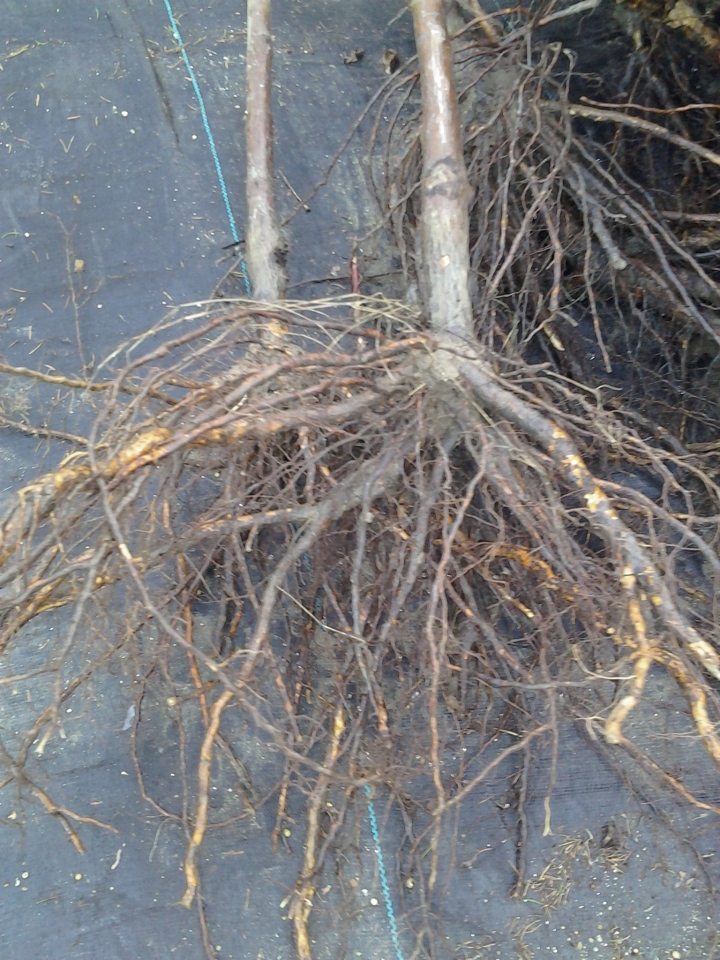
80124thumbWhile dormant for winter, some types of plants get dug from the soil and sent to nurseries as ‘bare root’ stock. Some get packaged with their otherwise bare roots contained in bags of damp sawdust. Most just get heeled into damp sand in the retail nurseries where they get sold. These simply get pulled from the sand when sold.

At their new home gardens, bare root plants simply get planted where they will sleep through the rest of winter. In spring, they wake up and start to grow as if nothing ever happened. How sneaky! They do not need big holes for their bare roots. Their graft unions (the ‘kinks’ at the bases of the trunks of grafted plants) must stand above grade. Roots only need to be spread out laterally.

Soil amendment should be minimal. Too much soil amendment promotes root growth around the trunk, which can inhibit root dispersion elsewhere. Too much excavation and amendment below the roots may eventually settle, so that graft unions sag below grade, and get buried. A light dose of fertilizer a bit later promotes early root growth, even while the branches are still bare.

Bare root plants are much more portable than canned (potted) plants. Several can be wrapped and sent home in a small car, or even through the mail; which is why so many bare root plants can be purchased online. (Climate zones should be considered when purchasing online.) Because they occupy less space than canned plants, many more varieties are available in nurseries.

Because they are so easy to handle and process, bare root plants cost about a third of what canned plants cost. Mail order plants from growers often cost even less than those that must be sent to retail nurseries first. Bare root plants are at least as reliable as canned stock, disperse roots more efficiently, and are less likely to be infected with disease when they arrive.

The most popular bare root plants are roses, cane berries, grapevines and fruit trees, like apricot, peach, nectarine, cherry, plum, prune, almond, apple, pear and persimmon. Flowering crabapple, flowering cherry, poplar, lilac, forsythia, wisteria, rhubarb, strawberry and asparagus are also available.

Berries For Color In Winter

81226thumbIn milder climates of California, where many of us expect at least a few flowers to bloom right through winter, autumn foliar color and colorful winter berries are not appreciated quite as much as they are where autumn and winter arrive earlier, and are cool enough to prevent lingering bloom. Coincidentally, the same mild weather that allows winter bloom here also limits autumn foliar color.

However, mild autumn and winter weather does not inhibit the production of the various winter berries. Such berries can either provide extra color while bloom might be scarce, or at least keep migrating and overwintering birds well fed while trying to do so. Many of us actually grow colorful berries more to keep wildlife happy than to provide color. Some enjoy using them like cut flowers.

It is no coincidence that most colorful berries that ripen in winter are small, red, and profuse. Just like flowers use color to attract pollinators, many types of fruits use color to attract the birds that eat them and subsequently disperse their seed. Bright red happens to work best for that purpose, although there are other options. Small berries happen to be easy for birds to grab and go with.

Most of the specie that provide winter berries are related, within the family of Rosaceae, and most are evergreen shrubs. Of these, firethorn, which is also known by its Latin name of Pyracantha, is the most familiar and most prolific with berry production. The various specie and cultivars of Cotoneaster are not nearly as bold with their berries, but provide a bit more variety of plant form.

English hawthorn and related hawthorns happen to be small deciduous trees that defoliate in winter to leave their ripe berries exposed. Incidentally, as their names imply, both firethorn and the various hawthorns are unpleasantly thorny. The native toyon is a big evergreen shrub that can get almost as big as the smaller hawthorns, and has the potential to be pruned up as a small tree. Hollies are not related to the others, and although very traditional, are unreliable for berry production locally.

Do Not Forget Potted Plants

30918thumbAside from all the seasonal raking and dormant pruning, there is not as much to do in the garden as there was earlier in the year. Lawns do not need much mowing. Hedges do not need much shearing. Untimely mowing and shearing can actually damage lawns and hedges. Watering, which was so important while the weather was warm, is now rare in the cool weather between rain.

Watering is now so infrequent that the few plants that still need it sometimes do without. Plants that are merely sheltered by eaves probably do not mind so much because their roots are dispersed beyond the eaves. However, potted plants that are sheltered by eaves do not have that option. It may take a while in the cool and damp air, but they can slowly get uncomfortably dry.

Watering sheltered potted plants is too easy to forget about while everything that is not sheltered is getting soaked by rain. It is even more easy to forget because it is so infrequent. Things just do not dry out like they do in summer. Also, plants are less active, and many are dormant and defoliated, so really do not lose much moisture to evapotranspiration (evaporation from foliar surfaces.)

In fact, overzealous watering can be just as detrimental as neglect. Soil saturation may not be as immediately dangerous as it would be during warmer weather, but eventually kills roots. Even with adequate drainage, soil moisture can linger if plants do not consume it. Determining how much water is needed for sheltered potted plants may not be as simple as it should be.

Larger plants in smaller pots want more water than smaller plants in larger pots. Those that are exposed to wind will get dry faster than those that are protected. Hanging pots dry out the fastest. Ironically, drought tolerant plants that need the least water in the ground often want the most in pots. They are the most reliant on extensive root dispersion, which is not possible in confinement.

Some potted (frost tolerant) plants might get slightly relocated out into the weather so that they get the rain that keeps the rest of the garden well watered through winter.

Potted Plants Have Their Place

30918thumbPavement serves a purpose in a landscape. So does decking. They are the flooring of the outdoor spaces that are used for outdoor living. Patios and decks are where we barbecue and dine. Walkways and porches are how we get around the exteriors of our homes. Driveways are where we park cars. For what they get used for, they are better than turf grass, ground cover or bare soil.

So why is it so trendy to clutter pavement and decking with potted plants that would really prefer to be in the ground? It would be more practical to pave less area, and leave more space to plant things in the ground. There would be no damp pots staining concrete or rotting decking. There would be less area to rake or blow, with fewer obstacles in the way. Watering would be much easier.

Well, as it turns out, there are a few plants that should be potted. Houseplants are the most obvious. After all, not many homes have exposed soil where houseplants can be grown on the inside. Even if they did, it is still easier to keep houseplants potted for portability. Plants such as orchids and Christmas cactus, can live in the garden most of the time, and then come in while blooming. Portability is also important for tropical plants that need protection from even mild frost. It might be easier to move them than to cover them.

There are also a few plants that are contained because they are invasive. Mint and horseradish are culinary plants that are so famously invasive that not many of us would bother growing them if they were not so much better fresh from the garden than purchased from elsewhere. Rather than allow them to escape, mint is popularly potted, and horseradish is commonly grown in deep tubs.

Container gardening and growing plants in pots is something that we do for out own convenience, or just because it looks good cluttering otherwise useful parts of the landscape. With only a few exceptions, plants prefer to be in the ground, where they can disperse their roots as extensively as they like. They are healthier, and need less attention. To them, container gardening is unnatural.

Living Christmas Trees Grow Up

81031All around town, there are Italian stone pines, Canary Island pines, Monterey pines and Aleppo pines that are much too big for the home gardens that they live in. Some are too close to pavement or foundations. Others are under utility cables. Many are shading or crowding out other more desirable plants. What most have in common is that they started out as living Christmas trees.

Because they seem to be so cute and innocent when they are decorated in a small pot, living Christmas trees very often get planted where they really do not belong. Not much consideration is given to their true potential. Pines are innately difficult to contain, and can not easily be pruned back for confinement once they get growing in a space that is not spacious enough for them.

Living Christmas trees simply are not often the horticulturally responsible option for Christmas trees that we would like to believe that they are. Very few end up in good situations where they have room to grow. Planting them in the wild is not practical, since their roots are too confined to survive without watering. Because they are not native, they should not be planted in the wild anyway.

Contrary to popular belief, the most popular of the living Christmas trees do not do well in containers long enough to function as Christmas trees for more than just a few years. Some spruces and small pines can be happy in containers for many years, but can be demanding. If their roots get too disfigured, they are less likely to adapt to the landscape when they outgrow containment.

Ironically, cut Christmas trees are usually more practical than living Christmas trees. They may seem to be expensive, but they are less expensive than living Christmas trees of good quality (unless a living Christmas tree functions for a few years.) Even though they are bigger, cut Christmas trees are not as heavy and unwieldy as the big tubs of soil needed to sustain living trees.

Cut Christmas trees are not harvested from forests, but are grown on farms like any other horticultural commodity. There should be no guilt associated with bringing one into the home. In the end, they can be composted or otherwise recycled like green-waste. There is no long term commitment, and no need to provide accommodations for an eventually humongous tree in the garden.

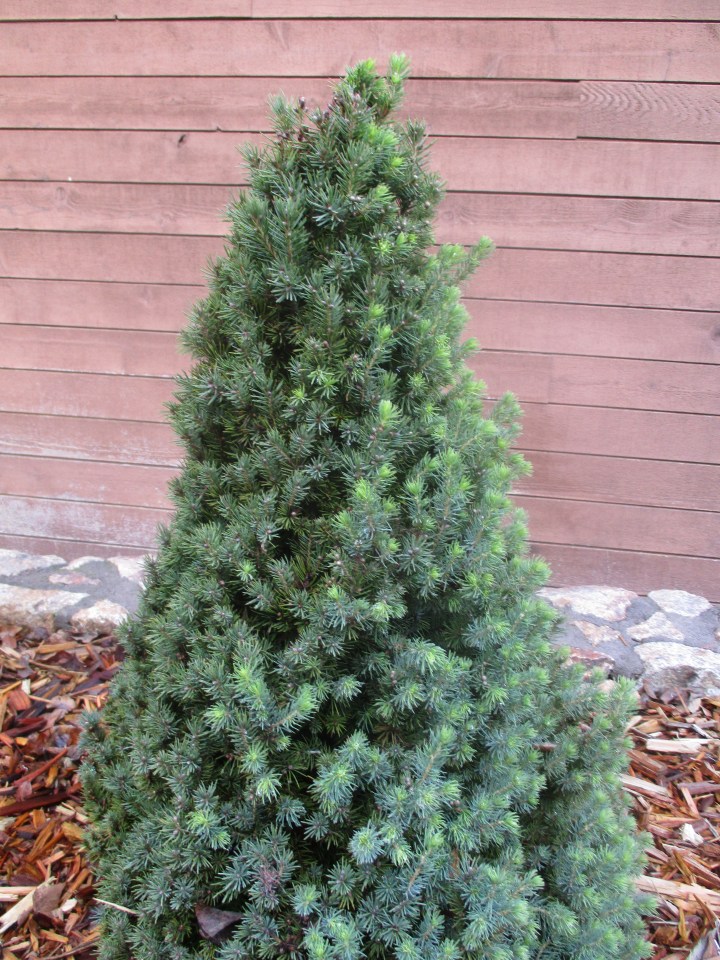
Those who insist on procuring a living Christmas tree should choose responsibly, and be ready to accommodate a growing young tree. Although not big enough to be real Christmas trees, dwarf Alberta spruce like those in the picture above are sometimes decorated as a small live Christmas tree. They happen to be conducive to confinement in proportionate pots. One in the ground, they grow like strictly conical shrubs that do not get big enough to cause problems.

Get Perennials Ready For Winter

81212thumbDilemmas are common in gardening. Should summer vegetables that are still producing be removed so that winter vegetables can get started on time? What about replacing summer annuals that are still blooming with winter annuals, and then replacing winter annuals with summer annuals half a year later? Should tender perennials be regarded as annuals, or get a second chance?

Right now, some perennials are looking tired. Many will be going dormant for winter. Many do not get much down time, and will start to develop new growth faster than old growth deteriorates. Not many make their intentions obvious. Deciding how to work with them can be confusing at times. It might take a few years and a few mistakes to get familiar with the habits and lifestyles of some.

If cut back too early, hardy zonal geraniums will not regenerate much until the weather gets warmer at the end of winter. In the interim, they are more likely to be killed by frost without the protection provided by old growth However, some varieties start to grow in winter. If not cut back soon enough, new growth mingles with old, so that they are difficult to separate when they do get cut back.

It is best to observe what hardy geraniums are up to before deciding on when to prune. If they start to develop vigorous new growth down near the ground, the old growth should probably be cut down as far as the new growth. It is likely better to take a chance that they might be damaged by frost. Those that do not start to grow right away can enjoy the insulation of old foliage for a while.

Thoroughly deciduous perennials, like deciduous daylilies, dahlias and some ferns, can be groomed of their deteriorated old growth without risk that they will start to regenerate new growth prematurely. However, cutting back some specie of salvia might actually stimulate development of exposed and frost sensitive new growth. Perennials that get damaged by frost later In winter should not be groomed of damaged growth right away. The damaged material provides a bit of insulation for lower growth, particularly if new growth was stimulated by the damage.

Being Cool Might Be Overrated

31218thumbThis really is the best climate for gardening. Even though summers are mild, there are not many plants that want for more warmth. Even though winters are mild, it gets just cool enough for many plants that require winter chilling. Yet, there are a few plants, particularly plants from tropical climates, that can be damaged by frost. The best way to protect such plants from frost is to not grow them.

Of course, this oversimplified technique would prevent the cultivation of familiar plants like banana, angel wing begonia and angel’s trumpet. In cooler regions, it might involve bougainvillea, philodendron and some types of citrus. Most of us would prefer to take some degree of risk to grow marginal plants. Some may get damaged by frost and then recover. Others may be killed by frost.

Potted plants can be moved to sheltered spots when threatened by frost. Some can be brought into the home or garage temporarily. For some, the simple shelter of a porch or a dense evergreen tree might be sufficient. Bougainvillea and other plants that do not like to be potted might prefer to be planted under the eaves against a warm south-facing wall. A bit of warmth radiates from walls at night.

During the coldest nights, some of the most sensitive plants that can not be moved to shelter may need shelter brought to them. Burlap, plastic, paper or any sort of sheeting that can be temporarily suspended on stakes above the foliage should be sufficient. Leaves that touch the sheeting can potentially get frozen. The sheeting should be removed during the day so that it does not get too warm in the sunlight.

Foliage that does get damaged by frost should not be pruned away immediately. It may be unsightly, but if left for later, it helps to insulate inner foliage and stems from subsequent damage from later frost. Besides, immediate pruning stimulates new growth that will be even more sensitive to frost than was the foliage and stems that had already been damaged.

Arborists Are Very Specialized Horticulturists

81205thumbThe first storm of the year has a way of reminding us if our trees need attention. Whether then need to be worked on this year or not, we tend to notice how they blow in the wind, or if they are full of dead and deteriorating debris that falls into the garden or onto the roof. As deciduous trees defoliate, they are less likely to be damaged by wind, but their structural deficiencies become visible.
This is when some of us will contact arborists to inspect and perform necessary arboricultural procedures for trees that have grown to big for us to maintain. We do not want trees to be damaged by the wind. Nor do we want them dropping limbs or falling onto whatever is within their reach. Those that are biggest and most beyond our reach have the most potential to cause major damage.
Arborists are horticulturists who specialize in the horticulture of trees, which is known as arboriculture. They assess the healthy, stability and structural integrity of trees, then prescribe necessary corrective arboricultural procedures, and if necessary, prescribe the best time for such procedures. Most arborists work with a tree service that is equipped to perform the prescribed procedures.
Arborists who are certified by the International Society of Arboriculture, or ISA, have passed an examination of their arboricultural expertise, and maintain their credential by continued involvement with the educational seminars, classes and workshops of the ISA. More information about the ISA, local certified arborists and even arboriculture, can be found at the website http://www.isa-arbor.com.
As mentioned earlier, arboriculture is specialized horticulture of trees. It is not something that gardeners should be expected to perform; particularly mow, blow and go gardeners who are not even proficient with simple gardening. Many arborists can concur that unqualified gardeners sometimes kill trees, and cause much of the damage to trees that arborists must later correct. Besides, arboriculture is the sort of work that can be very dangerous to those who lack training, experience or the necessary equipment.