Groundcover Is Carpeting For Landscapes

80912thumbIf shade trees are the ceilings, and hedges and shrubbery are the walls, then turf and other groundcover plants are the floors of some of our outdoor living spaces. Except for turf grasses, most groundcovers are not as useful as hardscapes like pavement and decking, but they perform other functions in areas that do not get such use. Groundcovers inhibit weeds, erosion, dust and mud.
Turf grasses used for lawn are of course the most popular groundcovers, and are a separate topic from other groundcover plants that grow over unused or lightly used ground. Because they need not tolerate traffic, these other groundcover plants need not be as resilient, or as flat as turf grasses are. They can be perennials, vines or low sprawling shrubbery. Most, but not all are evergreen.

Groundcover plants work something like mulch, although most want to be watered. They inhibit weed growth by occupying the space that weeds want. Many hold soil together with their roots. They may seem like they would compete with other plants, but groundcover plants insulate the soil, which makes it more comfortable for other plants. Many retain more moisture than they utilize.

Gazanias and iceplants are two of the most popular perennial groundcovers. They tend to replace their own growth regularly as old stems decompose below new growth that spreads over the top. They therefore do not get very deep. Some gazanias eventually develop bald spots. When they get trimmed around the edges, the scraps can be plugged back into bald spots as cuttings.

Cultivars of myoporum, cotoneaster, ceanothus, rosemary, juniper and other low and sprawling shrubbery that make good groundcover must not be confused with cultivars that grow as upright shrubbery or even trees. There is a big difference between creeping myoporum that stays less than a foot deep, and shrubby myoporum that can get almost thirty feet tall! Also, vines used as groundcover, like ivy and honeysuckle, should be maintained as such, and not allowed to climb trees, shrubbery and other landscape features, like vines naturally want to do.

Flowers Might Be Getting Scarce

70830thumbIt makes sense for flowers to bloom in spring. Winter is too cool, windy and damp for both flowers and the insects that pollinate many of them. By summer, successfully pollinated flowers have faded, are busy making seed to disperse in autumn. Some plants produce fruit to get birds and other animals to disperse their seed. There are certain advantages to blooming early in the spring.
Native plants that are endemic to chaparral climates are quicker with bloom, so that they finish before the air gets too arid. Desert plants might bloom for less than a week. Some tropical plants might bloom whenever they want to because they do not understand the concept of seasons, but they are not the prominent plants in our gardens. Therefore, flowers get scarce this time of year.

Besides the few perennials and annuals that bloom as long as the weather stays warm, there are not many plants that bloom reliably so late in summer. Belladonna lily, which is also known as naked lady, might be one of the flashiest, as its bright pink flowers bloom on top of bare stalks before the low basal foliage develops. It was actually dormant through the warmest part of summer.

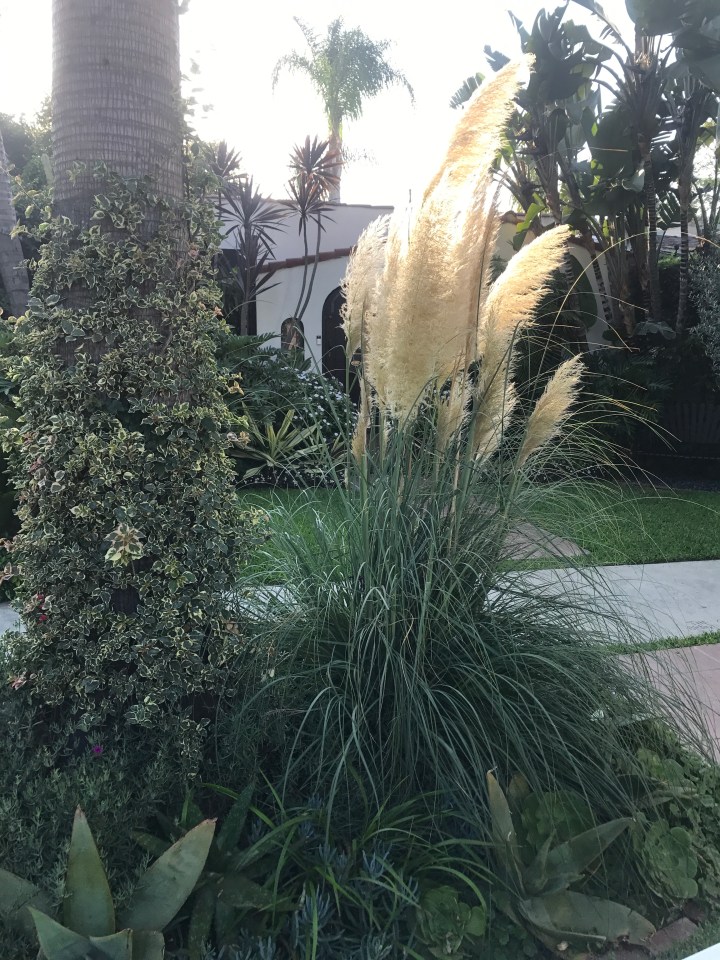
Billowy and bold pampas grass flowers bloom this time of year, but are uncommon. The boldest type of pampas grass is too big and difficult to manage for home gardens. The smaller type has dingy tan flowers, and is so invasive and weedy that it is unavailable in nurseries. Those of us who have it in our gardens did not plant it. Other grasses with nice late flowers are not very colorful.

Russian sage has become one of the more popular late blooming perennials. More traditional Japanese anemone, goldenrod, lion’s tail and showy stonecrop all seem to have lost popularity over the years. Mexican blue sage should bloom best late in summer, but often finishes sooner than expected. Yarrow often blooms later than expected, until summer ends. Marigold, blanket flower and some sunflowers bloom until frost. Chrysanthemums, whether grown as annuals or perennials, are just beginning late in summer.

Flowers For Late Summer Bloom

80905thumbNo mater how much work we put into our roses to sustain bloom all through the season, and not matter how successful we are with that endeavor, the first spring bloom is always the best. Some roses continue to bloom in floriferous phases afterward, while others bloom sporadically but continually; but there is nothing like the first bloom phase. The last blooms are just waiting for autumn.

Of course, concentrating resources into early bloom is very sensible. That is why so many plants bloom only once in spring. It gives them time to get pollinated, develop seed and fruit structures, and finally disperse their seed or fruit structures, all before winter. Plants that bloom in summer or autumn are either from regions where winters are not too harsh, or where summers are harsher.

Because summer weather in most regions tends to be warmer and drier than spring weather, flowers that prefer to bloom in summer tend to be more prolific but smaller and less colorful. By this time of year, they are more reliant on wind for pollination rather than insects anyway. Therefore, they do not need to be big and colorful to attract pollinators, although some are fragrant just in case.

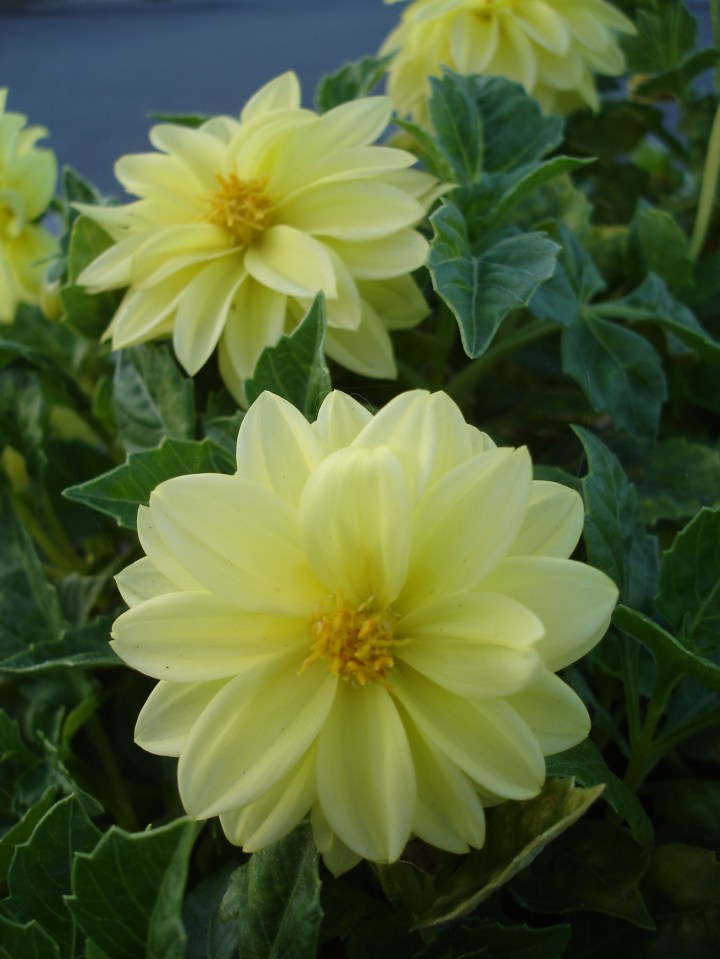
Sunflower, blanket flower, cone flower, zinnia, cosmos, delphinium, dahlia and of course rose, are some of the favorite flowers in the garden as well as for cutting in late summer and into autumn. Cut dahlia flowers should get their water changed daily so that they do not rot and smell bad so soon. Canna blooms about now, but does not last so well as cut flowers. Lily-of-the-Nile is finished.

Believe it or not, lemon bottlebrush is a delightful cut flower for those who are not allergic to it or repelled by the aromatic foliage. So are some of the showier eucalyptus, such as the red flowering gum, Eucalyptus ficifolia. Mexican blue sage that was cut back to the ground over winter blooms a bit in spring, takes a bit of time off through summer, and then starts to bloom as summer ends, ultimately blooming spectacularly early in autumn. A few other sages bloom as late, but few are good for cutting.

Herbs Are For All Seasons

70823thumbThere are only four seasons in which to grow herbs, but herbs are used for all sorts of seasonings. Most herbs are aromatic evergreen foliage. Some might be flowers, flower buds, stems, bark, seeds, roots or really any plant part. Those with the strongest flavors might be classified as spices. Herbs are used for culinary purposes. Many might be used medicinally. Some just smell pretty.
Most herbs are best fresh, like mint, chive, cilantro and parsley. Bay leaf and lavender are herbs that are more commonly used dried rather than fresh. Sage, rosemary and oregano can be used either dried or fresh, depending on the desired effect. Yet, for many of us, dried herbs are used merely because of convenience. They are available when their fresh versions are out of season.

Many gardening texts suggest that herbs that need to be dried should be collected and dried about now. That is true in the sense that most happen to be ready about now. Some might have been better earlier in the year. A few might need to mature a bit more. There are probably many that get collected and dried when it is convenient for us, or when overgrown plants need to be pruned.

Vegetative rosemary stems should be collected before they bloom again. Obviously, that might not be right now. It blooms in random phases. The trick is to catch it between phases. Lavender flowers get collected as they finish bloom. Oregano is an odd one, since the vertical stems with flower buds on top get cut for drying while the sprawling growth on the ground is good for fresh use.

Because rosemary is available throughout the year, it is not often dried. Even while in full bloom, there is plenty of foliage to go around. When it gets dried, it is probably because the dried flavor is preferred for a specific recipe. Other herbs are likely to be dried because they are not available during part of the year. Many herbs are annuals or perennials that die back through the winter. Drying the last bits of cilantro may not seem like a good idea now, but might be useful in winter.

Where The Green Ferns Grow

80829thumbThe list of what ferns will not do is more noteworthy than the list of what they will do. They do not bloom with colorful or fragrant flowers. The do not produce fruit. Very few turn color in autumn, and their color is generally nothing to brag about. Most ferns will not maintain their appeal through drought, or if neglected too long. Nor will they tolerate heat and wind, especially in full sun exposure.
Yet ferns are still popular for what they ‘will’ do. They provide remarkably distinctive and stylish foliage. They survive in spots that are too shady or perhaps too damp for other plants. Ferns will be quite happy in pots or planters, and some are happy to grow as houseplants. Ferns somehow avoid getting eaten by deer. If a fern gets tasted by a deer who does not know better, it will survive.

All ferns are perennial. Most are evergreen. Their foliage arches upward and outward from the terminal buds of stout rhizomes. Some ferns develop dense foliar rosettes. A few develop trunks by growing vertically instead of horizontally, and dispersing roots downward through their own decomposing fibrous rhizomes. Many ferns will get quite broad. Many are quite delicate and diminutive.

Ferns may not require too much maintenance, but the little bit of maintenance they require is somewhat important to keep them looking tidy. Old foliage should be pruned away as it is replaced by new foliage. This may be as simple as pruning away all old foliage just after new foliage develops early in spring. For some ferns, small batches of old foliage might get removed through the year.

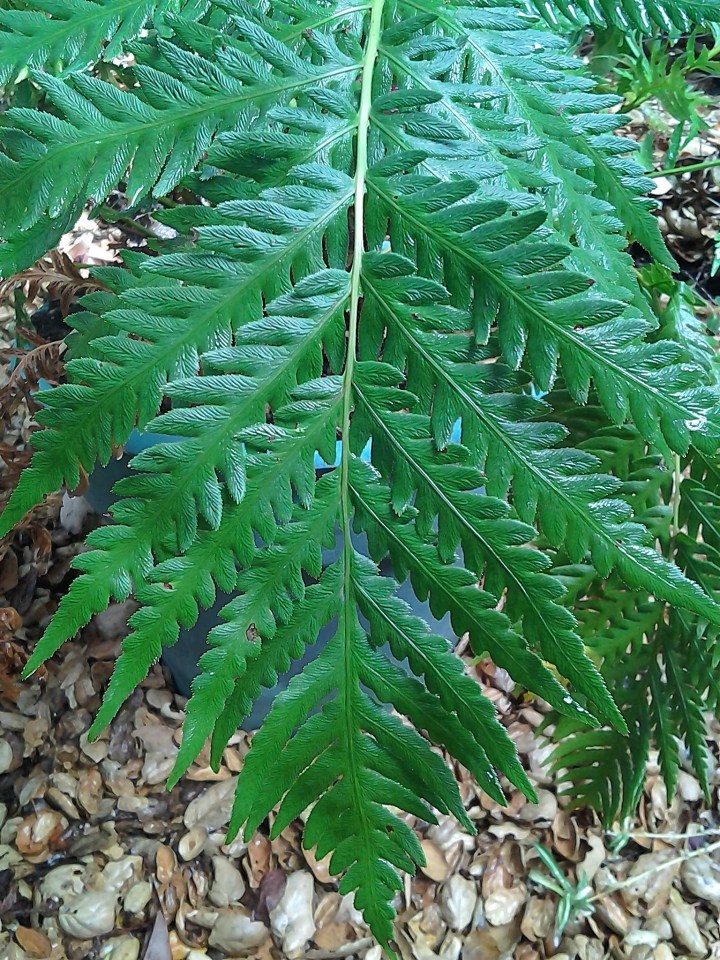
The foliage of ferns is comprised of leaves known as ‘fronds’. With few exceptions, the fronds of ferns are intricately lobed or divided into smaller leaflets known as ‘pinnae’. (‘Pinna’ is singular for pinnae.) These pinnae are arranged on opposite sides of fibrous leafstalks known as ‘rachi’. (‘Rachis’ is singular for rachi.) Rachi are quite fibrous and tough, so should be cut close to the ground with pruning shears when they get groomed, rather than plucked.

How Shade Is Made

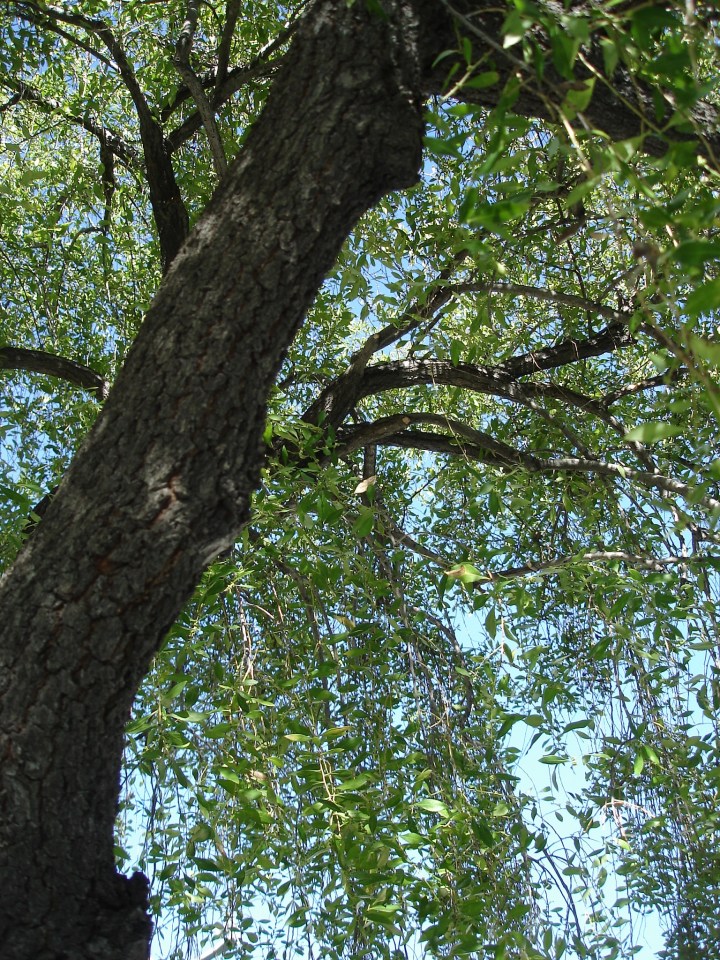
70816thumbMany of our trees live at our homes longer than we do. Some of our trees were there before we got there. Some of the trees we plant will be there for whomever comes along after we are gone. Trees very often evolve into something very different from what they were intended to be. Nonetheless, since they are the most significant features of our gardens, trees must be selected carefully.

The recommendation that shade trees near the home should be deciduous is cliché but accurate. It makes sense that the trees that provide cooling shade in summer will also allow warmth and light through while bare in the winter. Evergreen trees are better for obscuring undesirable views around the perimeter of the garden, where they will not shade the home too much through winter.

The problem is that many modern gardens are too small for such diversity. Modern homes are so close to each other that evergreen trees are more important for obscuring views. Consequently, evergreen trees that provide privacy between homes and gardens might also function as shade trees. Limited space also means that trees affect neighboring homes and gardens significantly.

This is why so many of the small trees (that are known almost disdainfully by some arborists as ‘microtrees’) are so popular. Japanese maple, flowering cherry and smoke tree that were once popular for atriums and small enclosed gardens are now popular shade trees. Realistically though, some modern backyards are not much bigger than what was once considered to be an atrium.

Small evergreen trees or large shrubbery, like Australian willow, mayten, photinia and the larger pittosporums, work nicely by providing both privacy and shade for small areas. Contrary to popular belief though, evergreens are generally messier than deciduous trees. They drop small amounts of foliage throughout the year instead of dropping most or all of their foliage within a limited season. Flowers or fruit add another dimension of mess, even for deciduous trees like crape myrtle, flowering crabapple and saucer magnolia.

Seasons Are Constantly In Flux

80822thumbGardening requires planning. There is always planning. The vegetables that are getting harvested now are developing mostly on plants that were put out in the garden early last spring. Some of those plants were grown from seed sown even earlier, late last winter. Now that it is more than halfway through summer, it is time to plan for cool season vegetable and annuals for next autumn.

There is still no need to rush cool season vegetables and flowering annuals that will be purchased as small plants in six packs or four inch pots. They are only beginning to become available in nurseries, and get planted a bit later. Broccoli, cauliflower, cabbage and kale are popularly purchased as small plants because not very many are needed, and they are reasonably inexpensive.

However, if varieties of these vegetables that are not expected to be available in nurseries are desired, they must be purchased as seed. If space allows, they can be sown directly into the garden early in September. Otherwise, they can be sown now into flats, six packs or small pots to grow into small plants that will be ready when warm season plants relinquish their space later in autumn.

Root vegetables like beets, turnips and carrots should not be grown or purchased in flats or pots. They get disfigured by transplant. Therefore, they should be sown directly into the garden through September. Carrots should perhaps be delayed until halfway through September. Turnip greens and leafy lettuces should be sown directly as well just because they get distressed from transplant.

Almost all cool season vegetable plants can be grown in phases, or several small groups planted every two week or so, in order to prolong harvest. Those planted first develop and are ready for harvest first. By the time they are depleted, the next phase should be ready. However, because most cool season vegetables develop somewhat slowly, and individual plants within each group develop at variable rates, planting only one early phase, and one late phase, perhaps with another phase in between, might prolong harvest more than adequately.

Division Is Equal To Multiplication

70809thumbMathematically, division is the opposite of multiplication. Horticulturally, they are the same. Digging and splitting overgrown perennials to propagate them is known as ‘division’ because it divides many rooted stems or rhizomes of one plant into many new plants. Division is a form of propagation; and propagation is commonly known as multiplication. So, we divide plants to multiply them.

Autumn is generally the best time for panting. It is after most of the warmest and driest weather, and just before the cool and rainy weather that keeps newly planted plants from getting too dry. It seems obvious that autumn would also be the best time for division. However, a few perennials that are dormant or mostly dormant by the middle of summer can be divided now for an early start.

Bearded iris may not look dormant with their leaves still green, but they are about as dormant now as they will get. If divided now and allowed to slowly disperse roots through the remainder of summer, they can prioritize the production of new foliage when they come out of dormancy in autumn, like they would do naturally. Like many perennials in mild climates, they grow through winter.

Once dug, the plump rhizomes need to be separated from the old shriveled rhizomes that they grew from. For most, the best segments of rhizome are between the leafy tips and the stalks of the flowers that bloomed earlier this year, although it may not be easy to see where floral stalks were attached. The older sections of rhizome behind the flower stems are probably shriveled already.

The freshly divided segments of rhizome should then be groomed of deteriorating old leaves. Remaining green leaves can be cut in half to remove drying tips. Rhizomes then get replanted just below the surface, with the perpendicular fans of foliage standing upright. The main difficulty with dividing iris now is that they will need to be watered until the rain starts late in autumn. Bergenia, lily-of-the-Nile and a variety of perennials with big rhizomes get divided in a similar manner.

Think Outside The Nursery Pot

80815thumbA dressed turkey that is packaged for retail sale in a supermarket is not ready to be eaten right away. If frozen, it must be thawed slowly. It must then be unwrapped; and little bag of giblets must be removed from inside, before the turkey gets stuffed and finally cooked. Although the inexperienced sometimes cook a turkey with a giblet bag still inside, doing so is not the correct procedure.

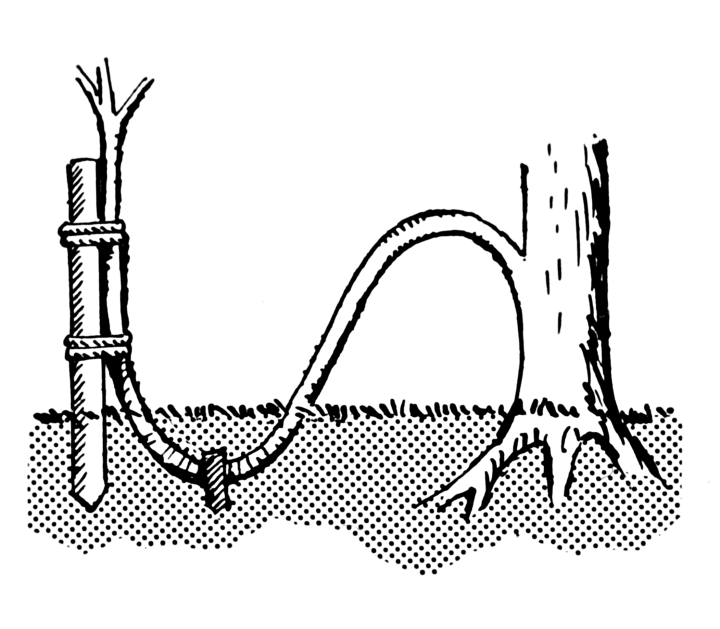
Plants that are purchased in retail nurseries are similarly packaged in such a manner that facilitates transportation from production nurseries to retail nurseries, and from retail nurseries to home gardens. Their roots are contained in vinyl cans. Larger trees might be boxed. Occasionally, balled and burlapped plants are available. Most trees and vines, and some tall perennials are staked.

Vinyl cans, which are also known as nursery pots, are designed for growing nursery stock in, and containing the stock as it is transported. That is all they are designed for. They are not meant to be used as planters in home gardens. Most young and actively growing plants that tolerate them in production nurseries really do not want to be confined to vinyl cans any longer than necessary.

Even if plants that are brought home from a nursery are to be grown in pots, they should be planted into more appealing pots that are designed for the comfort of the plants within, and not just left in the nursery pots that they were grown in. Clay pots and wooden planters are comfortably porous and better insulated than thin black vinyl that gets dangerously hot if directly exposed to sunlight.

Alternatively, nursery pots can be shaded and obscured within slightly larger pots, within groups of other pots, or by settling them into shallow shrubbery or deep ground covers temporarily. Plants that are big enough to provide their own shade are likely too big for their nursery pots. Invasive plants like mint are often grown in nursery pots that are buried almost to the rim in the ground, although mint eventually escapes through drainage holes. It is good to know the limitations of what nursery pots are useful for.

Easements Really Should Be Easier

70802thumbLike Michael Jackson said, “You got an easement on down the road.”. . . or something like that. In older neighborhoods, that is where the utility easements are usually located. These are zones for utility poles that suspend electrical, telephone and television cables. When electricity first became available, that was the easiest place to put the cables, and the practice continued for decades.

Utility easements in middle aged neighborhoods are usually at the rear boundaries of back yards. They were put there to get out of the way of shade trees in front yards, particularly street trees. Where there are alleys in back, easements are on one side of the alley or the other. The same applies to narrow streets with easements. More modern neighborhoods have subterranean utilities.

Those of us who must contend with easements know how difficult they can be. Trees that encroach too closely to the high voltage cables on top of the poles must be pruned for clearance, even if such pruning disfigures or kills them. Lower cables for telephone and cable television sometimes get tangled with vines or big shrubbery because clearance from vegetation is not such a priority.

Utility providers have access to easements to maintain their systems. So do the tree services that have the grim task of pruning encroaching vegetation for clearance from high voltage cables. They do what they must to maintain reliable service; which is unfortunately not always compatible with what we want for our trees. Clearance pruning is too often unsightly, but it is very necessary.

The only way to avoid unsightly and disfiguring clearance pruning to to only plant trees that will not encroach into high voltage cables. Of course, in small gardens with big easements, the choices of trees that stay proportionate to available space are very limited. Except for Mediterranean fan palm or palms that stay very short, palms should never be planted below utility cables. They grow only upward, and can not be pruned around cables, so must be removed when they get too close.