Six on Saturday: Too Much Autumn Color IV – Uncategorized Exotics


These are the last six of the twenty four pictures of autumn foliar color that I got before the rain knocked so much of the foliage to the ground more than a week ago. #2 is the only picture of foliage that is on the ground instead of still suspended on the stems that produced it. The fallen birch leaves were just too pretty on the stone wall to not get a picture of them.

1. Japanese maple is not my favorite species, but it does have certain attributes. There happen to be several at work just because they happen to work well there. Some that do not typically develop good color got remarkably colorful this year. I believe that this particular Japanese maple is the common ‘Bloodgood’. It had been dark reddish bronze through summer, and then turned brighter red for autumn.P81222

2. European white birch is grown for the elegant white trunks that contrast so nicely against the deep green of the redwoods. This autumn foliar color, although brief, is an added bonus. These trees were already starting to defoliate before the rain.P81222+

3. Hydrangea is not known for autumn foliar color, and as you can see, turns only pale yellow. Yet, it is striking in the shade, and contrasts nicely with the rich green of redwood and English ivy foliage.P81222++

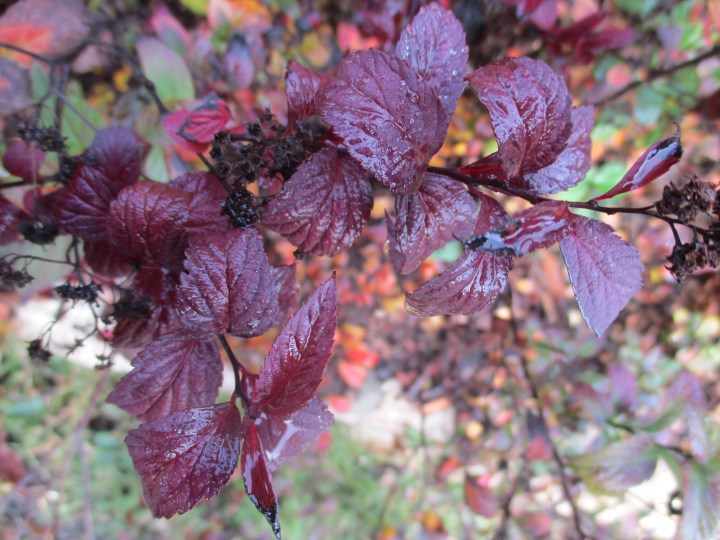
4. Spirea is likewise not grown for autumn foliar color, or at least no so much in our mild climate. There are more than a dozen of them here, and none are doing very well. They will get cut back and groomed now that they are bare. I do not know what cultivar this particular spirea is.P81222+++
5. Golden weeping willow was not only golden with autumn foliar color, but is still golden with the yellow bark on the twigs. So far, I am not too impressed with the yellow twigs. It is still a small tree, and growing in a mild climate that may not stimulate much color. Regardless, I happen to like weeping willows. This one happens to be in a swampy spot where it is quite happy.P81222++++

6. Bald cypress is rare here, but there happens to be two at work. One was supposed to be a dawn redwood, but was obviously mislabeled. Fortunately, it just happened to be planted on the bank of a small creek where it gets plenty of water. The other was planted in an area that is too swampy for other trees. Both are doing quite well. When they defoliated, they covered the ground with finely textured needles that would have been impossible to rake up.P81222+++++

This is the link for Six on Saturday, for anyone else who would like to participate:

https://thepropagatorblog.wordpress.com/2017/09/18/six-on-saturday-a-participant-guide/
Six on Saturday: Too Much Autumn Color III – Cherries, Berries, Plums, Apples, . . . & Ginkgo


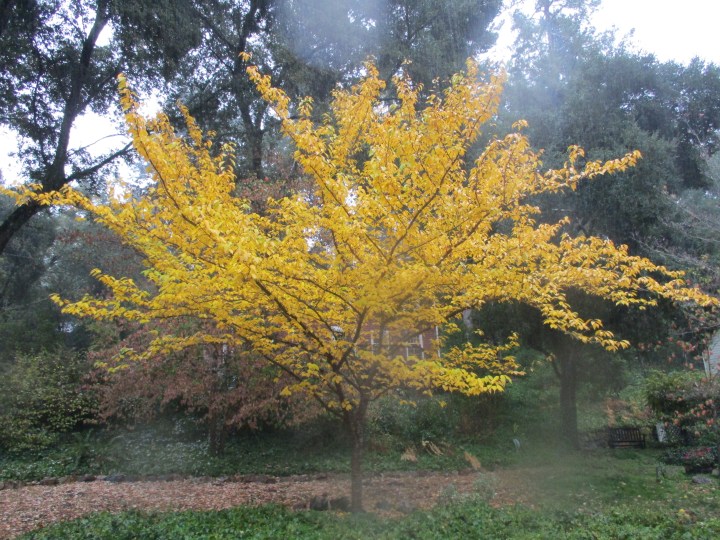
Autumn foliar color, fall color, autumn leaves or whatever you know it as; there was too much of it to fit into just six pictures. That is why I submitted two ‘Six on Saturday’ posts last week, and why this one is number ‘III’, and why there will be a number ‘IV’ right afterward. Only one reader expressed concern that submitting two posts to ‘Six on Saturday’ on the same Saturday is a violation of the rules, but I got the impression that even he did not mind. These pictures, as well as the next six, were actually taken more than a week ago, which might violate another rule. If you are seeing them now, I have not yet been prosecuted, and compelled to delete them. Much of the foliage was knocked to the ground by rain since the pictures were taken. The apple tree #4 was pruned back severely, and is now completely defoliate. The title ‘Cherries, Berries, Plums, Apples, . . . & Ginkgo’ implies that all but one are fruit trees; but they aren’t. Well, you can see what I mean.

1. Yoshino flowering cherry, which I know as ‘Akebono’, just might be the most traditional of the Japanese flowering cherries in America. It is the classic cherry blossom tree around Washington D. C.. As flashy as the bloom is, it is sterile; so the trees are fruitless. You can not see it, but the home in the background is of classic Early American architecture. It is a family home, so is too big for my taste. It would otherwise be my favorite home in the neighborhood.P8215

2. Kwanzan flowering cherry is the second most popular flowering cherry in our region. The big pink double flowers are a bit too garish for my taste, but they really are flashy! Like the Yoshino cherry, the Kwanzan cherry is fruitless.P8215+

3. American plum is not native here, but naturalized. It was and probably still is a common understock for quite a few of the stone fruits. It often grows from the roots of a stone fruit tree that got cut down to the ground. It makes small tart plums that are not much bigger than fat cherries, but not many of us use them for anything. Garden varieties of plum and cherry are naturally more desirable. I Intend to use American plum for jam, but I always get out to pick them after they have fallen to the ground and gone bad. You may have noticed that the first three subjects are of the same genus, Prunus.P8215++

4. Apple happens to do very well in our region. The old apple trees on the farm are remnants of an old orchard. Others in the neighborhood are from old farms. This one is on the edge of a sidewalk where it was not likely planted intentionally. It likely grew from a seed from a discarded apple core. It does happen to make apples, but they are no good. I just cut this tree back severely. If the apples are still no good next year, the tree might get cut down.P8215+++

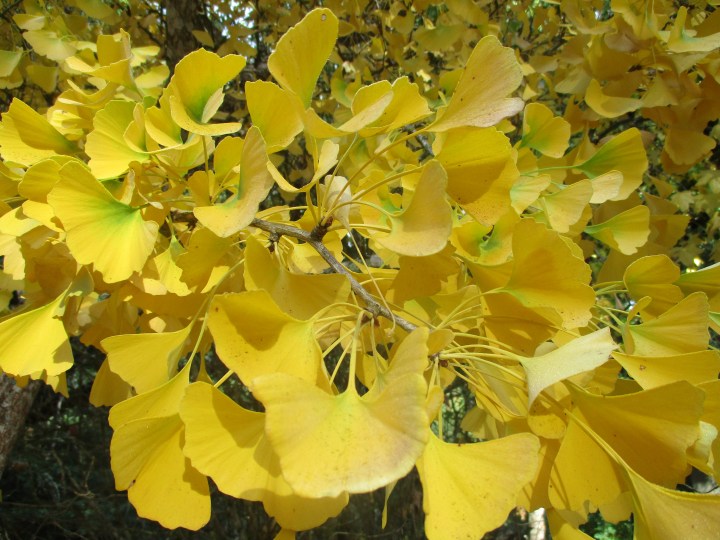
5. Ginkgo is an ornamental tree here. Because those of us who do not want the fruit find the stinky aroma and mess to be objectionable, garden varieties are all male, and therefore fruitless. However, in some cultures, ginkgo is grown both for fruit, and for the nuts within the fruit. There are a few female trees in older neighborhoods here. They were grown from seed before all male garden varieties were developed. Back then, there was no way to determine the gender of a ginkgo tree until it started to develop fruit . . . or hopefully didn’t.P8215++++

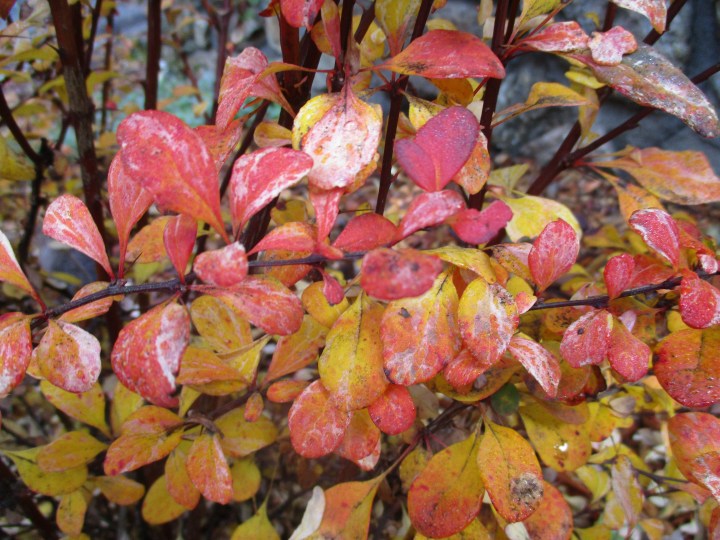
6. Barberry is strictly ornamental. I have never actually seen a bar’berry’ fruit. This particular unknown cultivar happens to be bronzed, with very dark foliage that turns bright yellow and orange for autumn. It is very thorny!P8215+++++

This is the link for Six on Saturday, for anyone else who would like to participate:

https://thepropagatorblog.wordpress.com/2017/09/18/six-on-saturday-a-participant-guide/

Horridculture – Lack Of Planning

P81128+This is a recycled picture that still annoys me. There was another that I did not want to use because it happens to be from a landscape that I sometimes work in.
The picture that I did not use shows a variety of annuals in a half wine barrel that is set on cobble stone that fills a square that is about five feet by five feet that was cut out of an asphalt paved area.
So:
The area was paved to function as a patio.
A square was cut into the pavement perhaps because there was too much pavement.
The square was filled with stone because there was too much exposed soil where there should have been pavement.
A half wine barrel of various annuals was installed on top of the stone as if a square filled with stone was not adequately in the way.\
The half wine barrel and stone should be removed so that the are can be paved as usable patio space. . . like it had originally been.
It reminds me of a monologue by the renowned comedian, Bill Cosby. He discussed the small compartment that is designed to keep butter from getting too cold within a refrigerator that is designed to keep food cold, within the home that is heated to keep the interior from getting too cold.
Now, back to the picture above. It annoys me even more because it is not the result of a series of mistakes by several different volunteers working in the landscape that I did not post a picture of. It was done by so-called ‘professionals’, like those I briefly worked for a few years ago.
The area was paved. I might add that it was paved quite well. Then, either because there was too much pavement, or because someone wanted to sell more junk, potted plants and the associated irrigation system were installed onto the pavement, so that the affected portion of pavement is now useless.
How does this makes sense? It should have been done properly when the pavement was installed only a few years ago. I would guess from looking at it that the pavement was done properly, but someone just wanted to sell more infrastructure.
The bigger urn in the foreground is planted with pink jasmine on a trellis. I explained the problem with the vine not getting released from its bindings last week. https://tonytomeo.com/2018/11/28/horridculture-well-done-stakes-are-rare/ Not only does a bundled thicket of stems remain in the middle, but all the new growth is crowded on top of the trellis because the landscape ‘professionals’ planted a big vine on a tiny trellis, and then neglect to maintain it. What is the point of a trellised vine in the first place? I mean, what does it ‘do’? Wouldn’t something shrubbier or a cascading perennial have been more appropriate? Do we really want to see the bare soil and accumulated cigarette butts below the vine? What about the landscape behind the potted plants? Why obscure that? Why create more obstacles for those who sweep or blow debris from the area.
Just look at all the pointless infrastructure in this useless space. Rather than a nice well designed landscape adjacent to clean and usable pavement, we have pointless potted plants cluttering the area, leaking water that stains the now useless pavement, and just getting in the way!

The Humongous Fungus Among Us

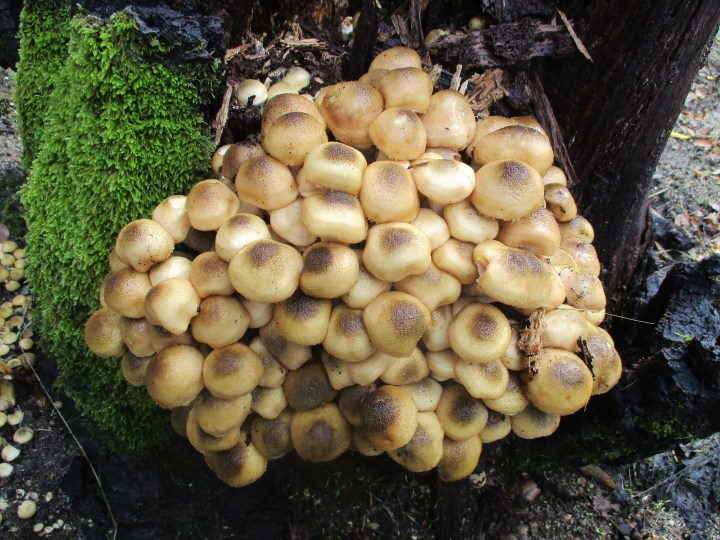
04Is this Armillaria mellea, the dreaded oak root rot fungus? I really do not know. All the elements are here. The stump is that of a coast live oak. Bellow the stump there are the remains of roots. Those necrotic roots are undoubtedly decomposing as a result of rot. That rot is undoubtedly associated with this fungus. Furthermore, it fits the description of oak root rot fungus. The toasted spots were probably caused by weathering as the mushrooms started to develop while the weather was still warm and dry.

Now that the soil and rotting wood are damp from rain, this fungus is really proliferating. The individual mushrooms within the soccer ball sized mass were only about as big as those at the lower left margin of the picture just prior to the rain. They do not last long, and might become gooey black slop after only a few sunny days. The stump may continue to rot for a few more years. It is out of the way, so there is not need to get rid of it.

It annoys me when landscape professionals tell me that a particular spot in the region has oak root rot fungus. Of course it does. It is everywhere. It is quite natural here.

Oak root rot fungus is justifiably dreaded. It can easily kill the most majestic oaks that have survived for centuries.

However, most of the problems with oak root rot fungus in landscape situations are caused by supplemental irrigation and other gardening techniques. Oaks that have survived on natural seasonal rainfall for centuries are much more susceptible to rot if their roots are kept continually moist by the irrigation needed to sustain other plants added around them. Roots that get severed for the installation of pavement or building foundations are likewise much more susceptible to rot, particularly in spots where drainage from roofs or paved surfaces enhances soil moisture.

For this particular pathogen, gardening is more often the problem.

Crape Myrtle Finale

P81201KIt is certainly not my favorite small tree. Actually, in most situations, I rather dislike it, which is why I sometimes accidentally spell it without the first ‘e’. It is a cop out; a micro tree that too often ends up where a larger and more respectable tree would be more appropriate. They are not shade trees. They are not not big enough for freeway landscapes or to be street trees on wide boulevards. They are not immune to diseases and insect infestations; and they commonly drop honeydew from aphid or scale infestation, and lose their bloom to powdery mildew. They are not ‘low-maintenance’, and really should be pruned more than they are, but will get you in trouble with the neighbors if you prune them as aggressively as they should be pruned.
They are popular because of their potential for remarkably flashy bloom, and because they do not get big enough to damage the sidewalks and curbs that they are so often planted next to. ‘Gardeners’ like them because they survive their neglect. That is no long list of attributes; but there is one more.
FALL COLOR! On a bad year, they merely turn bright yellow. This year, some are this exquisitely bright orange with a slight red blush. The various cultivars display various colors, so some are more colorful than others. They are also on different schedules, so the most colorful are not necessarily the most colorful every year. Those that colored early are already bare, but could be the most colorful next year if the weather turns cold early. A bunch in town that are also defoliating as fast as they color because of the recent rain, could be the most colorful next year if rain is delayed later than it was this year.P81201K+

Six on Saturday: Too Much Autumn Color II – Natives & Exotics


Now we have a bit more variety than the last batch of six.

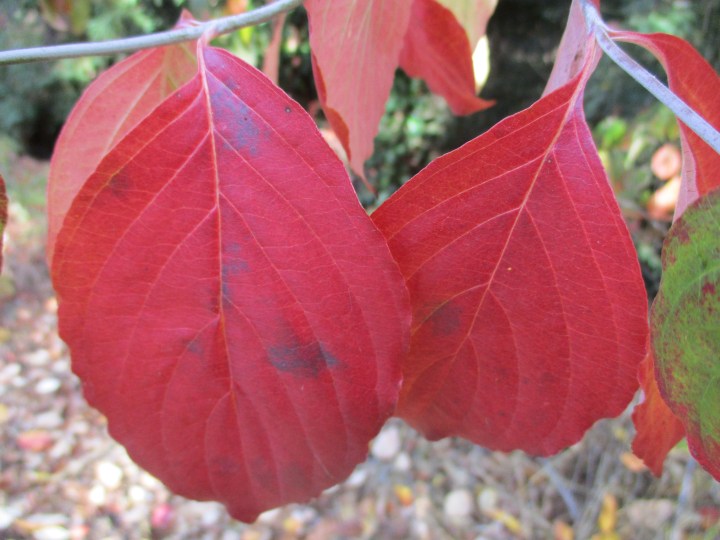
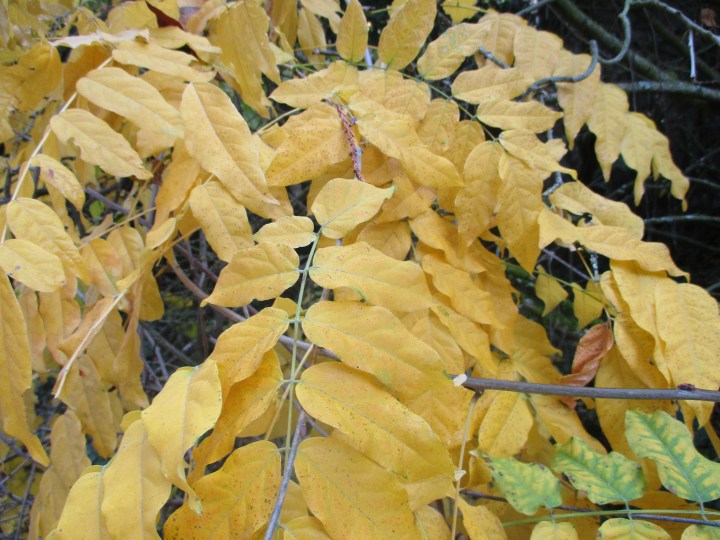
Red stem dogwood of the first and second pictures is the only species that is locally native. The California currant of the fourth picture, and the California black walnut of the fifth picture are both as native to California as the names imply, but are not native locally. The flowering dogwood of the third picture is from Eastern North America. You can guess the origin of the Chinese wisteria of the sixth picture, which happens to be the only vine represented in all four groups of six pictures.

The first three of the six pictures, or half, are of dogwood. The first two pictures are the only two in all four groups of six pictures that are the same species, namely red stem dogwood. Both were posted just to demonstrate that red twig dogwood, which typically turns only pale yellow like the foliage of the first picture, can develop a bit of red foliage like that of the second picture, if conditions are just so. Both the red stem dogwood of the second picture, and the flowering dogwood of the third picture, are the first two examples of red foliage from my four groups of six pictures. In the next two groups of six pictures, there is only one other example of bright red foliage, as well as an example of brown foliage, and an example of irregularly bronzed orange foliage. Those are topics for next week.

1. red stem dogwoodP81208

2. red stem dogwoodP81208+

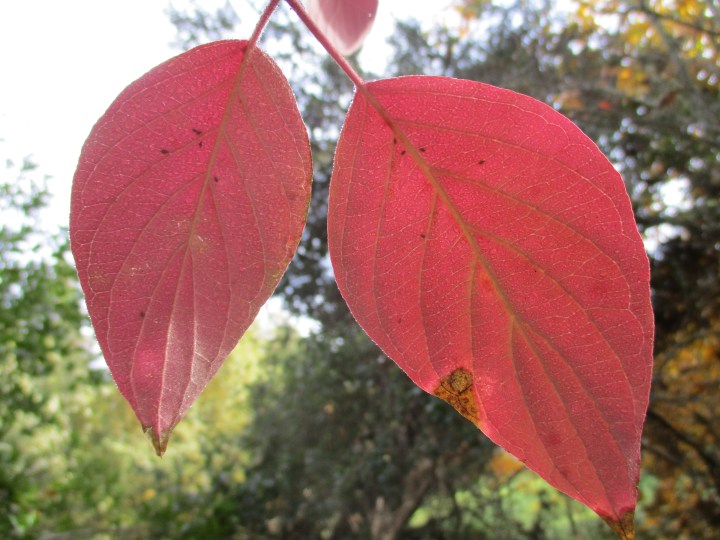
3. flowering dogwoodP81208++

4. California currantP81208+++

5. California black walnutP81208++++

6. Chinese wisteriaP81208+++++

This is the link for Six on Saturday, for anyone else who would like to participate:

https://thepropagatorblog.wordpress.com/2017/09/18/six-on-saturday-a-participant-guide/

Six on Saturday: Too Much Autumn Color I – Natives


The merely adequate color among the sweetgums early in the season suggested that color would be insipid this year. Then, the weather did something that set it all off. There was too much autumn foliar color this week to select just six pictures. So, I didn’t. These six are only the first of four groups of six. It would not be practical to post a group weekly for four weeks, particularly since some of the colorful foliage in these pictures was dislodged by generous rainstorms shortly after the pictures were taken. There will be very little foliage left by the time the last group of six posts. Instead, two groups of six will be posted presently, and the other two groups of six will be posted next Saturday, before they are two weeks old. I hope this does not violate any rules.

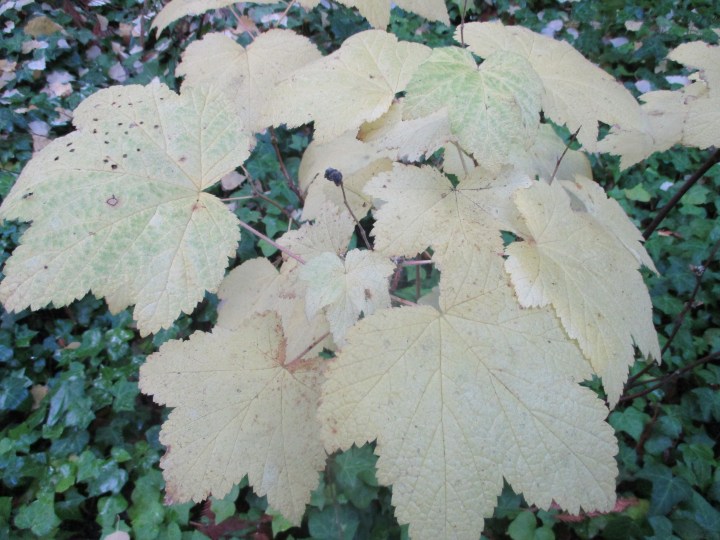
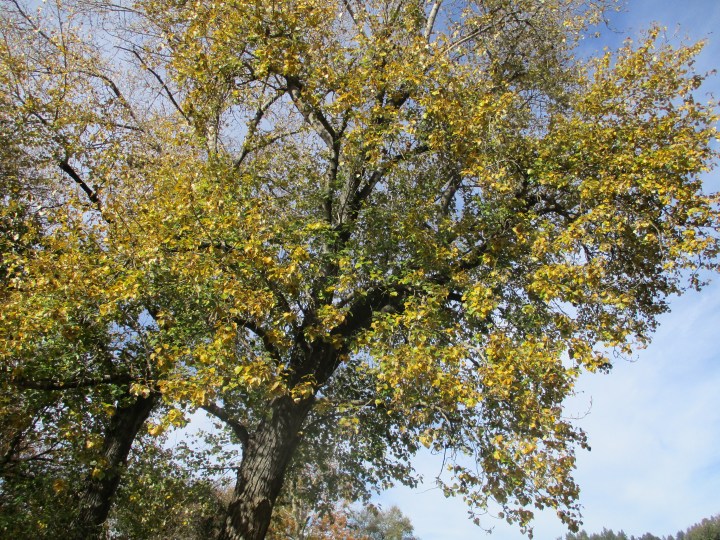
All six specie in this first group happen to be locally native. They are also all yellow, which is the standard color here. Regionally, there is not much orange or red. The thimbleberry in the first picture is rather pale yellow, but that is more color than it typically gets. Of these six, the thimbleberry is also the only species that does not grow as a tree, or a shrub like the hazelnut of the second picture. The hazelnut happens to be a Western hazelnut. The cottonwood happens to be a black cottonwood, although I would not know what distinguishes it from any other cottonwood. The sycamore is more specifically a California sycamore, which really is quite distinct.

1. thimbleberryP81201

2. hazelnutP81201+

3. cottonwoodP81201++

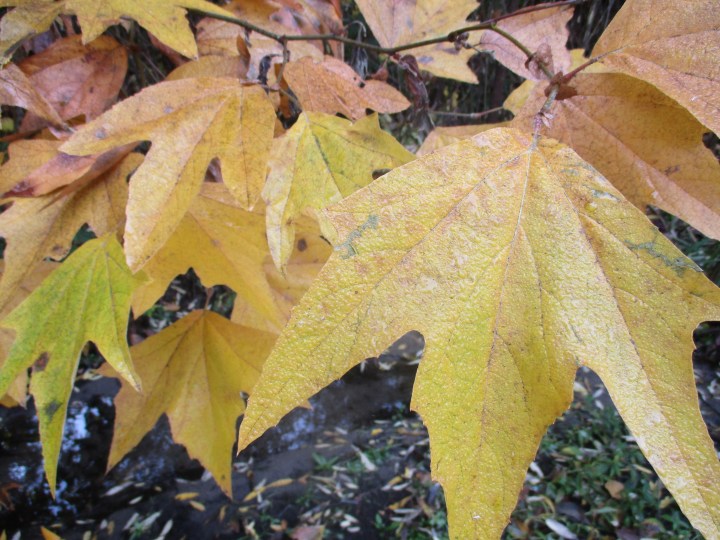
4. sycamoreP81201+++

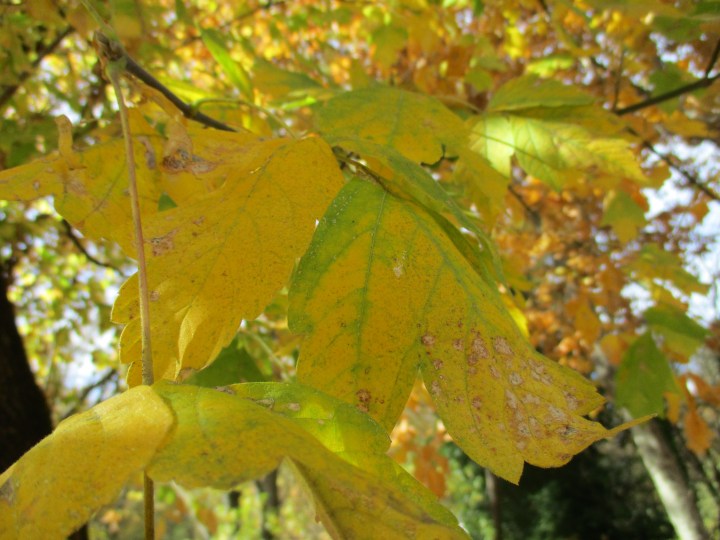
5. boxelderP81201++++

6. bigleaf mapleP81201+++++

This is the link for Six on Saturday, for anyone else who would like to participate:

https://thepropagatorblog.wordpress.com/2017/09/18/six-on-saturday-a-participant-guide/

Horridculture – Well Done Stakes Are Rare

P81128++

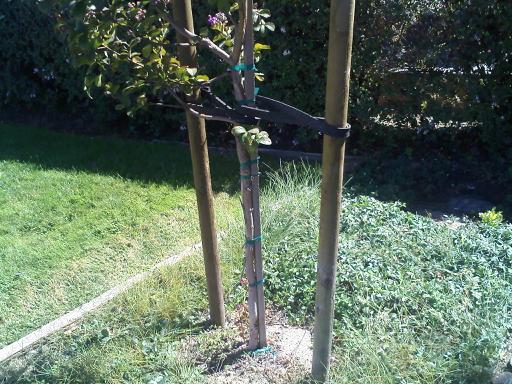
Stakes are temporary. That is what so called maintenance ‘gardeners’ do not seem to understand. Stakes should not stay any longer than necessary, so need to be removed sooner than later, depending on their function. Stakes that are left too long can interfere with the healthy development of the trees and vines that they were intended to help.
Nursery stakes are used either to straighten the trunks of developing trees, or to support climbing vines. They must be removed when the trees or vines that they worked for get installed into the landscape, or as soon after installation as possible. Some flimsy trees may need their stakes for more than their first year.
The problem with leaving trees bound to their nursery stakes for too long is that they rely on the stakes for support as they grow, so do not put much effort into supporting their own weight.
The picture above shows a coast live oak that was staked properly with landscape stakes to the side, but while still bound to the original nursery stake. Because the tree was bound for too long as it grew, it may be too flimsy to support itself without bending when the binding nursery stakes eventually gets removed. For this particular tree, the bindings may need to be removed in phases so that the tree can learn to support itself before the last binding is cut loose.
The problem with leaving vines bound to their nursery stakes is that they remain bundled in the middle while new growth spreads out more naturally. Vines should instead be unbound and spread out onto their support, even if they need to be bound to the new support like they were bound to their nursery stake. Only a few vines that will get cut to the ground annually or after their first growing season, such as Boston ivy and creeping fig, can remain bound through their first year, only because the whole mess will be pruned to the ground, and replaced with new growth later.
The picture below shows a pink jasmine vine that is still bound to its stake, right in front of a disproportionately small trellis. The bundled mess of stems in the middle is partially obscured only because the tangled upper growth is so overgrown. There are so many problems with this unfortunate potted pink jasmine that it will be a topic for next week.P81128+

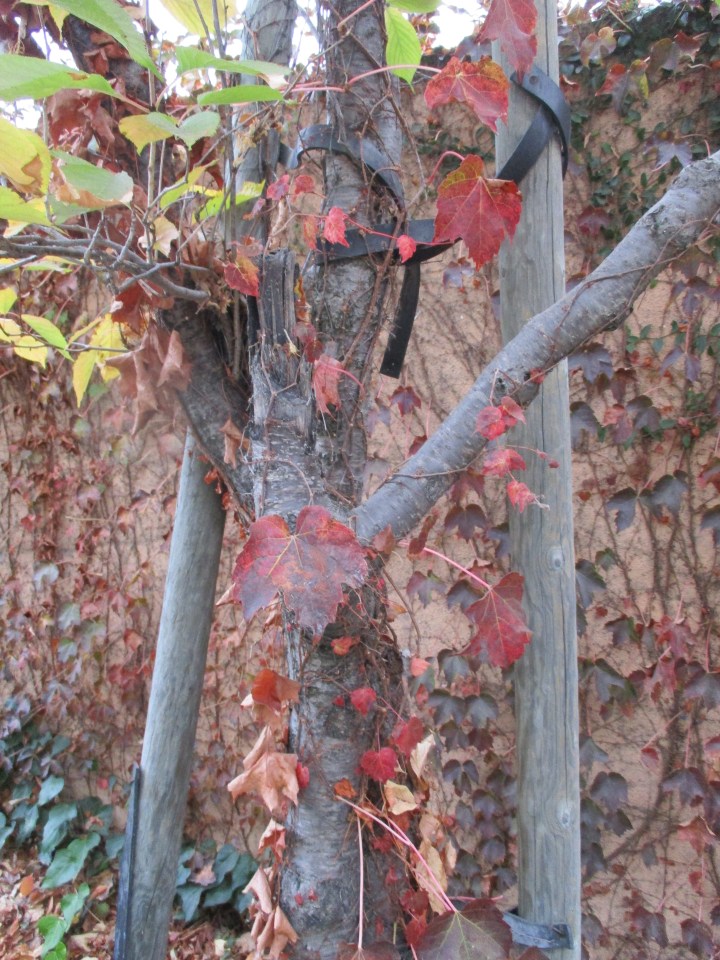
Landscape stakes are very different from nursery stakes. They are not needed to straighten trunks of trees, but are merely used for a little bit of support while new trees disperse their roots. When trees have adequately dispersed their roots and are stable enough to stand up to a bit of wind on their own, landscape stakes must be removed. They are not as likely to interfere with the development of structural integrity like nursery stakes do, but can interfere with root dispersion and development of adequate stability if trees become reliant on them for support.
The flowering cherry tree in the picture below obviously does not need the support of the unsightly landscape stakes that remain partly strapped to the trunk. The stakes did not compromise stability only because the tree is so naturally stout. The stakes really are unsightly though. So is the overgrown Boston ivy on the trunk and up into the canopy, . . . and the mutilated stubs and stems that were ‘pruned’ by the maintenance ‘gardeners’. Seriously; what kind of ‘gardener’ does this sort of atrocious work?! Well, those topics can be addressed at another time.P81128

Frost

P81125We do not get much frost here. This picture of the view through the windshield of one of the work vehicles was taken more than a week ago, while the humidity and the temperatures were still quite low. The sparse and angular pattern of the frost on the windshield is a result of the minimal humidity. There will be more frost later in winter, although there will not be nearly as much as most other climates get.
After a cool Monday morning last week, the weather got a bit warmer, or really just less cool. Rain started about midnight between Tuesday and Wednesday, and continued through the day and into the night. More rain is predicted to start after noon next Tuesday, and continue through Thursday. There will be no frost during this weather pattern. Frost happens here only between rainy weather. One might think that since we do not get much rain, there would be plenty of time in between for frost. Really though, much of our winter weather is simply quite pleasant, neither rainy nor frosty.
As appealing as this might be to those in harsher climates, it has certain disadvantages.
So far, there was just enough chill to start defoliation of the black locusts and box elders in the background of the picture, and just enough rain to almost finish it. Trees that need more of a chill to start this process are not so impressed with the weather. Many of the crape myrtles have not even started to color yet. Cottonwoods are starting to defoliate, but are doing so while still only dingy greenish yellow because they did not get enough chill for better color.
Spring bulbs that got planted earlier or are being planted about now will bloom next spring because they were so optimal and primed to do so before they were planted. However, many will not get enough chill in their second winter to bloom again. Consequently, many of the bulbs that would be perennial in other climates are grown as expensive annuals here. Likewise, seed of certain specie that self sow may not get enough chill through winter to germinate next spring.
So again, what is comfortable for us is not so ideal for everything in the garden.

Time Travel

P81124KOne never knows what strange artifacts might be found out in public landscapes. It is amusing enough to find items discarded or simply misplaced long ago by former occupants of a home out in a private home garden. Public landscapes are even more interesting, since they collect debris and artifacts from many more people. Some landscapes have been doing so for a long time.
Besides litter, the most commonly found artifacts are sporting equipment. Frisbees, baseballs, tennis balls, soccer balls, volleyballs and such are commonly lost in dense vegetation. Golf clubs, baseball bats and tennis rackets sort of make one wonder. Chew toys are sometimes left by dogs who go after them, but then return with something they perceive to be more interesting.
Landscapes that are near roadways often feature car parts that might have fallen out of cars as they drove by, as well as a few that cars could not have driven by without. Obviously stolen items, such as purses and wallets, often surrounded by a few credit cards that they likely contained sometimes appear. Stolen mail might fit into that category.
I have yet to find anything as interesting as tickets to a San Jose Sharks game, a big bag of money, Elvis, a purple dinosaur from another plant or a flying saucer that brought it here. However, I have found evidence of time travel!
A retaining wall that holds back an embankment above a parking lot at work was apparently constructed by Mike Menard in 1982, who left his name and the date inscribed into the concrete on top of the wall. That by itself is nothing too remarkable. What IS remarkable is that an adjacent retaining wall was constructed four hundred years later, and three hundred and sixty-four years from now, in 2382!P81124K+