Horridculture – Blame

P81106The response to the brief article that I wrote about the smoke from a small and localized wildfire on Sunday is not easy to dismiss. The original article is at https://tonytomeo.com/2018/11/04/smoke/ . It is about the smoke from the small and localized Rincon Fire, and goes on to discuss how the clear cut harvesting of redwood more then a century ago enhanced the combustibility of the forest. It was shared to Facebook, including the Facebook page of Felton League.

The article did not blame anyone for starting the fire. I read it again just to be certain. I said nothing about arsonists, the homeless, homeless arsonists, or anything of the sort! Blame, in regard to the Rincon Fire, is not relevant to horticulture, forestry, arboriculture or anything that I write about.

We all know that there are mentally ill people who are homeless because they do not function well enough to maintain a domestic lifestyle. Some are potentially dangerous because they can do things, such as start fires, without thinking about it. There are also those who can accidentally start fires as they are just trying to stay warm when the weather gets cold out in the forests where they live.

Do we really believe that blaming and vilifying the homeless or mentally ill helps? Chasing them from their encampments and farther out into the forests, as so many suggest, only increases the innate hazards by relocating them into areas that are more inaccessible and more combustible. If we really are so concerned, we should want such hazards relocated to more localized and accessible situations. The severely mentally ill who can not manage a descent lifestyle simply should not be homeless.

Furthermore, what about the vast majority of fires that are caused by electrical malfunction? Why are we not wanting to outlaw electricity? What about the fires that are caused by sparks from lawn mowers and weed whackers? Shouldn’t such machines be outlawed? What about forest fires that start as house fires? Should we blame those who live in homes? Who do we blame for all those combustible trees that grow wild in the forests?

I intend to resume writing mostly and perhaps nearly exclusively about horticultural topics after today. It is what I am qualified to write about. I apologize for this deviation. If I eventually establish a blog regarding homelessness, I will be sure to share a link to it here.

Smoke!

P81104K.JPGWhat a surprise. There was none when I went in to use the computer as the sun came up into a clear blue sky this morning. When I came outside just a few hours later, it was everywhere. It was so thick and so aromatic that it was obviously very close, but it did not smell like it was in the ponderosa pines around Scott’s Valley where I happened to be at the time. Once I got on the road back to Felton, I could see that besides the monochromatic ambient smoke that obscured the surrounding hills, a prominent and much thicker brown cloud of smoke hovered low over the San Lorenzo Valley. The smoke was even thicker in Felton, and obscures the range to the west where Bonny Doon is. As I write this in Felton Covered Bridge Park, ash is falling onto the computer screen.
The fire has apparently been burning since last night in the Pogonip, closer to Santa Cruz, and is now contained. Paradise Park has been evacuated. Highway 9 is closed between here and there. Sirens announce the arrivals and departures of firetrucks as they migrate into town from the south on Highway 9, and back south toward Santa Cruz on Graham Hill Road and Mount Hermon Road, as if even they can not get through on Highway 9. Heavy helicopters can be heard but not seen off to the south. A cumbersome airplane is circling the area.
There is not much of a breeze. It seems as if it has not gotten as warm as predicted for today. The smoke and sirens sets the mood. It is not good, even though we know that the fire is contained.
Fire is part of life here. Clear cut harvesting of redwood more than a century ago allowed more combustible specie to proliferate over the area and among the redwoods as they recover and regenerate. The forest is now more combustible than it has ever been, but can not be allowed to burn with so many of us living here. Without burning, it becomes more combustible.

Trees Hate Cars

P71028That is a myth. They do not hate all cars. They just hate particular cars.

I did an internship with arborists in the summer of 1988, and have never been able to get away from arboriculture. Even as a nurseryman, I still sometimes work for arborists, and inspect trees that they are concerned with. I have seen many of their subject trees that have fallen onto parked cars, homes and whatever trees fall onto. I have noticed particular patterns.
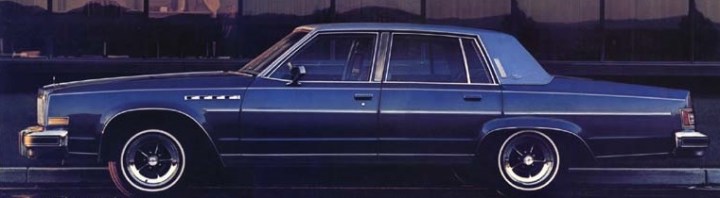
Trees are more careful with Buick, Oldsmobile, Pontiac, Chrysler, Volkswagen, Mercedes Benz, and Datsun or Nissan. I have seen them put considerable effort into avoiding these cars when dropping limbs or falling over. When I was in school in San Luis Obispo, I drove my neighbor’s 1969 Oldsmobile Cutlass out from under his Chinese elm that fell over it. The tree held itself up on limbs that landed on the opposite side of the driveway so that the car came out from under it completely unharmed. When I lived in town in Los Gatos, a massive coast live oak two doors down fell harmlessly into the front yard next door. The roots pulled up in front of and behind a Volkswagen GTI that was parked at the curb, and barely tossed an ounce or two of mud onto the hood. A few big olive trees did the same at a large condominium complex in San Jose during a windy storm, leaving nothing more than a bunch of leaves and olives on top of a classic Mercedes Benz sedan and an old Datsun B210. These are certainly not the only examples. This seems to be a common theme for these particular cars.
I can not say the same for Mercury, Plymouth, Jeep, Cadillac, Mazda, Toyota, Lexus, Honda, Subaru, Infinity or Volvo. I have never seen trees damage or avoid damaging them.
Damage to Ford, Dodge, Audi, Isuzu and BMW did not see to be targeted. It was the sort of random damage that one would expect from a tree innocently falling onto parked cars.
Both of the only two cars that I know of that were squashed while being driven were Lincoln Navigators. That is not a good statistic at all. One was hit by a falling Canary Island pine in Fremont. The other was clobbered by a Coast live oak in Saratoga. No one was hurt; but the cars were killed.
I have seen only one Chevrolet damaged by a tree, but it was vicious! It was one of only three coastal redwood trees in a landscape situation that I had ever seen fall, although ‘fall’ does not adequately describe what this tree did. Without enough wind to damage adjacent and notoriously structurally deficient California pepper and Chinese elm trees, this redwood seemed to jump out of the ground to land on top of an Astro Van about twenty feet away! I do not think the tree was targeting it because it was a Chevrolet. The tree obviously hated this specific Astro Van VERY much.
Acura seems to be the second most hated sort of car among trees. They are less common than Honda, but I have never seen a Honda damaged by a tree that it did not run into first. Yet, I have seen at least three Acuras destroyed by a coast live oak, a blue gum eucalyptus and a Monterey pine. That is an inordinate number!
The car that trees seem to hate most is Porsche! They are uncommon cars, and are probably less common than any other car that I have ever seen damaged or destroyed by trees. Yet, I have probably seen more of them destroyed than Acuras, including one that was attacked as blatantly as the Astro Van was attacked by the small redwood. The ONLY blue spruce that I have ever seen fall landed squarely down the middle of a new Cayenne, back when they were the first SUV that Porsche made. The densely foliated canopy enveloped the car so thoroughly that only the middle of the tailgate was visible.
It would be interesting to know if insurance companies have determined if any particular types of cars are more likely to be damaged or destroyed by trees than any other. I would think that if the trends that I have noticed are accurate, that insurance companies would be aware of them as well. I am also curious to know if other arborists have noticed similar trends.P80106

Neither Here Nor There

P81103KIs it coming or going? Autumn that is. It normally gets here last. We are typically only beginning to see the first foliar color of autumn while other parts of America get their first snow. We typically get a few more tomatoes out of our vegetable gardens long after most everyone else has pulled out their frosted tomato plants.
Well, we still got it. Tomatoes that is. The plant that produces these bright orange cherry tomatoes is looking a bit tired and pale, but the tomatoes are as good as ever. It probably will not last until frost. The plant might get pulled out when the tomatoes run out. Without bloom, that could be pretty soon. Frost does not happen until well into winter. Regardless, tired tomato plants say that autumn is coming.
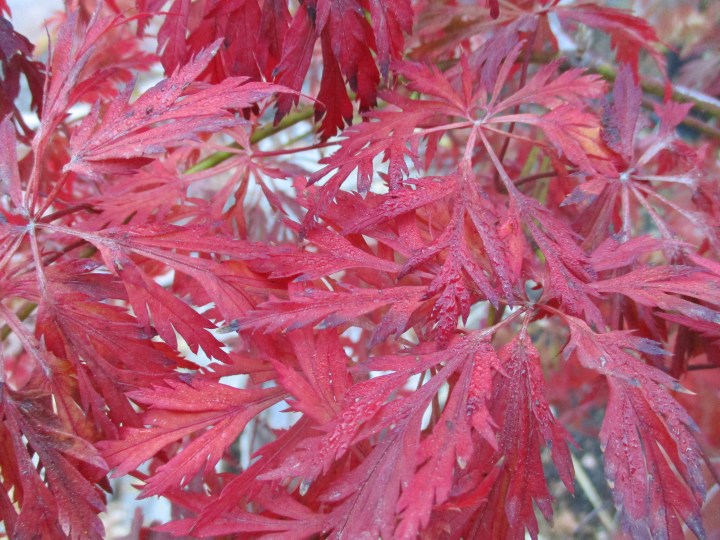
We got foliar color too. This Japanese maple turned this nice garnet red quite some time ago. Sweetgum trees all over town are also well colored. They seem to be ahead of schedule, as if winter is on the way. Defoliating black oak trees say that autumn is going.
While the days are still pleasantly warm, with temperatures into the 80s, the nights get cool enough to color deciduous foliage. Warm days are quite normal for this time of year. So are cool nights. However, the two typically do not happen together for more than a few days. Warm days typically alternate with mild nights. Cool nights typically alternate with cool days.
Well, even in our mild climate, the weather is always full of surprises. We will enjoy it while it lasts. Autumn has always been a mere in-between season anyway. In the chaparral and desert climates of California, winter and the rain that comes with it will be welcome when they arrive.P81103K+

Six on Saturday: Dia De Los Muertos


Dia de los Muertos, or Day of the Dead, was yesterday, Friday, November 2. However, the dead are still dead. They don’t need a special day to be so. In fact, they do it every day of the year. Dia de los Muertos is just one day of celebration to honor them.

Dia de los Muertos is not for plants though. Dead plants just get cut down and disposed of. Some get composted. Dead trees get recycled into firewood. These are six pictures of five species of dead plants that I needed to contend with in the week before last.

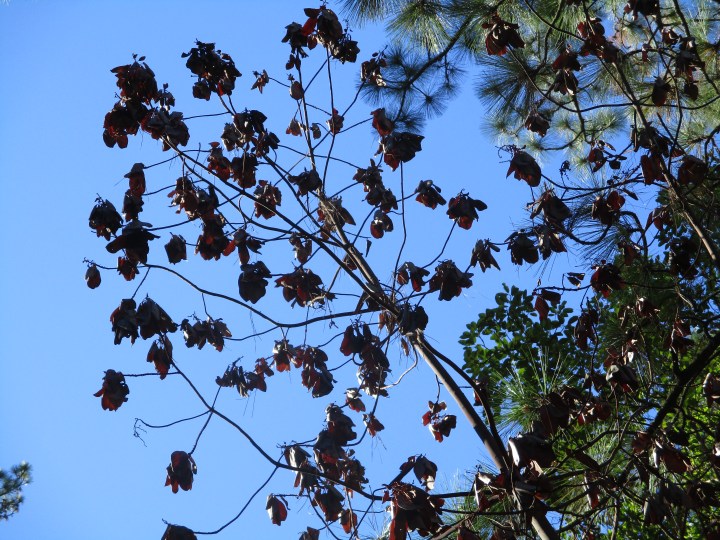
1. Rhododendron. I really do not know what killed this group of rhododendrons. It is not uncommon for one to die. With all the rhododendrons in the landscape here, a few dead ones get removed annually. However, it is rather disconcerting that a few died all in the same area at the same time. All their dead stems were rather sculptural. They were removed just after this picture was taken. Of the five specie in these six pictures, this is the only species that is not native.P81103

2. Madrone. Bits and pieces of madrone commonly succumb to blight, sort of like fireblight in apple and pear trees. Sometimes, entire trees are killed like this one. It is fire wood now.P81103+

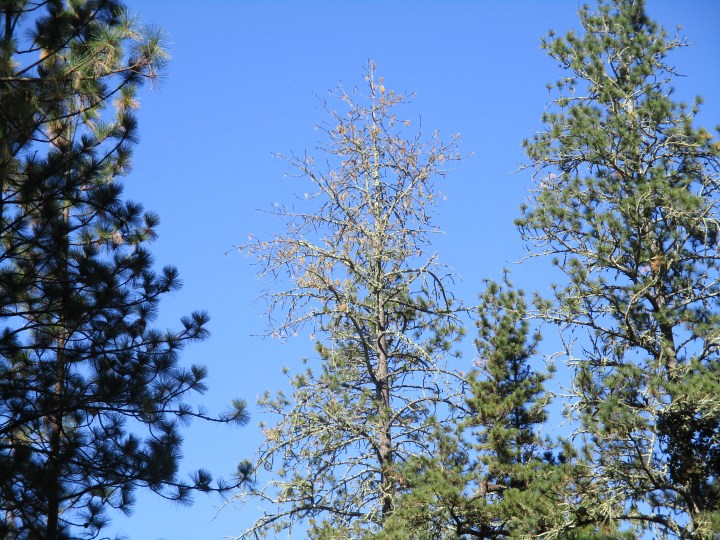
3. Ponderosa pine. The forest does not burn as frequently as it used to before people were here to extinguish forest fires. The lack of restorative fires interferes with regional ecology. Not only is the forest becoming congested with unburned fuel, but pathogens are proliferating in the aging flora and consequently accelerating the deterioration of the forest, which increases the combustibility. It is a natural process designed to correct an unnatural lack of restorative fires, but does not go well for those of us who live here. Ponderosa pines can live for a few centuries. However, in our compromised ecosystem, many succumb to pathogens while still relatively young. This one will need to be removed next year. Once dead, they deteriorate and start to drop limbs within the year.P81103++

4. Coast live oak. This is one of the most adaptable of tree specie in California. It lives right down to the beach, and into interior valleys, and up the summit of the Santa Cruz Mountains. It does what it must to adapt to the various environments within its range. It often lives in groves of the same, where it is more likely to burn every few decades or so. In spacious valleys, it is often not so social, with individual trees living in relative isolation from their neighbors. Grass fires can burn harmlessly between such trees, allowing them to live for a few centuries. Wherever they are, they develop more trunks than they need. As they mature, subordinating trunks like this one, get shed naturally and harmlessly. It is not as bad as it looks. In the wild, it would rot and fall to the ground as the rest of the tree continues on as if nothing happened. In our landscape, it was cut and taken away.P81103+++

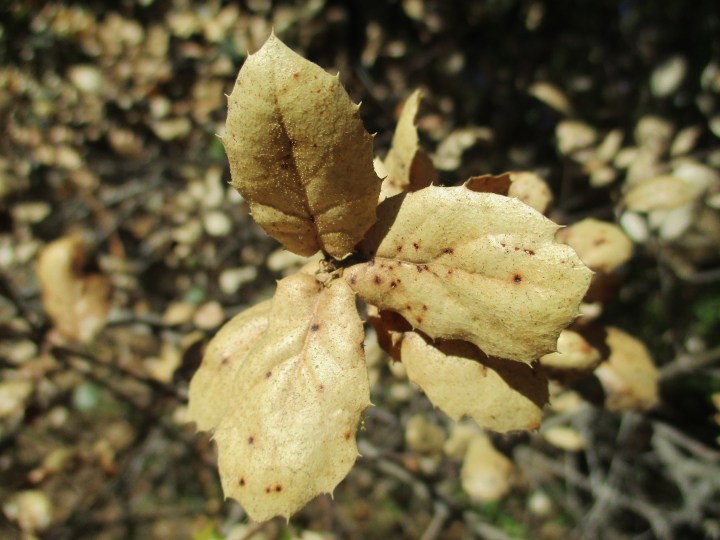
5. Coast live oak. This dead foliage is a bit more alarming because I do not know what caused it. It is probably superficial damage caused by a girdling beetle. I did not look for evidence. Sudden Oak Death Syndrome is a much more serious disease that is all too common here (and a very sensitive subject). Fortunately, this particular specimen is a small and unimportant tree that I would not mind cutting down if it were to succumb. I just do not like to be reminded of how rampant Sudden Oak Death Syndrome is here.P81103++++

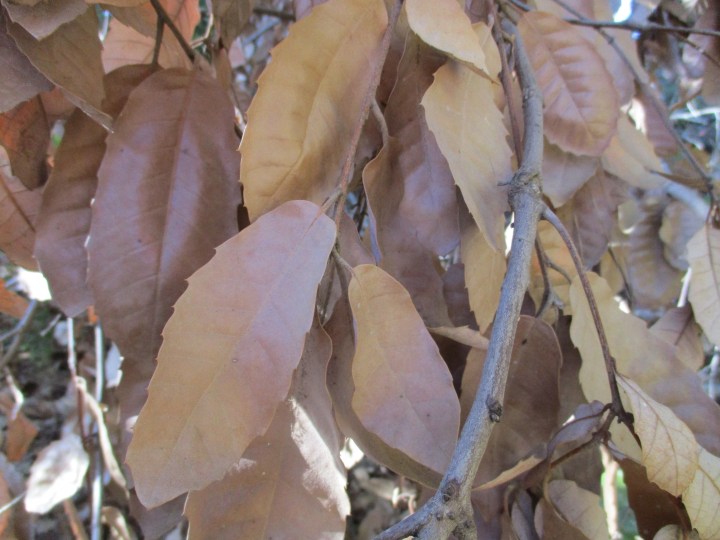
6. Tan oak. This tree really did succumb to Sudden Oak Death Syndrome, Phytophthora ramorum, which is more commonly known here as SODS or SOD. A few adjacent tan oaks that succumbed last year are already very deteriorated and will soon be dropping limbs if not removed over winter. These particular trees are not very important to the surrounding forest. Their removal will actually improve the collective landscape, and give the surrounding redwoods more space to expand. The problem with SOD is that we never know which oaks it will kill next. It kills trees before we know they are infected. There is no remedy.P81103+++++

This is the link for Six on Saturday, for anyone else who would like to participate:

https://thepropagatorblog.wordpress.com/2017/09/18/six-on-saturday-a-participant-guide/

Horridculture – All Hallows’ Eve

P81031All Saints’ Day is November 1. As the name implies, it is a feast day that honors all Saints. It is one of the most important Holy Days of the Catholic Church. Yet, not many of us know about it.
We are much more familiar with the day before, which had been known as All Hollows’ Eve, and is now known simply as Halloween. Although some of the associated traditions are fun for children, Halloween has become an excuse for people to dress up in costumes, party, ruin perfectly good pumpkins, and behave stupidly. What an unsaintly way to celebrate, just prior to the day designated to honor all Saints!
Saint Patrick’s Day is no better. People dress up in green, party, exchange disposable potted shamrocks, and behave stupidly, all on a day that had been designated to honor a Saint whom they know very little about, and care even less about.
Mardi Gras at least makes a bit more sense, with all the indulgent behavior just prior to forty days of good behavior and fasting. Even societies that do not party for Mardi Gras have old traditions of feasting on foods that will be abstained from through Lent, just to avoid wasting them. It is easy to see how such feasting and indulgence evolved into over indulgence and partying. Mardi Gras lacks a tradition of wasting innocent horticultural commodities like pumpkins and shamrocks.
Easter, at the other end of Lent, is still a respectable Holy Day. Most people know that it is a celebration of the Resurrection of Jesus, and celebrate accordingly. Perhaps a bit of indulgence is in order after forty days of fasting, Colored eggs nestled in fake grass, and disposable potted lilies, do not seem to be as inappropriate as ruined pumpkins.
Christmas is the most complicated Holy Day of all. It should probably be divided into two separate Holy Days. The primary Christmas should be the celebration of the birthday of Jesus. The secondary Christmas, which could be assigned another day, and given a different name, could be a celebration of disposable potted poinsettias, dead mistletoe, and a fat guy in red coming down chimneys to deliver gifts under dead coniferous trees that would be terribly embarrassed by their tacky adornments if they were alive.
There is more to Holy Days than pumpkins, shamrocks, lilies, poinsettias, mistletoe and coniferous trees.

KinderGarden

P81028

By modern standards, the public schools that I attended in the early 1970s would be considered to be bleak and primitive. The building were utilitarian and simple, from about twenty years earlier. The landscaping was comparably simple, with a big lawn and proportionately big shade trees. A screen of alternating Monterey pine and Monterey cypress was hedged on the southern half of the eastern boundary of the schoolyard. The only deviants to the simplicity were a few significantly older trees on the northern half of the eastern boundary of the school yard. There were two coastal redwoods, a Canary Island date palm, a cedar, and a spruce of some sort. They were all quite mature, and were likely remnants from an old farmhouse that was there before. Perhaps they wanted us to be aware that everything changes.
On the way to kindergarten, back when children were allowed to walk to school, I weaseled my way underneath the first Monterey pine and Monterey cypress on the southern end of the fence line, and fell asleep. I do not remember how long I stayed there, but it was long enough to get in serious trouble with my very worried kindergarten teacher. After that, I could only visit those two trees in passing, and perhaps stop only briefly to smell the foliage or shake some of the rain away.
Nearly four decades later, but only a few years ago, I was assigned the grim task of composing the arborist report that would justify the issuance of a permit to remove that same Monterey pine, which was the last that remained of the hedged trees that I remember. I did not know that when I went to the site. I was just told that it was a ‘pine’.
Visiting the old school was not a pleasant experience. The entire site was surrounded with a prison like fence and saran screens to obscure the view inside and out. There were no open gates. I needed to be escorted to the tree by a professional chaperone. Much of the schoolyard had been very synthetically landscaped with microtrees and pretty flowering shrubbery that was intended to impress parents rather than appeal to children. It is bad enough that there are no orchards or open spaces remaining in the region, but it is worse that children are deprived of the open lawns and trees and natural spaces that my generation had taken for granted on the grounds of our school. Are children even allowed to climb trees anymore? Do they know what dirt is? Can they observe a chrysalis split open to reveal a new butterfly before the gardeners shear the shrubbery and take the learning experience away? It was saddening.
Once I realized that the tree that I was expected to condemn was my old friend, I asked the chaperone, who seemed to know a bit about facilities at the site, why anyone would want the now mature tree to be removed. I knew that it had been mutilated while young, but was impressed with how it somehow recovered and developed a well structured trunk. I thought that perhaps someone noticed something that I was missing in my inspection. People who are not arborists are sometimes alarmed by something that is perfectly normal for a tree, such as furrowed bark, or slight seasonal foliar discoloration.
The chaperone explained that the tree needed to be removed simply because it did not conform to the style of the rest of the landscape. I waited for the rest of the answer, but that was it. The tree did not conform.
Nothing gave me more pleasure than to explain that after my evaluation of the health, stability and structural integrity of the subject, I could find no justification for removal.
I was dismissed.
Yes, it was worth it.
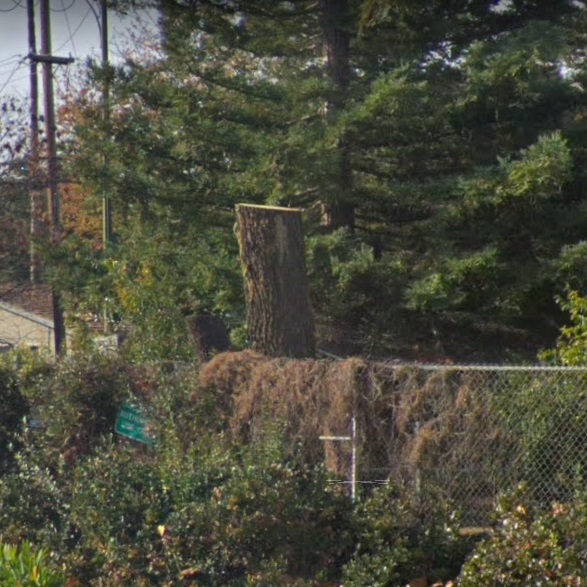
However, I knew that for the right price, another arborist would be pleased to condemn the tree. The picture of what remains suggests that the arborist who did so was not even professional enough to get his crew to finish the job. How does this dead stump conform to the rest of the landscape?
Those old trees, the redwoods, palm, cedar and spruce, were right. Everything changes.
The Monterey pine that would not conform is gone now, but it was right too.

My First Tree

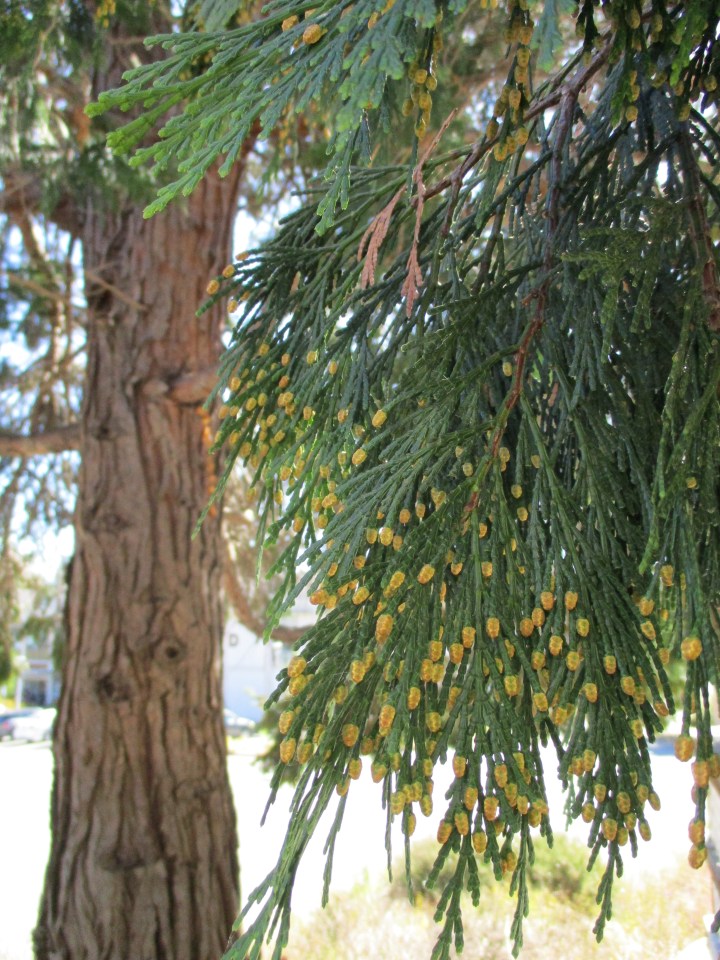
71108Calocedrus decurrens. Incense cedar. The first tree that I ever planted was a small incense cedar, like the tree in the picture here. Of course, it was not this big when I planted it.
It came from my maternal grandparents’ cabin near Pioneer, in the foothills of the Sierra Nevada. It was a wild seedling that might have been pulled up because it was where the cabin was to be built. My grandmother planted it into a small wooden planter in the backyard. Once it recovered and started to grow, she gave it to my parents, who had me plant it on a small hill in the back yard. Although not native to the Santa Clara Valley, it did well, and grew tall and lean. I tend to compare all incense cedars to my first tree.

Almost all are older and bigger, with plump trunks. I can guess from their age that most were planted during the Victorian Period. Quite a few were planted half a century later, during the 1950s, when Monterey pine and Monterey cypress were too commonly planted. Not many incense cedars are young. It is as if they had been available in nurseries until the early 1970s, and were not grown much after that. I planted a few in Scott’s Valley back in the 1990s, on the southern margin of what is now Sky Park, but only because my colleague happened to grow them.

Because it was less expensive to transport ‘relatively’ local lumber than to import Eastern red cedar lumber from the East, incense cedar provided the veneer for closets of old homes here, as well as cedar chests. Small groves of incense cedar were grown in the Santa Cruz Mountains as a local source of cedar wood. Now that cedar closets and chests are no loner necessary to repel moths from woolens and furs, the naturalized groves are abandoned, and now grow wild. I know that they are technically not locally native, but I still like to see a few of them around. They look so much like my first tree.

Six on Saturday: Tequila


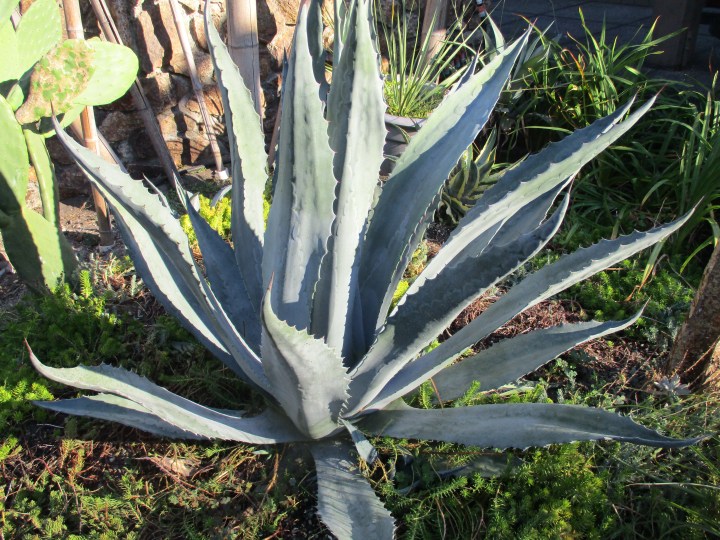
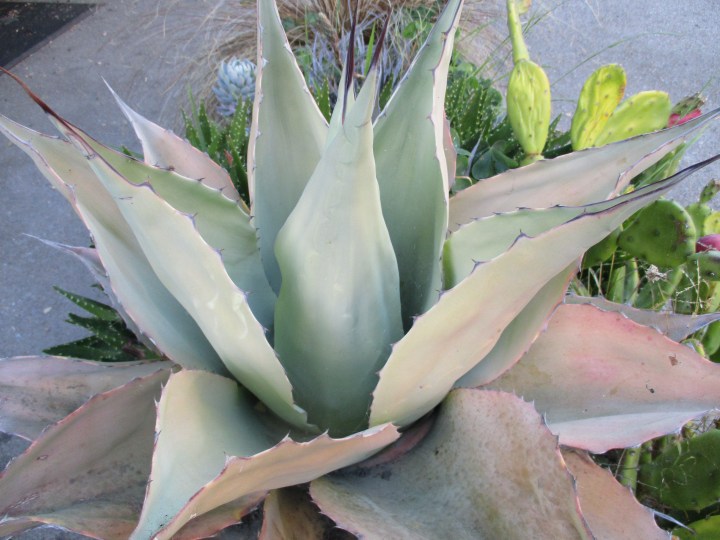
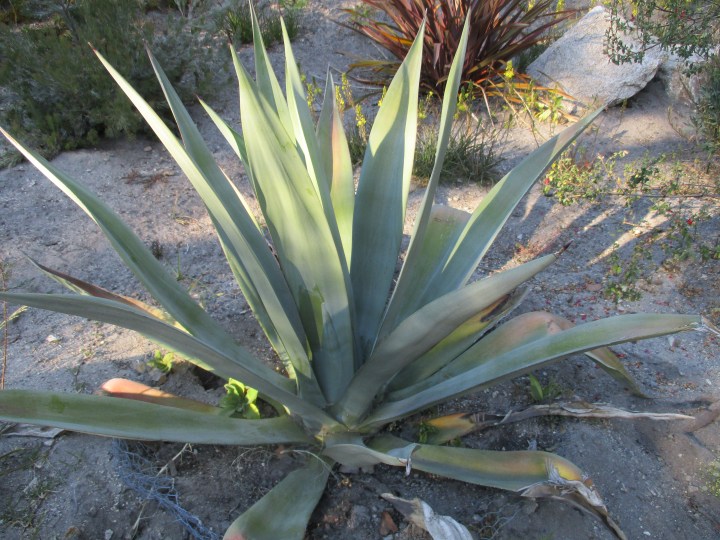
If one of these six different agaves happens to be the blue agave from which tequila is made, I would not know. I only know that all six are various specie or cultivars of the Agave genus. The sixth picture is that of the common century plant, Agave americana, which is not used for tequila. I have no idea what the other five are. The fifth looks like it could possibly be a picture of Agave victoriae, but if I remember correctly, I was specifically told that it is not.

All six of these agaves were procured by my colleague. The first specimen is still potted at the shops where we work. The second specimen was relocated into a new landscape early last spring. The other four are within minimal proximity of each other, in a more established part of the landscape. There happens to be two agave pups in the Infirmary Nursery. At least one is from the agave in the second picture. I believe that the second pup is the same as well, but it seems to be developing teeth.

The wickedly sharp teeth and spines of most specie of agave are the main reason that agaves are not more practical in home gardens or small landscapes. It is not practical to try to snip the terminal spines off, because more develop with every new leaf. If they get enough space out of the way, agaves are bold and remarkably striking big perennials that are very resilient to arid climates.

There are no captions this week, because I do not know what to say about agaves that I know nothing about.

1.P81027

2.P81027+

3.P81027++

4.P81027+++

5.P81027++++

6.P81027+++++

This is the link for Six on Saturday, for anyone else who would like to participate:

https://thepropagatorblog.wordpress.com/2017/09/18/six-on-saturday-a-participant-guide/

Horridculture – WEED!

0Q: What do I spray on my medicinal marijuana plants to kill mealybug?
A: Roundup.
This solutions takes care of two problems at the same time; the mealybug infestation as well as the weed that it is growing on! Cutting the weed at the base and simply discarding it is just as effective and even more practical because it does not involve a toxic, environmentally controversial, and expensive chemical herbicide. The best option is to simply not grow weed in the first place.
I am a horticulturist. I love what I do. I love plants. However, I do not worship them.
When I grew citrus trees back in the early 1990s, I happened to enjoy all sorts of rare and unusual citrus fruit that grew on the trees that we grew. However, there were no citrus themed clothing, jewelry, accessories, home furnishings or tattoos. There was no overly indulgent or theatrical manner of consuming the fruit with fancy blown glass utensils designed for doing so, or a traditional technique of taking a piece and passing the rest around. I enjoyed citrus and got on with my life. Yes, I enjoyed growing citrus AND I had a life.
I realize that almost all of those who use marijuana medicinally do so responsibly. That is fine. Keep it out of my way. I am no more interested in smelling it, seeing it, or fleeing the smoke, than anyone else is interested in sharing my prostate medication. I find it to be quite objectionable and offensive.
It would not be so objectionable if those who use it excessively would not so predictably assume that I am a horticulturist because I grow it! Again, there is more to life and the flora of the world than WEED! If you are a stoner, wastoid or burnout because of your reverence for pot, do not recommend that I should try it! It is not as if you are a good example of the attributes of WEED!