Fall

P81013I prefer to call it ‘autumn’. It sounds prettier. Perhaps it even sounds a bit more exotic, like something that happens in far away climates were the seasons are more distinct, and the weather gets a bit cooler this time of year.
‘Fall’ sounds more like a simple verb. It is merely what outdated leaves do when deciduous trees no longer have use for them. Many trees in mild climates do not even bother to indulge their foliage with a bit of color first.
Exotic places like Pennsylvania, Minnesota and Kentucky get autumn. Oklahoma, Oregon and Alaska get it as well, although it is commonly mistaken for fall because the deciduous foliage of most native specie turns brown in Oklahoma, and yellow in Oregon and Alaska, with significantly less of the oranges, reds and other bright colors that are so prominent in other regions.
Rather than complain about the minimal variety of color among out native specie, and how the best color is provided by very accommodating exotic specie that color well even in our locally mild weather, I prefer to brag about how excellent the weather is through our fall. Except for the longer and cooler nights, our fall is like an extension of summer. It is often referred to as Indian summer. While others share pictures of their colorful autumn foliage, I get to share pictures of fall roses that continue blooming until frost,or even right through winter. Yes, in some regards, fall can be better than autumn.
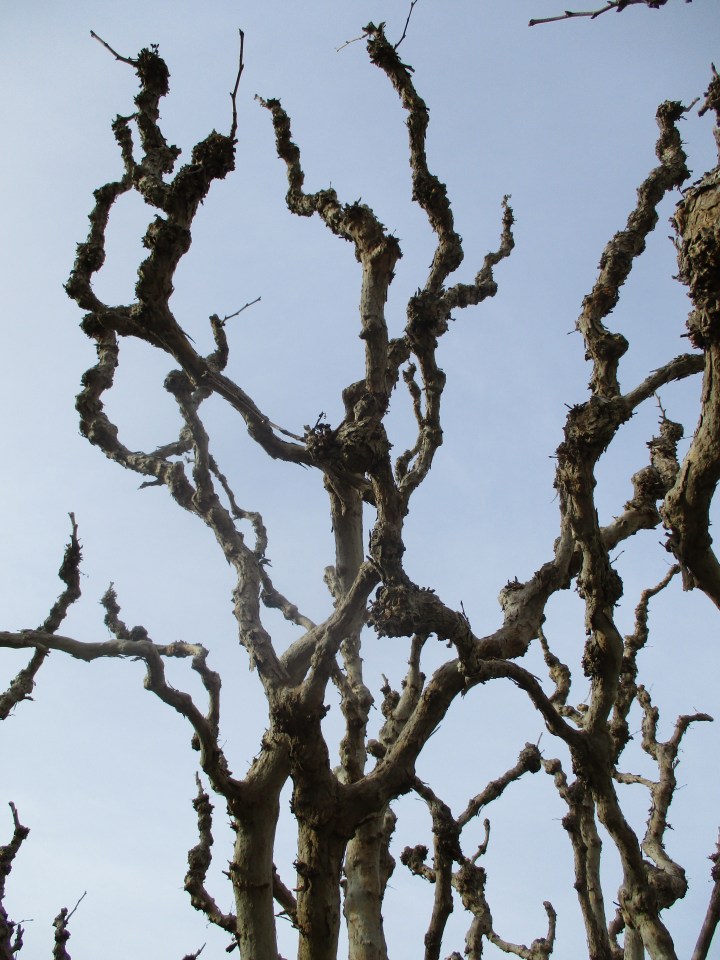
Then, this happened. While dahlia, zinnia, black-eyed Susan and even rose continue to bloom for those whom I would otherwise shame with my superior blooms, fall moved in, and is already defoliating a few trees! Sweetgum is starting to turn orange and red, but cottonwood, box elder, various willows and other riparian trees are beginning to defoliate without much color at all. This black oak is significantly farther along. At least it turned a nice rusty brown before defoliating.
How embarrassing! I can brag neither about extended bloom through a late fall, nor the bright foliar color of autumn!P81013+

Six on Saturday: Clearance


Clearance can get one into some interesting situations. Yes, with the necessary clearance, one can get into penitentiaries, protected military facilities, sensitive areas of the White House, or even Area 51.

The sort of clearance that I was concerned with this past week and the week prior was not so interesting. Now that roofs and gutters of the buildings at work are in the process of being cleaned before wintry weather, trees must also be pruned for clearance. As they grew through summer, some got detrimentally close to the roofs and gutters that are getting cleaned, as well as chimneys, windows, outdoor lighting and walkways. Such clearance is a concern throughout the year, but becomes more of a priority as we get ready for winter. No one wants to go back onto the roofs any more than necessary.

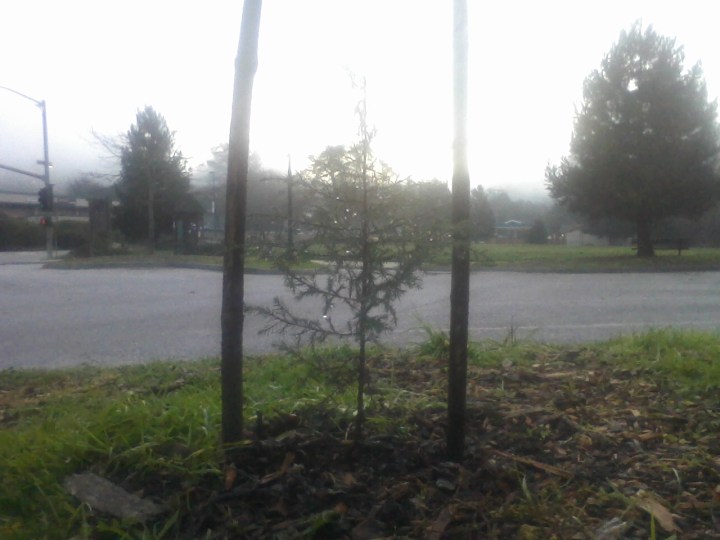
1. Before. The redwoods must be pruned for adequate clearance from the roof, chimney, lamppost, and even the umbrella on the patio that can not be opened without pushing a bit of foliage aside.P81013

2. After.P81013+

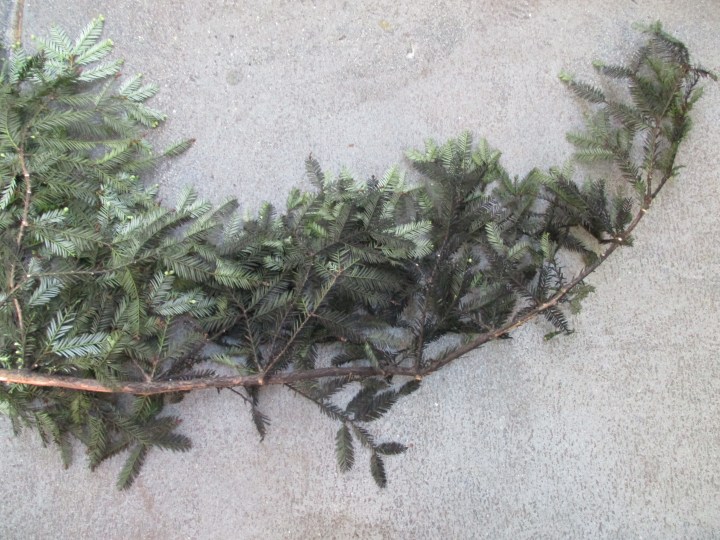
3. Soot on the tip of one of the redwood limbs demonstrates why clearance from chimneys is so important. Foliage that gets too close to chimneys can ignite and fall back onto the roof below, where it has the potential to ignite any foliar debris that might have accumulated behind the chimney since last year.P81013++

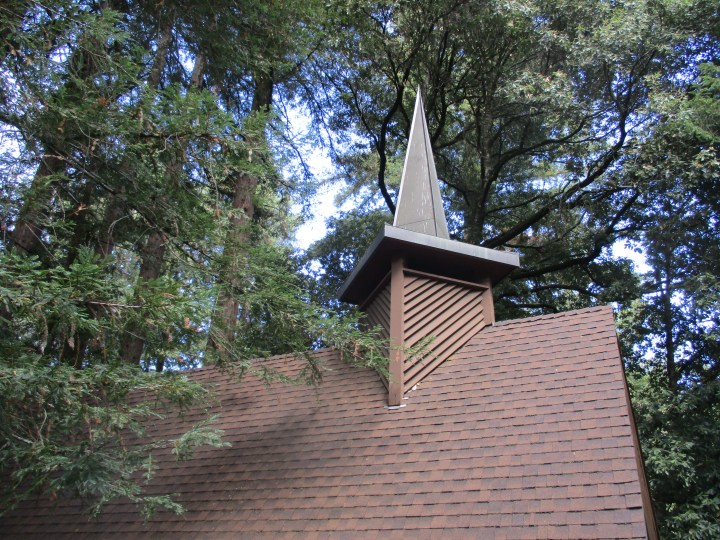
4. The belfry of the chapel next door really bothered me. Clearance was barely adequate. Although I am not worried about the shingles or painted surfaced getting damaged as wind starts to blow during winter, I think that the chapel would look better with more clearance from the encroaching redwood limbs. The problem was that I could not reach the limbs. Because this clearance was not a priority, the pruning here was postponed. A colleague who is not as plump as I am suggested that I get onto the roof through that gap between the top of the louvered sides of the belfry, and the underside of the roof above. Now, even if I could somehow get through that little gap, where would I go on the outside?! Let Quasimodo do it!P81013+++

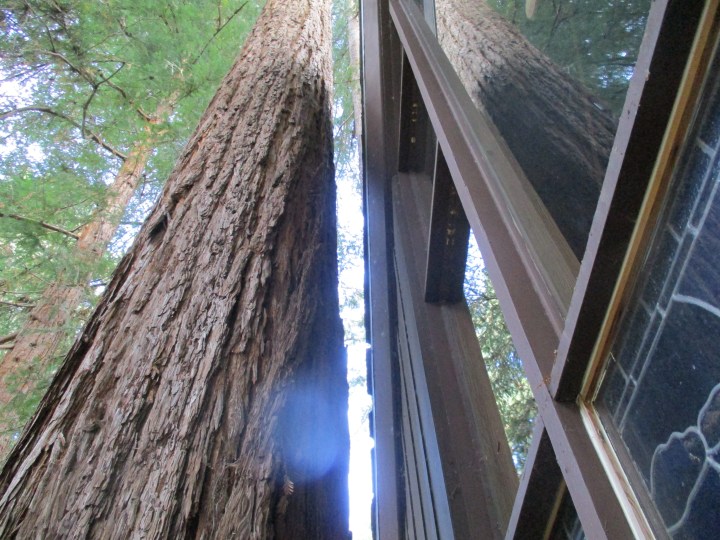
5. The chapel was built among the redwoods, very literally. Expanding trunks are beginning to displace the foundation and utilities. I can not prune for the sort of clearance that is needed here. Because the chapel is such an important building, and the redwoods are such important trees, it would be feasible to move the chapel over onto a new foundation. The problem with that idea is that the redwood trunks are pressing up against the building on three sides! There is no place to move the building without cutting something out!P81013++++

6. Phytophthora ramorum, which is commonly known as Sudden Oak Death Syndrome, or SODS, continues to kill tanoaks, (Notho)lithocarpus densiflorus, and coast live oaks, Quercus agrifolia. These trees do not need to be pruned for clearance, but must be removed before they start to deteriorate and drop limbs onto adjacent buildings or whatever happens to be below.P81013+++++

This is the link for Six on Saturday, for anyone else who would like to participate:

https://thepropagatorblog.wordpress.com/2017/09/18/six-on-saturday-a-participant-guide/

Horridculture – Lessons From Motivational Posters

P81010I work for the best. I do not intend to be too terribly pompous about it. I am just being honest.
This is not first time I have worked for the best. I have worked for at least three of the best arborists in the Santa Clara Valley, and two legendary horticulturists. I intend to eventually return to work for one of those legendary horticulturists back on the farm.
The main work I do now is part time and temporary. That means that I work less than four days each week, and will not be working there forever. I try to not think about leaving because it is saddening. I enjoy those whom I work for so much.
I work for only one other horticulturist, and one who is studying to be an arborist. Neither of them grow any significant quantity of nursery stock like I intend to spend the rest of my career doing. They maintain landscapes and facilities. The others of our elite group are very specialized professionals who work with everything else that is not relevant to horticulture. One is a carpenter. One is an electrician. One is a plumber; and so on. Although impeccably specialized, any one of us would do what he must to accomplish whatever needs to be done, even if it is beyond his respective specialty. Collectively, we are the ‘maintenance staff’.
How is this relevant to horticulture? I suppose it is not very relevant. However, everyone else on the maintenance staff respects what the other horticulturist, the other arborist, and I do. Anyone who needs vegetation pruned for clearance from a project contacts us to get it done properly. Anyone who sees obvious problems in the landscape informs us about them. Everyone on the maintenance staff respects everyone else and their respective professions.
To describe what makes the maintenance staff the best, I could use any combination of those inspirational words that are so ungraciously followed by an overly simplified dictionary definition on those insultingly inane motivational posters that so many other employers display prominently in the workplace. They are all relevant. However, we have nothing to prove.
Besides, this is not about the best. It is Wednesday, when I write within the context of my ‘Horridculture’ theme.
I have also worked for the worst. One of these worst was portrayed to be a very professional landscape maintenance company. We had a much larger staff, spread out over nine counties. We had a good variety of those motivational posters in our main office. Unfortunately, I did not realize when I went to work there, that those posters merely defined what we lacked.
Integrity – Dedication – Perseverance – Discipline – Teamwork – Excellence – Strength – Endurance – Accountability – We had none of that. I was the only horticulturist in the big staff of a big landscape maintenance company that simply did not care. I do not know how to describe it more accurately. We simply did not care. We were there to make a buck any way we could. We swindled, cheated and lied. I was only there as their token horticulturist and arborist, to help them get away with more of their illicit activity, and to make a good impression for their victims.
It is so backward. The big and seemingly reputable landscape maintenance company has less regard for horticulture than a maintenance staff who has other completely different priorities.

The Great Pumpkin

P81007The Third Day of Creation was when it all started. Plant life was created just two days after Heaven and Earth, and Night and Day. It must have been a pretty big deal. Humans were not created until three whole days later!
After all this time since Creation, the flora of the World is still just as important as it has always been. Vegans can survive without the consumption of animal products, but no one can survive without the consumption of plants, or the consumption of animals who were sustained by plants. We breath oxygen generated by plants. We live in homes made of wood. We wear clothes made of cotton. Until relatively recent history, wood was the primary fuel for cooking and warmth through winter. Even modern fossil fuels that have replaced wood are derived partly from fossilized plants. There seems to be no end to the long list of what plants do for us.
As if all that were not enough, plants provide pleasure. Some are dazzling desert wildflowers. Some are majestic forest trees. Most are something in between. Many are invited to inhabit our gardens, landscapes and even our homes and offices. Some are bred to do what they do even better than they did originally.
David Paul, in the picture above, made a career of cabinetry, which involved all sorts of fancy and exotic woods. Most of these woods were derived from genetically unimproved trees that would have been found growing in the wild. Most were from eastern North America. Some were from other continents. Some of the favorite maple burls were specifically from New England and the Pacific Northwest. David Paul was no horticulturist, but he knew quite a bit about the flora that produced the fancy woods that he worked with.
The pumpkin is another story. David Paul grew giant pumpkins for several years in Colorado Springs merely because he enjoyed doing so. It required serious dedication throughout the entire long growing season. Yet, the pumpkins were grown only for the fun of competition. As huge as they were, they were not to be eaten. That is the epitome of growing something merely for the fun of it. This is such an excellent picture of that epic pumpkin that it was the illustration for the obituary of David Paul.

No Rain

P81006KFor the first time since last winter, a few raindrops were heard on the roof early last Monday morning. It was over by the time I realized that the odd and unfamiliar noise really was that of raindrops. By the time the sun came up, everything was dry. I do not even know if these few raindrops could be considered to be the first rain of the season. There were a few similar raindrops on my windshield a while back, but they were dismissed as such; merely a few random raindrops rather than a confirmed rain shower.
That is how our climate works here. The Santa Clara Valley is in a chaparral climate. Much of Southern California is in a desert climate. We do not get much rain, and it is almost exclusive to a limited rainy season that is centered around winter.
Dust and crud that accumulates on foliage through the long dry season tends to stay there until the rain rinses it away. Oddly, many native plants do not mind, and a few seem to appreciate it. Some have tomentum (fuzz) on their leaves that collects dust, particularly during the warmest and driest summer weather when foliage is most sensitive to desiccation and scorch. Others have sticky foliage that does the same. However, such foliage is remarkably efficient at allowing such crud to rinse away in the first rain. Both deciduous foliage that will be shed shortly after the rainy season starts, and evergreen foliage that will be replaced through winter, seem to prefer to start the rainy season clean. Is this just coincidental, or do the plants intentionally collect dust and crud to shade and insulate their foliage through the harshest summer weather, and then wash up for a good sunning at the last minute?

Six on Saturday: Zoning Out


Zonal geraniums, Pelargonium hortorum, can bloom anytime it wants to here, but really does tend to slow down somewhat through autumn and winter. As growth slows, older foliage will deteriorate and become more susceptible to rust and decay. Where exposed, older grown might succumb to frost over winter. Zonal geraniums will soon be zoning out.

Such deterioration and winter frost damage is not as bad as it looks, unless of course, frost is severe enough to kill the entire affected plants. By the time old growth looks shabby enough to be removed, new growth is probably already starting to develop down near the roots. After the last frost date (when no more frost is likely), old growth can be cut back to expose new growth that will soon replace it. Even if new growth is very minimal, growth will accelerate once exposed by the removal of old foliage, and as weather warms into spring.

That is still a few months away. For now, zonal geraniums are just beginning the process of zoning out, which is why their floral trusses are neither as big nor as abundant as they had been through summer. While they are busy with that, autumn flowers are beginning to bloom, and some of the winter flowers are getting ready for their season. Winter flowers get started in autumn because growth is slower in cooler weather, even for plants that prefer cool weather.

1. Chrysanthemum is ‘the’ classic autumn flower. These are blooming well enough in the infirmary that they will soon be relocated out into prominent spots or pots out in landscaped areas.P81006

2. Cyclamen is a winter flower that is just now starting to grow after its long summer dormancy. These rudimentary first blooms are not much to brag about, but will likely be followed by enough for these plants to also be recycled back into the landscape from which they came last spring. These white flowers really are the best of the cyclamen for now. (I did not take this picture just because white is my favorite color.)P81006+

3. Reddish orange zonal geranium, and the magenta zonal geranium below, exhibit two more of those colors that I can not identify. I will just say that it is reddish orange. I happen to like it because the color resembles that of one of my two first zonal geraniums. Mine is not so well bred, so exhibits weedier growth and less prominent bloom. Nonetheless, I like mine because it is so resilient and predictable. I cut it to the ground at the end of winter, before new growth develops, and it grows right back. This prettier garden variety would probably prefer a gentler process.P81006++

4. Red zonal geranium seems to me to be the most elegant of those blooming here presently. Of course, I do not know for certain if it is. I do not know much about color. It just seems to me that this color is not as garish as the magenta sort of color below, or as unrefined as the common reddish orange above.P81006+++

5. Magenta zonal geranium, like the reddish orange zonal geranium above, is another color that I can not identify. It is a bit too flashy for my taste. However, the other one of my two first zonal geraniums blooms with a softer hue of a similar color. As much as I prefer to not admit it, my two first zonal geraniums are still my favorites, even though they bloom in colors that I am none too keen on.P81006++++

6. White zonal geranium happens to contrast well with the dark greens of landscapes in the redwood forests. Although it is my favorite of the four zonal geraniums that are blooming here now, my first two weedy zonal geraniums that bloom with unrefined reddish orange and garish magenta are still my two favorites.P81006+++++

This is the link for Six on Saturday, for anyone else who would like to participate:

https://thepropagatorblog.wordpress.com/2017/09/18/six-on-saturday-a-participant-guide/

Horridculture – Ignoring Arboriculture

P81003There are too many different types of horticultural professionals to count. There are nurserymen who grow horticultural commodities. There are landscape architects and landscape designers who design the landscapes into which some of these horticultural commodities will go. There are landscapers who install such landscapes. Of course, there are gardeners who maintain the landscapes after they are installed. These are just a few of the more familiar horticultural professionals.
I will refrain from my typical ranting about the extreme lack of professionalism among almost all horticultural professionals who are not nurserymen or arborists (okay, and one landscape designer), but must point out something in the picture above. Do you see it?
It is not the fact that this once very well designed landscape was dismantled and mostly replaced with a cheap slapped together assemblage of cliché plants by someone who just needed work.
Nor is it the pointlessly disfigured shrubbery from the original landscape that was salvaged while the best features that could have been salvaged were removed.
Nor is it the fact that this process has been repeated a few times since the building was originally landscaped back in the 1980s, leaving a nicely maturing but weirdly non conforming crape myrtle in front of the queen palm that should be the focal point, as well as a new dogwood that will compete with both focal points.
It is the fact that despite all the effort that went into the installation of this garage sale style landscape, no one bothered to procure the services of an arborist to groom the queen palm. Do you see it now; all those dead fronds hanging from the canopy of the queen palm? It is like taking a pick up through a car wash while it is loaded with garbage.

Gilley’s

P80930Immediately after the Loma Prieta Earthquake, nothing was open for business downtown on North Santa Cruz Avenue south of Bean Avenue. As buildings were inspected for safety and cleaned up, sections of cyclone fence that had kept everyone out were slowly and systematically moved out so that businesses on the east side could open for business. The same slow process was repeated on the west side, moving south from the corner at Bean Avenue, but did not get very far. The old Los Gatos Cinema, as well as the several other building between it and the seemingly destroyed old La Canada Building on the southern corner of the block, were too badly damaged for the fence to be removed.
Right there next door to the Cinema where the fence stopped moving, Gilley’s Coffee Shoppe happened to be one of the fortunate businesses that was able to open for business again, and serve breakfast and lunch to those so diligently reconstructing downtown. It had always been there, longer than anyone can remember. Older people knew it as the ‘Sweet Shoppe’, a soda fountain that was very popular with those who cruised North Santa Cruz Avenue. It was the last of the first business that that moved into the old Cannery Building when it was converted to retail stores. Gilley converted it to more of a coffee shoppe and named it after himself in the 1970s. While everything in Los Gatos changed around it, Gilley’s remained about the same. Everyone knows Gilley’s.
I had not gone there more than a few times prior to the Loma Prieta Earthquake. I was away at school for the second half of the 1980s, and just did not go downtown much while in high school or earlier. I stopped by on the way to work early one autumn morning in 1990 because it was the only restaurant that was open in the recovering downtown neighborhood It instantly became my place to go for breakfast, and sometimes for lunch. It was nothing fancy, but it was what I wanted.
For the past twenty eight years, Gilley’s was where many of my work days started. I used their tables to sketch out irrigation systems and small sections of landscapes. I met clients there rather than at my home office. Back when I was able to write about local gardening events in my gardening column, I conducted interviews there. Readers sometimes brought me pieces of plants for identification, or for diagnoses of a disease. When Gilley’s sold and was prettied up a slight bit in the early 1990s, I procured small potted bromeliads, and later, cut flowers for the tables. Before permanent succulent were installed into the big pots flanking the door, I cycled flowering annuals for a little bit of color out front. A whole lot of horticulture went on at Gilley’s.
Sadly, nothing is permanent. Los Gatos is always changing, just like it has always done. By the time you read this, after 3:00 on September 30, 2018, Gilley’s will have closed for the last time.

Not Enough Blue

P80929KThere were barely enough blue elderberries left this late in the season for the blue elderberry jelly that should have won the blue ribbon at the Harvest Festival. It’s a long story.
After the main supplier of blue elderberries was removed to widen the driveway that it was next to many years ago, I started collecting blue elderberries from other wild shrubs on roadsides about town. At the time, the berries were very abundant. No one else was collecting them, and the doves did not come down to eat them until later in the season.
A friend eventually asked me why I was collecting the berries. I informed him that they could be used just like the black elderberries that grow wild in Eastern North American and Europe. He decided to make wine and booze with them, and payed others for whatever they could harvest. The berries were much more scarce the following season, not because they had been any less prolific, but because others were collecting them as quickly as they ripened. They became comparably scarce elsewhere as well, seemingly since the blue elderberry jelly started winning second place annually at the Harvest Festival. https://tonytomeo.com/2017/10/01/blue-ribbon/
This year, the elderberries were collected faster than I could get them. Even the berries at work that were out of reach of those collecting berries closer to town were taken by the doves who arrived early, and could not get enough to eat around town. Some of my friends insisted that they could find berries for me, but by the time I asked one of the them to do so, it was just too late in the season. She found barely enough for the two half pints of jelly needed to enter into the competition at the Harvest Festival. I was pleased with that much. It would have been all that I needed for my blue ribbon. However . . .
The Jelly and Jam Competition at the Santa Cruz Mountains Harvest Festival was canceled for this year!
That too is a long story. There are not enough entries to make it worth the bother. A few years ago, there were only seven entries, and five were mine (which makes my ‘temporary’ lack of a blue ribbon even more embarrassing)! The competition will resume next year, and it will get more publicity. The Santa Cruz Mountains Harvest Festival is happening right now (until 6:30 this evening), but without the Jelly and Jam Competition.
For now, I made only one pint of elderberry syrup.

Six on Saturday: Beat Box


It sounds more compelling that way, like the old song by Art of Noise in 1984. It was . . . unique for the time. I suppose it still it. Brent introduced me to that Beat Box when we lived in the dorms at Cal Poly in 1986. Otherwise, to me, the name would have suggested a shallow wooden box for storing root vegetables in a cellar, or a crisper drawer of a refrigerator – a box for beets.

Well, I am just beeting around the bush to avoid sharing the unsightly pictures of my beat-up and neglected planter box downtown, which, incidentally, features neither beets, nor bushes.

The last update was only six weeks ago. https://tonytomeo.com/2018/08/18/six-on-saturday-out-with-the-old/ There has not been much improvement. I manage to remove the litter that accumulates. The condition of most of the plants is unfortunately natural for this time of year. It will not last long. For now, it is what I have to share.

The main problem now is that the common houseleeks, which are the most prominent perennials, naturally looks very tired. I would have no problem with it in my own garden. I know that they look great for most of the year. They look like they do now only in late summer. They recover immediately as soon as the rain starts in autumn. I do not know what is so great about rain, or what rain does that the irrigation does not do. I think that it coincides with cool humidity. Warm aridity is probably what causes the houseleeks to fold up and shed much of their foliage the way they do.

1. Common houseleek was grown from two tiny cuttings that I acquired from the garden of a friend’s deceased mother as we were emptying her home in Monterey. They arrived with a bronze common houseleek, another unidentified houseleek, an unidentified aloe, and, of all things, a bearded iris. They grew like weeds, and are now the most prominent features in the planter box. They would not have been my first choice, but once they started to grow, everyone liked them. I sometimes consider cutting them back so that they regenerate as lower foliar plants; but most people like their height and sculptural stems. I will instead groom out some of the superfluous grown to display their stems better. Once the rain starts, and they regenerate new foliage, they will look exquisite! For now, they look like . . . this.P80929

2. Bronze common houseleek was planted between the two common houseleeks, and at the same time, but never gets going well. As soon as it tries to grow, someone takes the top off of it. It would be an excellent contrast if it gets the chance. It really looks bad right now, but like the others, it will fluff out with the rain. The third smaller houseleek is right below it.P80929+

3. One never knows what might be found in a roadside planter box or landscape. Besides the concrete slurry (that was dumped by a tile-setter working in the adjacent building) and big puddles of vomit (such as those commonly found outside of downtown bars), I have found discarded bicycle parts (that were replaced by the adjacent bicycle store), baggies of dog poop, loaded diapers, small bags of trash, and a variety of dishes, glasses and flatware from neighboring restaurants. This disfigured fender is certainly not the strangest item to appear in my planter box, but is one of the largest.P80929++

4. Two nice urns outside of the adjacent bicycle shop always look so much better than my planter box. They are filled with nice potting soil, and get watered more generously. The big houseleek in the closer of the two urns was removed from my planter box when it got too crowded. I would have planted a matching pair, but the farther of the two urns had been temporarily removed to make room for a sign. Now that it has returned, it is outfitted with a big aloe from the planter box. The aloe was cut back when the tile on the corner of the planter box where the aloe is located was repaired. I was not there when it happened, but I am very pleased that someone in the bicycle store salvaged the severed bits of aloe. I would have been annoyed if they had been wasted. They are quite large now. It would be excellent if they bloom soon. Most aloes bloom in summer, but this species has tried to bloom at really odd times . . . except in summer! The floral stalks in the planter box have always gotten broken off before they bloom, so I do not even know what the flowers look like. If they never get the chance to bloom, the foliage still looks great.P80929+++

5. The adjacent tree well really did not look this bad after I pulled up some of the debris that collected in it a month or so ago. It now looks as nasty as it did during my previous update. I know the bit of housleek looks really nasty, but it stays because I expect it to recover once the rain resumes. Nasturtiums grow here too. I will sow seed for ‘Jewels Mix’ nasturtiums in the planter box only because nasturtiums do not regenerate there as reliably.P80929++++

6. This second tree well that is just west of that in the #5 picture above had a nice magnolia tree in it a month ago. Only this pile of chipped stump remains. The sidewalk, curb and road pavement will be replaced soon. Street trees will be added later. The magnolias were so pretty, but were too impractical and messy. I am impressed that they did not do more damage than they did during the half century that they were there.P80929+++++

This is the link for Six on Saturday, for anyone else who would like to participate:

https://thepropagatorblog.wordpress.com/2017/09/18/six-on-saturday-a-participant-guide/