Horridculture – All Hallows’ Eve

P81031All Saints’ Day is November 1. As the name implies, it is a feast day that honors all Saints. It is one of the most important Holy Days of the Catholic Church. Yet, not many of us know about it.
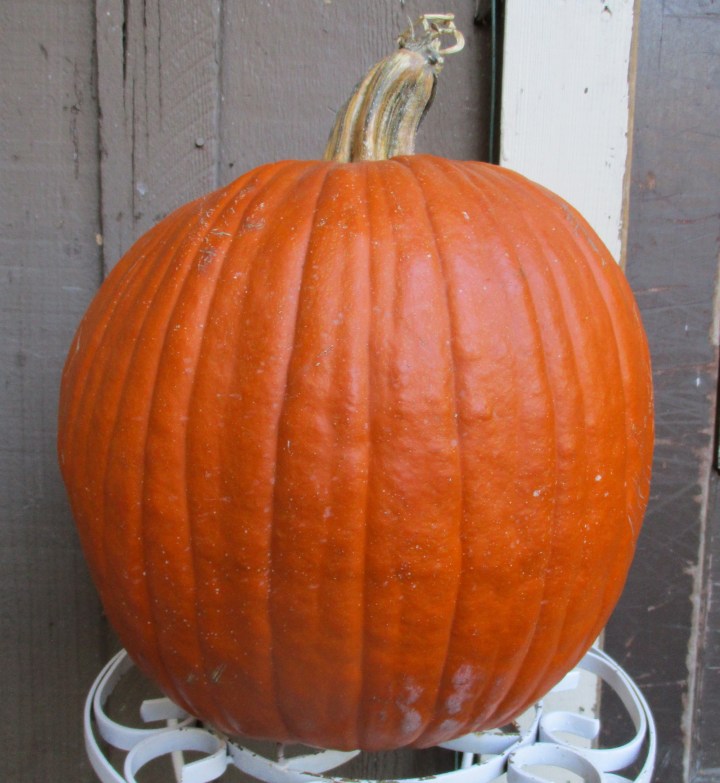
We are much more familiar with the day before, which had been known as All Hollows’ Eve, and is now known simply as Halloween. Although some of the associated traditions are fun for children, Halloween has become an excuse for people to dress up in costumes, party, ruin perfectly good pumpkins, and behave stupidly. What an unsaintly way to celebrate, just prior to the day designated to honor all Saints!
Saint Patrick’s Day is no better. People dress up in green, party, exchange disposable potted shamrocks, and behave stupidly, all on a day that had been designated to honor a Saint whom they know very little about, and care even less about.
Mardi Gras at least makes a bit more sense, with all the indulgent behavior just prior to forty days of good behavior and fasting. Even societies that do not party for Mardi Gras have old traditions of feasting on foods that will be abstained from through Lent, just to avoid wasting them. It is easy to see how such feasting and indulgence evolved into over indulgence and partying. Mardi Gras lacks a tradition of wasting innocent horticultural commodities like pumpkins and shamrocks.
Easter, at the other end of Lent, is still a respectable Holy Day. Most people know that it is a celebration of the Resurrection of Jesus, and celebrate accordingly. Perhaps a bit of indulgence is in order after forty days of fasting, Colored eggs nestled in fake grass, and disposable potted lilies, do not seem to be as inappropriate as ruined pumpkins.
Christmas is the most complicated Holy Day of all. It should probably be divided into two separate Holy Days. The primary Christmas should be the celebration of the birthday of Jesus. The secondary Christmas, which could be assigned another day, and given a different name, could be a celebration of disposable potted poinsettias, dead mistletoe, and a fat guy in red coming down chimneys to deliver gifts under dead coniferous trees that would be terribly embarrassed by their tacky adornments if they were alive.
There is more to Holy Days than pumpkins, shamrocks, lilies, poinsettias, mistletoe and coniferous trees.

KinderGarden

P81028

By modern standards, the public schools that I attended in the early 1970s would be considered to be bleak and primitive. The building were utilitarian and simple, from about twenty years earlier. The landscaping was comparably simple, with a big lawn and proportionately big shade trees. A screen of alternating Monterey pine and Monterey cypress was hedged on the southern half of the eastern boundary of the schoolyard. The only deviants to the simplicity were a few significantly older trees on the northern half of the eastern boundary of the school yard. There were two coastal redwoods, a Canary Island date palm, a cedar, and a spruce of some sort. They were all quite mature, and were likely remnants from an old farmhouse that was there before. Perhaps they wanted us to be aware that everything changes.
On the way to kindergarten, back when children were allowed to walk to school, I weaseled my way underneath the first Monterey pine and Monterey cypress on the southern end of the fence line, and fell asleep. I do not remember how long I stayed there, but it was long enough to get in serious trouble with my very worried kindergarten teacher. After that, I could only visit those two trees in passing, and perhaps stop only briefly to smell the foliage or shake some of the rain away.
Nearly four decades later, but only a few years ago, I was assigned the grim task of composing the arborist report that would justify the issuance of a permit to remove that same Monterey pine, which was the last that remained of the hedged trees that I remember. I did not know that when I went to the site. I was just told that it was a ‘pine’.
Visiting the old school was not a pleasant experience. The entire site was surrounded with a prison like fence and saran screens to obscure the view inside and out. There were no open gates. I needed to be escorted to the tree by a professional chaperone. Much of the schoolyard had been very synthetically landscaped with microtrees and pretty flowering shrubbery that was intended to impress parents rather than appeal to children. It is bad enough that there are no orchards or open spaces remaining in the region, but it is worse that children are deprived of the open lawns and trees and natural spaces that my generation had taken for granted on the grounds of our school. Are children even allowed to climb trees anymore? Do they know what dirt is? Can they observe a chrysalis split open to reveal a new butterfly before the gardeners shear the shrubbery and take the learning experience away? It was saddening.
Once I realized that the tree that I was expected to condemn was my old friend, I asked the chaperone, who seemed to know a bit about facilities at the site, why anyone would want the now mature tree to be removed. I knew that it had been mutilated while young, but was impressed with how it somehow recovered and developed a well structured trunk. I thought that perhaps someone noticed something that I was missing in my inspection. People who are not arborists are sometimes alarmed by something that is perfectly normal for a tree, such as furrowed bark, or slight seasonal foliar discoloration.
The chaperone explained that the tree needed to be removed simply because it did not conform to the style of the rest of the landscape. I waited for the rest of the answer, but that was it. The tree did not conform.
Nothing gave me more pleasure than to explain that after my evaluation of the health, stability and structural integrity of the subject, I could find no justification for removal.
I was dismissed.
Yes, it was worth it.
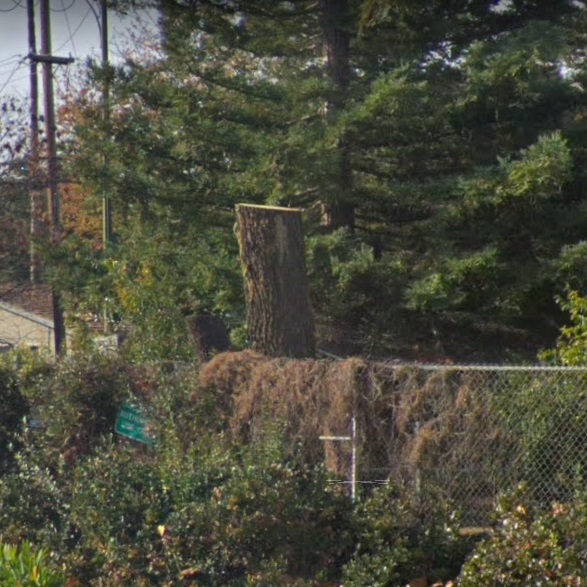
However, I knew that for the right price, another arborist would be pleased to condemn the tree. The picture of what remains suggests that the arborist who did so was not even professional enough to get his crew to finish the job. How does this dead stump conform to the rest of the landscape?
Those old trees, the redwoods, palm, cedar and spruce, were right. Everything changes.
The Monterey pine that would not conform is gone now, but it was right too.

My First Tree

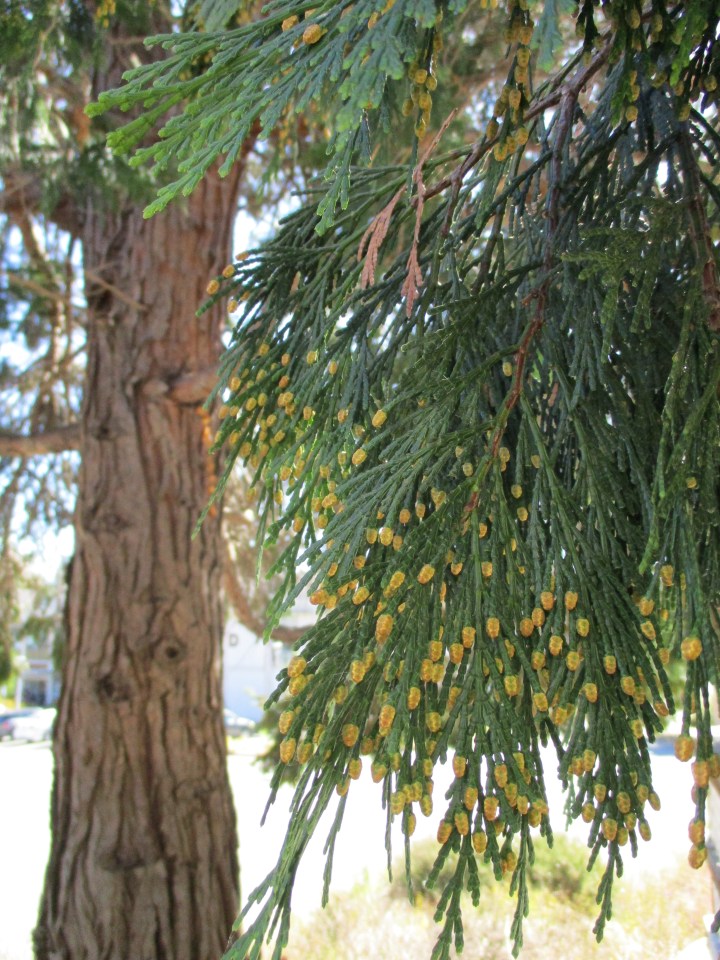
71108Calocedrus decurrens. Incense cedar. The first tree that I ever planted was a small incense cedar, like the tree in the picture here. Of course, it was not this big when I planted it.

It came from my maternal grandparents’ cabin near Pioneer, in the foothills of the Sierra Nevada. It was a wild seedling that might have been pulled up because it was where the cabin was to be built. My grandmother planted it into a small wooden planter in the backyard. Once it recovered and started to grow, she gave it to my parents, who had me plant it on a small hill in the back yard. Although not native to the Santa Clara Valley, it did well, and grew tall and lean. I tend to compare all incense cedars to my first tree.

Almost all are older and bigger, with plump trunks. I can guess from their age that most were planted during the Victorian Period. Quite a few were planted half a century later, during the 1950s, when Monterey pine and Monterey cypress were too commonly planted. Not many incense cedars are young. It is as if they had been available in nurseries until the early 1970s, and were not grown much after that. I planted a few in Scott’s Valley back in the 1990s, on the southern margin of what is now Sky Park, but only because my colleague happened to grow them.

Because it was less expensive to transport ‘relatively’ local lumber than to import Eastern red cedar lumber from the East, incense cedar provided the veneer for closets of old homes here, as well as cedar chests. Small groves of incense cedar were grown in the Santa Cruz Mountains as a local source of cedar wood. Now that cedar closets and chests are no loner necessary to repel moths from woolens and furs, the naturalized groves are abandoned, and now grow wild. I know that they are technically not locally native, but I still like to see a few of them around. They look so much like my first tree.

Six on Saturday: Tequila


If one of these six different agaves happens to be the blue agave from which tequila is made, I would not know. I only know that all six are various specie or cultivars of the Agave genus. The sixth picture is that of the common century plant, Agave americana, which is not used for tequila. I have no idea what the other five are. The fifth looks like it could possibly be a picture of Agave victoriae, but if I remember correctly, I was specifically told that it is not.

All six of these agaves were procured by my colleague. The first specimen is still potted at the shops where we work. The second specimen was relocated into a new landscape early last spring. The other four are within minimal proximity of each other, in a more established part of the landscape. There happens to be two agave pups in the Infirmary Nursery. At least one is from the agave in the second picture. I believe that the second pup is the same as well, but it seems to be developing teeth.

The wickedly sharp teeth and spines of most specie of agave are the main reason that agaves are not more practical in home gardens or small landscapes. It is not practical to try to snip the terminal spines off, because more develop with every new leaf. If they get enough space out of the way, agaves are bold and remarkably striking big perennials that are very resilient to arid climates.

There are no captions this week, because I do not know what to say about agaves that I know nothing about.

1.P81027

2.P81027+

3.P81027++

4.P81027+++

5.P81027++++

6.P81027+++++

This is the link for Six on Saturday, for anyone else who would like to participate:

https://thepropagatorblog.wordpress.com/2017/09/18/six-on-saturday-a-participant-guide/

Horridculture – WEED!

0Q: What do I spray on my medicinal marijuana plants to kill mealybug?
A: Roundup.
This solutions takes care of two problems at the same time; the mealybug infestation as well as the weed that it is growing on! Cutting the weed at the base and simply discarding it is just as effective and even more practical because it does not involve a toxic, environmentally controversial, and expensive chemical herbicide. The best option is to simply not grow weed in the first place.
I am a horticulturist. I love what I do. I love plants. However, I do not worship them.
When I grew citrus trees back in the early 1990s, I happened to enjoy all sorts of rare and unusual citrus fruit that grew on the trees that we grew. However, there were no citrus themed clothing, jewelry, accessories, home furnishings or tattoos. There was no overly indulgent or theatrical manner of consuming the fruit with fancy blown glass utensils designed for doing so, or a traditional technique of taking a piece and passing the rest around. I enjoyed citrus and got on with my life. Yes, I enjoyed growing citrus AND I had a life.
I realize that almost all of those who use marijuana medicinally do so responsibly. That is fine. Keep it out of my way. I am no more interested in smelling it, seeing it, or fleeing the smoke, than anyone else is interested in sharing my prostate medication. I find it to be quite objectionable and offensive.
It would not be so objectionable if those who use it excessively would not so predictably assume that I am a horticulturist because I grow it! Again, there is more to life and the flora of the world than WEED! If you are a stoner, wastoid or burnout because of your reverence for pot, do not recommend that I should try it! It is not as if you are a good example of the attributes of WEED!

My Private Heritage Tree

P81020+++++I really believed that I had something special here. A few fruit trees that are either remnants or descendants of remnants of fruit trees of the old Zayante Rancho have survived on a vacant parcel east of town.
There are two pear trees, a prune tree and an apple tree. The pear and prune trees are too overgrown to make much fruit. Almost all of the fruit that they manage to produce is too high to reach, and of inferior quality. They could be renovated, but the process would require severe winter pruning for several years.
However, the apple tree is still somewhat compact and quite productive. Much of the fruit is within reach for the ground. Much of the rest can be shaken from the tree without damaging it too much. Although abandoned for decades, someone actually put the effort into pruning the apple tree a few years ago. It still needs some major pruning, but would be easier to renovate and restore than the other trees.
I can not identify the cultivar of the apple, or even the type. The fruit looked and tasted like some sort of Pippin apple earlier in the season, but is now slightly more blushed than other familiar Pippin apples in the region. It could of course be another cultivar of Pippin. It is not very juicy, but is quite richly flavored. Winter pruning to concentrate resources would probably improve the quality of the fruit.
Until recently, anyone who wanted to forage for a bit of fruit from these few fruit trees had open access to them. Both prunes and pears needed to be knocked out of their trees, and collected from the ground. Timing was critical for the prunes. They would be unripe if a few days early, or squishy and on the ground if a few days late. Apples were the most popular because they were more abundant and easiest to collect from the tree.
Unfortunately, the vacant parcel needed to be fenced. Only those who are involved with maintenance of the parcel have access to the trees now.
Well, I happen to occasionally work for one of those privileged few, which indirectly gives me access to the distinguished trees.
Of course, I could not resist bragging to my Pa about my privileged access to these now private heritage trees, especially the apple tree. As I said earlier, I really believed that I had something special here.
To my surprise, and perhaps disappointment, my Pa is very familiar with my special apple tree! I had nothing to brag about that he could not also claim! He actually picked apples from it with his mother when he was a little tyke living on Ashley Street in town!

Vahz, Vawz or Voz

P81020‘V-A-S-E ‘ is probably how it is spelled, just like that which is pronounced exactly as it looks, or ‘vays’. ‘Vahz’, ‘vawz’ or ‘voz’ just sounds fancier, . . . or bigger.

That is how I learned it. ‘Vays’ is the smaller version that is designed to contain one or only a few flowers and maybe some foliage. ‘Vahz’, ‘vawz’ or ‘voz’ is the much larger version that is designed to contain entire bouquets or ‘floral arrangements’. Those that contain only dried flowers and foliage do not even need to hold water.

I learned this from those who were experts on the subject. My Aunt Betsy and her best friend Cathy were ‘flower children’. They rented an apartment in a hip and trendy neighborhood in western San Jose back in the early 1970s. The neighborhood was so trendy and hip that the neighbors were known as ‘hippies’. Aunt Betsy and Cathy outfitted their apartment accordingly, with wicker, shaggy rugs, and a big spider plant hanging from beaded macrame.

Of course, there was also a rather big ‘vahz’, ‘vawz’ or ‘voz’. It was cheap molded plaster painted glossy chocolaty brown. It contained a billowy abundance of only two species of dried cut flowers, cattails and pampas grass, that had been sprayed with hair spray to prevent them from sharing their seed. It was as gloriously hideous as it sounds, and more than adequately expressed impeccable cultural refinement and a keen appreciation for the remarkably distinctive and exquisitely tacky style of home decor that was so prevalent at the time.

The cattails might have been collected on the side of Highway 80 in Auburn, near the home of Aunt Betsy’s Great Aunt Mamie. The pampas grass might have been found in Vasona Lake County Park in Los Gatos.

Six on Saturday: Expect The Unexpected


There will be no more bragging about how late the nice summer weather continued into autumn here. Foliage and berries are already coloring for autumn. During this past week, there were a few other unexpected discoveries in the garden, and one that was not in the garden.

1. Pampas grass is an old fashioned cut flower that was popular when I was a kid in the early 1970s. It lost popularity as the style of floral design became less informal and more refined. The pampas grass plants that produce the blooms were beginning to be recognized as seriously invasive exotic specie at about the same time. Those that produce the biggest and most billowy white blooms are not as invasive as those that produce the leaner pinkish tan blooms. Well, I could write another article about pampas grass; but presently, I only need to say is that I did not expect to see these big billowy pampas grass flowers up above and in the background of this big floral display that was left at work from a wedding there last Saturday.P81020

2. Red hydrangea is too modern for my taste. Deep blue or deep purple are no better. I believe that hydrangeas should be white or pastel hues of pink or blue, or perhaps lavender. You can’t improve on perfection. I did not expect to take a liking to this rich maroon hydrangea.P81020+

3. Dogwood foliage, as well as other foliage that colors in autumn, should develop color later here in our mild climate that in most of America. I did not expect to find such bright red foliage on a dogwood tree already.P81020++

4. Cotoneaster berries should likewise develop color as they ripen a bit later than they do elsewhere. I did not expect to find such ripe red cotoneaster berries already.P81020+++

5. Star magnolia was in rough condition after being relocated over summer. It was in an area that was in the process of being landscaped, so the relocation could not have been delayed until after defoliation in autumn or winter. The little magnolia initially seemed to tolerate the process rather well, but about two weeks later, started to wilt and discolor in warm weather. Subsequent defoliation was a slow process that continued into the end of summer. Axillary buds swelled slightly, as if the tree was getting ready for premature autumn dormancy. That was what I was hoping for. I did not expect the now seemingly happy little star magnolia to develop a second phase of new foliage that it will now need to shed later in autumn.P81020++++

6. Apples ripen at various times. Some cultivars finish as early as late July. Others are just finishing now, and might hang on the trees until early November! These apples are from an old tree on a vacant parcel that I do not get to very often. I intend to prune the tree over winter so that it can be renovated and cultivated as such a distinguished old tree should be. I will be recycling this picture tomorrow, and writing more about it. You will understand why if you read that article. Because I do not know what cultivar this tree is, I did know what to expect from it, but after ignoring it for a while, I did not expect that there would be so many apples remaining.P81020+++++

This is the link for Six on Saturday, for anyone else who would like to participate:

https://thepropagatorblog.wordpress.com/2017/09/18/six-on-saturday-a-participant-guide/

Horridculture – Arborists Are . . . Unique.

80221thumbThere are many different types of horticulturists. We are all unique, both individually as well as collectively within our respective professional group classifications. For some of us, individuality interferes with conformity to the collective generalizations that are so commonly associated with our collective groups. For some of us, the stereotypes are a perfect fit.
‘Primarily’, I am a nurseryman. We are the intellectual ones. Well, at least we get most of the credit for being the intellectual ones. Most of us really are quite intellectual. Most of us are rather humble about it.
My excuse for nonconformity to the latter is that I am ‘secondarily’ an arborist. Arboriculture is something that I have never been able to get away from. I did an internship with the most excellent arborists in the entire universe in the summer of 1988. After all these years of mostly growing horticultural commodities, I still sometimes conduct inspections and compile reports for trees that other arborists and their clients are concerned about.
You see, arborists are the passionate ones. One might say that we are enthusiastic, fanatical and zealous. Nurseryman might say that we lack restraint and cultural refinement. It is not such a simple task to distinguish between exuberant dedication and primitive efficiency. Regardless, most arborists do not like to write reports. It is easier to get a nurseryman to do it.
In fact, arborists do not like to write much of anything. There are several elaborate blogs that are written by nurserymen; but blogs written by arborists are rare, with brief and infrequently posted articles.
The irony of this is that it is more important for arborists to express professionalism with clients than it is for nurserymen. Arborists are out in the real world, working directly with clients. Nurserymen work on the farm, isolated from those who purchase the horticultural commodities that are grown there.
Arborists are horticulturists who specialize in the horticulture of trees. The best are just as educated and experienced as nurserymen are. In fact, much of my education was derived from arborists. Yet, arborists are so often regarded as mere gardeners who go up trees.
That is where I get offended. Yes, I am aware that there are hackers out there. I am also aware of what clearance pruning of utility cables entails. I also know how serious my arborist colleagues are about their profession. They are not to be compared to gardeners.
There are many gardeners who are just as educated, experienced and proficient with horticulture as arborists and nurserymen. However, the majority of gardeners are not. I will not elaborate on this presently. It will be the subject of other rants. I have written articles about my professional experience with gardeners already, and none of them go well. (I lack experience with good gardeners simply because they have no need for my expertise.)
The picture above is an example of a sycamore that is pollarded in the traditional English style. The work is exemplary, and is repeated annually every winter. It is no simple task. I certainly would not want to do it. I can not think of any other nurseryman who would know how to do it properly. It is the work of a very skilled and very experienced arborist.

Memorial Memorial

P81014The little Memorial Tree in Felton Covered Bridge park that I so frequently write about is not the first to be planted there in its parking lot island. It is actually the fourth! The first was a California black oak like the other four in the other islands. They were all planted with the original landscape. It did not live there long before getting run over by a car. The island was empty for many years.

The second tree (above) was an Eastern red cedar that I brought from Oklahoma. It arrived here very early in the morning on the last day of 2012, in a bag with a few others that I pulled out of the ground the day before we left. They may be nothing special within their native range, but they are very exotic to me. At the time, I had no plans for the small trees. I just wanted to grow them.

I was downtown and up late the following night when I realized that it was nearing midnight between 2012 and 2013. I took out a trowel, dug a small hole in the island, and planted one of the Eastern red cedars right at the moment that one year changed to the next. I did not give it any more thought than that. Otherwise, I would have preferred a native species like the Park was originally landscaped with.

Sadly, that tree lasted only a few months before succumbing to what dogs do to young trees in parking lot islands. It was a bare root tree, so was not very resilient.

The third tree (below) was a native bigleaf maple that was planted the following winter between 2013 and 2014. It did not get much more planning than the Eastern red cedar. I found it growing on the side of the road where it would have been killed by vegetation management within the utility easement. Like the little Eastern red cedar, I pulled it up and planted it bare root. It was a better choice in some ways, but would have needed to be watered by bucket for the first few years. It survived through the first year and half way through 2015 before it too succumbed to what dogs do. I was being optimistic by thinking that a bare root tree would survive that.

The fourth tree is the little native valley oak Memorial Tree that is there now. I found it for just a few dollars at a local nursery. It was planted in the winter between 2015 and 2016, so this was its third summer. It was a canned tree, so started with more of a root system than the previous two trees that were planted bare root. Nonetheless, life out in that exposed parking lot island is not easy. The tree was severely damaged by weed whackers both in 2016 and in 2017, so barely grew, and is recovering slowly. It is quite well rooted now, so should have a much better season next summer.

https://tonytomeo.com/2018/09/22/illegally-planting/ – This is a link to one of the more recent articles about the Memorial Tree. It includes a link to another previous article, which also links to other older articles. I really do not remember how many updates I have written about the Memorial Tree.P81014+