Six on Saturday: Infrastructure


There is so much more to horticulture than plant material. There is a lot of hard work, which is hard to get in pictures. There are a lot of materials. There is a lot in infrastructure.

Well, I do not have pictures from the farm to show how our horticultural commodities are grown. That would not be very interesting anyway. These pictures are merely odds and ends of what we work with in regard to landscape maintenance.

1. Incarcerated stone. Yes, it is quite obvious that this prison is overcrowded. This is where they do ‘hard’ time. Incidentally, ‘Pet Rock’ was invented in Los Gatos.P80630
2. Half barrel. Back when there were more real wineries in the Santa Clara Valley, barrels such as this were cheap, and could sometimes be found left on the sides of roads for anyone who wanted to take them for kindling. At nurseries and lumber yards, they could be purchased already cut in half, perforated with a few drainage holes on the bottom, and painted with wax on the inside, for use as planters. They are more expensive now. This particular barrel came from France, so is not even made of local valley oak. See the fancy label at the top of the picture? The drainage hole on the left was not drilled through because the drill bit encountered something metallic in the wood. Check out the tips of my stylish boots at the bottom of the picture.P80630+
3. ErmitagE France. This metallic label on the wine barrel is so comically contradictory! The lack of an ‘H’ at the beginning, and the capitalized ‘E” at the end of ‘ErmitagE’ implies that the former contents of the barrel was something fancy, but is then followed by ‘France’.P80630++

4. NO DUMPING ALLOWED. This is a classic example of ‘Do as I say, not as I do’. We dump debris from landscape maintenance all the time. When we prune for road clearance, much of the debris gets thrown back out into the forest behind what was pruned. In some spots, it works like mulch to keep some of the weeds down. Larger bits must get taken away of course. This sign will be posted on a wide spot on one of the roadways where dumping had apparently been a problem. By the way, it is just coincidence that the two words ‘CHILD DUMPING’ lined up like that.P80630+++
5. White star magnolia. This was just moved to the new landscape of a newly renovated building. https://tonytomeo.wordpress.com/2018/06/16/six-on-saturday-rock-on/ We would have preferred to wait for it to defoliate in autumn before relocating it, but it was in the way within another recently landscaped area, and we really wanted to install it here in the new landscape before other material gets installed around it. https://tonytomeo.wordpress.com/2018/04/07/six-on-saturday-rock-concert/ It does not seem to know that it has been moved. I happened to grow these along with many other magnolias back in the late 1990s, and really did not like working with them in the nursery. We just were not set up for them. However, I really like them in the landscape. This particular magnolia grows like a large shrub, so will not get big enough to drop flowers onto all that pavement. That would have been a concern with larger magnolia trees that bloom with larger flowers that can be a slipping hazard when they fall onto pavement.P80630++++
6. Epiphyllum. This just happens to be in bloom at the shop. It belongs to the horticulturist who maintains all the landscapes here, so has nothing do do with the landscapes. With all the pictures of inert items and only one white star magnolia, I thought I should include something a bit more colorful. It does not get much more colorful than this.P80630+++++
This is the link for Six on Saturday, for anyone else who would like to participate:

https://thepropagatorblog.wordpress.com/2017/09/18/six-on-saturday-a-participant-guide/

Horridculture – The Wrong Plant In The Wrong Place

P80627This is the opposite of the ‘right plant in the right place’. It is something that horticultural professionals should neither promote nor tolerate when feral plants appear in landscapes that they are getting payed to maintain. This example looks like it is more relevant to the topic of ‘Fat Hedges’ from https://tonytomeo.wordpress.com/2018/06/06/horridculture-fat-hedges/ , but there is more to this feral pyracantha than that. Yes, it is shorn too frequently to bloom or produce colorful berries. Yes, it looks like an upside-down and halfway buried Christmas tree. Yes, it contributes nothing to the landscape. What is worst of all is that it does not even belong there. It was certainly not planted there on the edge of the curb. There are others nearby, but they happened to appear in spots where they could have actually been assets to the landscape if they had not also been shorn into this weird upside-down and halfway buried Christmas tree shape.

Pulling or at least cutting weeds is generally one of the responsibilities of maintenance ‘gardeners’. It might be acceptable or even preferred to leave a few feral plants if they happen to appear where they might be useful. Those that appear where they would be a problem must be removed. It really would not have been much work to pull this particular pyracantha if it had been done when it first appeared. Even if it had not been pulled right away, and gotten cut down by a weed whacker long enough to develop strongly attached roots, it could have been dug out while young with only a bit of effort.

Okay, so that is in the past now, just like all the other days, weeks, months and years that this feral pyracantha was not removed. Okay, so if for some reason known only the maintenance ‘gardener’ who likely charges significant fees for the maintenance of this landscape, this specimen is to be salvaged, should it not have been pruned back away from the curb? Of course! Although it is right on the curb, much of the growth could have been directed back away from the curb and over the bare embankment. That area is not used for anything anyway. The emptiness of the embankment is certainly no asset to the landscape. Empty pavement is an asset here.

A chain is only as strong as the weakest link. A driveway is only as wide as the narrowest part. All this asphalt pavement and concrete curb is expensive. It was probably worth it to get a nice wide driveway. However, the usable area is not as wide now as it was originally. The feral pyracantha that looks like an upside-down and halfway buried Christmas tree extends nearly four feet into it. That means that the usable space of the expensive driveway is nearly four feet narrower in that spot than it should be. Just think of all the expense that could have been saved if the driveway had been constructed four feet narrower than it had been!

Fiercely Local

P80624There are two terms that I avoid using within the context of my writing:

1. SILICON VALLEY – The name of the main newspaper group that I had been writing for since 1998, almost twenty years ago, is the Silicon Valley Community Newspapers. As much as I enjoyed writing for the small local newspapers of the group, I hate the name. I find the term ‘Silicon Valley’ to be offensive. It exemplifies that which destroyed the idyllic culture and lifestyle of the Santa Clara Valley, which is also known as the Valley of Heart’s Delight. I have never written the term until now.

2. BLOG – It is the contraction of ‘web log’. The ‘log’ in ‘blog’ is not what bother me. It implies a chronological journal, perhaps documenting experiences that are relevant to a designated topic. It is the ‘b’, or more specifically, the ‘web’ in ‘blog’ that is the problem. It implies that information posted on a ‘blog’ gets shared on the World Wide Web. The reason that I avoided sharing my gardening article on the World Wide Web for so long is that they are written very specifically for the Santa Clara Valley. Although some of them are rather universal to gardening, and some are relevant to regions with similar climates and soils, some are not relevant and perhaps inaccurate for other regions.

My gardening column started with the Silicon Valley Community Newspapers, which at that time was ‘fiercely local’. I always thought that was an odd term, but it makes sense. It means that each of the local newspapers features news that is relevant to their specified local communities. Los Gatos Weekly Times was for the news of Los Gatos. Saratoga News was for the news of Saratoga, and so on. When I started writing my gardening column, I wrote about gardening within our local climate and local soils. I could write about local gardening events and even the weather it it happened to be particularly relevant to gardening at the time.

As the gardening column was added to other newspapers in other regions, I was no longer able to write about local events or weather. I was very fortunate early on that all of the newspapers that used the column happened to be within the same climate zones. However, when it was added to the Canyon News of Beverly Hills (in the region of Los Angeles), and a bit later to the related San Francisco News, it became necessary to modify some of the articles to accommodate for differences of climate. Articles that were universally applicable needed no modification. However, those that were too specific to our local climate needed to be edited for the other two climates. For example, when writing about bare root fruit trees, I deleted discussion of apple and pear trees from the copy of the article that was sent to the Canyon News, and replaced it with discussion of bare root plants that are popular and appropriate in that particular region.

Over the years, I realized that my articles became too available online. Not only were they posted within the context of the online versions of the newspapers that had access to it, but they could be inadvertently opened from other related online newspaper . . . or just about anywhere. Someone in Oklahoma, Pennsylvania, Australia or anywhere in the World could click onto one of my articles just as easily as a local article, and could do so without knowing that it was written for a completely different climate or hemisphere!

I explain in my ‘About’ section that the articles are written for the Santa Clara Valley, but I doubt that means much to those who find the articled without seeing that explanation. I will continue to write my article for the newspapers that still use them, and will continue to post those articles, as well as ‘elaborations’ articles on my ‘blog’. Like so many other gardening articles that are out there nowadays, they will be inaccurate for some regions. Those reading them will need to use their own discretion.

What is sad about all this is that I started writing my garden column precisely because I was so frustrated with what was being published in the San Jose Mercury News at the time. It was typically written quite well, and by professional writers, but was very often very inaccurate because those writing it were either writing for other regions, or simply knew nothing about horticulture. I was so pleased with the opportunity to write accurate information about gardening for our region. Yet, after all these years, I feel like I am now doing exactly what I found to be so frustrating twenty years ago.

Upgrade

P80624.jpgThis autumn, it would have been twenty years that I have been writing my weekly gardening column for the Silicon Valley Community Newspapers, affectionately known as SVCN. It would have been excellent if it had lasted that long, but it was discontinued a few months ago. There was no warning, although we all know the direction that such media is going nowadays, and that such changes are abrupt. Nothing is like it was nearly twenty years ago.

My weekly gardening columns will continue for the other newspapers that still use it, even if they do not use it for their print versions. Again, due to the way such media operates nowadays, I have no idea of which newspapers who have access to it actually use it, or if they use it for their print versions or merely their online versions.

I could elaborate on the history of my garden column and its inclusion into the various other newspapers that continue to use it, but that can just as easily be another topic for another time. Perhaps I will merely put a bit of that information in my ‘About’ section if I ever get around to updating it. I have another topic to discuss now.

I would like to upgrade this blog. I would like to make it as fancy and user-friendly as some of the other blogs that are out there. I know that the last thing I need right now is more work, but I also want to maintain this as an venue for my weekly gardening column, particularly if other newspapers are likely to discontinue using it in the future.

Upgrading will include selling add space, or at least making add space available to advertisers who can use it. Newspapers pay very minimally for my weekly gardening column, and the newspaper group that payed the most for it no longer uses it. Advertisements might help to justify the work that goes into writing a new gardening article weekly. Hopefully, no one will be to bothered by these changes. I have enjoyed writing my weekly gardening column for almost twenty years, and would like to be able to continue doing so for a while longer.


Summer Deciduous

P80623K+++That is a term that we do not hear much. There are not many plants that it applies to. Cyclamen is one of the more familiar plants that is summer deciduous. It is from a climate with reasonably mild winters and unpleasantly dry and warm summers. Just like most deciduous plants are dormant through winter to avoid the unpleasantries of the weather, cyclamen defoliates as the weather gets warm in early summer to avoid the expected heat and aridity. It somehow knows how to stay dormant until the weather starts to get cooler in autumn, and is ready to regenerate new foliage and bloom as the rain starts. The active growing season is through autumn, winter and into spring. It is all a matter of taking advantage of the weather while it can, and avoiding the discomforts of severe weather when necessary.

Rhody, like most dogs, has been shedding his fluffier inner winter coat through spring. He still seems to be too fluffy for the weather, but he must know what he is doing. The remaining wiry outer coat provides a bit of shade, and helps to dissipate a bit of warmth when necessary.

Unlike Rhody, I do not have a fluffier undercoat to shed. All that I could do is shed some of the sparse and wiry outer coat. It might have provided shade, but also interfered with cooling air circulation. It does not seem to be designed to dissipate heat like Rhody’s is. Regardless, it was shed just before the Summer Solstice, and will not regenerate until autumn. A barber sheared back the upper evergreen growth first. I then pollarded most of the lower growth, leaving only a pair of formally shorn hedges flanking the upper margin. They too may be removed soon. Antithetically of https://tonytomeo.wordpress.com/2018/01/17/winter-coat/P80623KP80623K+P80623K++

Six on Saturday: Nursery Rhyme


I wish we had one. There is no rhyme and only a few disjointed reasons for what happens at the small storage nursery at the maintenance shops. This is nothing like acres of production nursery full of rhododendrons, azaleas, camellias and such. Nor is it like the retain nurseries that sell the rhododendrons, azaleas, camellias and such. This is merely a small yard where we store a few plants that get removed from landscapes, and plants that were recently procured from a nursery but have not yet been planted.

It is like the nursery version of the wood shop, with its collection of new lumber and old recycled lumber that gets used on the historic buildings. The plumbing shop contains all sorts of new plumbing and fixtures, as well as many old fixtures that might someday be useful. The landscape shop, which is separate from the nursery, is #7 of about twelve specialized shops used by the maintenance staff. The nursery might seem to be the most dysfunctional of the several shops, but only because plants are dynamic and need maintenance . . . and because, without necessary maintenance, a few have deteriorated, died or conversely thrived and made themselves at home.

Newly procured plants like #5 and #6 are easy to work with. They come in with a plan, and generally leave within a week or two as they get installed out somewhere in the various landscapes. Recycled plants like #1 and #2 were removed from the landscapes either because they were in the way of something, or because they proliferated too much, but could someday go back into other landscaped areas. Then there are a few plants like #3 and #4 that stay long enough to disperse roots through the bottoms of their cans and into the ground, essentially planting themselves on the spot because they got tired of waiting for a new home.

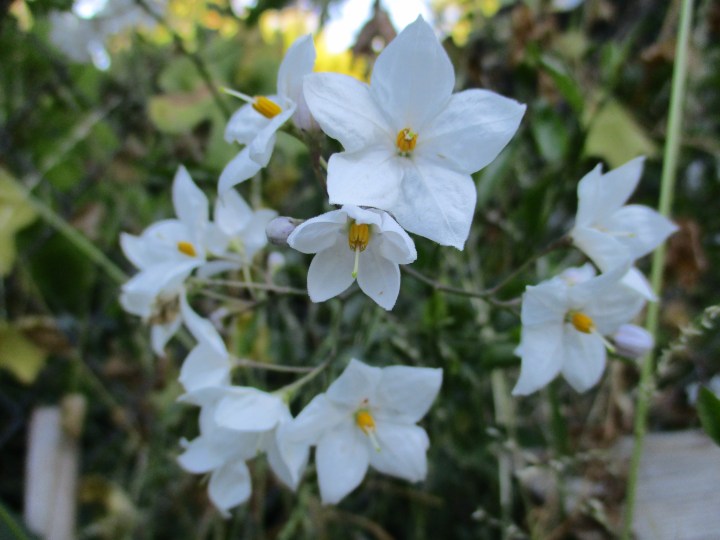
1. Peruvian lily was so prolific at the Post Office that many needed to be pulled. They were canned to be installed elsewhere, but no one wants to put them into a situation where they might proliferate like they did at the Post Office. Besides this pink, there is also peachy pink and yellow. All are the tall types that were originally grown fro cut flowers, rather than the lower mounding home garden varieties. Consequently, they need to be staked or caged like tomatoes so that they do not lay on the ground.P80623
2. Chrysanthemum was grown as annuals in a few various locations, but when they were removed to relinquish their space for more seasonable annuals, a few were canned. It is not always easy to discard certain perennials just because their time is up. The problem is that, although they look so good in the nursery, and bloom in spring instead of autumn, they do not get cycled back into the landscape. When new color is needed, it is often purchased and planted before the old stock is considered.P80623+
3. Potato vine has been growing like a weed on the cyclone fence and shade structure for so long that no one knows where it came from. I do not even know where the vines originate from. I would guess that somewhere under the overgrowth, the main canes emerge from the remains of a #1 can that the roots split apart years ago. This vine lives here now. Even if we had a spot for it, relocation is not practical. If it gets too overgrown, it might get cut back.P80623++
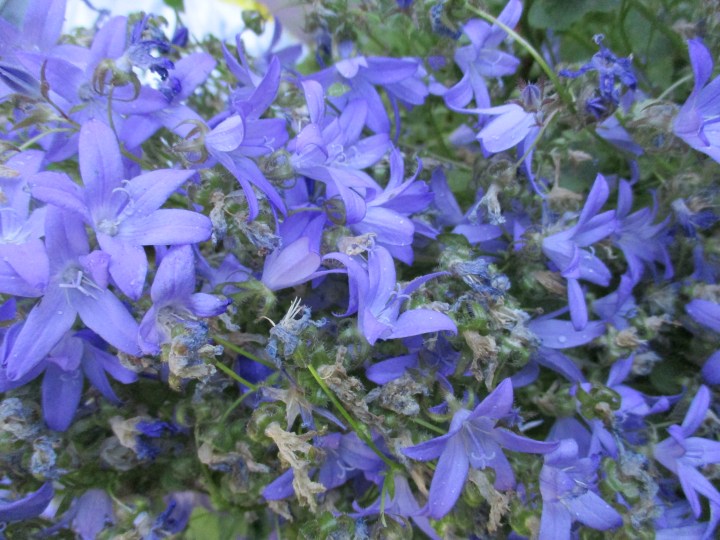
4. Campanula was probably in a 4” pot that got set into the #15 can of a ‘Black Lace’ elderberry and forgotten about. It might have been recycled, or it might have been something new that never got installed. Before the elderberry was relocated, the campanula had spread into the cans of other trees, so like the potato vine, it lives here now.P80623+++
5. Cone flower is easy. I just arrived from a nursery, and will be installed into a landscape in just a few days.P80623++++
6. Yarrow came with the cone flower, and will be planted nearby in the same landscape at about the same time.P80623+++++

This is the link for Six on Saturday, for anyone else who would like to participate:

https://thepropagatorblog.wordpress.com/2017/09/18/six-on-saturday-a-participant-guide/

Horridculture – Stub

P80620.JPGHow can a professional ‘gardener’ leave such a stub on the little California black oak in Felton Covered Bridge Park. It is not as if it is high in the canopy of a large tree, and out of reach to an arborist. This one is right at eye level, exactly where someone getting out of a car parked in the adjacent parking space would run into it. The entire tree needs some major corrective pruning, which would include the removal of significant limbs and portions of the canopy, but that is only because of years of neglect, and is another story. Right now, we are focusing on the eye-level stub.
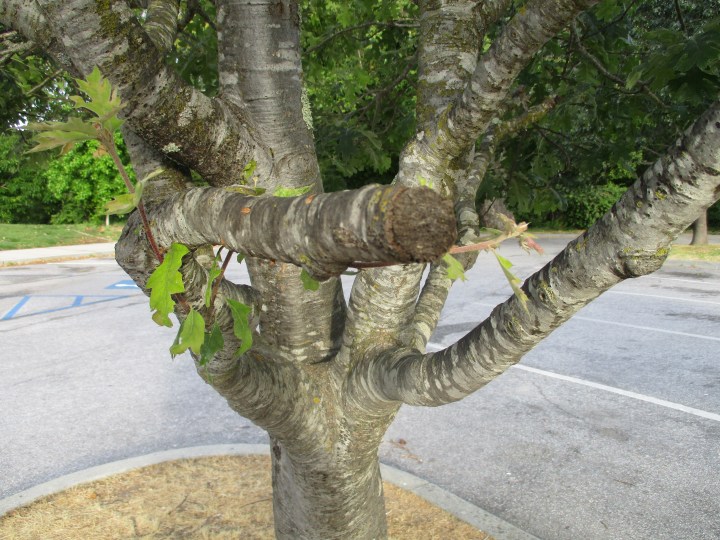
It is not easy to see in these pictures because the lower branches are so congested. The stub extends from the lower left to the upper right in the first picture. It is right in the center of the second picture, protruding upward and to the left of the trunk, and then kinking back to the right. The last picture shows how easy it would be to reach from the ground. This particular tree is located right across from the Memorial Tree. https://tonytomeo.wordpress.com/2018/04/15/memorial-tree-update-to-the-updated-update-etc-the-sequel-to-all-those-other-sequels/

We are always taught to not leave stubs. They interfere with compartmentalization of the pruning wound, or in this case, grow back into a disfigured wad of useless growth that will just need to be removed later. This poor tree already has plenty structural problems. Even if it were not unhealthy for the tree, it is just plain unsightly. Seriously, this looks ridiculous.

‘Gardeners’ do it all the time, as if they all take the same class on ‘how to leave stubs’. What was the advantage to cutting the limb right there instead of two feet closer to the trunk to eliminate the entire stub?P80620+P80620++

Gemini

P80617Astrology is an interesting concept. It is amazing how accurate the various zodiacs are. In fact, they are so accurate, that all twelve of the zodiacs can apply to just about anyone, regardless of their respective birthday.

For example, Gemini people are gentle, affectionate, curious and adaptable. Well, who isn’t? If I told you that these traits applied to Leo, Aquarius or Sagittarius, would you believe me? The weaknesses of Gemini are nervousness, inconsistency and indecisiveness. We all of us experience these weaknesses at one time or another. Gemini people like music, books, magazines and strolling about town. What about Aries, Capricorn and Taurus? Don’t they? Are Gemini people unique in their dislike for loneliness, confinement or repetition? Probably not.

June 20 will be the end of Gemini. It will then be time for Cancer, with its set of distinctive traits, strengths and weaknesses.

Gardening according to astrology might seem to be just as ‘accurate’, but there is a bit more science to justify it. Back before calenders were commonly in use, the seasons were identified by the weather. Since weather changes like . . . well, like the weather, astrology provided another level of accuracy based on the time of year rather than on variable weather. For years when warm weather lingered into autumn, astrology dictated when cool season vegetables needed to be planted, even if the weather suggested that it was too early. Astrology was also used to forecast the last frost date, even while winter was still cold. It might have taken decades to compile enough data for the system to work, but it really was, and continues to be effective. After all, the calendars that we use now are based on the position of the Earth within the Solar System, or in other words, astrology.

Gemini

P80617Astrology is an interesting concept. It is amazing how accurate the various zodiacs are. In fact, they are so accurate, that all twelve of the zodiacs can apply to just about anyone, regardless of their respective birthday.

For example, Gemini people are gentle, affectionate, curious and adaptable. Well, who isn’t? If I told you that these traits applied to Leo, Aquarius or Sagittarius, would you believe me? The weaknesses of Gemini are nervousness, inconsistency and indecisiveness. We all of us experience these weaknesses at one time or another. Gemini people like music, books, magazines and strolling about town. What about Aries, Capricorn and Taurus? Don’t they? Are Gemini people unique in their dislike for loneliness, confinement or repetition? Probably not.

June 20 will be the end of Gemini. It will then be time for Cancer, with its set of distinctive traits, strengths and weaknesses.

Gardening according to astrology might seem to be just as ‘accurate’, but there is a bit more science to justify it. Back before calenders were commonly in use, the seasons were identified by the weather. Since weather changes like . . . well, like the weather, astrology provided another level of accuracy based on the time of year rather than on variable weather. For years when warm weather lingered into autumn, astrology dictated when cool season vegetables needed to be planted, even if the weather suggested that it was too early. Astrology was also used to forecast the last frost date, even while winter was still cold. It might have taken decades to compile enough data for the system to work, but it really was, and continues to be effective. After all, the calendars that we use now are based on the position of the Earth within the Solar System, or in other words, astrology.

The Good Weed

P80616KOnce in a while, a stray seed of a plant that would normally be considered to be an invasive exotic species happens to grow in a spot where it happens to fit. Those of us who regularly pull up unwanted feral seedlings, are typically skeptical. We probably pull up many such seedlings merely because we do not trust them, or because we do not want them broadcasting their seeds elsewhere in the neighborhood. In our region, Acacia dealbata, blue gum eucalyptus, black locust, pampas grass, broom, poke berry and Himalayan blackberry get no consideration; and their seedlings should be removed as promptly as they are discovered. English ivy does not get much more consideration, but every once in a while, it happens to wander into a situation where it is allowed to stay.

Catalpa is one that we are not quite sure about. It is an exotic species that happens to disperse unwanted seed at times, but is not invasive enough to warrant prompt removal of all seedlings. Many seedlings appeared in the area several years ago, and most were removed because of where they were. However, if any other seedlings have appeared since then, they have been discreet enough to remain unnoticed. It was as if there was a very specific mating season. Catalpa had not been invasive prior to that, and has not been invasive since.

Two of the feral catalpa seedlings appeared on the edge of the parking lot at the Felton Presbyterian Church. One became disfigured and distressed, and finally died before being removed. The other just happened to be in the middle of a parkstrip, and in a location where a good sized shade tree had room to grow. Because no one could find a good reason for removal, it stayed. After only a few years, it is now a good sized and very well structured shade tree that blooms nicely this time of year. It may not last long, since catalpas are short lived, but for now, it is a nice component to the landscape. This weed gets a happy ending.