Trout and Cabbage

61012No; this is not a recipe. It is two brief stories about my first fishing trip and the first vegetables I ever grew.

My first fishing trip was at Silver Lake, past my grandparents summer house in Pioneer. I was just a little tyke. I think I had just a small cane with a hook on a string tied to it. I doubt that I was expected to catch anything with it. I sat on a bare granite shore with my Uncle Bill behind me to keep me from falling in, and my hook on a string in the water.
‘Fishy’ took the hook almost immediately. He was a slippery and shiny trout who startled everyone around with his eagerness to grab onto the hook in order to come home with us. I pulled him up so that my Uncle Bill could take him off of the hook. However, to my surprise, my Uncle Bill explained that Fishy had to go back into the lake because he was too small! I was baffled. I told my Uncle Bill that Fishy could not bee too small because he was bigger than any other fish in my grandfather’s aquarium!
Of course, Uncle Bill then explained that the objective of fishing was not to relocate fish from the uncomfortably cold lake to the cozy warm aquarium. As he continued to explain what the real objective of fishing was, it became very obvious that the lake was the best option for Fishy! Uncle Bill put Fishy back in the water, where he happily swam away. I am pleased to say that I never saw Fishy again.
Shortly afterward, my grandmother gave me a six-pack of cabbage seedlings that I planted in a neat row below my mother’s kitchen window. I was so pleased with them. I watered them and talked to them and sometimes just petted their waxy leaves. They grew quite large, and started to crowd each other.
Then, one day while I was out playing with my pine cones and favorite dirt on the patio, my mother came out with a paring knife and walked by without saying anything. To my HORROR, she returned with a severed cabbage! I totally freaked out! Of course, my mother explained to me that the objective of growing the cabbages was to eat them, and that they were the same vegetable that I liked so much in a cooked form. That was not much consolation. If I had known that, I would have planted them up at Silver Lake so that they could live happily ever after with Fishy.
Well, I did not eat any cabbage with supper that evening. By the time the second cabbage was murdered, I was able to eat it. I did not want it to die in vain; and it really was quite good. So were the third, fourth and fifth cabbage.
The last cabbage was the runt of the litter, so my mother allowed me to care for it all through winter. When it got muddy from splattering rain water falling from the eave, I washed it with soap, which is how I learned that plants do not like soap. As the weather warmed in spring, it bolted. The outer leaves got rather crispy, and a floral stalk stretched upward from the center. It bloomed with small yellow flowers and even made little seed capsules. I do not know if it ever made viable seed, because I did not collect any. By the time it deteriorated and died, I knew that it had lived a full life, so was not too sad about it. The funeral was brief before it was interred behind the apricot tree.
In the end, I ate neither the first fish I ever caught, nor the first vegetable I ever grew.

Schedule Adjustment

P80624Something that I neglected to consider about the first year anniversary of this blog is that what was new is now old. The articles from my weekly gardening column that were new when posted last year are now a year old. That necessitates an adjustment to scheduling.
Recent articles get posted on Mondays and Tuesdays. Each article gets split into two separate posts. The first part on Monday is the main article, which is about a specified horticultural topic. The second part on Tuesday is about the featured species. Older articles from the same time a year earlier get posted in the same manner on Thursdays and Fridays. That format worked well until now. Articles that were new in the beginning of September of last year are scheduled to be recycled now, for the beginning of September this year.
Obviously, there is no point in posting the same articles twice. ‘Flowers Might Be Getting Scarce’ and ‘Fernleaf Yarrow’ were already recycled earlier, before I noticed that they were two of the first articles posted a year ago. The simple solution would be to back up a year, to recycle articles from 2016 instead of from 2017. However, those articles were already recycled on Thursdays and Fridays. Therefore, the schedule will be backed up even farther, to recycle articles from the same time in 2015. I am trying to keep this simple. Of course, no one should notice. The articles are appropriate to the season regardless of what year they were written in.
What might get noticed is that a few extra articles will be added to the mix. This will only continue between about now and the beginning of November, which was when I started recycling articles last year. Because the blog started in the beginning of September, and I started recycling year-old articles in the beginning of November, there are articles from September and October (between about September 1 and November 1) of 2016 that have not yet been recycled. I want to use them up just to that none get left out.
This is probably way more explanation than anyone needs, particularly since it is mostly in regard to something that should not get noticed; but it will explain the few extra articles between now and November. If I get a bit of time later today, I might add the first of the superfluous articles tonight.

Six on Saturday: Again – Not My Garden


There are just too many cool things blooming in my colleague’s garden to not get some more pictures. Some may seem to be redundant to others that were shared earlier, as well as to some that have not been shared yet. The unknown salvia and lion’s tail are finishing their bloom, as it the know what time of year it is. The weather may not seem like that of late summer, but they know otherwise. I got these pictures while I could. African iris and African daisy are oblivious. They bloom whenever they want to, and African iris can even bloom a little bit through winter if it chooses to. Autumn sage, as the name implies blooms best about now. Of these six, only the four O’clock will deteriorate in autumn and die back through winter. The salvias will get pruned back anyway.

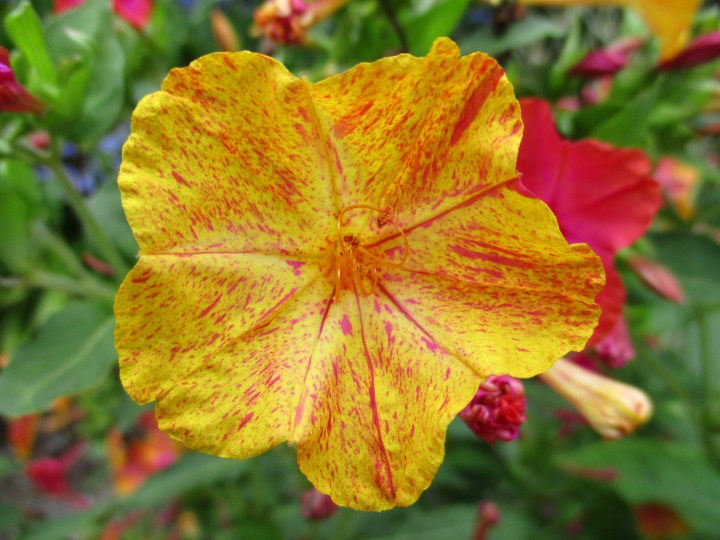
1. Four O’clock, Mirabilis jalapa, are the same as those featured last Saturday in Six on Saturday, and in the following brief article about the individual plants that bloom with flowers of different colors. This one looks like a blob of mustard with a bit of ketchup that squirted out of a hamburger as someone bit into it. The rich red flower in the background that looks more like plain ketchup is on the same stem.P80908

2. Autumn sage, Salvia gregii, is a different cultivar of the same species featured yesterday. The picture that was posted yesterday was from a specimen in the landscape at the library in town. This picture is that of a cultivar of smaller stature but with bigger flowers. The zonal geraniums of questionable (pink, salmon, peach or whatever) color that were featured last week can be seen in the background.P80908+

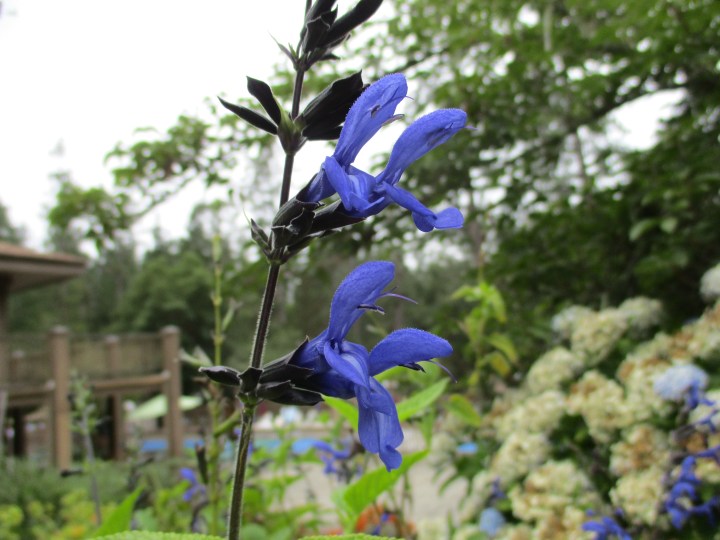
3. Black and blue salvia, Salvia guarantica, looks just like this. . . or this looks just like black and blue salvia. I really do not know what it is. It sure is an exquisite blue though. The base of the plant is rather scrawny, almost as if it intends to grow only as an annual. It will get cut back like other salvias, but not as aggressively. If it regenerates from the base like it should, the old growth can be cut back later.P80908++

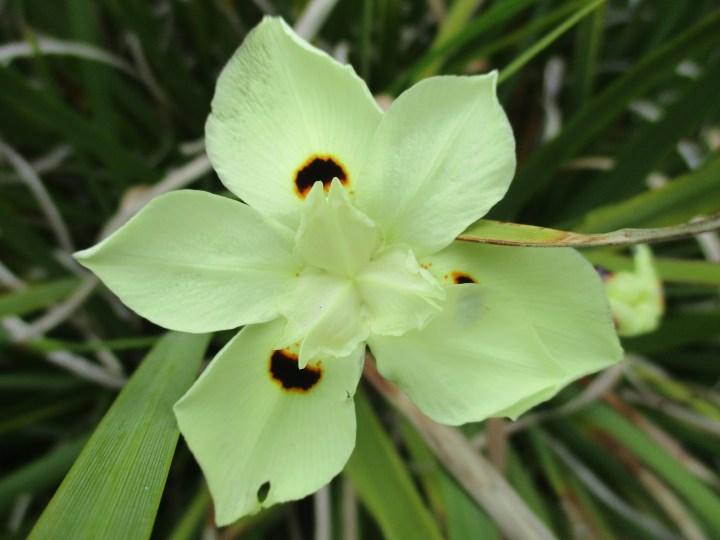
4. Yellow African iris, Morea bicolor, is sort of cliché. However, this is the only one anywhere around. Seriously, with all the many acres of landscape that my colleague maintains out there, this is the only one. The more common white African iris, Dietes iridioides, is lacking completely. (‘Dietes‘ and ‘Morea‘ are synonyms, but ‘Dietes‘ is uses more for the ‘iridiodes, and ‘Morea‘ is used more for the ‘bicolor‘.)P80908+++

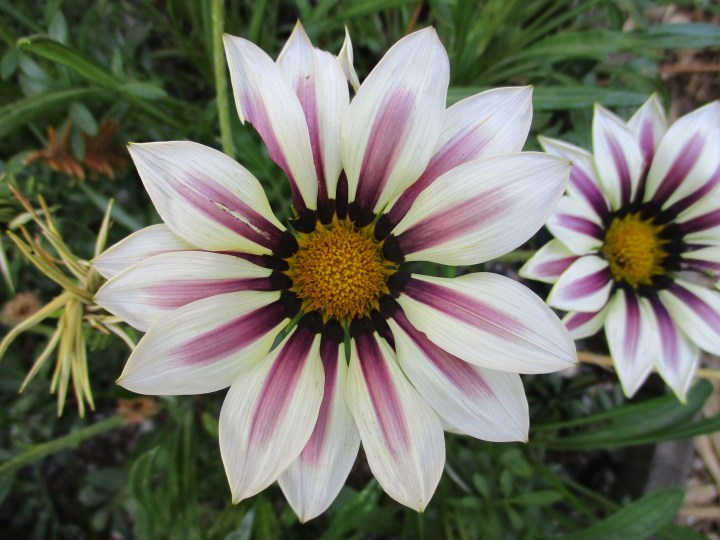
5. African daisy, Osteospermum ecklonsis, looks something like gazania. There are plenty pictures of gazania as well, but I will use them for the next two weeks. This species of African daisy is shrubbier and more colorful than the sprawling types that were popular as ground cover back in the 1980s. It blooms more profusely, and with more vivid colors. I probably should have gotten pictures of the other colors too.P80908++++

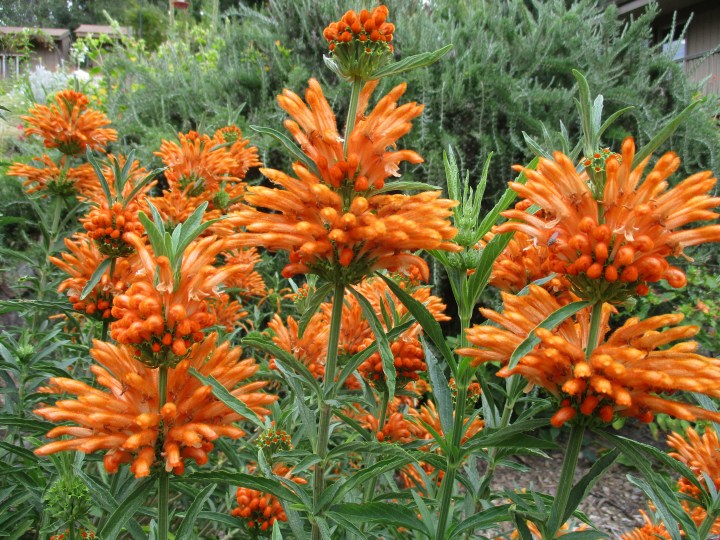
6. Lion’s tail, Leonotis leonurus, will be featured in my weekly gardening column this week, which shows up here on Tuesday. I am no fan of orange, but I can not dislike this bloom. The color is as flashy as that of California poppy. I will never understand why this perennial is not more popular than it it. It has been available longer than some of the less impressive salvias, but salvias are trendy. They are related of course.P80908+++++

This is the link for Six on Saturday, for anyone else who would like to participate:

https://thepropagatorblog.wordpress.com/2017/09/18/six-on-saturday-a-participant-guide/

Horridculture – Drought

P80905It is a way of life in much of California. Many of us grew up with it, or at least believing in it. Many of us never heard the end of it. That is how it lost its meaning.
Drought is a weather condition. It might last one year or a few. Drought can even continue for several years. For us, it entails less than normal rainfall through winter, only because winter is when rain is supposed to fall here.
As a weather condition, drought is not permanent. There have been a many during the past few centuries of recorded history here, and a few of those have been in just the last half century that I can remember. They happen frequently enough that I can not remember the exact years that were drought years, although I can remember a significant drought in the middle of the 1970s. No drought lasts forever.
If drought lasts forever, or at least as long as anyone can remember, then it is not a weather condition, so is therefore not really a drought. It is ‘climate’.
The climate of much of California is naturally arid. San Jose and the entire Santa Clara Valley have a ‘chaparral’ climate, which is classified as ‘semi-arid’. Some areas near the base of the Santa Cruz Mountains get only about a foot of rainfall annually. Los Angles and the region around it in Southern California have a ‘desert’ climate, which is ‘arid’. Parts of the Mojave Desert get less annual rainfall than other climates get from a single storm.
Although droughts happen here, the limited availability of water is due to the natural climate, not weather. Those who came to California a long time ago knew how to use what was available. The problem now is that there are simply too many people wanting too much of a naturally limited supply of water. Way too many expect way too much.

Un-Update

P80902KThere is NO news regarding the tiny Memorial Tree in Felton Covered Bridge Park that I so frequently provide updates for. It did not do much this year. I probably already mentioned this when it was busy not doing much in spring. It is in a difficult situation, where too many dogs do what dogs do to tiny valley oaks that are busy not doing much more than trying to survive without regular watering, out in a harshly exposed island in a parking lot. Once it gets going, it should do fine. It is only slow now, but is not unhealthy. It is doing exactly what it should be doing this time of year. By late autumn, it will try to defoliate. Valley oaks are never in a rush for that.P80902K+
This angel’s trumpet is more interesting because it was seemingly deceased. As you can see, it is trying to recover . . . just in time for autumn. Unfortunately, there will not be sufficient time and warm weather for it to mature enough for the new stems to survive even a mild frost next winter. At least it will get a bit of time to recharge the roots so that it can regenerate a bit more vigorously next spring.
There is of course the possibility that it will not get frosted too severely in winter. It is somewhat sheltered by the canopies of nearby trees. We may even try to protect it under a box on the coldest nights.
Realistically though, the loss of such minor growth would not hurt it much. As it matures, it will likely lose much or most of its outer foliar growth annually each winter, and then replace it with new growth each spring. The priority for it now, or at least next spring, is to develop substantial stems that are above where ‘gardeners’ will cut it down with a weed whacker. Once it does that, it will have a relatively permanent framework of resilient trunks that it can get frosted back to.
The main problem since it was installed was not the frost, but unskilled labor with weed whackers. No matter how emphatically we explain to the ‘gardener’ that it is not a weed, his crew cuts it down a few times annually when no one is there to stop them.P80902K++
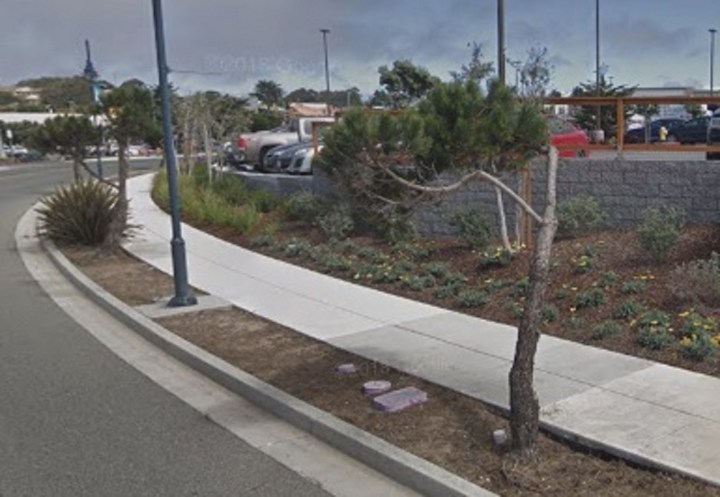
Naked ladies continue to bloom all over the region. These happen to be in the parking lot of Felton Covered Bridge Park. Several that were surplus in a neighbor’s garden were planted in the corners of the various islands. Unfortunately, because of their locations, most of their flower stalks get trampled and broken off. The picture below shows how exposed they are within an area of substantial traffic. The foliage that develops later does considerably better. It is too substantial to be trampled and ruined completely, and it gets a bit more substantial every year. However, the substantial foliage is not here yet to prevent the flower stalks from getting trampled.P80902K+++
By the way, if you think that I wrote this post because of the (former) lack of a horticulturally oriented topic for today, you are correct.

Dogs


It is now September 2, the day after both the feastday of Saint Fiacre, patron saint of gardeners, and the first anniversary of this blog. It is also the anniversary of the only day in the last year that I did not post anything. Yes, the second day of the blog was the only day without a post. Early in those first few days, I posted the only article that was irrelevant to horticulture, and an explanation that I would not make a habit of doing so. I wanted to try it just once to see if I could do it like so many others do. It was overrated. Nonetheless, after almost a year since that naughty diversion from my self imposed discriminating standards, I want to try it again. After all, I have not yet posted a horticulturally oriented article on September 2 within the context of this blog, so why start now.

PRIVET
This is Privet. He passed away on December 1, 2004, after about eleven years of devout service since about 1993 or so.
Privet was a feral dog who lived in Thomspson Creek behind a retail nursery in the Evergreen District of San Jose where I worked temporarily in the early 1990s. Late every afternoon, he commuted down Thompson Creek to a neighborhood pet store where food was left out for him. Aster and Yarrow, two angry guard dogs who lived in the nursery, would thrash about on the inside of the enclosing cyclone fence as they tried to get to him, but only damaged the merchandise inside the fence. I would cuss at him and threaten him through the fence. He would just stare at me blankly, and keep a safe distance.
One day, Privet was noticeably absent. He was likewise absent the following day. In fact, I did not see him again until several weeks later when we went to the Humane Society of Santa Clara County to adopt a cat to help with the mice in the office. We happened to go through the wrong door to where the adoptable dogs were. There he was! As usual, I cussed at him and said all sorts of mean things to him . . . .until I noticed that his time was up. I asked someone who worked there what that ominous date on his placard meant, only to be told something too unpleasant to repeat here. They were understaffed, so had not gotten around to it yet. Well, the next thing I knew I had payed the adoption fees, and Privet was sitting defiantly next to me in the Buick as we drove away real fast. We never spoke of it again.

WILLOW
My niece named this cool dude Willow, but we just called him Bill because I was told that Willow is a girly name. He was not planned either. In about 2008, I saw his picture on the website of the Peninsula Humane Society in Burlingame. Without thinking, I drove up and adopted him on the spot. On the way, I telephone a friend who I though would try to talk me out of it. He did not. Those working at the Humane Society asked if I would like to interview other dogs. I told them who I was there for. Bill was a several years old when we met. He became blind and deaf in old age, but was still happy until he passed away on December 4, 2016.

P71014
Rhody arrived only a few months later, early in 2017 and in the traditional unplanned manner. I can not imagine why he was available for adoption for several months in Santa Cruz. It was not my idea for him to come live with me. It was his. I could not talk him out of it. He seems to be remarkably happy with his simple lifestyle, although I can not imagine why. I wish I could provide better for him. Like Privet and Bill, he has more friends than he can keep up with. Privet was a Pontiac man. Bill was an Oldsmobile man. So far, Rhody seems to be a simple Chevrolet man.

BLACKJACK
Blackjack does not live with me. He is not a dog either. He is a big kitty who has enslaved one of my colleagues, although my colleague does not seem to be aware of it. Cats are of course masters of mind control techniques. Blackjack did not get his name from the blackjack oak. It is just a cool name that suits him well. He is not really as demonic as he seems to be in this picture. Nor is he trying to fly upside down. He just happened to yawn while laying on his back and stretching.
Of course, only the names are horticultural. None of these guys cares about gardening. I sort of feel guilty about not writing about a horticultural topic today, but perhaps I will get over it.

Saint Fiacre Day

P80901KK

Today, September 1, was the Feastday of Saint Fiacre, the Patron Saint of gardeners. I would not have known if I had not earlier seen this very thorough and informative article written by Doctor David Marsh of the Gardens Trust;

https://thegardenstrustblog.wordpress.com/2018/09/01/st-fiacre/

In all my writing, I had mentioned Saint Fiacre only once, and only in regard to garden statuary. I described how Saint Francis, who happens to be the patron saint of animals, is popularly believed to be the patron saint of gardeners because his statue is so popular in gardens, often in conjunction with statues of frolicking animals, but that statues of Saint Fiacre are very rare.

Besides the Feastday of Saint Fiacre, this September 1 also happens to be the first year anniversary of my blog. I have now been posting articles from my weekly gardening column, as well as other elaborations, for an entire year. With the exception of September 2, the day after establishing the blog, I have posted an article daily. Since participating with the Six on Saturday meme, I have been posting two articles on Saturday. There were even a few days in which three articles were posted.

Unfortunately, back in February or March, my weekly gardening column was discontinued from the Silicon Valley Community Newspapers, which was the first newspaper group that I started writing for nearly twenty years ago. Silicon Valley Community Newspapers still has access to the articles, and can use them if they choose to; but I am no longer employed with them. Because I write for several other newspaper groups, I did not want to stop writing my weekly gardening column just yet. I enjoy it too much. I will have been writing it for twenty years in October, but blogging is still new to me.

P80901KK+

Different Time Zones

P80901KIf the flower on the left is a four o’clock, is the flower on the right a five o’clock, or perhaps a three o’clock? Is one a.m. and the other p.m.? What about the flower of the same species that I featured twelve hours ago? What about those in another picture that I will share next Saturday?
Of course, only the colors are different; not the name . . . or the time.
What is odd about these two seemingly different flowers is that they are on the same plant. In fact, they are on the same stem, separated only by a few inches.
Four o’clocks can be odd that way. Individual plants typically bloom with exclusively pink, red, white, yellow or orange flowers. The shades and hues of these colors are variable, but are typically homogeneous throughout each entire plant.
Some plants bloom with flowers of one color that are spotted or variably striped with another. Their flowers are not as homogeneous as those that bloom with only one color, so some of their flowers might be uniformly one color or the other, without spots or stripes. Some plants bloom with a few different colors!
Distinctly bright pink (but not light pink) flowers seem to be the most fragrant and the least variable, typically devoid of spotting or striping. They may be more closely related to the wild species, as it would have been found in its natural range in the Andes, prior to breeding for more interesting colors. Perhaps, after enough generations, other four o’clocks would eventually revert to the same characteristically fragrant bright pink flowers, just like many varieties of nasturtium eventually revert to standard bright orange and yellow. It is hard to say now, while naturalized four o’clocks have yet to do so.

Six on Saturday: Not My Garden


My garden really is not much to talk about. Really. It is just a bunch of redwoods with a bit of other native vegetation dominating the few items that I added into the mix. There are fourteen stock fig trees, but they are very small and mostly obscured by the underbrush. The elderberries, currants and huckleberries are the same as what grows wild, so they do not look like much either. Even the cane berries look very similar to the native blackberries. There is a quince tree, some rhubarb, and some small prickly pear, but they are barely visible amongst the other vegetation. Well, that is enough talk about why my garden is not much to talk about.

These pictures are from one of the gardens that one of my colleagues maintains.

1. Hibiscus is probably the flashiest bloom in this garden now. I have no idea what cultivar this hibiscus is; and I am not even certain about the species. It sure is impressive though. This flower is more than six inches wide!P80901

2. Red honeysuckle is something that I really want to grow, but can not justify it. I mean, it does not exactly ‘do’ anything more than look good. It is not fragrant like Japanese honeysuckle is. This one took a while to bloom.P80901+

3. Zonal geranium happens to be one of my favorite perennials, even if others consider it to be too cheap and common. I do not know if this one is pink, peach, salmon . . . or one of those odd colors that only girls can see.P80901++

4. Mandevilla is my best guess. Again, I do not know the species. Did I mention that this is not my garden? I do happen to like this one though, because it is so perfectly white. Otherwise, I am none too keen on mandevilla.P80901+++

5. Morning glory is quite happy here. This one is annual of course. There was a perennial white morning glory known as a moonflower nearby, but it succumbed to frost last winter. Hope for its recovery ran out months ago.P80901++++

6. 4:00 (four o’clock) is a prolific naturalized exotic species. I would not say that it is invasive, but merely prolific. I do not know if this one is 4:00 a.m. or 4:00 p.m., but I do know it will not be the last. More on that later.P80901+++++

This is the link for Six on Saturday, for anyone else who would like to participate:

https://thepropagatorblog.wordpress.com/2017/09/18/six-on-saturday-a-participant-guide/


Horridculture – CH CH CH CHIA!

P80829Skyscrapers are already very efficient. They fit more usable floorspace into their ‘footprint’ than any other type of building does. They conserve energy that gets used for heating and cooling by exposing less of that floorspace to the outside weather. For all that usable floorspace, they need only a single roof.
Think about it. A relatively short ten story building contains as much floorspace as ten single story buildings that occupy the same area individually, but collectively occupy ten times as much area! Nine of those stories loose heat during cold weather, and collect heat during hot weather, only around the exterior walls. Only the top floor loses and collects heat through the roof, and only if there is not an upper utility ‘attic’ floor that insulates it. Ten single story buildings of the same area are all exposed on top, as well as all the way around. Of course, ten single story buildings of the same area need ten roofs comparable to the single roof of the ten story skyscraper.
Skyscrapers certainly need more infrastructure to support all of their floors, and they lose a bit of their floorspace to that infrastructure, as well as to the elevators needed for access to the upper floors. It also takes significant energy to pump water up to upper floors. Regardless, skyscrapers are still the most efficient of buildings. They have nothing to prove to the treehuggers who dislike them so.
‘Green roofs’ on top of skyscrapers are a fun concept. They utilize space that is otherwise useless, and they really do help to insulate the top and most exposed floor of big buildings. However, they are no more ‘green’ than landscapes that are at ground level. In fact, they necessitate the incorporation of extra infrastructure into their respective buildings in order to sustain their synthetic environments, and to support the extra weight of the soil, water and flora. Pumping water to irrigate green roofs takes more energy than irrigating landscapes at ground level. Generally though, they are probably worth the effort, as long as they are not too elaborate,
Chia Pet Skyscrapers are what happens when they get too elaborate. The vertical landscapes incorporated into the facades of these buildings consume more resources and energy than they conserve. Although less energy is needed for cooling the buildings during warm weather, more energy is used to pump water for irrigation. Not only must the buildings be constructed to sustain these landscapes, but they require much more specialized maintenance than conventional skyscrapers need. Because the flora in these vertical landscapes can not disperse roots into real soil, the growing medium must be fertilized very regularly with more synthetic fertilizer than conventional landscapes in the ground need, and all this fertilizer eventually leaches into the drainage systems of the landscape. Insects might enjoy these vertical landscapes, but the necessary regular maintenance would prevent much other fauna from getting established like they could in conventional landscapes at ground level.
Although the skyscraper within this spectacular Chia Pet Skyscraper benefits the environment, the vertical landscape that adorns the exterior only benefits those who live and work in and around it.